Your child’s new back teeth have finally come through. You look closely and notice what many parents notice for the first time: those chewing surfaces aren’t flat at all. They’re full of tiny grooves, folds, and narrow lines that seem almost impossible to clean properly with a toothbrush.
That worry is reasonable. Those grooves are exactly where food, plaque, and bacteria tend to sit. A fissure sealant dental treatment is designed for that specific problem. It doesn’t rebuild a damaged tooth. It protects a healthy one before trouble starts.
A Protective Shield for Your Child's Smile
A parent will often tell me the same thing in different words: “We brush well, but those back teeth still look hard to keep clean.” They’re right. Molars are built for chewing, and their shape makes them useful, but it also makes them vulnerable.
The narrow grooves on the biting surface are called pits and fissures. In children, newly erupted molars are especially important because they arrive at an age when brushing skill is still developing. Even a very cooperative child can miss those areas.
Why those new molars matter so much
The first permanent molars usually emerge unnoticed. They often come through without loosening a baby tooth first, so some families don’t realise these are adult teeth. Once they erupt, they have to last for decades.
That’s why a fissure sealant dental approach is so valuable. Think of it as placing a thin shield over the most cavity-prone parts of the tooth before bacteria have a chance to settle in. It’s a preventive step, not a response to damage.
Practical rule: The best time to protect a tooth is when it has just erupted and is still sound.
For many families, this changes the conversation. Instead of waiting to see whether a cavity develops, they start looking at prevention as a long-term investment in comfort, fewer fillings, and less dental treatment later on.
A small treatment with a big preventive role
Sealants are simple, but they’re not casual. The result depends on timing, tooth selection, and how carefully the material is placed. That’s one reason parents benefit from understanding more than the basic brochure version.
A child who’s due for preventive care often benefits from a broader look at oral development, cleaning habits, and eruption timing. If you want a wider overview, our guide to paediatric dental care explains how these early preventive decisions fit into lifelong dental health.
Parents are often relieved when they learn that sealants are painless, non-invasive, and designed to protect natural tooth structure. No drilling is needed for a straightforward sealant. No needle is needed either. For a child who’s already a little unsure about the dentist, that matters.
What Exactly Are Dental Fissure Sealants
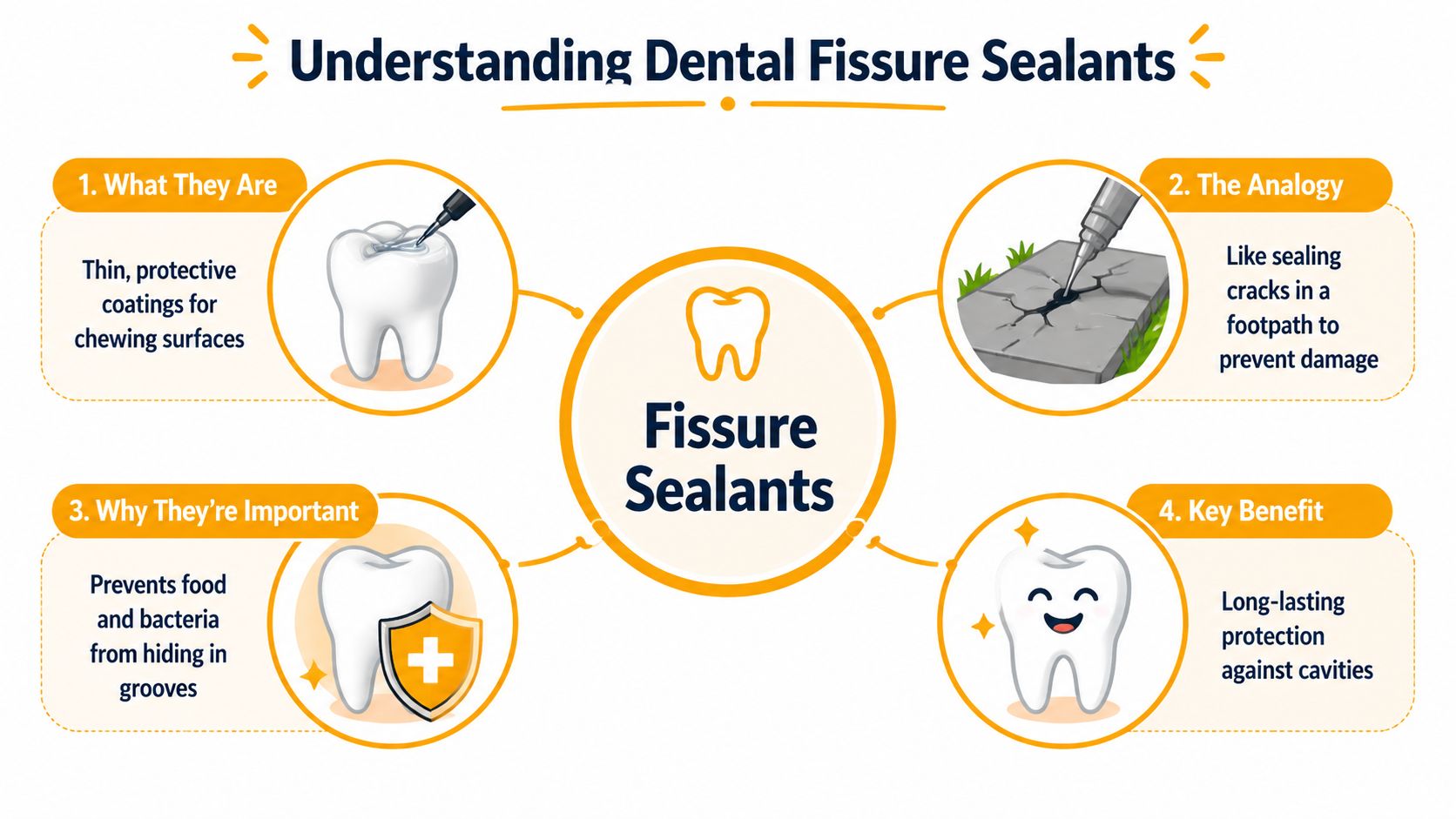
A dental fissure sealant is a thin protective coating placed over the chewing surface of a back tooth. Most often, it’s used on molars because that’s where the deepest grooves tend to sit.
A simple analogy helps. It’s like sealing the cracks in a footpath so weeds and dirt can’t settle into them. The groove is still there underneath, but it’s covered by a smooth barrier that’s much easier to keep clean.
Why molars are different from other teeth
Front teeth are relatively smooth. Molars aren’t. Their chewing surfaces are full of anatomy that helps grind food, but some fissures are so narrow that toothbrush bristles can’t clean them effectively.
That matters because, in NSW, 9 in 10 childhood cavities occur in the deep pits and fissures of back teeth, and a 2020 Sydney Local Health District report on 5,000 Inner West students showed that sealants prevented 80% of these cavities over two years according to this Inner West sealant report summary.
When parents hear that, the logic of sealants usually becomes much clearer. They’re not a general coating placed everywhere. They’re a targeted defence for a very specific weak point.
What the material actually does
The sealant flows into the tiny pits and grooves, then hardens into a protective layer. That changes the tooth surface from rough and trap-like to smoother and easier to brush.
It doesn’t replace brushing. It doesn’t replace fluoride. It improves the tooth’s shape from a hygiene point of view so daily cleaning works better.
Here’s a simple comparison:
| Tooth surface | What tends to happen |
|---|---|
| Unsealed deep fissures | Food and plaque collect in narrow grooves that are difficult to clean fully |
| Sealed fissures | The chewing surface becomes smoother, so bacteria have fewer sheltered areas to sit in |
Why this matters in real family dentistry
A fissure sealant dental treatment is often recommended when a tooth is healthy but clearly vulnerable. That includes children with newly erupted molars, teenagers with deep grooves, and some adults whose molars have never been restored.
Parents sometimes ask whether orthodontic development changes the decision. It can. Tooth position, eruption timing, and how easily a child can clean around developing arches all influence preventive planning. Our article on a dental space maintainer explains another part of that early-development picture.
A sealant works because it changes the environment on the tooth surface. Bacteria need a protected place to stay. Sealants take that place away.
That’s the essence of it. A fissure sealant dental procedure is a physical barrier placed exactly where many childhood cavities begin.
The Fissure Sealant Application Process Step by Step
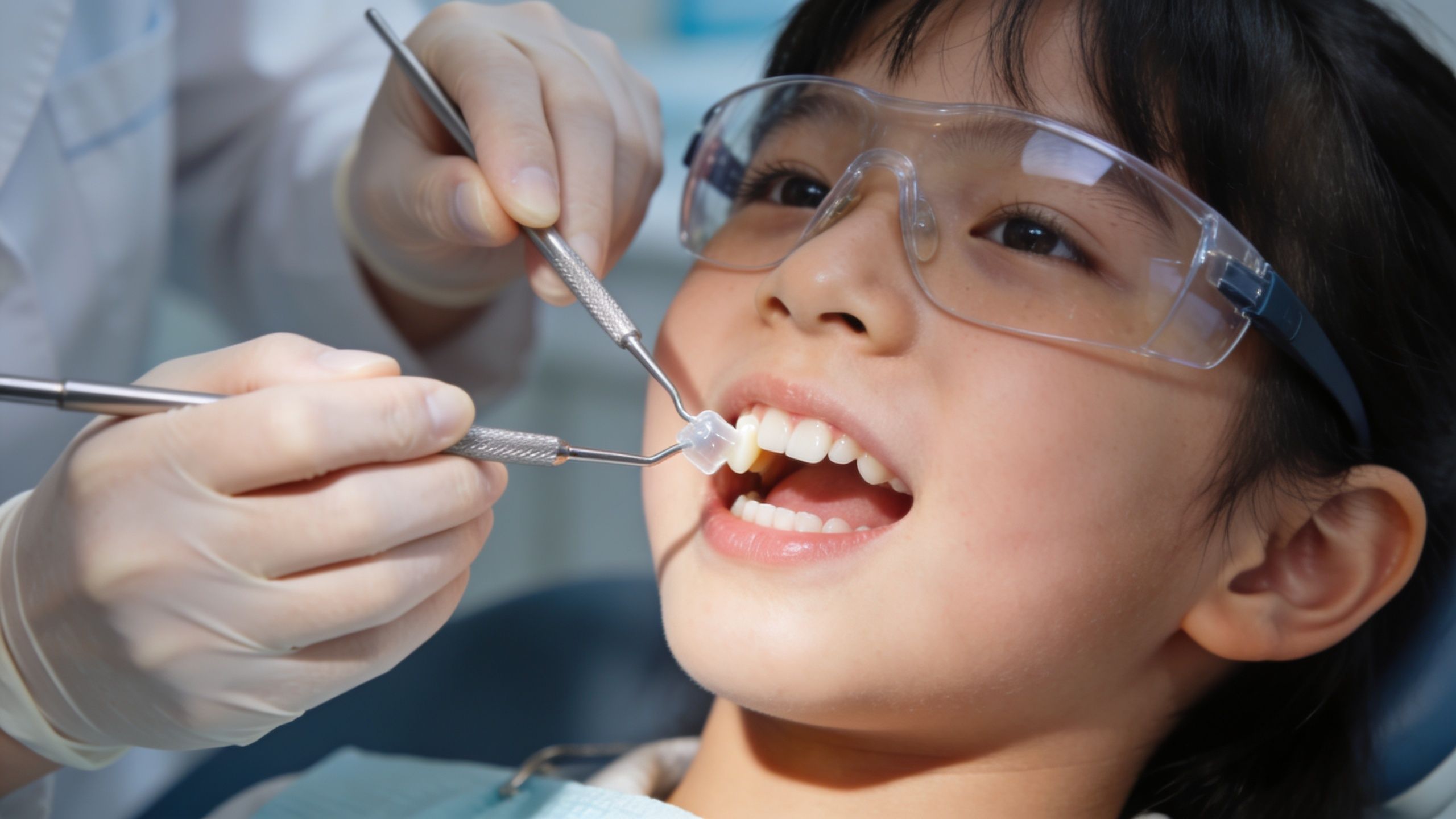
Most parents are surprised by how straightforward the appointment is. In a standard case, sealing a tooth is quick, comfortable, and completely non-invasive.
What your child experiences in the chair
From the patient’s point of view, there’s no drilling into the tooth and no injection. The focus is on preparing a clean, dry surface so the sealant can bond properly.
A typical visit looks like this:
The tooth is cleaned
Any plaque or debris is removed from the fissures so the material isn’t sealed over a dirty surface.The surface is prepared
A gentle etching gel is placed on the enamel. This creates a microscopically rough surface so the sealant can grip the tooth more securely.The tooth is rinsed and dried
This step matters more than many people realise. Moisture can weaken the bond if it gets onto the tooth at the wrong moment.The liquid sealant is placed
The material is guided into the grooves and checked to make sure it covers the vulnerable anatomy properly.A blue curing light hardens the sealant
The liquid becomes a firm protective layer within seconds.The bite is checked
The final shape must feel natural when your child closes their mouth.
The technical part that parents usually don’t hear about
Experience matters. A sealant isn’t successful just because material was placed on the tooth. It has to be placed well.
According to this discussion of sealant technique and retention, a sealant’s success depends heavily on placement technique. Proper etching time of 15 to 30 seconds and careful moisture isolation directly affect bond strength, and 5 to 10% may need annual repair or replacement.
That tells you something important. Sealants are simple in concept, but not casual in execution.
The tooth has to stay clean and dry at exactly the right stages. If moisture interferes, the sealant may still look fine on the day but fail earlier than it should.
Why moisture control is such a big deal
Parents often assume the hardest part is getting a child to sit still. Sometimes that’s true, but the clinical challenge is often moisture control. Saliva, tongue movement, and a partially erupted molar can all complicate placement.
That’s why clinicians pay close attention to isolation, visibility, and timing. In some children, especially anxious ones, making the visit calm and predictable improves the result because the operator can work more precisely. If your child gets nervous in the chair, our guide to seeing a dentist with nitrous oxide explains one option that can make treatment easier.
A short demonstration often helps parents understand how gentle the process is:
What works and what doesn’t
The difference between a durable sealant and a disappointing one usually comes down to fundamentals.
What works
Careful isolation: keeping the tooth dry at the critical stages
Correct etching: long enough to prepare the enamel, not rushed
Thoughtful placement: flowing the material into the full fissure pattern, not just brushing it over the top
Checking the bite: making sure the sealant isn’t too highWhat doesn’t
Rushing moisture control: especially with newly erupted back teeth
Treating every tooth the same way: some fissures are straightforward, others are anatomically complex
Assuming all failures are material failures: often, technique is the actual issue
That’s the part many generic articles skip. With fissure sealant dental treatment, the material matters, but the method matters just as much.
Who Benefits Most from Fissure Sealants
The strongest case for sealants is usually in children with newly erupted permanent molars. That’s the window where prevention can do the most work with the least intervention.
A key reason is clear in the data. A landmark AIHW survey found that sealed molars in 12-year-olds had 80% fewer occlusal decays than unsealed ones, yet only 55% of Australian children aged 6 to 12 had sealants as of 2022, according to this summary of sealant use and underutilisation.

Children in the eruption years
The first group to think about is children whose permanent molars have just come through. These teeth are fresh, often grooved, and harder to clean well because they sit further back in the mouth.
Parents sometimes wait because the teeth “look fine”. That’s exactly when to discuss sealing them. Sealants are for sound teeth that are at risk, not only for teeth that already look suspicious.
The ideal timing often includes:
- First permanent molars when they erupt in early school years
- Second permanent molars when they arrive later
- Children with deep fissures even if their brushing routine is good
- Children with a history of decay elsewhere because past decay often signals future risk
Teenagers and adults who still have vulnerable grooves
Sealants aren’t only for younger children. Teenagers may still have unsealed molars with deep fissure patterns, especially if those teeth were missed when they erupted.
Adults can also benefit if the chewing surfaces are intact and cavity-prone. If a molar has never had a filling and still has deep, plaque-retentive grooves, prevention can still make sense.
The question isn’t “How old is the patient?” The question is “Is this tooth healthy, vulnerable, and still worth protecting?”
Who deserves a closer look
Some people have a higher caries risk even when they try hard with home care. In those patients, sealants can be part of a broader prevention plan.
A dentist may look more closely at sealants if your child or teen has:
| Situation | Why sealants may help |
|---|---|
| Deep molar grooves | Brushing may not clean the base of the fissures effectively |
| Previous cavities | Past disease often points to ongoing risk |
| Dietary risk | Frequent sugar exposure gives bacteria more fuel |
| Orthodontic challenges | Cleaning can be more difficult during treatment |
If you’re unsure whether your child fits this picture, a paediatric dentist near me style search often starts the right conversation, but the final decision comes from examining the actual tooth surface, not making assumptions based on age alone.
Longevity Maintenance and When to Consider Alternatives
Sealants are durable, but they aren’t permanent in every case. Their lifespan depends on how well they were placed, the shape of the tooth, the patient’s bite, and what happens in the mouth over time.
That doesn’t mean they’re fragile. It means they need sensible follow-up, just like any other preventive dental work.
What maintenance actually involves
For most families, maintenance is simple. Keep brushing well, keep sugar exposure sensible, and have the sealants checked during routine dental visits.
A good review appointment looks for whether the sealant is still covering the fissure pattern properly, whether any edge has chipped, and whether the surface still feels intact. Small defects are often manageable when found early.
The practical point is this:
- Brush as normal because sealants protect grooves, not the whole tooth
- Attend regular reviews so wear or partial loss is spotted before risk returns
- Don’t assume a sealed tooth never needs attention because the material can wear or break down in spots
- Ask specifically whether the sealant is still intact during your child’s examination
A regular checkup and clean is usually when this assessment happens.
A sealant doesn’t fail because time passed. It fails when the protective barrier is no longer complete.
When a resin sealant is ideal
Resin sealants are often the preferred option when the tooth is fully erupted and can be kept dry. They bond well and can provide strong physical protection when placed carefully.
At this stage, meticulous technique matters again. Good isolation and proper enamel preparation give resin the best chance of long-term retention. On a cooperative child with a fully accessible molar, resin is often the straightforward choice.
When an alternative may be smarter
Not every child arrives with a textbook molar ready for a textbook sealant.
Partially erupted molars can be difficult to isolate. Young children may struggle with keeping the mouth open. Some teeth sit under a flap of gum or close to the cheek, where moisture control is harder.
In those cases, glass ionomer sealants can be a sensible alternative because they’re more moisture tolerant. Public awareness around this is often limited, but the distinction matters clinically. Research highlighted in this article on fissure sealant materials for children notes that glass ionomer materials can be useful for difficult cases such as newly erupted or partially erupted molars, and an Australian school-based program reported a 67% caries reduction among 8 to 10 year-olds.
That’s often the practical sequence. Protect the tooth with a moisture-tolerant material when ideal isolation isn’t realistic, then review later and consider replacement with resin once full eruption allows a drier field.
Sealants compared with fluoride and fillings
Parents sometimes ask whether sealants are just another version of fluoride. They’re not.
| Option | Main role |
|---|---|
| Fluoride | Strengthens enamel chemically |
| Sealants | Block pits and fissures physically |
| Fillings | Repair a tooth after decay has already caused damage |
Fluoride and sealants often work well together because they solve different problems. A filling sits in a different category altogether. Once a tooth needs a filling, some natural structure has already been lost.
That’s why fissure sealant dental care is best understood as preservation. It’s a way of keeping a healthy tooth healthy, rather than restoring one after the fact.
Your Fissure Sealant Journey at The Smile Spot
A parent often brings in a child whose new molars have only just come through. The tooth looks ready for protection, but the grooves are still hard to keep dry, the child is unsure in the chair, and the long-term result depends less on speed than on how carefully the sealant is placed.
That is why families should expect more than a quick coating on the tooth. A lasting fissure sealant depends on case selection, moisture control, timing, and the discipline to stop and reassess if conditions are not right.
What a practical appointment pathway looks like
At The Smile Spot, sealants are part of preventive family care rather than a stand-alone routine. We assess eruption stage, fissure shape, cleaning patterns at home, diet risk, and whether the tooth can be isolated well enough for a reliable bond.
For some children, the first visit is mainly assessment and planning. The clinic offers a $240 complete care package that includes an exam, X-rays, scale and fluoride, and there is a reduced rate for children. The practice also accepts private health funds and supports eligible care under the Child Dental Benefits Schedule.

Some appointments are straightforward. Others benefit from a slower pace, behaviour support, or delaying placement until a partially erupted molar is easier to isolate. Clinician judgement is essential here.
Why technique and environment matter to families
Dr Dimitrios Thanos has led the practice since 1996, and that experience shows most clearly in the small technical choices that parents rarely see. A sealant only bonds well if the enamel is properly prepared and kept dry at the key moments. Saliva contamination for even a short time can shorten its lifespan.
That is why meticulous technique matters so much. Before placing a sealant, the tooth has to be cleaned carefully without damaging the enamel surface, isolated so moisture does not creep back into the fissures, and checked again before bonding. If a child is finding it hard to stay open, or a lower molar is sitting close to the cheek and tongue, the plan may need to change. Sometimes the right decision is to pause, improve isolation, or use a different material rather than push ahead and accept a weaker result.
Parents often assume sealants succeed because the material is good. In practice, the material is only part of the story. The result is often decided by the operator's control of the field, the visibility of the grooves, and the willingness to tailor the appointment to the child in the chair.
The practice also uses modern technology, including Biolase laser dentistry in other areas of care. Even though a laser is not typically part of sealant placement, the same philosophy carries through. Precision, conservative treatment, and close attention to detail tend to produce better preventive outcomes than a rushed, one-size-fits-all workflow.
Practical details matter too. Evening appointments, Saturday availability, and online booking make reviews easier to keep, and follow-up is part of making sealants last.
Good preventive dentistry depends on timing, moisture control, cooperation, and a family routine that can keep review appointments on track.
Frequently Asked Questions about Fissure Sealants
Parents often leave the main discussion feeling comfortable with the idea of sealants, but still have a few very specific questions. These are the ones that come up most often.
Are fissure sealants safe
Yes. Sealants are widely used as a routine preventive treatment. They sit on the tooth surface and don’t require drilling in a straightforward preventive case.
Parents sometimes ask about BPA because they’ve seen online discussions about dental materials. It’s reasonable to raise that concern with your dentist. The practical conversation should focus on the material being used, how it’s placed, and why the preventive value is considered worthwhile for your child’s risk profile.
Can a dentist place a sealant over very early decay
Sometimes a dentist may consider a conservative approach if a fissure looks suspicious but not clearly cavitated. That decision has to be made clinically, tooth by tooth.
What matters is proper assessment. If decay is already established and the tooth structure is compromised, a simple sealant may not be the right treatment. If the tooth is still suitable for prevention, a sealant can help protect it. This isn’t a one-size-fits-all call.
Will my child feel anything after the appointment
Most children feel very little beyond noticing that the tooth surface feels smoother. Some are aware of the sealant with their tongue for a short time because the biting surface feels different from before.
If the bite feels uneven, it should be checked. A properly finished sealant should feel natural very quickly.
Do sealants replace brushing and fluoride
No. They work alongside normal preventive care.
A sealant protects the grooves it covers. It does not protect between the teeth, near the gumline, or every surface in the mouth. Brushing with fluoride toothpaste, sensible snacking habits, and regular dental reviews are still essential.
Are sealants only for children
No. Children are often the clearest candidates because newly erupted molars are at a high preventive opportunity point, but some teenagers and adults can benefit too.
The deciding factors are the anatomy of the tooth, whether it’s already been restored or damaged, and how high the person’s decay risk is.
Does private health cover fissure sealants
Cover depends on your level of extras and your individual fund rules. Some plans contribute to preventive care, but the amount varies.
It’s worth checking item coverage before the appointment if cost certainty matters to you. If your child is eligible under the Child Dental Benefits Schedule, that may also affect how preventive services are managed.
What’s the biggest reason sealants don’t last
Most parents expect the answer to be chewing hard foods. Sometimes that contributes, but the larger issue is often whether the original bond was strong enough.
That brings the conversation back to technique. Dry field control, careful preparation, and proper review matter just as much as the material itself. That’s why fissure sealant dental care shouldn’t be treated like a quick add-on with no attention to detail.
If you’d like a specific assessment for your child’s newly erupted molars, or you want to know whether sealants, fluoride, or another preventive approach makes more sense, book a visit with The Smile Spot. A careful exam can tell you whether those deep grooves are normal anatomy or a cavity risk worth protecting early.