Putting off dental treatment often starts with one bad memory. Then it becomes a pattern. You notice a tooth that's bothering you, you know you should book, but the thought of the chair, the sounds, the injections, or the feeling of not being in control keeps pushing the appointment further away.
That's exactly where iv sedation dentistry can help. It gives anxious patients a realistic way to get treatment done without white-knuckling the whole experience. Instead of trying to “just cope”, you're cared for in a very relaxed, closely monitored state that's designed for comfort and safety.
Your Guide to Calm and Comfortable Dental Care
A lot of patients who ask about IV sedation aren't looking for luxury. They're looking for a way through. They may need a wisdom tooth removed, several restorations completed, or implant treatment, but anxiety has become the main obstacle.

Some patients tell me they can manage day-to-day stress perfectly well, yet still feel overwhelmed by dental care. Others have a strong gag reflex, panic when they smell the surgery, or haven't had treatment in years because they're embarrassed about how long they've waited. All of those reactions are more common than people think.
If that sounds familiar, reading through real patient experiences can help. Reviews such as these 4squares Dentistry testimonials often show the same pattern: anxious patients don't need pressure, they need a process that feels manageable.
For many people in the Inner West, the first step isn't treatment. It's finding a clinic that understands gentle care from the first conversation. If that's what you're searching for, this guide on a gentle dentist near you is a useful place to start.
You don't need to be fearless to have dental treatment. You need a plan that matches your anxiety level, your health history, and the kind of procedure you need.
IV sedation fits that role for the right patient. It's not for every appointment, and it's not meant to replace careful diagnosis or good communication. But when fear, complexity, or treatment length are barriers, it can make necessary care feel possible again.
What Is IV Sedation Dentistry
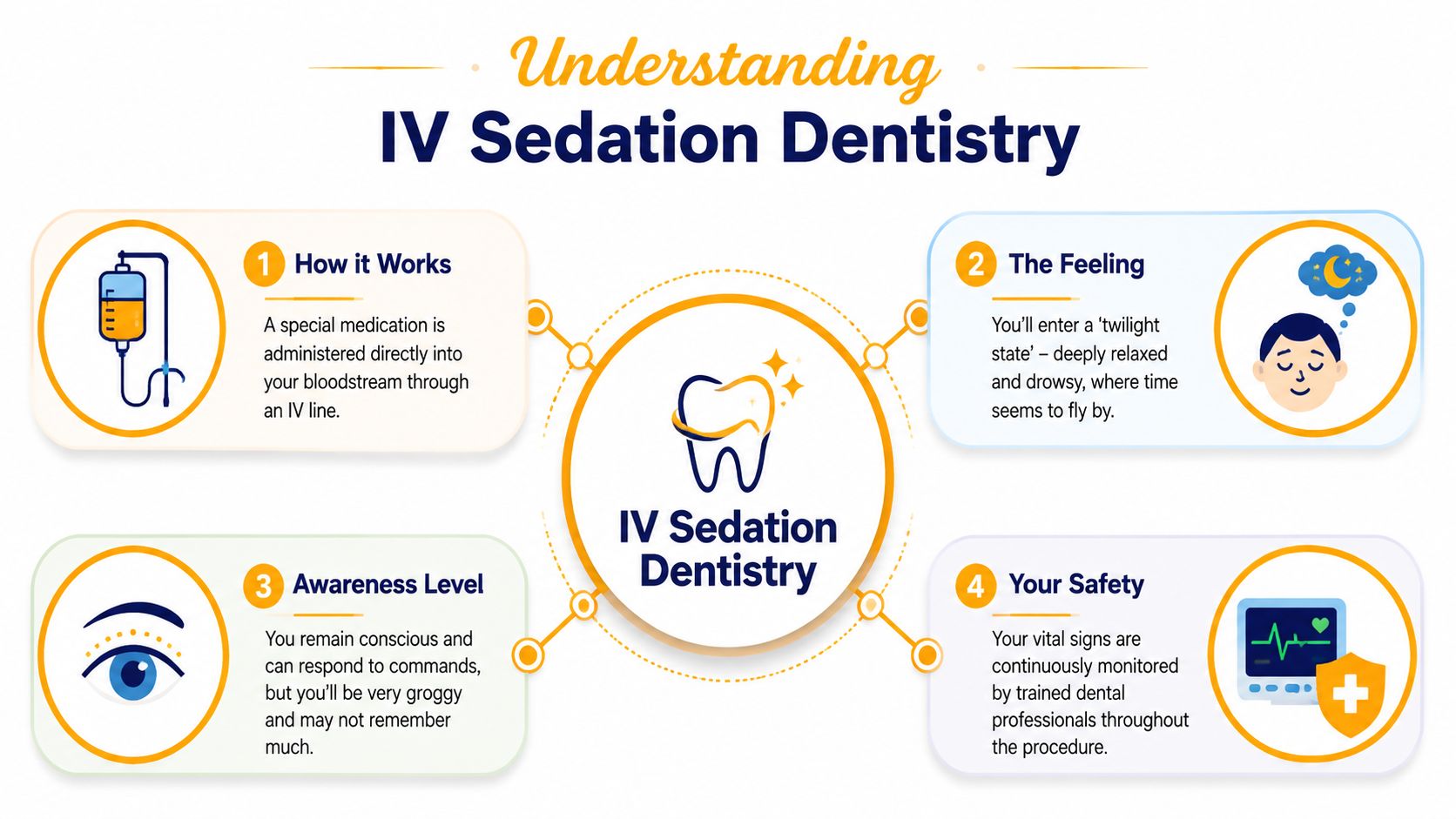
IV sedation dentistry is a form of conscious sedation. A sedative medication is given through a small IV line, usually in the hand or arm, to help you become very relaxed and drowsy during dental treatment.
What it feels like
Most patients describe it less as “being asleep” and more as being in a twilight state. Time tends to pass very quickly. You're calm, detached from the usual stress of treatment, and often remember little afterwards.
That last point matters. Many anxious patients assume sedation means losing consciousness completely. In routine dental IV sedation, that isn't usually the goal.
According to this explanation of IV sedation and conscious sedation, IV sedation is not equivalent to general anaesthesia. Patients typically keep breathing on their own and can respond to verbal cues, while often experiencing profound calm and partial or complete amnesia of the procedure.
What it is not
General anaesthesia aims for unconsciousness. IV dental sedation aims for a controlled level of sedation where you remain responsive, but profoundly relaxed.
That difference affects the whole experience:
- Breathing: You usually continue breathing spontaneously.
- Awareness: You may respond if spoken to, even if you don't remember doing so.
- Recovery: You'll still need supervision afterwards because grogginess can linger.
- Monitoring: The team's job is to keep you in a safe sedation window, not push you into full unconsciousness.
If you've been comparing options and want a broader overview before deciding, this article on dental sedation near you gives context around where IV sedation sits among other approaches.
Key distinction: IV sedation reduces fear and improves tolerance of treatment. It does not mean you're completely “put under” in the same way as hospital-based general anaesthesia.
For anxious patients, that's often reassuring. You're not surrendering all control. You're choosing a carefully managed level of relaxation that helps treatment become tolerable.
How IV Sedation Works and Its Key Benefits
The biggest advantage of IV sedation is control. That's the practical reason dentists use it for more demanding situations instead of relying on a single tablet or a one-size-fits-all approach.
Why the IV route gives more control
With IV sedation, a small cannula is placed in the hand or arm. The sedative is then given in small increments, based on how the patient is responding in real time.
A clinical review available through PubMed Central on incremental titration to effect explains that this method is preferred because the medication goes directly into the bloodstream, acts quickly, and allows the sedation level to be adjusted as needed. It also notes that incremental titration helps avoid the unpredictability sometimes seen with repeated fixed bolus dosing or oral sedatives.
That matters in real life because patients don't all respond the same way. One person may become settled with a small amount of medication. Another may still be tense, hyper-aware, or gagging unless the level is adjusted carefully.
What that means for the patient
The process creates several practical benefits:
- Faster onset: Because the medication doesn't need to pass through the digestive system, the calming effect comes on quickly.
- Fine adjustment: The sedation depth can be increased or reduced depending on anxiety level and treatment intensity.
- Better predictability: The response is generally more manageable than with oral sedation alone.
- Useful for longer care: Extractions, implants, and multiple restorations are easier to complete when the patient stays settled throughout.
A severe gag reflex is a good example. If someone can't tolerate impressions, X-rays, suction, or instruments near the back of the mouth, simple reassurance often doesn't solve the problem. IV sedation can reduce that overactive stress response enough to let treatment proceed smoothly.
What works and what doesn't
IV sedation works well when the main issue is anxiety, distress, procedure length, or difficulty tolerating treatment. It also helps when completing more work in one visit is kinder than bringing an anxious patient back again and again.
What doesn't work is using sedation as a shortcut around poor planning. It won't fix an unsuitable treatment plan, and it doesn't remove the need for local anaesthetic, proper diagnosis, or careful case selection.
Practical rule: The right amount of sedation is the amount that keeps the patient comfortable and safe while allowing treatment to proceed properly. More is not automatically better.
For the right case, though, IV sedation can change the whole tone of treatment. Instead of enduring dentistry, the patient gets through it calmly, with far less psychological strain.
The IV Sedation Procedure Your Patient Journey
For most anxious patients, the hardest part is not the treatment itself. It's not knowing exactly what will happen. A clear, step-by-step plan makes the day feel much more manageable.
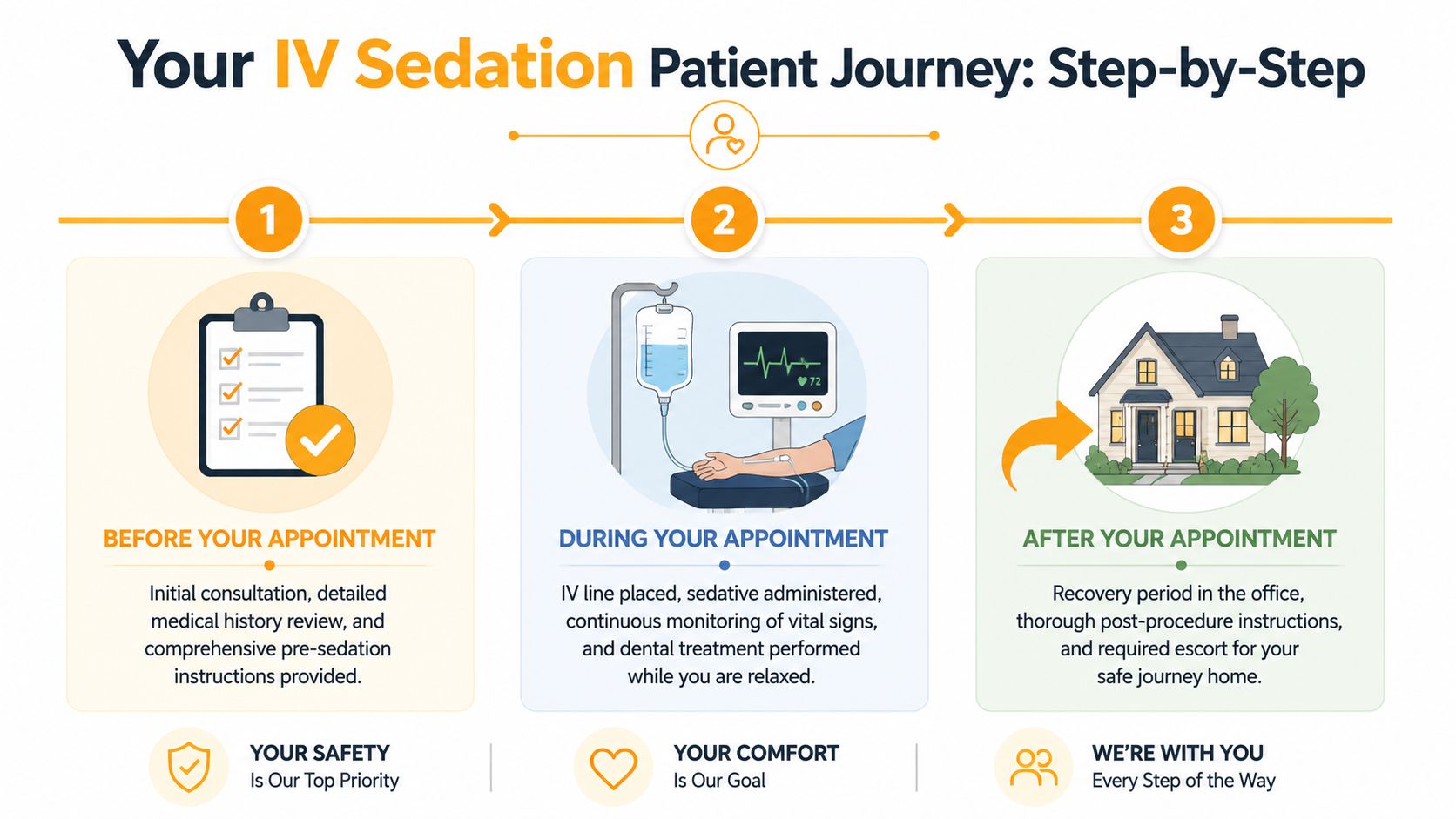
Before your appointment
Everything starts with assessment. In Australia, IV sedation in a dental clinic is governed by a structured safety framework that includes pre-procedure assessment, continuous monitoring, and defined discharge protocols. That framework is outlined in this review of Australian sedation practice and safety standards.
Before the day, the dental team reviews your medical history, current medications, and whether IV sedation is suitable for you. You'll also be given preparation instructions. These may include fasting guidance, what to wear, and what medications to discuss in advance.
One requirement is not optional. You must arrange a responsible adult escort to take you home and stay with you afterwards if advised.
If your treatment involves oral surgery, the logistics matter just as much as the procedure. Patients planning extractions often find it helpful to read about wisdom tooth removal near you alongside sedation information so they know what recovery may involve.
During your appointment
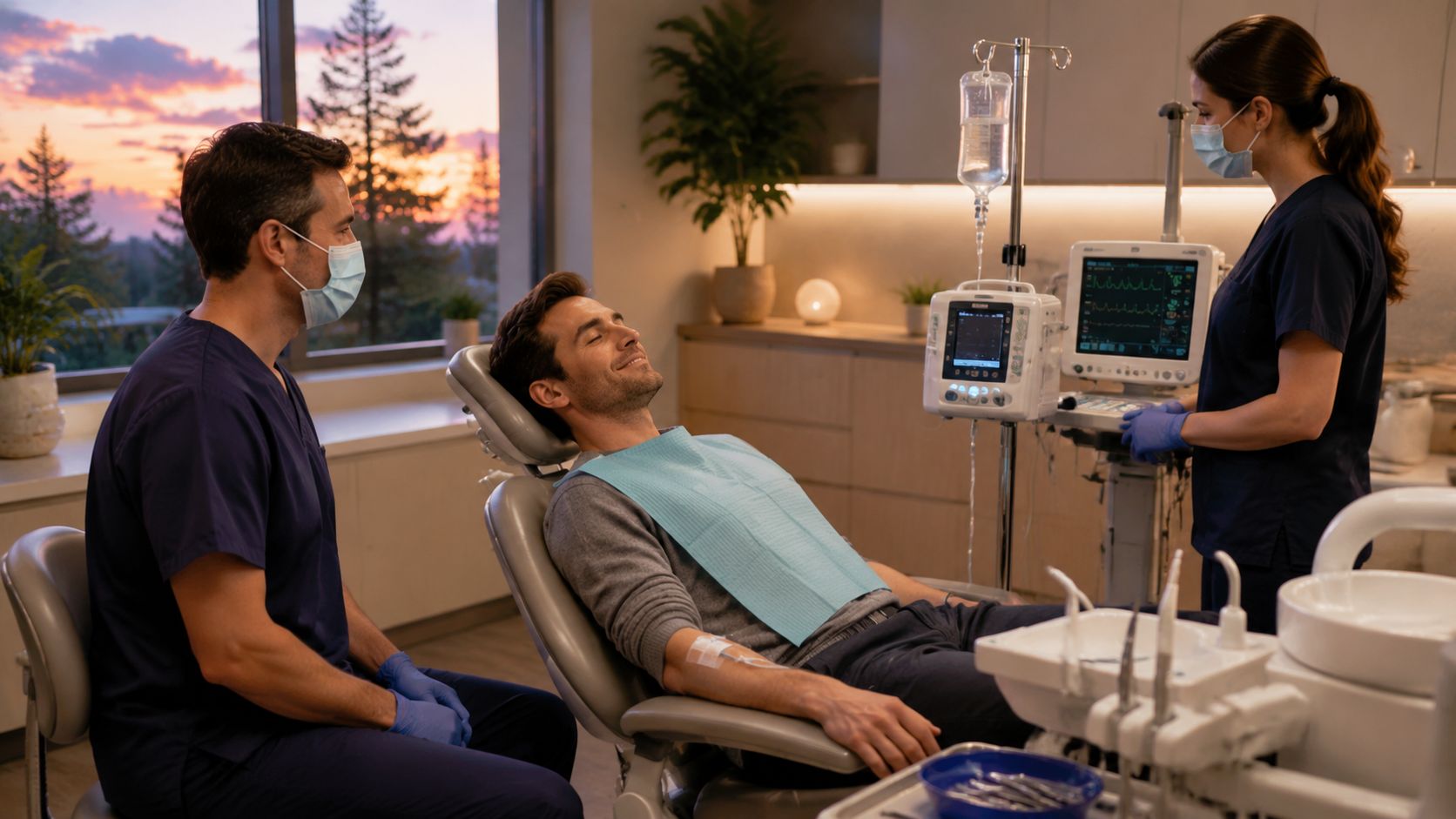
On the day, you'll be checked in, made comfortable, and prepared for treatment. A small IV line is placed, usually in the hand or arm. Monitoring equipment is used throughout so the clinical team can track your response continuously.
At this stage, many patients are surprised by how calm the process feels.
The sedative is administered gradually, not all at once. As it takes effect, patients become profoundly relaxed and drowsy. Local anaesthetic is still used where needed for pain control, but the emotional intensity of the appointment is usually much lower.
During treatment, the team watches key signs such as oxygen saturation, blood pressure, and heart rhythm. If you appear too lightly or overly sedated, the medication level can be adjusted.
After your appointment
Recovery begins in the clinic, not in the car park. You'll remain under supervision until you're considered ready for discharge under the clinic's protocol.
Most patients still feel groggy afterwards, even if they seem outwardly alert. That's why there are same-day restrictions. You shouldn't plan to drive, work, make important decisions, or head straight back into a busy schedule.
A sensible plan for the rest of the day usually includes:
- Going straight home with your escort.
- Resting rather than returning to errands or work.
- Following written instructions for eating, drinking, medication, and recovery.
- Allowing the day to stay clear, because sedation effects can outlast the obvious drowsiness.
Bring your escort arrangements into the planning stage, not the night before. It removes stress and avoids last-minute cancellations.
Patients usually cope best when they treat the day as a proper medical recovery day, even for straightforward procedures.
Is IV Sedation Right for You
Not everyone who feels nervous needs IV sedation. For some people, a slower appointment, clear communication, local anaesthetic, or nitrous oxide is enough. But there are situations where IV sedation is a very sensible option.
Patients who often benefit most
IV sedation is commonly considered when one or more of these issues are present:
- High dental anxiety or phobia: You're unlikely to get through treatment comfortably with reassurance alone.
- Strong gag reflex: Even simple procedures become difficult to tolerate.
- Long or complex treatment: Implants, multiple restorations, surgical extractions, or several procedures in one visit.
- Previous traumatic dental experiences: The memory of prior treatment makes routine care feel overwhelming.
- Difficulty sitting through treatment: Tension, panic, or restlessness makes longer appointments unrealistic.
The broader demand for sedation dentistry has grown with patient preference for pain-free treatment and its usefulness in complex care. A market overview and clinical summary from Rank My Dentist's sedation dentistry statistics article notes a global market estimate of about USD 4.85 billion in 2024, with a projection of nearly USD 8.95 billion by 2033, and also reports that clinical reviews in dental surgery found IV sedation can lower stress, improve cooperation, and increase satisfaction.
When another option may be better
IV sedation isn't automatically the best fit just because it sounds more powerful. Sometimes a less intensive option makes more sense, especially for shorter procedures or milder anxiety.
A careful dentist will also look at health factors before recommending it. Certain medical conditions, medications, airway concerns, or recovery limitations may affect whether IV sedation is appropriate in a clinic setting.
That's why the best consultation isn't a sales pitch. It's a matching process.
| Situation | IV sedation may be a strong fit | Another option may suit better |
|---|---|---|
| Severe anxiety | Yes | Sometimes not enough with lighter methods |
| Single short filling | Usually not first choice | Often yes |
| Implant surgery | Often useful | Depends on case and patient |
| Mild nerves only | Not always necessary | Often yes |
| No escort available | Not suitable that day | Lighter options may be considered |
A good question to ask yourself
Ask this: Is the main barrier discomfort that could be solved with local anaesthetic, or is the underlying barrier anxiety, gagging, panic, or inability to tolerate the appointment?
If it's the second group, IV sedation often becomes a practical solution rather than an optional extra. It can let treatment happen in fewer visits, with less emotional strain before, during, and after the procedure.
Comparing Your Dental Sedation Options
Patients often assume sedation is a single category. It isn't. Different methods suit different levels of anxiety, different procedures, and different recovery needs.
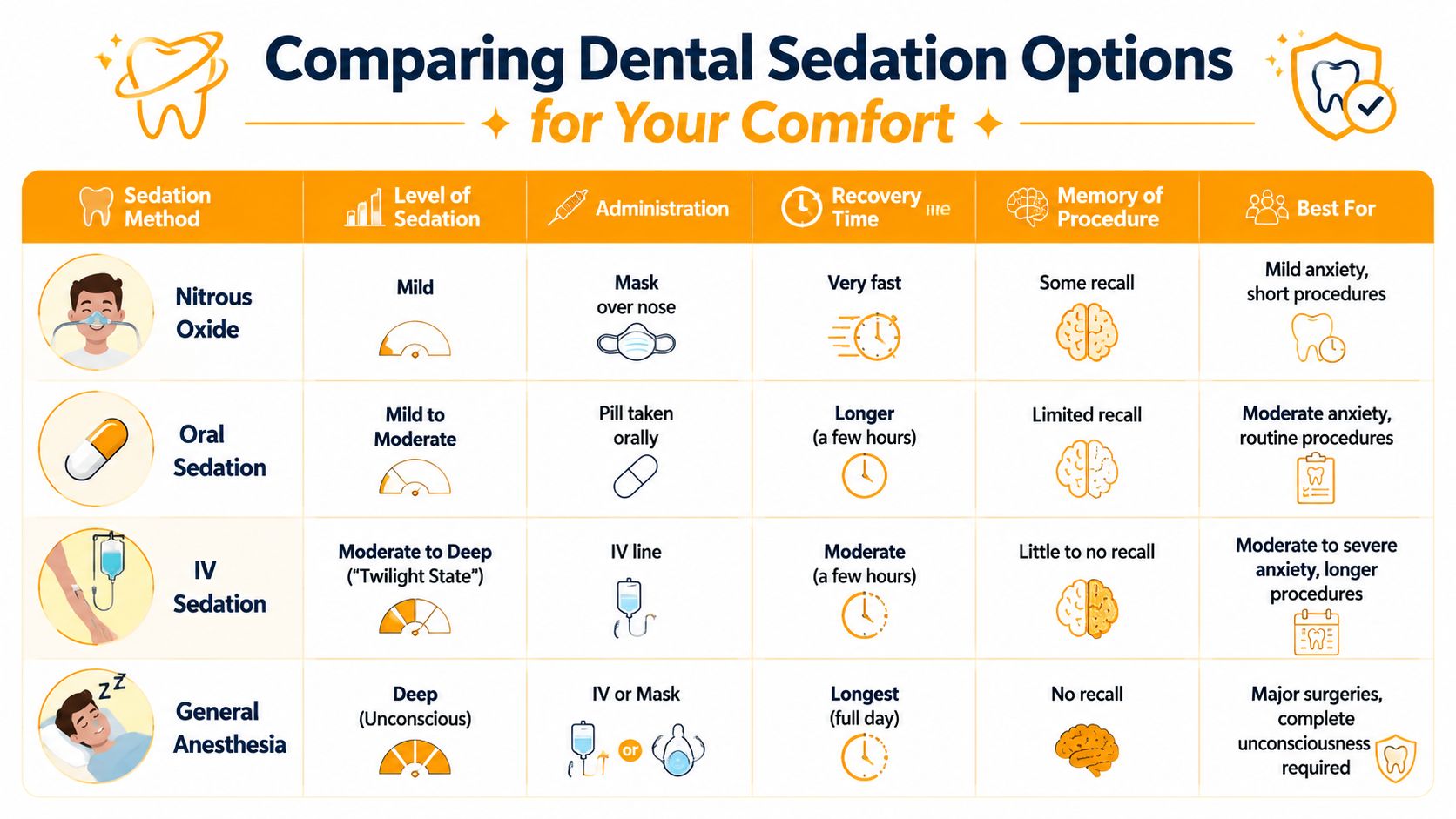
A practical summary from this guide comparing sedation dentistry choices notes that the decision involves trade-offs in recovery time, cost, and the need for an escort, and that IV sedation is usually reserved for more complex cases, longer procedures, or anxiety levels where oral sedation or nitrous oxide may not be enough.
Dental Sedation Options at a Glance
| Feature | Nitrous Oxide ('Happy Gas') | Oral Sedation | IV Sedation | General Anaesthesia |
|---|---|---|---|---|
| Level of sedation | Mild | Mild to moderate | Moderate to deep conscious sedation | Deep unconsciousness |
| Administration | Inhaled through a nose mask | Tablet or capsule | IV line in hand or arm | Usually hospital-based anaesthetic care |
| Onset | Fast | Less predictable | Rapid | Managed for full unconsciousness |
| Recovery | Usually quick | Longer than nitrous oxide | Requires recovery time and escort | Longest recovery |
| Memory of procedure | Usually some recall | Often reduced recall | Often little or no recall | No recall |
| Best suited for | Mild anxiety, shorter visits | Moderate anxiety, simpler treatment | Higher anxiety, longer or more involved care | Cases needing complete unconsciousness |
The trade-offs that matter most
Some patients do very well with nitrous oxide. It's light, convenient, and often enough for routine care. If you're considering that option, this guide to a dentist with nitrous oxide explains where it can be most helpful.
Oral sedation can help too, but it's less adjustable once taken. That's the main limitation. If the response is too light or too heavy, there's less fine control than with IV sedation.
General anaesthesia has its place, but it's a different category entirely. It's usually reserved for cases where unconsciousness is required, not because a patient feels nervous.
The best sedation method is the one that matches the procedure, the patient's anxiety level, and the safety requirements of the setting.
That's why a proper consultation matters. The question isn't “Which option is strongest?” It's “Which option is appropriate for this person, for this treatment, on this day?”
Safety, Costs, and Your Next Steps at The Smile Spot
When patients ask whether IV sedation is safe, they're usually asking a broader question. They want to know who is providing it, how they're monitored, and what happens if something doesn't go to plan.
Those are the right questions.
In NSW, safe IV sedation depends on proper assessment, trained clinicians, continuous monitoring, emergency readiness, and clear discharge rules. It's a structured service, not routine chairside treatment. That's why the consultation is so important. It determines whether IV sedation is appropriate, what preparation is needed, and whether another option would be better.
Cost is part of the decision too. Fees vary based on the procedure, the time involved, and the sedation arrangements. Private health cover questions also come up often, and they're best answered case by case after the treatment plan is clear. If budget is part of the concern, this guide to dentists with payment plans near you may help you think through the practical side.
For patients in Dulwich Hill and the Inner West, The Smile Spot provides family, restorative, surgical, and implant dentistry, with sedation available for suitable cases. Dr. Dimitrios Thanos has been principal dentist since 1996, and the clinic treats many patients who want a calmer, more manageable path through necessary care.
If you've been postponing treatment because anxiety keeps winning, the next step isn't committing to sedation on the spot. It's booking a conversation, reviewing your health history, and deciding what level of support makes sense for you.
If you're ready to talk through iv sedation dentistry in a calm, practical way, book a consultation with The Smile Spot. You can discuss your anxiety level, the treatment you need, whether IV sedation is appropriate, and what the process would look like from preparation through recovery.