You might hear the term “full anaesthesia dentist,” but it’s not an official title. It simply refers to a dental team, like ours, that coordinates your treatment to be completed while you are under General Anaesthesia (GA). This allows you to be completely asleep and unaware, so we can perform complex or extensive work without causing you any stress or discomfort. It’s a wonderful solution for patients with severe dental anxiety, extensive treatment needs, or certain medical conditions.
Understanding Full Anaesthesia in Modern Dentistry
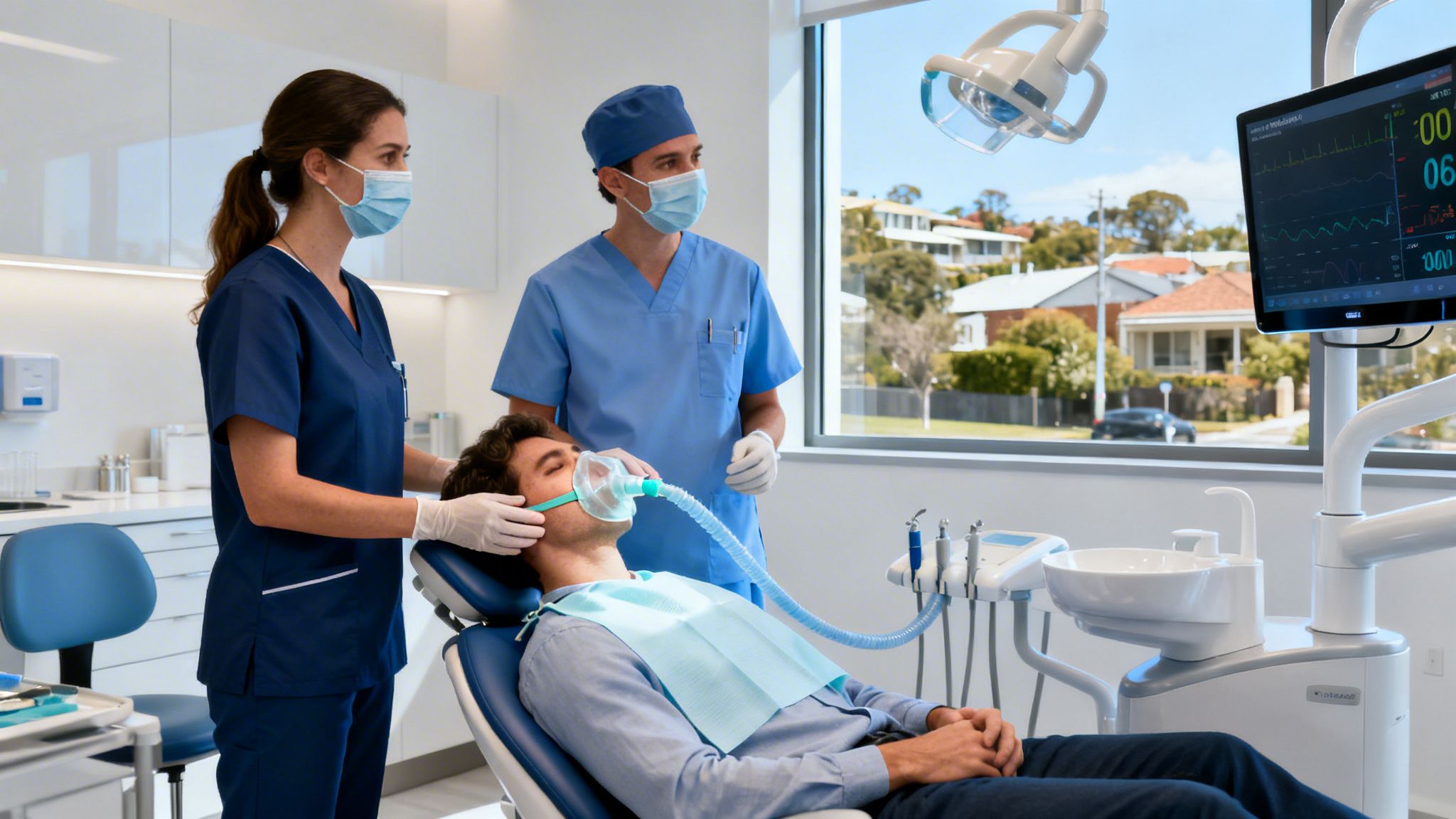
Think of full anaesthesia, or General Anaesthesia (GA), as a deep, medically supervised sleep. It allows our dental team to work efficiently and without interruption while you remain completely comfortable and at ease. Unlike other forms of sedation where you are simply relaxed but still awake, GA means you are entirely unconscious. You will have no memory, awareness, or sensation of the procedure afterward.
This is a specialised service that requires a team effort. Here at The Smile Spot, we don’t perform GA in our clinic chairs. Instead, we partner with specialist anaesthetists and accredited day surgeries or private hospitals to ensure the absolute highest standards of safety and care for our patients from Dulwich Hill and across the Inner West.
Who Is This For?
Going under general anaesthesia is a significant step, so we reserve it for specific situations where standard dental care just isn’t a practical option. It’s an essential service for people who:
- Suffer from severe dental phobia or extreme anxiety that prevents them from getting the treatment they need.
- Require extensive dental work, like a full mouth rehabilitation or multiple wisdom tooth extractions, to be done in a single sitting.
- Have special needs, a strong gag reflex, or a medical condition that makes it hard to sit comfortably and safely in the dental chair.
When dental anxiety is a major barrier, even booking an appointment can feel overwhelming. That's why we focus on making the entire process as smooth as possible, from your first phone call to your recovery. Learning more about creating a relaxing dental clinic environment for anxious patients can help you see how seriously we take your comfort.
At The Smile Spot, your well-being guides every recommendation we make. Dr. Thanos and our team are dedicated to providing a compassionate, judgement-free space where we can talk through all your options. We’ll coordinate every single aspect of your GA journey, from the initial consultation to your post-procedure recovery plan.
To help you see where GA fits in, it’s useful to look at the full spectrum of comfort options we offer.
A Glance at Sedation Options at The Smile Spot
While GA provides the deepest level of sedation, many of our patients find that lighter forms of sedation are more than enough to help them feel relaxed. Here’s a quick comparison to help you understand the differences.
| Sedation Type | Level of Consciousness | Best For | Memory of Procedure |
|---|---|---|---|
| Nitrous Oxide (Happy Gas) | Conscious but very relaxed | Mild to moderate anxiety, shorter procedures | Usually remember everything |
| Oral Sedation (Tablet) | Drowsy and relaxed, may doze off | Moderate anxiety, longer appointments | Vague or no memory (amnesia is common) |
| IV Sedation (Twilight) | Conscious but deeply sedated | Moderate to severe anxiety, complex procedures | Little to no memory |
| General Anaesthesia (GA) | Completely unconscious | Severe phobia, extensive work, special needs | No memory at all |
Choosing the right path is always a decision we make together. If you're exploring your options, our team is here to help you find the best and safest solution for your dental health. You can learn more about our approach by seeing what our dentist in Dulwich Hill can do for you and your family.
Comparing General Anaesthesia to Other Sedation Methods
To really wrap your head around what a full anaesthesia dentist does, it helps to see where General Anaesthesia (GA) fits in with other types of sedation. Think of it like a spectrum of relaxation—some methods just take the edge off, while GA allows you to sleep peacefully through your entire treatment.
The biggest difference between them all is your level of consciousness. With other options, you’re still awake and able to respond, just in a state of deep calm. General Anaesthesia is in a league of its own, creating a state of complete, managed unconsciousness so you don't feel, see, or remember a thing.
The Gentle Start to Dental Comfort
At The Smile Spot, our first priority is always making sure you feel safe and comfortable with us. For many people, especially those with mild nerves, a gentle approach and clear communication is all it takes to feel at ease.
When a little extra help is needed, we often start with the mildest form of sedation there is: nitrous oxide, or what many people know as ‘happy gas’.
- What it is: A simple blend of oxygen and nitrous oxide that you breathe in through a small, soft mask placed over your nose.
- How it feels: It creates a warm, floaty feeling of relaxation and well-being. Some patients say it gives them a pleasant tingling sensation in their hands and feet.
- Key Advantage: The effects come on within minutes and, just as importantly, they disappear just as fast once the mask is removed. This means you’re completely fine to drive yourself home after your visit.
Happy gas is a fantastic choice for shorter appointments or for anyone who just needs to take the edge off their anxiety without any drowsy after-effects.
Stepping Up to Conscious Sedation
For those with more significant anxiety or who need longer, more involved procedures, conscious sedation provides a deeper level of relaxation. You’re still technically awake, but you’ll be so relaxed that you’ll be mostly unaware of the treatment happening around you.
The most common method we use is an oral sedative, usually a pill like Valium, taken about an hour before your procedure. By the time you settle into the dental chair, you’ll feel very calm and drowsy.
A Key Distinction: One of the biggest benefits of oral sedation is that it often has an amnesic effect. Most patients have little or no memory of the procedure afterwards, which is a huge relief for those with a real dental phobia.
Because these effects are much stronger and last longer than happy gas, it's essential that you arrange for a trusted adult to drive you both to and from your appointment. You won't be in any state to drive for the rest of the day. It's also wise to think about recovery, as some procedures can involve discomfort afterwards. Our guide on managing tooth extraction pain has some great practical advice.
The Peak of Sedation: Full General Anaesthesia
General Anaesthesia is the most profound level of sedation available. This isn’t just deep relaxation—it’s a controlled, temporary state of unconsciousness, overseen from start to finish by a specialist anaesthetist in a hospital or an accredited day surgery setting.
This is what sets GA completely apart from other methods:
- You are completely asleep and have no awareness of the sights, sounds, or sensations of the dental procedure.
- You feel absolutely no pain and will have zero memory of the treatment once you wake up.
- Your breathing, heart rate, and other vital signs are monitored constantly by a dedicated anaesthetic team.
GA is the ultimate solution for patients who simply cannot undergo dental treatment while awake. This could be due to a severe, deep-seated phobia, certain special needs, or the need for very extensive surgical work to be completed all at once. It gives our dentists the ability to perform all the necessary care in a single, stress-free session while you rest.
Who Is Full Dental Anaesthesia For?
General anaesthesia isn’t a one-size-fits-all service. Think of it as a specialised pathway to care, reserved for those times when a standard dental visit just isn't possible. For some people, it’s the only way to get the treatment they desperately need to achieve a healthy, pain-free smile. We see the real challenges that can make even a simple check-up feel impossible, and we approach this option with genuine understanding.
This isn’t just about making things more comfortable; it’s about providing essential dental work that would otherwise be completely out of reach. We truly believe everyone deserves a healthy smile, and sometimes, general anaesthesia is the key that unlocks that possibility.
Patients with Severe Dental Phobia
For many, dental anxiety is more than just feeling a bit nervous—it’s a deep-seated phobia that can be completely debilitating. This level of fear often leads to panic attacks, overwhelming distress, and avoiding the dentist altogether, even when you're in serious pain. When the mere thought of a check-up is terrifying, a complex procedure like a root canal can feel unthinkable.
General anaesthesia offers a real way forward. It allows patients to get the treatment they need without the psychological trauma. You simply go to sleep and wake up after everything is done, with no memory of the procedure. It’s a way to finally break the cycle of fear and avoidance, putting you back in control of your oral health.
By completely bypassing the triggers of dental phobia, general anaesthesia transforms a source of intense fear into a calm, safe, and productive experience. It empowers you to reclaim your dental wellbeing.
Individuals with Special Needs or Movement Disorders
Sitting perfectly still in a dental chair for a long time is a challenge for anyone. For people with certain physical or intellectual disabilities, it can be downright impossible. Conditions like cerebral palsy, severe autism, or uncontrollable muscle spasms can make routine dental work unsafe in a typical clinic.
A full anaesthesia dentist can coordinate your care in a hospital setting where you can be safely asleep and completely still. This ensures two vital outcomes:
- Safety: It removes the risk of sudden movements that could lead to injury during treatment.
- Quality of Care: It allows our dental team to work meticulously without interruption, ensuring the highest standard of work is delivered.
Patients Requiring Extensive Dental Work
Imagine needing several extractions, a few root canals, and dental implants all at once. This amount of work would normally take numerous long, stressful appointments spread over weeks or even months. That’s a huge commitment of your time, energy, and emotional reserves.
With general anaesthesia, it’s possible to get all of this extensive treatment done in a single, efficient session. Patients who need a full mouth rehabilitation or have all four wisdom teeth removed can have it all taken care of while comfortably asleep. This ‘one and done’ approach is not only convenient but also dramatically lowers the overall stress of major dental work. Our goal is always to find the safest and most effective path for you, whether that’s with GA or our gentle, in-clinic laser dentistry.
The Full Anaesthesia Process Explained Step by Step
Knowing exactly what happens before, during, and after a dental procedure under general anaesthesia can make all the difference, turning uncertainty into confidence. To help you feel prepared, we’ve broken down the entire journey into three clear phases. It’s a transparent, step-by-step approach designed to take the fear of the unknown out of the equation for you and your family.
The path is quite straightforward. It all starts with a detailed consultation, moves to the procedure itself at a specialised facility, and finishes with a comfortable, guided recovery at home.
This infographic gives you a simple overview of the journey you can expect.
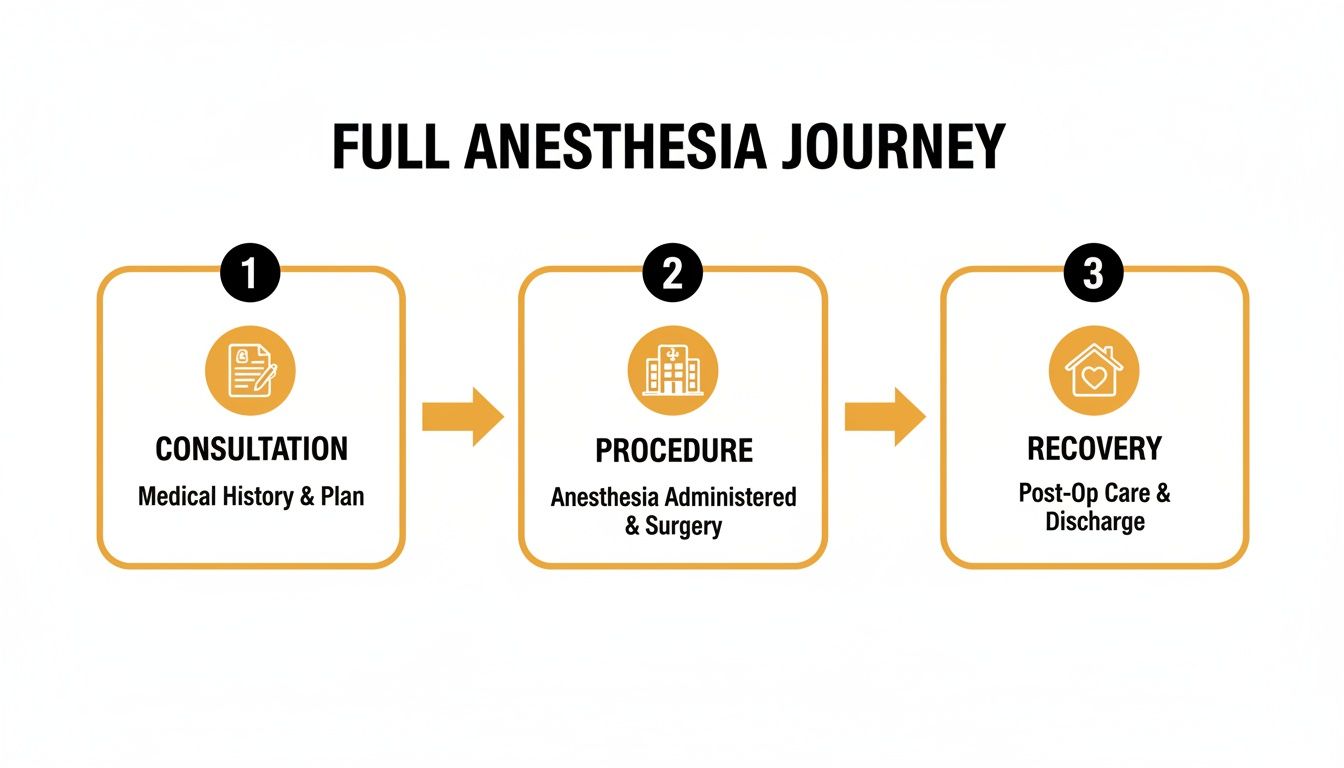
As you can see, the process is a structured partnership between our dental team, a dedicated hospital or day surgery, and your own at-home care.
Phase 1: Your Preparation and Consultation
The first step is a comprehensive consultation right here at The Smile Spot. This is our chance to sit down together, discuss your dental needs, carefully review your medical history, and determine if general anaesthesia is the safest and best path forward for you. Dr. Thanos will explain the entire treatment plan and answer every question you have.
Once we agree to proceed, we handle all the coordination with our trusted specialist anaesthetists and an accredited local hospital or day surgery. The anaesthetist will also conduct their own pre-anaesthetic assessment, making sure you’re medically cleared and ready. This usually involves a detailed look at your medical history and may require some specific health checks.
You’ll also receive some very important pre-operative instructions. Following these is critical for your safety. They typically include:
- Fasting: You’ll need to stop eating and drinking for a set period before the procedure, usually at least six hours. This is essential to prevent complications while you are asleep.
- Medication Adjustments: We will give you clear guidance on any regular medications you take, letting you know what to continue and what to pause on the day.
- Arranging Support: It's a must to have a responsible adult bring you to the facility, take you home afterwards, and stay with you for at least 24 hours post-procedure.
Phase 2: The Day of the Procedure
On the day of your treatment, you’ll arrive at the designated hospital or day surgery. The friendly anaesthetic team will greet you, run through the plan one last time, and help you get settled and comfortable. Your specialist anaesthetist is your dedicated medical expert for the day—they are responsible for administering the anaesthesia and monitoring you from start to finish.
Once you are peacefully asleep, the anaesthetist remains right by your side. They will continuously monitor your heart rate, blood pressure, oxygen levels, and breathing, ensuring you are completely safe and stable throughout the entire procedure.
With the anaesthetic team fully focused on your wellbeing, our dental team from The Smile Spot can work efficiently and without interruption. This setup allows us to complete all the necessary dental work—whether it’s multiple fillings, complex extractions, or implants—to the highest standard in a single, stress-free session.
Phase 3: Your Recovery and Aftercare
When all the dental work is finished, the anaesthetist will gently begin to reverse the anaesthesia. You will wake up in a dedicated recovery room, where you’ll be looked after by specialised nurses. It’s perfectly normal to feel a bit groggy, disoriented, or have a slight sore throat as you wake up, but these feelings usually fade quite quickly.
Once you’re stable and alert, you’ll be discharged into the care of your support person. We’ll arm you with a detailed set of at-home care instructions to make sure your recovery is as smooth as possible. Following these guidelines is key and will cover things like:
- Rest: Plan to take it easy for the rest of the day. You must avoid driving, operating machinery, or making important decisions for at least 24 hours.
- Diet: Stick to soft foods and clear liquids at first. You can gradually reintroduce your normal diet as you begin to feel more comfortable.
- Managing Discomfort: We will advise you on the best pain relief options to manage any post-operative soreness.
Proper aftercare is just as important as the procedure itself for a successful outcome. For more detailed healing tips, feel free to explore our resources on dental aftercare. By following these steps, you can help ensure your recovery is just as comfortable and straightforward as the treatment itself.
Understanding the Safety and Risks in Australia
Your safety is, without a doubt, our number one priority. When you’re considering a big step like dental treatment under general anaesthesia, it’s completely normal to wonder about the risks involved. We believe in being upfront and open, so let’s talk through the strict safety standards here in Australia that allow us to provide this care with complete confidence.
First, it’s important to know that dental general anaesthesia is never performed in a regular dental chair at our clinic. This type of treatment only ever happens in highly regulated and accredited private hospitals or specialised day surgery centres. This guarantees you have a full medical team and hospital-grade equipment dedicated to your care.

The Role of the Specialist Anaesthetist
Your dentist focuses on your teeth, but the most important person in the room for your overall health is the specialist anaesthetist. This is a medical doctor who has gone through years of extra training to become an expert in anaesthesia. Their only job during your procedure is to look after you.
The anaesthetist is responsible for:
- Providing one-on-one monitoring from the moment you drift off to sleep until you’re awake and resting in the recovery room.
- Keeping a close watch on all your vital signs—like your heart rate, blood pressure, and oxygen levels.
- Making constant, tiny adjustments to the anaesthetic to make sure you stay completely stable and comfortable.
This dedicated medical oversight is the cornerstone of safety for any GA procedure. At The Smile Spot, we partner exclusively with trusted anaesthetists and accredited facilities, giving our Inner West patients total peace of mind.
A Tightly Regulated and Trusted Field
More and more people are looking for ways to get the dental care they need without the stress. In fact, the Australian dental anaesthesia market, which includes full GA, brought in USD 37.4 million in 2023. This is expected to grow to USD 54.1 million by 2030, which shows just how vital these options have become.
This growth is happening within a very safe and controlled environment. The entire field is overseen by state Dental Boards, including the Dental Council of New South Wales. These strict regulations ensure that the practice is mature, well-managed, and sticks to the highest possible safety protocols.
How We Minimise Risks with Careful Screening
While modern anaesthesia is incredibly safe, any medical procedure comes with some level of risk. The best way to keep these risks to an absolute minimum is through a careful pre-screening process. Before you’re cleared for GA, the anaesthetist will sit down with you and do a thorough review of your medical history.
This check helps identify anything that might need special attention, like a heart or lung condition, any allergies, or if you’ve had a bad reaction to anaesthesia before. By getting a full picture of your health, the team can create an anaesthetic plan just for you.
This preparation helps manage any potential side effects, which are usually mild and short-lived, like feeling groggy or having a sore throat. Sometimes, you might need help managing discomfort afterwards, and you can learn more about post-procedure care in our guide on what to expect after a tooth extraction and using Panadeine Forte.
Your Questions About Full Anaesthesia Dentistry Answered
Choosing to have dental work done under full anaesthesia is a big decision, and it’s completely natural to have questions—especially when it’s for yourself or your child. We believe clear, honest answers are the best way to help you feel comfortable and in control.
Here, we tackle the most common questions we hear from our patients in Dulwich Hill and across the Inner West.
Is Dental Treatment Under GA Covered by Insurance?
This is a critical question for many families, and the answer has a few moving parts. In Australia, Medicare generally doesn't cover the costs of dental procedures, even when they’re done in a hospital.
The key to your coverage almost always lies with your private health insurance. Here’s how it usually breaks down:
- Hospital Cover: This part of your policy is designed to cover the fees for the hospital or day surgery facility, plus the specialist anaesthetist’s fee. Most policies cover a significant portion, but you may still have an out-of-pocket 'gap' payment.
- Extras Cover: The actual dental treatment performed by our team is claimed under your 'extras' cover. How much you get back depends entirely on your policy, its annual limits, and any waiting periods.
At The Smile Spot, we are committed to being completely upfront about costs. Before any treatment, we’ll give you a detailed estimate with all the specific dental item numbers. This lets you talk to your health fund and get a clear picture of what you’re entitled to, so there are no financial surprises.
You can learn more by exploring our detailed breakdown of our dentist fees and charges, which explains our commitment to clear and fair pricing.
How Is My Child's Safety Ensured During the Procedure?
For any parent, this is the most important question of all. We want to assure you that your child's safety is our absolute, non-negotiable priority. When a child needs dental work under general anaesthesia, the entire process is managed with the highest level of care.
Dental GA for children is only ever performed in an accredited hospital or a dedicated day surgery. Your child will be looked after by a specialist paediatric anaesthetist—a medical doctor with extensive extra training focused specifically on keeping children safe and comfortable under anaesthesia.
This specialist and a team of expert nurses use state-of-the-art equipment to continuously monitor every single vital sign—heartbeat, breathing, and oxygen levels—from start to finish. A full medical assessment is also done beforehand to ensure your child is a suitable candidate. While any anaesthetic has a very small risk, the safety standards and expertise in Australia are exceptionally high, making it a very safe procedure in the hands of a dedicated team.
Do I Need Full Anaesthesia or Is In-Clinic Sedation Enough?
This is a fantastic question, and it’s one we’ll answer together. You don’t have to make this decision on your own. The right choice comes down to your unique situation.
During your first consultation, Dr. Thanos will take the time to properly assess your dental needs, look over your medical history, and most importantly, have a chat about your anxiety levels.
- For many nervous patients, our gentle in-clinic options are a perfect fit. The combination of oral sedation (a calming tablet) and our minimally invasive Biolase laser dentistry can make the experience comfortable and anxiety-free for many procedures.
- For profound phobia or complex needs, we may recommend general anaesthesia. This is often the best path for those with deep-seated fear, certain medical or behavioural conditions, or when very extensive surgery is required.
We will walk you through the pros and cons of every option. Our goal is to give you all the information you need to make a choice that you feel truly confident about.
What Is the Recovery Process Like?
Recovery from a dental general anaesthetic is usually quite straightforward. Once the treatment is done, you’ll be moved to a recovery room where nurses will monitor you carefully until the anaesthetic wears off and you’re alert and stable.
You’ll be discharged into the care of your designated responsible adult to go home. It’s normal to feel a few common, temporary side effects, such as:
- Grogginess or feeling a bit "out of it"
- A mild sore throat or dry mouth
- Nausea, though this is less common with modern anaesthetics
These symptoms typically fade within a few hours. We’ll send you home with very specific post-operative instructions on what to eat, how to rest, and how to manage any discomfort. Most people feel much better by the next day. The golden rule is that you must rest for a full 24 hours. That means no driving, operating machinery, or making any important decisions during this initial recovery period.