Losing most of your teeth rarely happens all at once. For many people in Sydney, it builds slowly. A few broken molars. A bridge that keeps failing. Dentures that move when you eat or speak. Before long, meals become cautious, photos become awkward, and everyday social situations start to feel tiring.
That’s usually the point where people start searching for all-on-4 dental implants sydney. They want something fixed, stable, and realistic. They also want straight answers about cost, healing, comfort, and whether they’re even suitable.
A full-arch implant solution can change daily life, but only when it’s planned properly. The details matter. Implant position matters. Bone quality matters. So does the way your provisional teeth are designed, how you heal, and how well the final bridge is maintained over time.
Reclaiming Your Smile with a Full Arch Solution
When someone has lost most or all of the teeth in one arch, the problem isn’t only appearance. It affects chewing, speech, facial support, and confidence. Many long-term denture wearers also describe the same frustration. Their teeth are technically replaced, but they still don’t feel secure.
All-on-4 offers a different path. Instead of replacing each missing tooth one by one, the treatment uses a small number of strategically placed implants to support a full fixed bridge. That gives patients a restoration that stays in place and feels far closer to natural teeth than a removable denture.
For Inner West patients, local access matters too. You don’t want to travel all over Sydney for scans, surgery, reviews, and adjustments if you can avoid it. Treatment is easier to manage when the planning, surgery, and follow-up are organised close to home, especially if you’re balancing work, family, and recovery.
A lot of people first explore this option after seeing real smile transformations. Looking through dental implants before and after examples often helps people understand what full-arch restoration can actually achieve in practical terms.
Practical rule: If you’re hiding your smile, avoiding tougher foods, or relying on dentures that no longer feel secure, it’s worth having your jawbone and bite assessed rather than assuming you have to keep managing the problem.
The important part is that this isn’t a cosmetic shortcut. It’s a structured restorative treatment designed to rebuild function first. A better smile follows from that foundation.
What Exactly Are All-on-4 Dental Implants
A lot of Sydney patients arrive at this point with the same question. If there are only four implants, how can they hold a full set of teeth?
The answer is in the design. All-on-4 uses four dental implants to support one full arch of fixed replacement teeth. It does not mean four replacement teeth. It means four carefully positioned anchors under a full bridge.
How the design supports a full arch
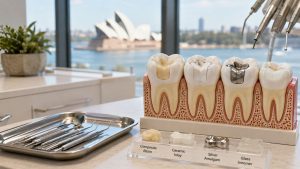
The approach relies on implant position, bone quality, and bite planning, not sheer implant numbers. The front implants are usually placed more vertically in the stronger bone at the front of the jaw. The back implants are angled to use available bone more effectively and to reduce the need to place implants into areas that are harder to access safely. Sydney Implant Institute’s explanation of All-on-4 outlines this standard concept, including the use of tilted posterior implants to support a full-arch bridge.
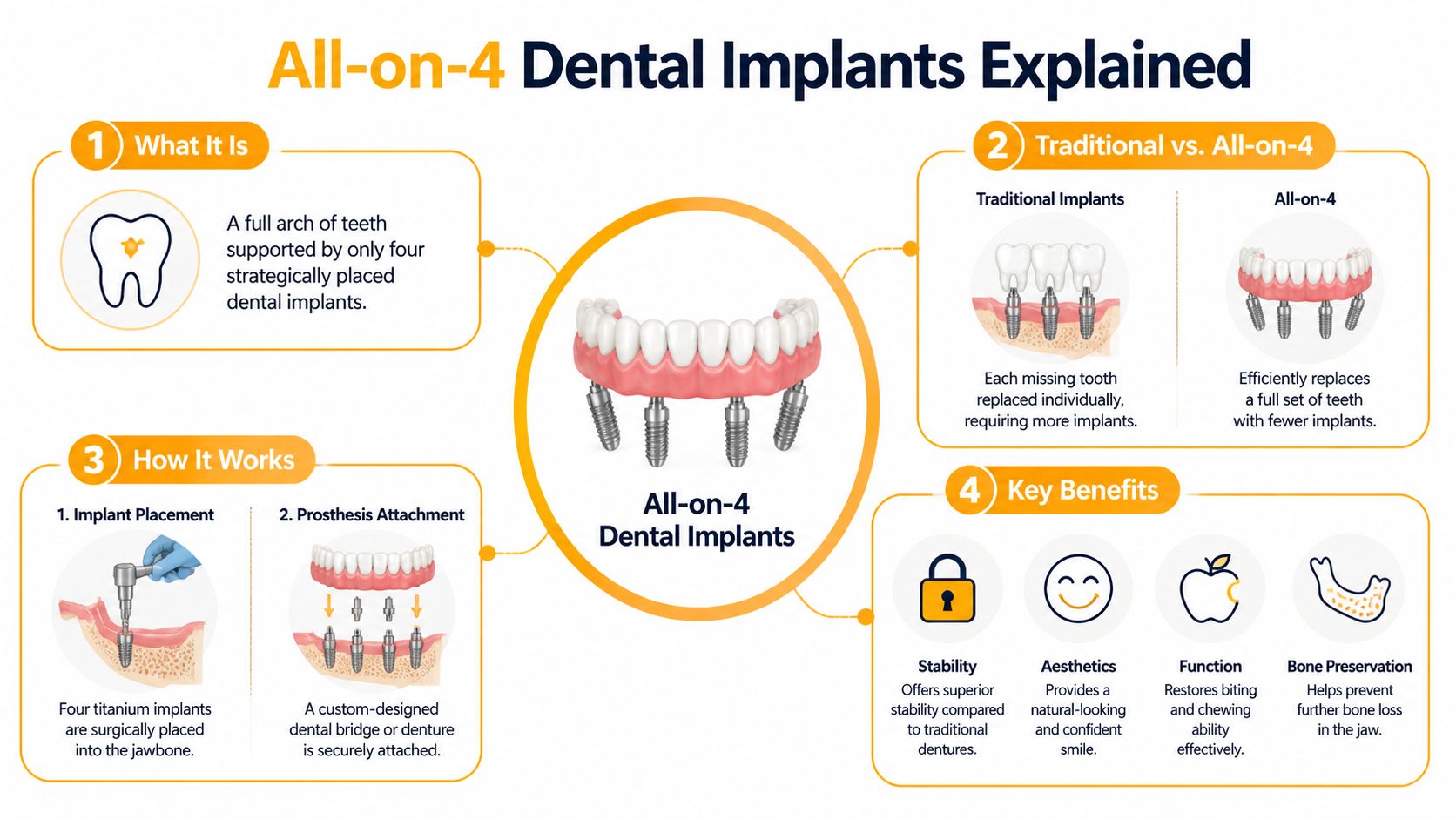
That angulation matters in day-to-day practice. In the upper jaw, it can help avoid the sinus area. In the lower jaw, it helps keep clear of the main nerve. For Inner West patients who want to limit extra surgery, that planning can make treatment more straightforward and, in some cases, reduce cost and healing demands.
Why implant angulation matters in real treatment
This is not just a technical detail for dentists. It affects whether a patient may need bone grafting, how stable the bridge can be, and how efficiently force is spread across the arch when chewing.
Bone grafting is sometimes still needed. It has a place. But if available bone can be used well with careful implant positioning, treatment may involve fewer stages, fewer appointments, and a shorter path to fixed teeth. That matters to patients balancing work, school runs, recovery time, and the practical reality of travelling across Sydney for care.
At The Smile Spot, this planning stage is where technology makes a real difference. Detailed scans and digital surgical planning help assess bone volume, implant position, prosthetic space, and whether immediate teeth are realistic for that specific case. In some cases, laser dentistry also helps make parts of treatment more comfortable and precise, particularly when managing soft tissue.
What patients usually notice first
The first thing patients tend to notice is stability.
A denture sits on the gums and can shift under pressure. An All-on-4 bridge is attached to implants in the jaw, so the teeth feel more secure during eating and speaking. That often changes confidence as much as function.
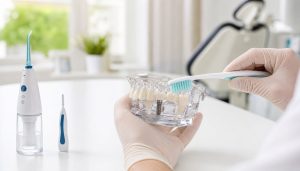
The second difference is maintenance style. The bridge stays in place. Patients do not remove it at night, and they do not rely on adhesives. That does not mean zero maintenance. It means a different kind of maintenance, with daily cleaning under the bridge and regular professional reviews to protect the implants and surrounding tissue.
Here is the practical structure:
- Four implants support one arch: The system replaces a full arch with a fixed bridge, rather than placing one implant for every missing tooth.
- Back implants are angled: This helps use existing bone more efficiently in many cases.
- The teeth are fixed in place: The bridge is secured to implants rather than resting on the gums like a removable denture.
- Planning is prosthetic as well as surgical: The bite, smile line, speech, cleaning access, and bridge design all need to be worked out before surgery.
A good All-on-4 result depends on more than placing implants. The bridge has to be designed so it bites evenly, looks natural for the face, and can be cleaned properly over the long term.
What All-on-4 is not
All-on-4 is one full-arch treatment option. It is not the right answer for every patient, and it is not a shortcut around ongoing care.
Some patients are better suited to individual implants, overdentures, or a staged rebuild. Others need extra treatment first because of active gum disease, uncontrolled health issues, or severe bone loss. The trade-off with All-on-4 is that it can provide a fixed full-arch result with fewer implants and a simpler surgical plan than placing many separate implants, but success still depends on case selection, hygiene, bite control, and follow-up care.
Who Is an Ideal Candidate for All-on-4 Treatment
The best candidates usually aren’t looking for a small cosmetic improvement. They’re dealing with a bigger restorative problem. Their teeth may be missing, heavily broken down, loose, infected, or repeatedly patched with short-term fixes.

A practical self-check
You may be a strong candidate if several of these apply:
- You’re missing most or all teeth in one arch: Full-arch treatment suits people with widespread tooth loss better than those with only one or two missing teeth.
- Your remaining teeth are failing: Multiple broken teeth, advanced decay, or a collapsing bite can make piecemeal treatment poor value.
- You’ve worn dentures for years and want something fixed: This is one of the most common reasons patients ask about all-on-4 dental implants sydney.
- You’ve been told bone loss is an issue: Moderate bone loss doesn’t automatically rule you out.
- You want function, not just appearance: The right candidate cares about eating, speaking, and long-term stability, not only how the teeth look in photos.
- You can commit to maintenance: Daily cleaning and regular professional reviews are part of owning implant-supported teeth.
Bone loss matters, but it doesn’t answer everything
A lot of online marketing makes the process sound universal and immediate. Real life is more selective. Patients with severe bone loss need a careful assessment, and some may need preliminary treatment or a different implant approach.
That’s consistent with AllOn4.com.au’s discussion of realistic timelines and suitability, which notes that some patients with severe bone loss may require preliminary treatments and that advanced options such as Zygoma implants exist for people with insufficient jawbone.
What this means in practical terms is simple. Don’t self-diagnose based on what you’ve read online. A scan tells far more than a mirror does.
General health and habits
Medical history affects planning. Smoking, poorly controlled health conditions, bite forces, clenching, and oral hygiene all influence risk. None of those automatically excludes treatment, but they do change how cautiously a case should be planned and how closely healing should be monitored.
A thorough consultation usually looks at:
| Consideration | Why it matters |
|---|---|
| Existing teeth | Determines whether salvage is realistic or full-arch replacement is the better option |
| Bone availability | Helps decide whether standard All-on-4 placement is possible |
| Gum health | Healthy surrounding tissue supports long-term implant stability |
| Medical history | Affects healing, surgery planning, and recovery |
| Expectations | Helps match the treatment to what the patient actually wants day to day |
Some patients are suitable for fixed teeth, but not for same-day fixed teeth. That distinction matters. The safest plan is the right plan, even if it takes longer.
The ideal candidate isn’t the person who wants the fastest treatment. It’s the person whose anatomy, health, goals, and maintenance habits line up with a predictable long-term result.
The All-on-4 Clinical Workflow at The Smile Spot
Most patients feel less anxious once they understand the sequence. Full-arch implant treatment is a major procedure, but it’s not a mystery. It follows a structured pathway from assessment to surgery to healing to the final bridge.
The first consultation and planning stage
The first job is diagnosis. That means examining the teeth and gums, assessing the bite, discussing health history, and using 3D imaging to understand bone shape and volume. For full-arch work, planning isn’t only about whether implants fit. It’s also about where the final teeth should sit, how the smile line will look, and how the bridge will be cleaned.
At this stage, it becomes clear whether the case is straightforward or whether extra steps may be needed. Some patients are suitable for immediate function. Others need a more staged approach.
Digital planning improves decision-making because it lets the treating team assess implant positioning before surgery. That reduces guesswork and helps map the prosthetic result, not just the surgical one.
Surgery day and the provisional bridge
If remaining teeth in the arch can’t be saved, they’re usually removed as part of treatment. The implants are then placed in the planned positions, and sedation may be discussed for patients who are anxious about the procedure.
For suitable cases, a provisional bridge can be attached on the day of surgery. That’s what people usually mean when they say “teeth in a day”. It doesn’t mean the final bridge is completed that day. It means you don’t spend the healing period without teeth.
The provisional stage is important because it lets the implants heal while maintaining appearance and basic function. It also guides aesthetics, bite, phonetics, and comfort before the definitive bridge is made.
The healing period
Healing requires patience. The implants need time to integrate with bone before the final prosthesis is fitted. The verified information available for Australian protocols places this healing period at 3 to 6 months in typical pathways, as described in the background data provided for Sydney-based All-on-4 treatment.
During this phase, patients need to follow instructions carefully. Diet is usually modified. Cleaning technique matters. Review visits matter. Overloading a fresh provisional can create problems that were avoidable.
If you’re wondering what the first days and weeks usually involve, this guide to dental implant recovery time is a useful starting point for understanding the practical side of healing.
Healing isn’t passive. Patients who clean well, protect the provisional, and attend review appointments give the implants the best environment to integrate properly.
The final bridge
Once healing is stable, the final prosthesis is fabricated and fitted. This stage focuses on long-term durability, aesthetics, speech, cleansability, and bite balance. Materials and design are chosen according to the case rather than by default.
A final bridge should do more than look white and straight. It should support facial structure appropriately, feel comfortable to speak with, and allow access for hygiene underneath.
Why predictability matters more than speed
The long-term data is one reason this treatment remains so important in full-arch dentistry. A landmark 2011 study published in the Journal of the American Dental Association found that 95% of implants were still functional at 10 years and the prosthetic bridge had a 99% success rate, as summarised in this overview of All-on-4 success rates.
That doesn’t mean every patient gets the same timeline or the same complexity. It means that when case selection, planning, surgery, and maintenance are done properly, the treatment has strong long-term support.
For patients, the workflow usually feels more manageable when broken into these stages:
Assessment and scanning
Bone, bite, gum health, and goals are evaluated.Digital planning
Implant positions and provisional design are mapped before treatment.Surgery and immediate provisional if suitable
The implants are placed and temporary fixed teeth may be fitted.Healing and review phase
The implants integrate while the bite and soft tissues are monitored.Final bridge delivery
The definitive restoration is fitted and adjusted for long-term function.
The smoother the planning, the calmer the treatment feels from the patient side.
Comparing All-on-4 with Other Dental Solutions
The right option depends on what problem you’re trying to solve. Some people need a fixed full-arch solution. Some are better served by conventional dentures. Others may be considering many individual implants because they want each tooth replaced separately.
Side-by-side comparison
| Feature | All-on-4 Implants | Full Set of Single Implants | Traditional Dentures |
|---|---|---|---|
| How it’s supported | Full bridge supported by four implants per arch | Multiple implants placed across the arch | Rests on the gums |
| Feel in the mouth | Fixed and stable | Fixed and stable | Removable, may shift |
| Surgical demand | Moderate compared with replacing every tooth individually | Higher because more implants are typically required | No implant surgery |
| Need for bone grafting | Often reduced due to angled implant design in suitable cases | More likely in complex bone-loss cases | Not applicable |
| Treatment goal | Full-arch fixed replacement | Tooth-by-tooth replacement across an arch | Basic removable tooth replacement |
| Daily cleaning | Needs careful under-bridge cleaning | Needs cleaning around multiple implant sites | Removed for cleaning |
| Chewing confidence | Generally strong once healed | Generally strong once healed | Often less stable with tougher foods |
| Cost structure | Major upfront investment, fewer implants used | Usually more extensive treatment | Lower initial cost, different long-term trade-offs |
Where All-on-4 sits in the middle
All-on-4 often appeals to patients who want a fixed result but don’t want the surgical complexity of replacing an entire arch with many individual implants. That’s its main practical advantage. It creates full-arch support efficiently.
By contrast, a full set of single implants can be appropriate, but it’s usually a much bigger treatment commitment. More implants often mean more surgery, more restorative complexity, and less tolerance for bone limitations.
Why dentures still remain part of the conversation
Dentures aren’t “wrong”. They are different. For some patients, they remain the only practical option due to health, anatomy, budget, or preference. But removable dentures don’t provide the same anchored feel as implant-supported teeth.
That’s usually the turning point. Patients don’t come in saying, “I specifically want a prosthetic classification.” They say, “I want to eat without worrying,” or “I want my teeth to stay put when I talk.” Those are function questions, and fixed implant solutions answer them differently from dentures.
The trade-offs that matter most
When patients compare options well, they usually focus on these points:
- Stability: Fixed teeth feel more secure than removable teeth.
- Surgical scope: More implants usually means a larger treatment burden.
- Maintenance: Every option needs maintenance, just in different ways.
- Flexibility: Dentures are easier to modify quickly, but they’re less secure.
- Lifestyle fit: Someone who wants a non-removable solution usually won’t be satisfied by a denture for long.
If you’re weighing whether implants are a worthwhile long-term investment, this article on whether dental implants are worth it can help frame the decision beyond the initial fee.
The best solution isn’t the one with the most hardware. It’s the one that solves the patient’s actual problem with the least unnecessary treatment.
For many full-arch cases, that’s exactly where All-on-4 is strongest. It offers a fixed outcome without automatically committing the patient to the most extensive implant plan possible.
Navigating the Cost of All-on-4 Implants in Sydney
A common Inner West scenario goes like this. Someone has spent years patching failing teeth, avoiding harder foods, and putting off a bigger decision because the numbers feel unclear. Then a crucial question emerges. What will full-arch treatment cost, and what am I paying for?
According to Australian pricing information summarised by Fixed Teeth Australia, All-on-4 dental implants in Sydney typically range from $19,000 to $35,000 per arch, as outlined in their Sydney All-on-4 cost discussion. In Sydney, fees tend to reflect higher operating costs, the planning involved in full-arch rehabilitation, and the materials used for the final restoration.
That range is broad for a reason. One patient may need straightforward extractions and a standard provisional bridge. Another may need more surgical time, more complex restorative work, or a different final prosthesis to manage bite forces and long-term wear.
At The Smile Spot, I encourage patients to look past the headline figure and examine the structure of the quote. A lower fee is not automatically better value if key parts of treatment are excluded and billed later. A higher fee is not automatically excessive if it includes imaging, surgery, provisional teeth, reviews, and the final bridge.
Why quotes vary from case to case
All-on-4 is not a single flat-fee product. It is a treatment approach built around your diagnosis.
The final cost usually depends on factors such as:
- Existing dental condition: failing teeth, infection, and broken restorations can increase treatment complexity
- Extractions and surgical time: some cases are more straightforward than others
- Provisional restoration: immediate fixed teeth may be included differently from clinic to clinic
- Final bridge material: options differ in strength, aesthetics, repairability, and long-term cost
- Planning technology: 3D imaging and guided planning add value because they reduce guesswork
Sydney patients should also ask how the clinic handles comfort-related technology. For example, if a practice uses advanced tools such as laser dentistry for soft tissue management, that may affect the overall experience and healing process, even if it is not the main driver of cost.
What to ask before you accept a fee
A good cost discussion is specific. Patients should know what is included on day one, what happens later, and what could change if the case becomes more involved once treatment starts.
Useful questions include:
- Is the diagnostic imaging included in the fee?
- Are extractions included or billed separately?
- Are temporary fixed teeth part of the treatment plan?
- What material is proposed for the final bridge?
- How many review visits and adjustments are covered?
- What maintenance costs should I expect after treatment?
That last point matters. Full-arch implant treatment is a long-term restoration, not a one-off purchase. Ongoing reviews, professional cleaning around implants, and occasional repairs should be part of the financial conversation from the start.
To hear a broader explanation of pricing factors, this video gives helpful context for patients considering full-arch treatment in Australia.
Financing and payment planning
For many Sydney patients, the challenge is not deciding whether fixed teeth would improve daily life. It is working out whether the treatment can be budgeted without unnecessary stress.
That is why transparent payment planning matters. Patients should be able to see the treatment stages, the timing of major costs, and whether finance options are available. A proper consultation should also explain the trade-off between delaying treatment and continuing to spend on short-term repairs that do not solve the underlying problem.
If you want a clearer breakdown of what affects fees across the country, this guide to All-on-4 dental implants cost in Australia gives more detail.
The key standard is simple. Your quote should be clear, clinically justified, and easy to follow. If a patient in the Inner West has to guess what is included, the financial discussion has not been done properly.
The Smile Spot Advantage for Your All-on-4 Treatment
A patient from the Inner West often comes in with the same practical question. Who is going to plan this case carefully, carry it out with as little stress as possible, and still be available months later if the bite feels off or the bridge needs review?
That is the advantage to look for with full-arch treatment in Sydney.
For All-on-4, the treating dentist’s judgement matters as much as the surgical appointment itself. Cases are rarely identical. Long-term denture wear, broken teeth, past dental work, gum changes, and bite problems all affect how the case should be planned. Dr. Dimitrios Thanos has been practising since 1996, and that depth of experience helps when treatment needs to be adapted to the patient in front of us rather than forced into a standard workflow.
Technology that supports comfort and precision
The tools used around implant treatment affect comfort, healing, and the day-to-day experience of care. At The Smile Spot, Biolase laser dentistry can be used for soft tissue management in suitable cases. That can reduce the amount of tissue handling needed and make recovery more comfortable for some patients.
Sedation also has a clear role. Many patients considering all-on-4 dental implants sydney have postponed treatment because of anxiety, previous difficult dental experiences, or fear of surgery. Sedation does not make someone a candidate if the clinical signs are wrong, but it can make a well-planned procedure feel much more manageable.
Why local access makes a difference
Full-arch treatment is not a single visit. It involves assessment, surgery, review appointments, maintenance, and occasional adjustments over time. For Inner West residents, access affects results because it affects follow-up. If getting back to the clinic is difficult, small issues are more likely to be left too long.
That is why practical details matter at The Smile Spot. Late evening appointments, Saturday availability, and online booking make it easier for Sydney patients to keep reviews on track around work, school runs, and commuting.
Cost access matters too, but only when the financial side is explained clearly and linked to the treatment plan. Patients comparing clinics often find it helpful to read about dentists with payment plans near me so they know what transparent financing and staged treatment discussions should look like.
Good implant treatment depends on consistent review, early problem-solving, and a clinic team that is easy to reach when something needs attention.
At The Smile Spot, that combination matters. Careful restorative planning, comfort-focused technology, and accessible local follow-up give Sydney patients a more realistic path through complex treatment.
Frequently Asked Questions About All-on-4
How do you clean under an All-on-4 bridge
You clean it differently from natural teeth, but not casually. Most patients use a soft toothbrush plus cleaning aids designed to pass under the bridge and around the implant-supported structure. The key is removing plaque from the underside where food can collect.
Will the new teeth feel natural
They usually feel much more secure than dentures because they’re fixed in place. That said, they still feel different from your original teeth at first. Patients go through an adjustment period with speech, bite awareness, and cleaning technique.
How long can All-on-4 last
Long-term success depends on planning, bone support, bite control, hygiene, and regular maintenance. The treatment has strong long-term evidence when properly managed, but it isn’t maintenance-free. The implants and the bridge both need ongoing review.
Are there food restrictions forever
Early on, yes. During healing, the provisional teeth need to be protected. Once treatment is complete and the final bridge is fitted, most patients return to a broad diet, but common sense still matters. Very hard habits such as chewing ice or using the teeth as tools can damage restorations.
If you’re considering The Smile Spot for full-arch treatment, the next step is a personalised consultation. A proper assessment can show whether All-on-4 is suitable, what your timeline may look like, and how to plan the treatment in a way that fits your health, comfort, and budget.