A lot of people look up an intravenous sedation dentist late at night, usually after putting off treatment for far too long. You might have a cracked tooth that’s started flaring up, wisdom teeth that keep troubling you, or a treatment plan you know you need but can’t bring yourself to book. The common thread is usually the same. You don’t just dislike the dentist. You feel tense before you even make the call.
That reaction is more common than many patients realise, and it doesn’t mean you’re weak, difficult, or “bad at coping”. It means your body has learned to treat dental care as a threat. The good news is that modern dentistry has ways to work with that response, not against it.
Overcoming Dental Fear with Modern Comfort
You finally book the appointment. Then the familiar thoughts start. What if I panic in the chair? What if I cannot cope once it begins? For many people in Dulwich Hill and across the Inner West, the hard part starts well before any treatment does.

Dental fear can be loud, such as cancelling on the day or avoiding the phone call altogether. It can also be quiet. Some patients keep delaying a check-up, ask for more time, or wait until a small problem turns urgent. The reason is often very personal. A difficult visit years ago. Sensitivity to sound or gagging. A strong dislike of needles. Shame about how long it has been.
At The Smile Spot, we treat that anxiety as a real health concern, not a personality flaw. Your nervous system is trying to protect you. That means comfort has to be built into the whole appointment, from the first conversation to the trip home after treatment.
When fear becomes the biggest obstacle
Many anxious patients say the treatment is not the only problem. The lead-up is often worse. The waiting room can feel like a countdown. Your stomach tightens, your chest feels heavy, and your mind jumps ahead to the part you are dreading.
IV sedation helps by reducing that stress response in a controlled, closely monitored way. It works a bit like turning down the volume on a blaring radio. The signal is still there, but it no longer fills the whole room. For the right patient, that can make dental care feel possible again.
Some people also benefit from support outside the dental setting, especially if fear shows up in other parts of life too. If fear is tied to panic, loss of control, or a long history of avoidance, these mental health support for anxiety in Florida resources can help you understand those patterns in a broader way.
Comfort starts before any sedative is given
Sedation is only one part of a calmer experience. Clear explanations matter. So does being listened to without judgement. A rushed, confusing appointment can increase fear, while a steady and respectful approach can lower it before treatment even starts. That is why many patients begin by searching for a gentle dentist near me before they decide whether sedation is needed.
At The Smile Spot, we slow the process down, explain each step plainly, and check that IV sedation is appropriate before recommending it. For local patients in Dulwich Hill and the Inner West, that means care is planned around safety, comfort, and trust, not just the procedure itself.
IV sedation adds another layer of support for patients who need more than reassurance alone.
What Is Intravenous Sedation in Dentistry
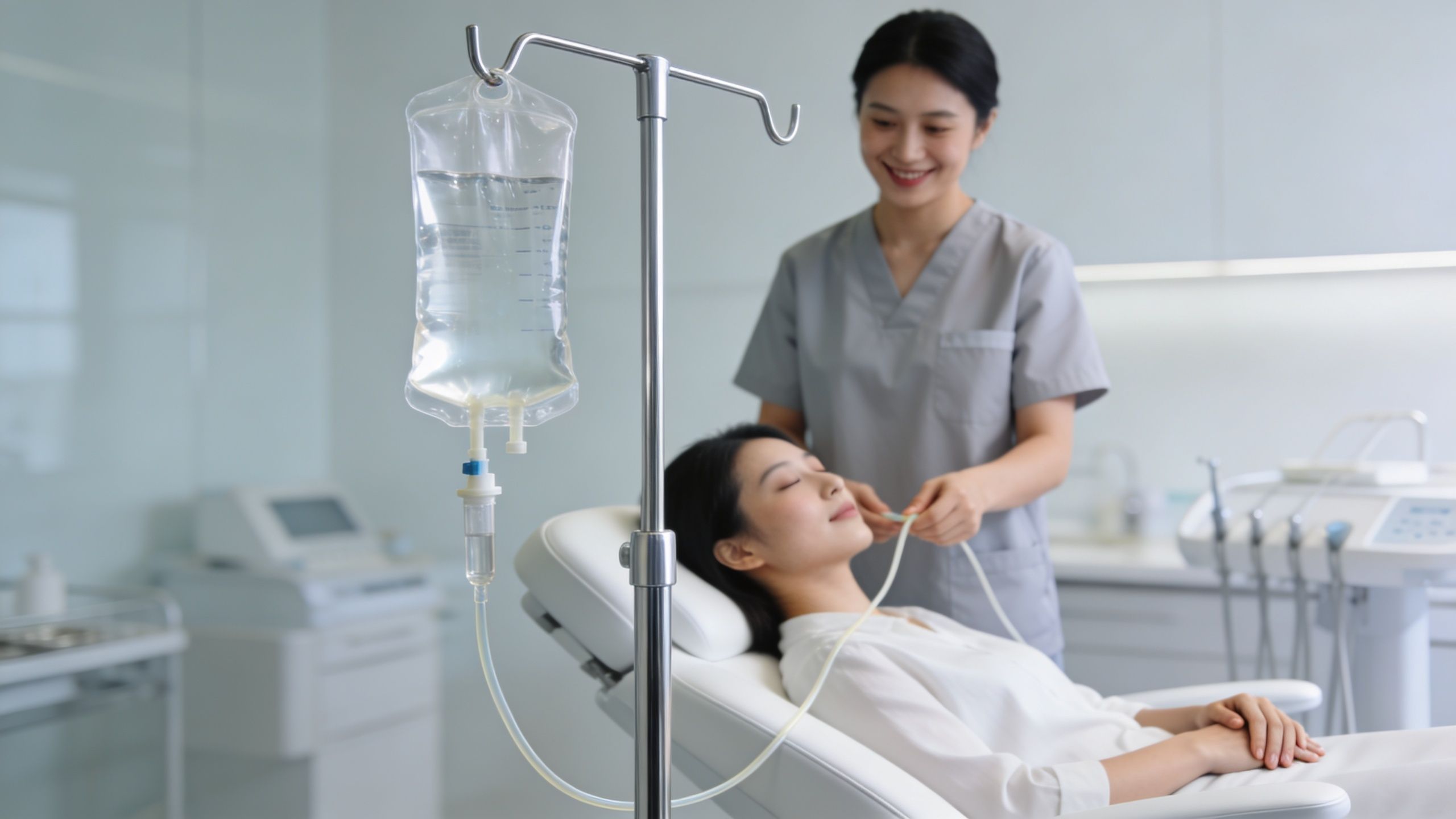
Intravenous sedation means sedative medication is given through a vein, usually in the hand or arm, so it can work quickly and be adjusted carefully during treatment. Most patients describe it as a kind of twilight state. You’re very relaxed, time feels blurred, and many people remember little or nothing afterwards.
A point that often confuses people is this: IV sedation is not the same as general anaesthesia.
You are relaxed, not unconscious
With general anaesthesia, you’re fully unconscious and require a different level of medical management. With IV sedation in dentistry, the aim is conscious sedation. That means you remain able to respond to simple verbal guidance, but you feel profoundly calm and detached from the procedure.
Patients sometimes ask, “Will I be asleep?” The most accurate answer is that it can feel a bit like sleep, but medically it’s different. You’re not fully “gone”. You’re so relaxed that the appointment feels distant, brief, or hard to recall afterwards.
Why the IV route matters
The reason many anxious patients prefer an intravenous sedation dentist over pill-based sedation is control. Because the medication enters the bloodstream directly, the clinician can adjust the level of sedation in real time. If you need a little more support, that can be titrated carefully. If you’re already comfortable, the dose can be maintained appropriately.
That matters because people don’t all respond the same way to sedatives. One patient may become very relaxed with a small amount. Another may need more gradual adjustment. IV sedation allows for that flexibility during the appointment itself.
Practical rule: IV sedation is often chosen when predictability matters. Especially for anxious patients, long procedures, or treatment that would otherwise feel overwhelming.
What the experience usually feels like
Most patients notice the process in stages:
The cannula is placed
A very small plastic tube is inserted into a vein, often after the skin is numbed. This step is brief.The medication starts working
Relaxation usually comes on quickly. Your body feels heavier, quieter, and less reactive.Time becomes vague
You may hear voices or notice moments of the appointment, but they usually don’t feel sharp or upsetting.Recovery begins after treatment
Once the sedative is stopped, you’re monitored as you wake more fully and become steady enough to go home with your escort.
Here’s a simple visual explanation for patients who like to see the process before discussing it in person.
What IV sedation does not do on its own
IV sedation helps with anxiety, awareness, and memory of the experience. It doesn’t replace local anaesthetic. Your dentist still numbs the treatment area so the procedure itself is pain-controlled in the usual way.
That distinction is helpful. Sedation handles the fear and stress response. Local anaesthetic handles the pain. Used together, they create a much calmer experience than either one alone for the right patient.
Key Benefits and Important Safety Considerations
IV sedation can make treatment possible for patients who would otherwise delay care for years. That’s its biggest benefit. It doesn’t just make dentistry more comfortable. It can remove the barrier that has stopped treatment altogether.
Why many anxious patients choose it
Some benefits are immediate and obvious. Others only become clear after treatment, when patients realise they got through an appointment that once felt impossible.
Profound anxiety relief
The main advantage is the sense of distance from the procedure. You’re less tense, less watchful, and less likely to spiral into panic.Reduced memory of treatment
Many patients value the amnesia effect almost as much as the relaxation itself. If past memories have fuelled your fear, not laying down another distressing memory can make future visits easier.Better tolerance for long appointments
More extensive work is often easier to complete when a patient is comfortable and settled for the duration.Help with a strong gag reflex
Patients who struggle with impressions, X-rays, or instruments near the back of the mouth often cope much better with sedation.Less treatment avoidance
Once fear is no longer in charge, people can finally deal with issues they’ve been postponing.
Situations where the benefit is practical, not just emotional
Think of someone needing multiple extractions, implant surgery, or lengthy restorative work. Without sedation, they may need repeated appointments, rising stress, and mounting fatigue. With sedation, the visit can feel more manageable from start to finish.
That doesn’t mean everyone needs the deepest option available. Some patients do well with inhalation sedation or oral medication. If you’re trying to understand how IV sedation compares with more intensive options, a guide to a full anesthesia dentist can help clarify where each approach fits.
The “best” sedation isn’t the strongest one. It’s the one that matches your anxiety level, health history, and planned treatment.
Important considerations to know before booking
A reassuring discussion about sedation should also be honest. IV sedation is safe when properly planned and monitored, but it does come with responsibilities and practical limitations.
Here are the points patients most often need explained clearly:
You’ll need an escort home
You won’t be able to drive yourself home afterwards. A responsible adult must accompany you.You may feel groggy for a while
Recovery is generally good, but the rest of the day should be kept light. No driving, important decisions, or strenuous activity unless your clinician specifically advises otherwise.You need medical screening first
Your dentist must know about your medications, allergies, previous sedation experiences, and relevant health conditions.Fasting instructions matter
If you’re told not to eat or drink for a set period before treatment, that isn’t optional. It’s part of safe sedation care.
Why safety depends on process
Safety in IV sedation comes from good systems, not luck. That includes careful case selection, trained clinicians, the right monitoring equipment, emergency preparedness, and proper recovery observation before discharge.
A calm patient experience usually starts long before the sedative is given. It starts when the dentist screens thoroughly, answers questions properly, and only recommends IV sedation when it’s appropriate. That’s why a trustworthy intravenous sedation dentist won’t rush the consent process or brush off your medical history.
Could IV Sedation Be Right for You
Not every nervous patient needs IV sedation. Some do well with clear communication, local anaesthetic, and a slower pace. Others know from the moment they sit down that reassurance alone won’t be enough.
People who often benefit most
IV sedation is often a good fit when fear is intense, physical, or ingrained. You may recognise yourself in one of these groups.
Severe dental phobia
If you’ve cancelled repeatedly, avoided treatment for years, or felt panic before appointments, IV sedation may help break that pattern. This is especially true if your fear is triggered before treatment even begins.
Strong gag reflex or low tolerance
Some patients aren’t mainly afraid. They just find treatment physically hard to tolerate. A strong gag reflex, difficulty keeping the mouth open, jaw fatigue, or trouble coping with sensations can all make sedation useful.
Complex or lengthy procedures
IV sedation is often considered for treatments that are more involved, such as implant placement, wisdom teeth removal, surgical extractions, or longer restorative appointments. The issue isn’t only discomfort. It’s the challenge of staying calm and still for the required time.
Questions worth asking yourself
A simple self-check can help you decide whether it’s worth having the conversation.
- Do you lose sleep before dental visits?
- Have you delayed recommended care because of fear?
- Do you dread the sounds, sensations, or loss of control more than the treatment itself?
- Have you had trouble completing treatment in the past?
- Are you facing a procedure that feels too big to manage awake and alert?
If several of those apply, IV sedation may be worth discussing.
Medical suitability matters just as much
Being a strong candidate emotionally doesn’t automatically mean sedation is appropriate medically. An intravenous sedation dentist needs to review your health history carefully before recommending it.
That review commonly includes:
- Current medications
- Allergies or previous reactions
- Respiratory conditions
- Heart-related issues
- Pregnancy status
- Sleep-related breathing concerns
- Past experiences with anaesthetic or sedation
Sometimes the result is, “Yes, IV sedation is suitable.” Sometimes it’s, “A lighter option would be safer.” And sometimes treatment needs to be coordinated differently.
Good sedation planning is collaborative. You bring the symptoms, fears, and history. The clinician brings the training and judgement.
If your anxiety is moderate rather than severe, or if you strongly prefer to avoid an IV, it may also be worth learning about a dentist with nitrous oxide. Inhalation sedation can be enough for some patients, particularly for shorter or less invasive visits.
The right question to ask
Patients often ask, “Am I bad enough to need sedation?” That’s not the most useful way to frame it.
A better question is, “Will sedation help me receive care safely and comfortably enough that I can go ahead with treatment?” If the answer is yes, then it’s a practical tool, not a last resort.
Comparing Your Sedation Dentistry Options
Sedation dentistry isn’t one single thing. It’s a range of options, each suited to different levels of anxiety, different procedures, and different patient preferences. IV sedation sits at the stronger, more controllable end of that range.
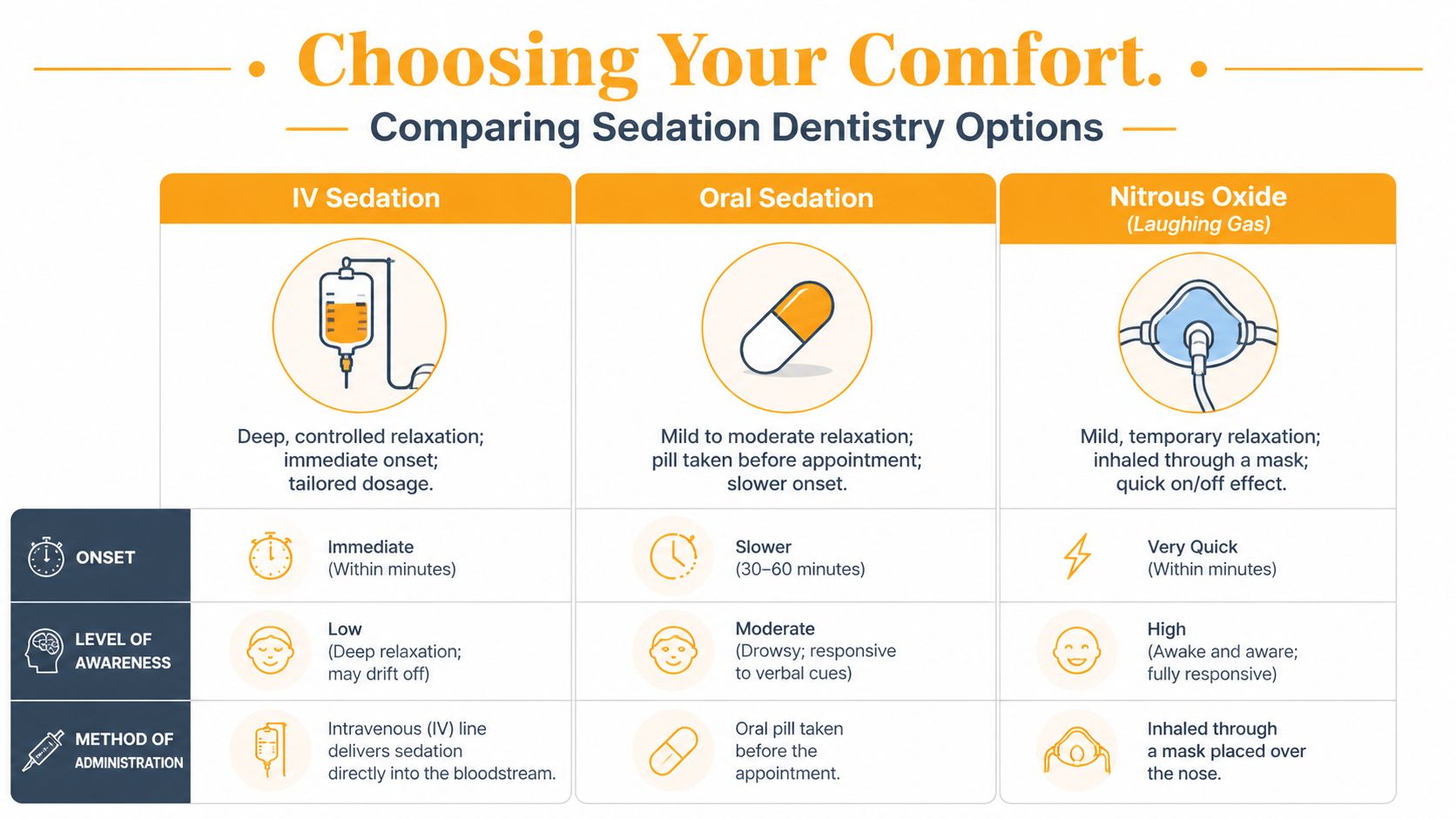
Sedation Dentistry at a Glance
| Feature | Inhalation Sedation (Nitrous Oxide) | Oral Sedation (Pill) | Intravenous (IV) Sedation |
|---|---|---|---|
| How it’s given | Breathed in through a nose mask | Taken by mouth before the appointment | Given through a vein by cannula |
| Typical level of relaxation | Mild | Mild to moderate | Moderate to deep conscious sedation |
| How quickly it works | Quick on and off | Slower, with less precision in timing | Fast onset and adjustable during treatment |
| Dose control during treatment | Limited by inhaled flow | Can’t be adjusted once swallowed | Can be titrated in real time |
| Memory of treatment | Usually remembered | May be patchy | Often limited or unclear |
| Best suited to | Mild anxiety, shorter visits | Moderate anxiety, selected routine care | Moderate to severe anxiety, longer or more complex work |
| Recovery pattern | Usually quite quick | Can feel lingering and sleepy | Monitored recovery, then home with escort |
Where nitrous oxide fits best
Nitrous oxide, often called laughing gas, is the lightest of the common options. It’s useful for people who feel nervous but still want to remain more aware and recover quickly. It can take the edge off a check-up, a filling, or a shorter procedure.
Its limitation is depth. If your anxiety is strong, or if you know you panic once treatment begins, nitrous oxide may not be enough on its own.
Where oral sedation can help
Oral sedation is often appealing because it doesn’t require a cannula. You take a prescribed sedative before the appointment and arrive feeling drowsier and calmer than usual.
That said, oral sedation has less precision. Once the tablet has been taken, the clinician can’t fine-tune the dose the way they can with IV sedation. Some patients become nicely relaxed. Others still feel too aware. For a broader look at that option, you can read about oral sedation dentistry.
Oral sedation is simpler. IV sedation is more controllable.
Why IV sedation is often seen as the most predictable option
The strength of IV sedation isn’t just that it can feel deeper. It’s that the clinician can tailor the experience while treatment is happening. That makes it especially helpful for patients with severe anxiety, complex dental needs, or a history of struggling through appointments.
A few examples make the differences clearer:
Mild anxiety before a clean
Nitrous oxide may be enough.Moderate anxiety for a crown appointment
Oral sedation might suit, depending on the patient and the length of treatment.Severe phobia before surgical extraction or implants
IV sedation is often the better match because it offers more profound relaxation and better control.
Choosing isn’t about bravery
Some people worry that choosing IV sedation means they’re not coping well enough. That’s the wrong lens. Sedation choice should be based on fit, not toughness.
If a lighter option would still leave you distressed, the stronger and more precise option may be the more sensible one. A good clinician will help you weigh the procedure, your medical history, your past experiences, and the level of support you need, rather than how much you think you should tolerate.
Your IV Sedation Journey at The Smile Spot
When patients ask what happens with IV sedation, they usually want practical detail. Not theory. They want to know what the day feels like, who’s involved, what checks are done, and when they’ll be allowed to go home.
Before the day of treatment
The process starts with consultation and screening. During this stage, your dental needs, your anxiety level, and your medical history are reviewed together. If you’re considering sedation for more involved care, that discussion may happen alongside planning for procedures such as implants or wisdom teeth removal.
You’ll usually be given clear instructions about food, fluids, medications, and escort arrangements. This stage matters as much as the treatment itself because sedation is safest when nothing is left vague.
What the team needs to know
You should expect questions about:
- Prescription and over-the-counter medications
- Allergies
- Past anaesthetic or sedation experiences
- Respiratory and cardiac history
- Any recent illness
- Whether you have someone to accompany you home
Patients sometimes feel they’re oversharing here. You’re not. Small details can change sedation planning.
On the day of your appointment
When you arrive, the goal is a calm, organised start. You won’t be rushed into treatment. A proper sedation appointment includes confirmation of your history, review of instructions, and preparation for monitoring before the sedative is administered.
A small IV cannula is then placed, usually into a vein in the hand or arm. For many anxious patients, this is one of the biggest worries. In reality, it’s usually quick, and topical numbing may be used to make it easier.
Most people find the anticipation of the cannula is worse than the cannula itself.
Once the intravenous line is in place, the sedation medication is given gradually. That gradual approach matters. Safe IV sedation in Australia is tightly controlled. Strictly regulated under ANZCA guidelines, safe IV sedation requires dentists to have certified training, use continuous vital signs monitoring, and titrate sedatives incrementally, a protocol shown in Australian audits to yield complication rates below 1% according to Australian guidance on sedation monitoring and safety.
During treatment
This is the part many anxious patients can’t quite picture beforehand. They imagine either being fully awake and frightened, or completely unconscious. IV sedation sits between those extremes.
You’ll be relaxed. The team continues to monitor your vital signs throughout. In practical terms, that means your breathing, oxygen levels, blood pressure, and overall response are being watched while the dentist focuses on the treatment itself.
For the patient, the common experience is simple:
- Time feels shortened.
- Awareness becomes fuzzy.
- Sounds and sensations feel less important.
- The appointment feels easier than expected.
That can be particularly helpful for treatments that people often postpone because they sound daunting, including implant surgery, surgical extractions, and other longer procedures.
Recovery and going home
After treatment, you stay until the team is satisfied that you’re recovering appropriately. You’re not sent out the door the moment the dentistry is finished. Monitoring continues while you become more alert and steady.
You’ll also receive aftercare instructions. These are usually straightforward:
- Go home with your escort
- Rest for the remainder of the day
- Don’t drive
- Avoid major decisions
- Follow eating, drinking, and medication guidance
- Call if anything concerns you
If cost planning is part of what has delayed treatment, many families also find it helpful to look at dentists with payment plans near me before committing to a larger procedure.
Why experience and systems matter
Sedation is one of those areas where patients should care about process, not just availability. An intravenous sedation dentist should be able to explain their training, monitoring standards, emergency preparedness, and recovery protocols in plain language.
That’s especially important when anxiety is high. The right environment doesn’t just administer sedation. It reduces uncertainty before the appointment, supports you during it, and gives you a clear path through recovery afterwards.
Frequently Asked Questions for Anxious Patients
A lot of anxious patients ask the same thing before they book at The Smile Spot in Dulwich Hill. “What will it feel like?” That question matters, because fear usually grows in the gaps where details are missing.
Does the IV needle hurt
Usually, only for a moment. Patients often describe it as a quick scratch or small pinch. After that, the needle comes out and a soft plastic cannula stays in place, so you do not have a metal needle sitting in your vein during treatment.
If needles are one of the hardest parts for you, tell the team early. We can talk you through that step before anything starts, which often makes it feel far more manageable.
Will I be unconscious
IV sedation in dentistry is usually conscious sedation. You become relaxed and sleepy, but you can still respond to simple instructions if needed.
A useful way to picture it is the drowsy, floaty feeling some people have just before they fall asleep on a couch, while still being able to hear their name. You are not under general anaesthesia.
Will I feel anything during treatment
You may notice pressure, vibration, or movement. What usually changes is how much those sensations bother you. Sedation helps quiet the alarm system in the brain, while local anaesthetic numbs the area being treated.
That combination matters. Sedation helps with fear and tension. Local anaesthetic helps with pain control. They do different jobs, and both are part of safe, comfortable care.
How groggy will I be afterwards
This varies from person to person. Many patients feel sleepy, slower than usual, and ready for a quiet afternoon at home.
That is why The Smile Spot plans discharge carefully. For patients from Dulwich Hill and the Inner West, we make sure an escort is in place, recovery is checked properly, and home instructions are clear before you leave.
How much does IV sedation usually cost
The fee depends on the length of the appointment, the complexity of treatment, and who is providing the sedation. The most accurate way to understand cost is to ask for an itemised estimate before the day of treatment, so you know what is included and can plan without surprises.
What if I’m anxious before I even arrive
That is extremely common. Anxiety often peaks the night before or on the drive in, not once you are already in the chair.
Simple routines can help bring your body down a gear. Slow breathing, relaxing your shoulders, and naming a few things you can see or feel around you can interrupt the spiral. If you want something practical to try beforehand, these actionable grounding methods can help settle the physical symptoms of anxiety while you’re getting ready.
If your fear spikes before appointments, focus on the next small step only. Get dressed. Arrive. Sit down. You do not need to mentally rehearse the whole procedure before you walk in.
Is IV sedation always the best choice
No single option suits every patient. The right choice depends on your anxiety level, medical history, past dental experiences, and the type of procedure planned.
At The Smile Spot, that decision is made carefully, with your comfort and safety at the centre of it. For many anxious patients in Dulwich Hill and the Inner West, genuine relief comes from having a clinic explain the options clearly, answer questions without rushing, and follow a process that feels calm from the first conversation to the trip home.
If you’ve been delaying care because of fear, discomfort, or worry about a bigger procedure, The Smile Spot can help you talk through your options in a calm, practical way. The goal is to help you understand what would make treatment feel manageable, safe, and realistic for you.