TL;DR: In Australia, porcelain veneers typically cost between $1,200 and $2,500 per tooth, and the final price depends on location, materials, and case complexity. For a standard upper arch smile makeover, 6 to 8 porcelain veneers usually range from $9,000 to $20,000.
A lot of people start looking into veneers at the same moment. They catch their smile in a photo, on a video call, or in the mirror under bright bathroom lighting and realise they’ve been hiding their teeth more than they’d like. The next thought is usually practical, not cosmetic. How much is this going to cost?
That’s the right question to ask. Porcelain veneers can produce a dramatic change, but they’re also a premium treatment. If you’re searching for porcelain veneers cost australia, you don’t need vague promises or glossy marketing language. You need clear numbers, honest trade-offs, and a realistic sense of what you’re paying for.
Porcelain veneers sit at the high end of cosmetic dentistry because they combine appearance, durability, and customisation in a way cheaper options often can’t. They can improve teeth that are stained, chipped, worn, uneven, or mildly misaligned, but they aren’t interchangeable products. One veneer case can be straightforward. Another can involve bite planning, shade matching, contour refinement, and preparatory treatment before a veneer is ever made.
Good veneers shouldn’t just look white. They should look like they belong in your face, your bite, and your smile.
That’s where cost starts to make more sense. The fee isn’t only for a thin porcelain shell. It reflects the planning, preparation, design work, materials, and clinical judgement behind the final result.
Thinking About a New Smile? Understanding Veneers
People rarely ask for veneers because they want “dental work”. They want to smile without noticing the chip on one front tooth, the dark staining that whitening won’t shift, or the uneven edge that draws their eye every time they speak. Veneers are often the treatment that closes the gap between healthy teeth and a smile that feels finished.
Porcelain veneers are thin custom-made shells bonded to the front of teeth. They’re used to change colour, shape, size, and visible alignment. In practice, they work best when someone wants a significant cosmetic upgrade without moving into more extensive restorative treatment.
What porcelain veneers are best at
Porcelain veneers are usually a strong choice when the issue is visible and aesthetic, such as:
- Persistent staining: Some discolouration doesn’t respond well to whitening alone.
- Chips and worn edges: Veneers can rebuild symmetry in a way that looks deliberate rather than patched.
- Minor shape concerns: Small teeth, uneven teeth, or teeth with irregular edges often respond very well.
- Mild alignment concerns: Veneers can create the appearance of straighter teeth in selected cases.
They aren’t the answer to every smile concern. If the main problem is bite position, heavy grinding, active gum disease, or major crowding, a different treatment may be safer and more predictable. Good cosmetic dentistry starts with choosing the right case, not trying to force every problem into the veneer category.
Why cost becomes the main question
Porcelain is usually described as the premium option because it offers the most natural finish and holds its appearance well over time. That also means it costs more than entry-level cosmetic alternatives. Patients often compare the fee to whitening or composite work and wonder why the gap is so wide.
The simplest answer is that veneers are custom treatment, not off-the-shelf treatment.
Practical rule: If a quote sounds unusually cheap for porcelain veneers, ask what material is being used, who is making them, and what planning is included.
That’s the discussion worth having before you commit. A realistic quote should make sense once you understand the material, the level of customisation, and the complexity of your smile.
The True Cost of Porcelain Veneers in Australia for 2026
A patient from the Inner West might come in expecting a simple per-tooth answer, then realise the quote depends on far more than counting front teeth. In practice, porcelain veneers in Australia usually sit in the low-thousands per tooth, and Sydney clinics often fall toward the upper end of that range because lab quality, chair time, and cosmetic planning standards are typically higher.
That national range is useful as a starting point. It is less useful for budgeting your own case unless it is translated into what treatment usually looks like in Sydney, especially in suburbs where patients expect a natural result rather than a bright, obvious cosmetic finish.
What patients in Sydney and the Inner West commonly budget for
In the Inner West, a single porcelain veneer for a front tooth often costs more than patients expect, not because it is a large case, but because matching one tooth perfectly can be very demanding. Colour, translucency, edge shape, and how the veneer blends with the neighbouring teeth all matter.
For broader cosmetic cases, the overall fee rises because more teeth are being designed together. The benefit is that the smile can be balanced as a whole.
Here is a practical guide to how costs often scale:
| Number of Veneers | Estimated Cost Range |
|---|---|
| 1 | $1,200 to $2,500 |
| 2 | $2,400 to $5,000 |
| 4 | $4,800 to $10,000 |
| 6 | $7,200 to $15,000 |
| 8 | $9,600 to $20,000 |
These figures are best read as planning ranges, not fixed fees. A carefully matched single veneer can be more technique-sensitive than a multi-tooth case. An eight-veneer smile design can also vary a lot depending on whether the goal is minor refinement or a full change in shape, colour, and symmetry.
Why one quote can be very different from another
Two veneer plans can look similar on paper and still be priced very differently. In a local practice, the fee usually reflects the time spent on smile design, the quality of the ceramist, how conservative the tooth preparation is, and whether the case needs temporary veneers, trial smiles, or additional review visits.
Technology also affects value. Digital photography, close-up shade analysis, bite records, and detailed communication with the lab all add cost, but they also reduce guesswork. That matters in cosmetic dentistry, because remaking veneers is expensive in both money and enamel.
Preparatory treatment is part of the total cost. If a tooth has an old filling, decay, gum inflammation, or wear from grinding, those issues often need to be addressed first. Patients sometimes compare veneers to simpler treatments such as whitening, and in some cases that is a sensible first step. If colour is your main concern, it helps to review how professional teeth whitening is priced before deciding how much porcelain treatment you need.
Cost per tooth is only part of the decision
Good veneer treatment is judged by the final smile, not by whether the initial quote looked cheap. A lower fee can become poor value if the teeth end up bulky, too opaque, poorly matched, or difficult to maintain. A higher fee can make sense when it includes stronger planning, better materials, and a result that still looks appropriate years later.
I usually advise patients to ask a simple question: what is included in the fee, and what is not? That conversation often explains the price more clearly than the per-tooth number on its own.
What Really Determines the Price of Your Veneers
A patient in the Inner West might be quoted one figure in Marrickville and a very different one a few suburbs away, even for the same number of veneers. That usually reflects differences in planning, the clinician’s judgement, the ceramist involved, and how much work is being done behind the scenes to make the result look natural and last well.

The dentist’s judgement changes the outcome
Porcelain veneers are small restorations, but the decisions around them are not. The fee partly reflects how carefully the case is assessed before any tooth is touched. That includes enamel preservation, smile design, bite analysis, shade planning, and whether the proposed shape will still suit the face when the patient speaks and smiles naturally.
Experience shows up in subtle ways. A dentist who plans cosmetic cases regularly is more likely to spot a poor candidate for veneers, see where gum levels will throw off symmetry, and avoid the bulky or overly white result patients often regret later.
That also means saying no when veneers are not the best first step. Mild crowding or edge irregularity can sometimes be handled more conservatively. Patients weighing that option often find it useful to read about ways to fix crooked teeth without braces before committing to porcelain.
Material choice affects both appearance and long-term value
“Porcelain” is not one single product. Different ceramics offer different strengths, translucency, and edge detail. Those differences affect how lifelike the veneers look under daylight, how they blend with natural enamel, and how they perform under bite pressure.
At practice level, material selection is tied to the case, not just the brand name. Some smiles need more translucency and fine layering. Others need a material that can better tolerate heavier function. Longevity also varies by material, as noted earlier, which is why a higher initial fee can represent better value over time if the veneers are chosen and made well.
In Sydney practices, the lab partnership matters just as much as the porcelain itself. A skilled ceramist, detailed photographs, close shade communication, and well-made temporaries all add to the cost. They also reduce the chance of remakes and disappointing aesthetics.
Case complexity changes the quote quickly
Two patients asking for six upper veneers can have very different treatment needs.
A straightforward case might involve healthy teeth, even gum levels, stable bite contacts, and minor shape changes. A more complex case may include worn edges, old composite bonding, tooth rotation, clenching, asymmetry, or a high smile line that exposes every small flaw. The second case usually takes more chair time, more planning, and more technical lab input, so the quote rises accordingly.
Common factors that increase the fee include:
- Tooth position: Rotations, spacing, and uneven incisal edges make smile design harder and may require more conservative reshaping or additional planning.
- Existing dental work: Old fillings, previous bonding, and cracks can affect preparation design and bonding reliability.
- Bite forces: Clenching and grinding influence material selection and may require an occlusal splint to protect the veneers.
- Gum shape: Uneven gum levels can make even beautifully made veneers look unbalanced if the soft tissue is not addressed first.
- Number of teeth treated: Matching one or two veneers into a natural smile can be more technically demanding than treating a carefully selected group together.
I often tell patients that veneers must work in function first and aesthetics second. If they look beautiful but chip because the bite was not managed properly, the treatment has not been planned well enough.
Preparatory treatment is part of the real cost
The veneer fee is not always the whole treatment fee. In many cases, the mouth needs to be stabilised first so the porcelain has a healthy foundation.
That may mean treating decay, replacing failing fillings, settling gum inflammation, or managing wear from grinding before cosmetic work begins. In some patients, a small amount of contouring or whitening improves the final result and can reduce how many veneers are needed.
This is one of the biggest differences between a low headline quote and a carefully built treatment plan. The lower number can look attractive at first. The better value usually sits in the plan that explains exactly what is being done, why it is needed, and how it protects the result over the long term.
In Inner West Sydney, that difference is often what separates a basic per-tooth quote from a cosmetic case developed for specific patient outcomes.
Porcelain Veneers vs Other Cosmetic Dental Options
A patient in the Inner West might come in asking for veneers when the underlying issue is one dark tooth, a small chip, or crowding that has bothered them for years. In those cases, veneers can be the right answer, but they are not automatically the best-value answer. The treatment needs to match the problem you are trying to solve.
Porcelain veneers compared with composite veneers
This is the comparison I discuss most often in practice.
Composite veneers usually cost less upfront and can be a sensible option for minor reshaping, small gaps, and short-term cosmetic improvement. Porcelain veneers cost more because the process is more involved. It includes detailed planning, laboratory fabrication, stronger colour stability, and a surface finish that generally stays cleaner and glossier over time.
For patients comparing quotes across Australia, composite usually sits in the lower fee range and porcelain in the premium range. In Inner West Sydney, that gap can be more noticeable because the fee often reflects the level of smile design, digital imaging, lab quality, and the experience of the dentist placing them. A lower quote may still be appropriate in a simple case. A higher quote often includes more planning, more precise customisation, and fewer compromises in the final result.
| Option | Best for | Cost position | Appearance | Long-term trade-off |
|---|---|---|---|---|
| Porcelain veneers | Multiple concerns such as colour, shape, size, and wear | Premium | Highly natural, light-reflective, and stable | Higher upfront fee |
| Composite veneers | Smaller cosmetic changes or lower initial spend | Lower upfront cost | Can look very good, but usually less stable over time | More polishing, repairs, and earlier replacement |
| Dental crowns | Teeth with large fillings, cracks, or structural weakness | Varies by case | Strong functional and cosmetic result | More tooth reduction than a veneer |
One practical point matters here. If someone wants eight to ten front teeth improved and expects a very even, long-lasting finish, porcelain usually gives more predictable value over time. If the goal is to improve one or two teeth conservatively, composite may be the smarter spend.
Where crowns fit in
Crowns are not a more expensive veneer. They are a different treatment for a different problem.
A veneer covers the visible front surface of the tooth. A crown wraps around much more of it. If a tooth has a large failing filling, a crack, root canal treatment, or significant structural loss, a crown may be the safer option because it protects the tooth more fully. In that situation, choosing a veneer just because it sounds more conservative can lead to a weaker result.
This is why fee comparisons on their own can be misleading. Two treatments may improve appearance, but they are not interchangeable if the tooth has different structural needs.
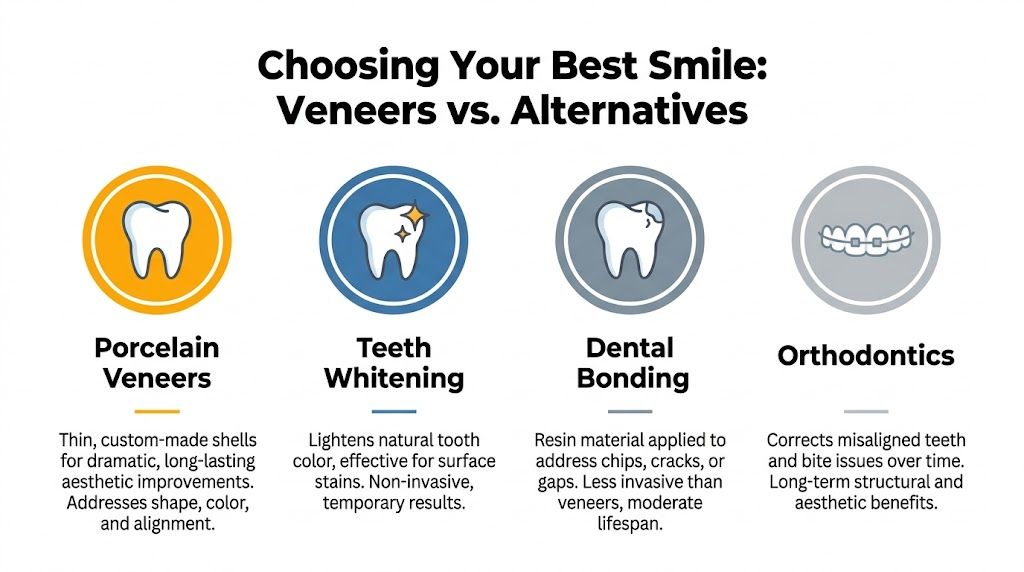
Other options may solve the problem more directly
Veneers sit in the middle of cosmetic dentistry. They can change colour, shape, width, and proportions at the same time. Other treatments are narrower, but sometimes that is exactly what makes them better value.
- Whitening suits teeth that are healthy and well-shaped but darker than you would like.
- Bonding works well for small chips, minor gaps, and edge repairs with minimal removal of tooth structure.
- Orthodontics moves teeth into a better position instead of covering misalignment.
- Crowns rebuild teeth that need more support than a veneer can provide.
If colour is the main concern, read about professional teeth whitening can and can’t change before committing to veneers. Whitening will not lengthen worn teeth or close spaces, but in the right smile it can make a very noticeable difference at a much lower cost.
Patients also ask why fees vary so much between clinics online. Part of that difference comes from how practices present cosmetic treatment, and even effective marketing strategies for dentists can shape what patients expect before they ever sit in the chair. The useful question is simpler. What treatment solves your concern with the least unnecessary dentistry, and what level of finish and longevity are you paying for?
The best cosmetic option is the one that fits the tooth, the smile, and your budget without creating avoidable future problems.
Your Porcelain Veneer Journey at The Smile Spot
A veneer case feels much easier when you know what the process looks like. Most anxiety comes from uncertainty, not from the treatment itself.
It starts with planning, not drilling
The first appointment is usually a design conversation as much as a clinical one. The dentist looks at your teeth, bite, gum levels, existing restorations, and the way your smile sits in your face. Just as important, they ask what you want to change and what you don’t want to lose.
Some patients want a brighter, cleaner version of their natural smile. Others want more symmetry and stronger edges. Those are different goals, and they shouldn’t be treated with the same template.
At this stage, photos, scans, and a detailed examination guide the planning. If there are signs of grinding, uneven wear, or underlying issues that would compromise longevity, those need to be addressed before cosmetic work moves ahead.
Trying the smile before it’s final
One of the most useful parts of modern veneer treatment is the mock-up or trial smile phase. This gives patients a chance to preview shape and proportion before the final porcelain is bonded. It can reveal small details that matter a lot, such as edge length, fullness, and how the teeth look when speaking.
That stage often changes a good plan into a precise one. Patients can react to something they can see instead of trying to imagine it from a verbal description.
A separate but related point is trust. Practices that communicate well tend to make cosmetic treatment smoother because patients understand each step and know why decisions are being made. In healthcare more broadly, that kind of communication matters online too. For anyone interested in how clinics build patient confidence before the first appointment, Titan Blue Australia has a useful piece on effective marketing strategies for dentists that explains why clarity and education shape patient decisions.
To see the veneer process in a simple visual format, this short video is helpful:
Preparation and final placement
Once the design is confirmed, the teeth are prepared conservatively where needed. In many cases, that means only a small amount of enamel adjustment. The exact approach depends on tooth position, shape goals, and material choice. Temporary restorations may be used while the final veneers are being crafted.
At the fit appointment, the veneers are tried in, checked carefully, and bonded once colour, contour, and bite are right. This is the stage patients usually think of as the “before and after” moment, but most of the quality is built in earlier, during planning and design.
The final result should feel natural, not bulky. Speech should be comfortable. The bite should feel balanced. And the smile should look improved without looking disconnected from the rest of the face.
A strong veneer result doesn’t announce itself as dental work. It reads as healthy, even, believable teeth.
Making Your New Smile Affordable With Payment Options
The cost of porcelain veneers is real, and for many people it’s the main obstacle. That doesn’t mean treatment is out of reach. It means the planning should be financial as well as clinical.
A good starting point is to think of veneers as a staged decision, not a snap purchase. The first step is a proper assessment and written treatment plan. Once you know the scope of treatment, it becomes much easier to weigh whether the timing and budget make sense.
Health funds and itemisation
Cosmetic dentistry and health fund cover don’t always line up neatly. Veneers are often considered cosmetic, which means rebates may be limited or may not apply in the way patients hope. The important part is not to assume either way. The exact answer depends on your policy, annual limits, and whether any part of the treatment relates to broader dental needs rather than appearance alone.
Practically, patients should ask for:
- A written treatment plan: This helps you understand what is being proposed and why.
- Itemised fees: You can see whether there are separate components beyond the veneers themselves.
- Health fund checking: Your clinic can often help clarify what may or may not attract a rebate.
Payment plans can change the timing
For many families and professionals, the issue isn’t whether veneers are worth doing. It’s whether the full fee can be managed comfortably in one hit. Payment plans can help spread the cost into more manageable amounts, which often makes elective treatment easier to approach.
That doesn’t make veneers cheap, but it can make them practical. If you’re comparing clinics, look beyond the headline price and ask what flexibility exists around scheduling and staged payments. Patients who want to explore that path can learn more about dentists with payment plans near me to understand what questions are worth asking before they commit.
Value matters more than the lowest quote
This is the point where many people get tempted by a bargain. That’s understandable. Veneers are discretionary for most patients, and everyone wants to spend wisely.
Still, low pricing can hide compromises. The material may be less refined. The planning may be minimal. The result may look acceptable on day one but age poorly in shape, colour, or fit.
A better way to judge value is to ask:
- Is the diagnosis sound? The treatment should suit your teeth, not just your wishlist.
- Is the cosmetic plan personalised? Shape and shade should be chosen for your face and smile.
- Is the fee transparent? You should understand what’s included.
- Is there a maintenance plan? Long-term success depends on review and care, not only placement.
If the answers are clear, the investment usually feels more rational. You’re not paying merely to make teeth look whiter. You’re paying for a carefully planned result that should still make sense years later.
Frequently Asked Questions About Veneers and Cost
Can I get just one or two porcelain veneers?
Yes, sometimes you can. A single veneer or a small number of veneers can work well when the problem is isolated, such as a chipped tooth, a discoloured tooth, or one tooth with an irregular shape.
The challenge is matching. One veneer beside natural front teeth can be harder to perfect than a broader smile design because the new porcelain has to blend perfectly with neighbouring enamel. That’s why small cases can still demand high-level planning.
Are porcelain veneers worth the extra cost over composite?
They can be, especially if you want a highly polished cosmetic result and stronger long-term stability. Porcelain tends to hold its colour better and offers a more refined surface and translucency.
Composite still has a valid place. It’s often chosen when budget matters most, when a patient wants a more conservative starting point, or when the cosmetic issue is relatively minor. The right answer depends on priorities, not just price.
How long do porcelain veneers last?
The verified Australian cost guidance notes that porcelain e.max veneers last 12.5 years on average, while zirconia lasts over 15 years. Longevity isn’t only about material, though. It also depends on case selection, bonding quality, bite forces, home care, and regular review.
If you want a practical overview of maintenance and lifespan factors, this guide on how long porcelain veneers last is worth reading.
Do veneers need special care?
They don’t need complicated care, but they do need consistent care. Good brushing, flossing, and regular dental visits matter. So does avoiding habits that put excess stress on the veneers, such as biting fingernails, chewing ice, or opening packaging with your teeth.
If you clench or grind, your dentist may also recommend a protective night guard. That’s not an optional extra for some patients. It can be an important part of protecting the investment.
Veneers are durable, but they’re not indestructible. The best-looking work lasts longest when patients treat it like dentistry, not jewellery.
Will health insurance cover porcelain veneers?
Often only partially, and in many cases not at all for the cosmetic component. Cover depends on your policy and the reason for treatment. That’s why it’s important to get a treatment plan and check with your insurer rather than relying on assumptions.
Is a consultation still worth it if I’m not ready yet?
Yes. A consultation gives you something more useful than a rough online estimate. It tells you whether veneers are appropriate, how many teeth may need treatment, whether any preliminary care is needed, and what the actual financial picture looks like.
That clarity helps even if you decide to wait. It’s much easier to plan treatment when you know the difference between what’s urgent, what’s elective, and what will give you the best result.
If you’re ready to get a personalised quote and clear advice on whether veneers are the right fit for your smile, book a consultation with The Smile Spot. You’ll get a personal assessment, transparent recommendations, and practical options for moving forward at a pace that suits you.