You catch your reflection in the bathroom mirror before work, or on the way out to school drop-off, and your eyes go straight to the same tooth every time. Maybe it overlaps. Maybe one front tooth sits slightly behind the others. Maybe your smile looks more crowded in photos than it used to. You’d like to fix it, but the idea of metal braces in adult life feels hard to picture.
That hesitation is common. People want straighter teeth, but they also want to keep speaking comfortably at work, eating normally, and smiling without feeling self-conscious during treatment. In Dulwich Hill and across the Inner West, that often means asking a very practical question: how to fix crooked teeth without braces.
The good news is that traditional brackets aren’t the only path. In many cases, teeth can be improved with clear aligners or cosmetic treatments that reshape what shows when you smile. In other cases, what looks like a simple crooked tooth is part of a larger bite or structural issue, which needs a more careful plan.
What matters most is choosing the right category of treatment for your mouth, not the fastest-looking option on paper. Some treatments move teeth. Some only disguise them. Some are ideal for busy professionals who want discretion. Others suit anxious patients who need a gentler, staged approach.
The Dream of a Straighter Smile Without Braces
A lot of adults assume they’ve missed their chance. They think straightening teeth is something you do in high school, not when you’re juggling meetings, school runs, commutes, or family life. That is not true.
Modern dentistry offers several ways to improve a crooked smile without wearing traditional metal braces. The right option depends on what you’re trying to change. If the issue is mild crowding or spacing, moving the teeth may be realistic with clear aligners. If the teeth are healthy and the concern is mostly cosmetic, veneers, bonding, or subtle reshaping may create the look you want without orthodontics.
A straighter-looking smile and a healthier bite aren’t always the same thing. The first question is never “What treatment do I want?” It’s “What problem am I actually solving?”
That distinction matters. A small twist in one front tooth may be cosmetic. A crowded arch with a bite that feels off may need real tooth movement. A missing tooth or heavily restored tooth changes the conversation again.
Many patients feel relief once they realise they don’t have to work this out on their own. There’s no need to guess from online before-and-after photos or compare yourself to someone else’s treatment.
A useful starting point is to think in three broad groups:
- Teeth that need moving often respond best to clear aligners.
- Teeth that look slightly uneven but function well may be improved with cosmetic masking.
- Teeth with damage, bite problems, or missing neighbours usually need a more detailed restorative plan.
That’s where the next step becomes important.
Your First Step A Comprehensive Smile Assessment
Before choosing aligners, veneers, or anything else, the mouth needs a proper assessment. “Crooked teeth” is a visual description, not a diagnosis. Two smiles can look similar in the mirror and need completely different treatment.
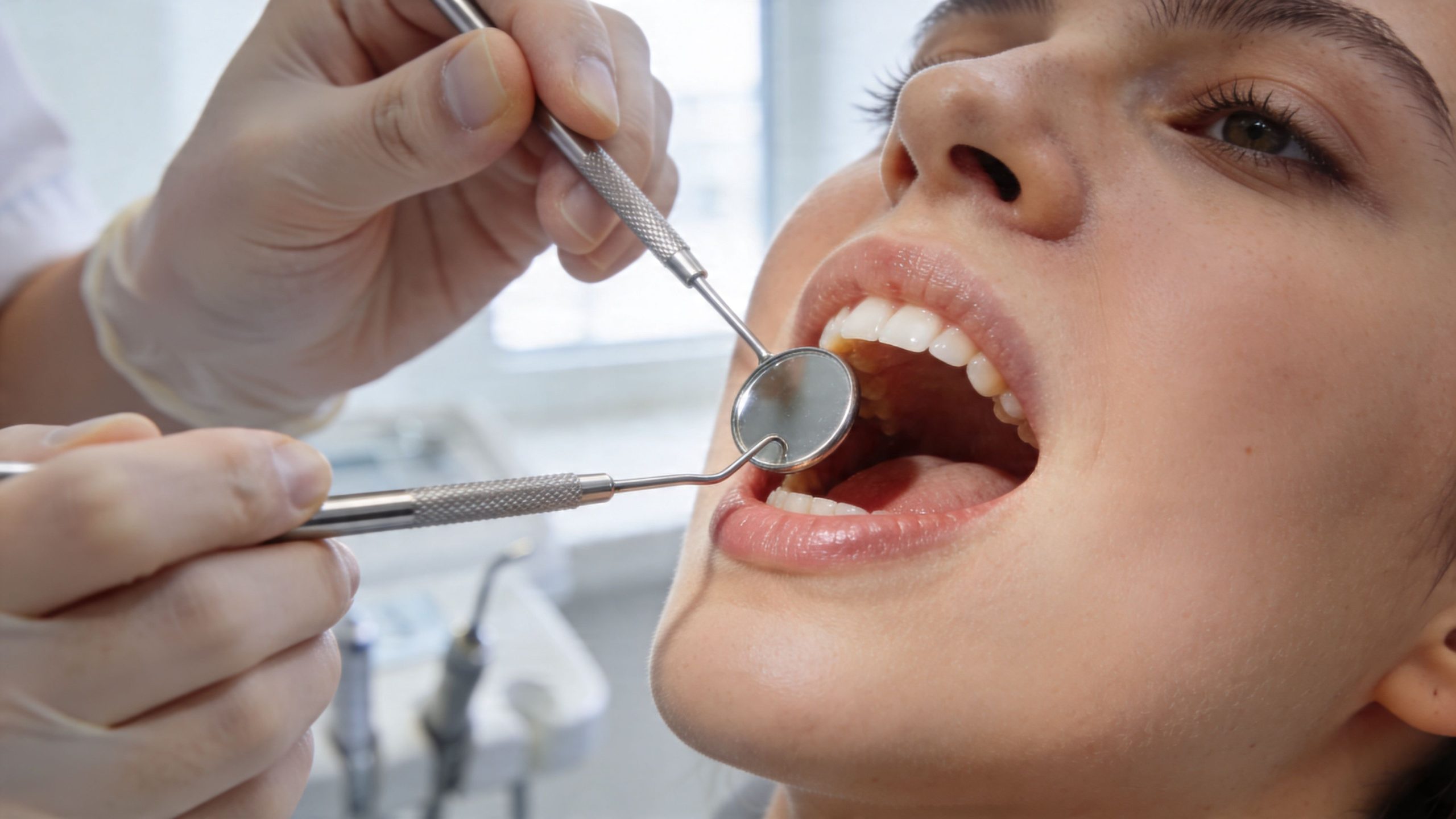
A thorough consultation looks beyond the front teeth. The key questions are whether the teeth fit together properly, whether the gums are healthy enough to support movement or restorations, and whether each tooth is structurally sound. If a tooth is worn, cracked, heavily filled, or affected by gum disease, that changes what’s sensible.
What a proper exam is looking for
A clinical assessment usually focuses on several areas at once:
- Alignment and spacing. Is the issue mild crowding, a rotated tooth, gaps, or a tooth sitting outside the arch?
- Bite relationship. Do the upper and lower teeth meet in a stable way, or is there pressure that could make a cosmetic fix fail?
- Gum and bone support. Healthy gums matter before any straightening or restorative work.
- Tooth strength. A chipped, root-treated, or weakened tooth may need protection as well as aesthetic improvement.
Patients often arrive thinking one front tooth is the whole story. Sometimes it is. Sometimes that tooth is compensating for a deeper bite problem.
Why self-diagnosis usually gets it wrong
Online comparisons can be misleading because cosmetic treatments and orthodontic treatments solve different problems. Veneers can make teeth look straighter from the front, but they don’t reposition roots or correct the way teeth bite together. Clear aligners can move teeth, but they aren’t the answer for every heavily restored or structurally compromised tooth.
Practical rule: if your teeth look crooked and your bite feels uncomfortable, don’t start with a cosmetic shortcut.
That’s also why routine care matters before planning elective treatment. A recent check-up and clean often reveals whether the foundation is healthy enough for the next step, or whether the mouth needs stabilising first.
What patients usually want from this visit
Many don’t want a lecture. They want clarity. They want to know:
- Is this mainly a cosmetic issue or a functional one?
- Can it be improved without braces?
- What’s the trade-off between speed, durability, and cost?
- Will the result feel natural, or just look different?
A good assessment answers those questions before any treatment starts. That’s what makes the rest of the decision much easier.
Discreet Straightening With Clear Aligners
A common Dulwich Hill scenario is this: you want straighter front teeth, you do not want metal braces, and you still need treatment to fit around work, family, and everyday life. Clear aligners are often the option that best suits that balance.
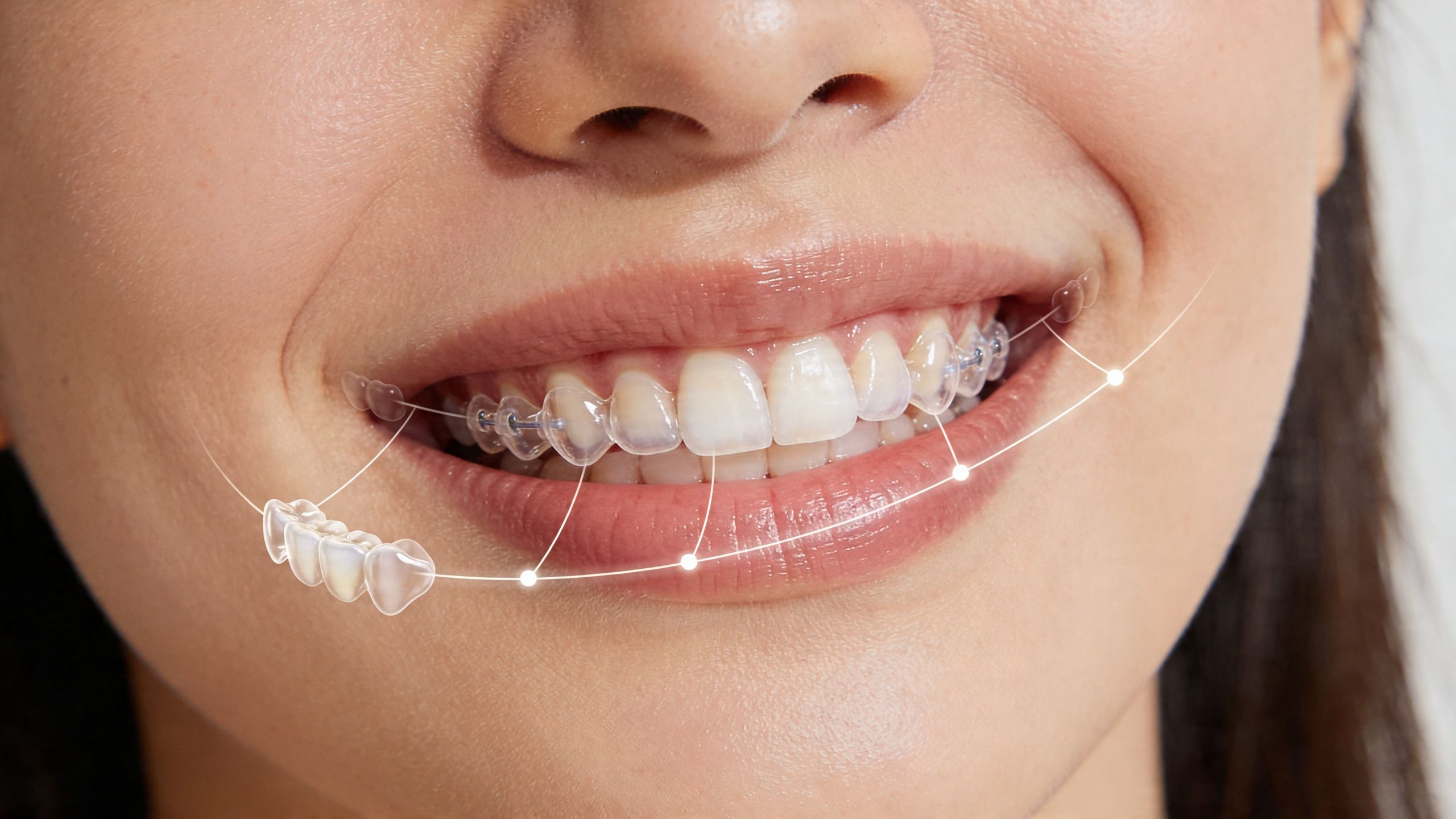
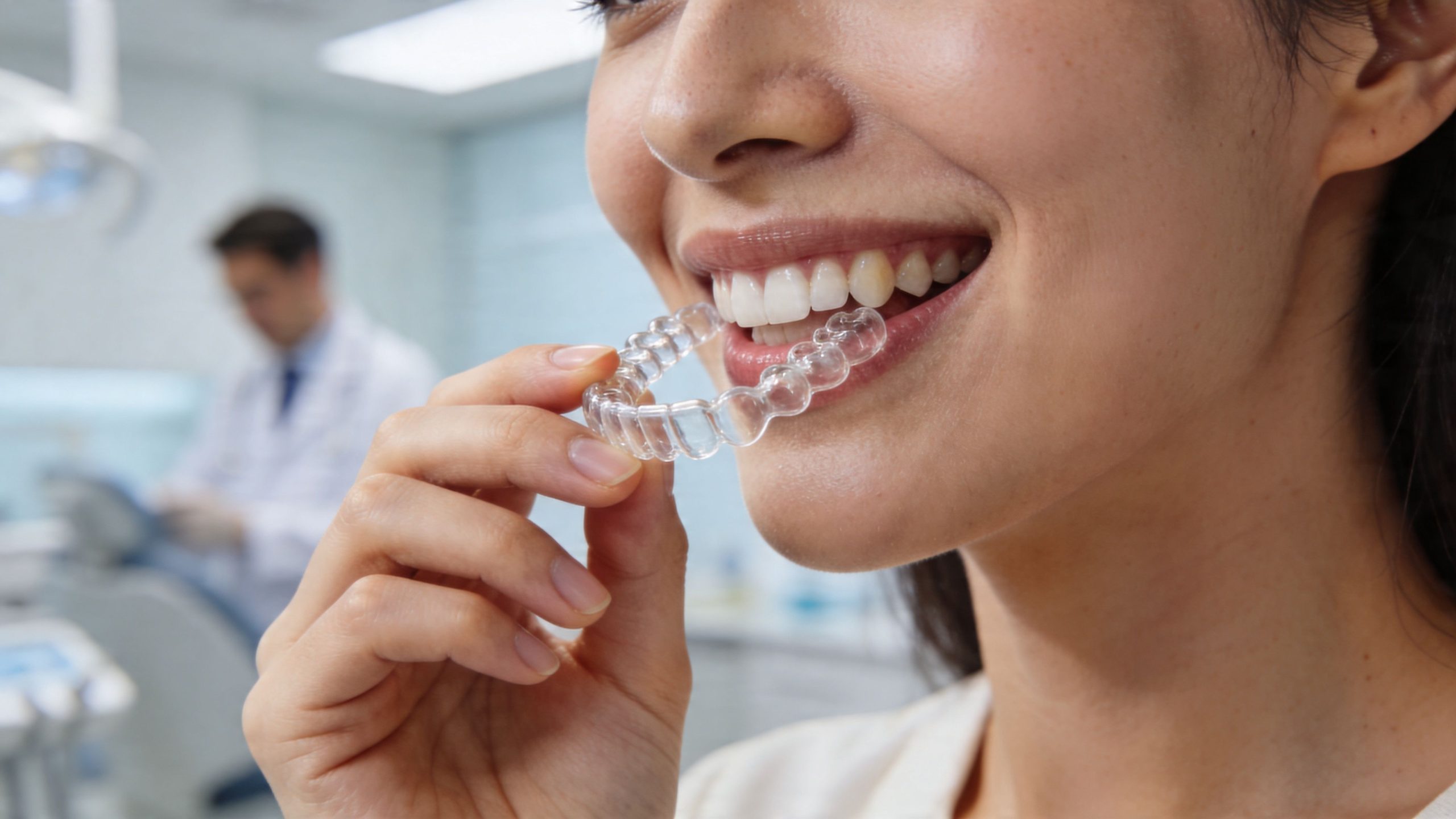
They move teeth gradually with a series of custom trays rather than fixed brackets and wires. For adults who want a low-profile treatment, that matters. The aligners are clear, removable, and usually easier to manage in professional and social settings.
How aligners actually work
Treatment starts with a digital scan, which lets us plan each stage of movement with much more precision than old-style moulds. A series of aligners is then made to shift the teeth step by step. Each tray is worn for a set period before changing to the next one.
The routine is simple, but it does ask for consistency. Aligners need to be worn for most of the day and night, coming out for meals, coffee if needed, and brushing and flossing. That removability is one of their strengths. You can eat normally, keep your teeth cleaner, and avoid the food restrictions that often frustrate adults with fixed appliances.
Who tends to suit aligners well
Clear aligners usually work best for mild to moderate crowding, spacing, and front-tooth alignment issues. They suit patients who care about discretion and can stick to the plan day after day.
In practice, the best candidates often include:
- adults with busy public-facing jobs who want a less visible option
- patients with minor to moderate overlap or spacing in the smile zone
- people who are organised enough to wear trays as instructed
- anxious patients who prefer a gentler treatment experience without brackets and wire adjustments
They are less predictable for significant bite problems, major crowding, or cases where teeth are heavily restored and need structural planning as well as alignment.
That is usually the point where the question changes from “Can I straighten these teeth without braces?” to “What is the right sequence of treatment?”
What treatment feels like day to day
Most patients describe clear aligners as pressure rather than pain. A new tray can feel tight for a day or two. After that, it usually settles.
For Inner West patients, the bigger issue is often convenience. Can you wear them through a long workday? Can you manage meals out, school pick-up, or travel? For many people, the answer is yes, provided they build the routine early. If budget planning is part of the decision, this guide to an Invisalign payment plan can help you understand the practical side before you commit.
A short visual overview can help if you’re still trying to picture the process:
Understanding the Trade-Offs
Clear aligners are discreet and effective in the right case, but they are still orthodontic treatment. They take time. They require daily wear. They also depend on accurate diagnosis, because straightening the visible front teeth is not enough if the bite underneath is unstable.
Experience is paramount. Some patients only need controlled tooth movement. Others need us to slow down and deal with gum health, worn edges, clenching, or a compromised tooth before any alignment starts. If soft tissue treatment is part of making that process more comfortable, Biolase can be useful for selected procedures because it allows precise, gentle laser care.
Cost is another practical factor. Aligners are often a worthwhile option for patients who want to move their natural teeth rather than mask the problem cosmetically, but they are still an investment in both time and money.
What happens after the last tray
The last aligner is not the end of treatment. Teeth can drift back if they are not held in their new position, so retainers are part of the plan from the start.
That matters more than many people expect.
Patients who do well long term are usually the ones who treat retention as routine maintenance, not an optional extra. Clear aligners can be an excellent conservative choice for the right smile, but if the underlying problem is more structural, or if teeth are missing or failing, a broader plan may be more appropriate than aligners alone. In those situations, options such as full-arch rehabilitation, including All-on-4 for suitable cases, may be the more realistic answer than trying to force a cosmetic fix.
Cosmetic Solutions For Instant Smile Enhancements
A common Dulwich Hill scenario is wanting your smile to look straighter before a wedding, a job change, or a run of client meetings, without wearing aligners for months. In that situation, cosmetic dentistry can improve how teeth look quickly, provided the teeth and bite are already stable enough for that approach to make sense.
These treatments change what people see. They do not move the roots or correct the way the upper and lower teeth meet. For the right patient, that is perfectly reasonable. For the wrong patient, it becomes camouflage over a problem that still needs attention.
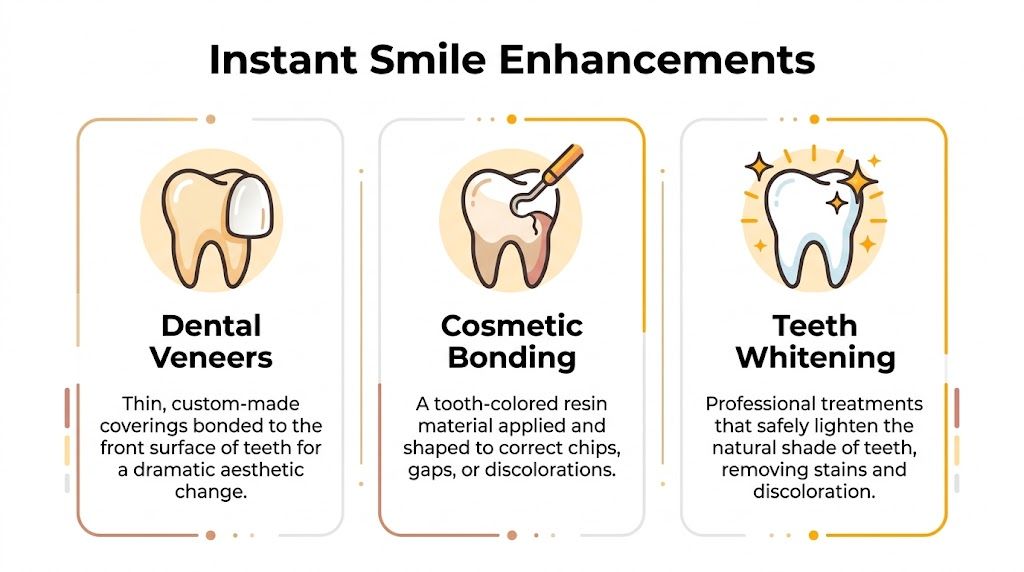
Veneers, bonding, and reshaping each solve a different problem
Porcelain veneers
Veneers are thin porcelain coverings bonded to the front surface of the teeth. They suit cases where the front teeth look uneven because of shape, size, colour, mild rotation, or small spaces. They can make several teeth look more balanced in a relatively short treatment sequence, which appeals to patients who want a polished result without visible orthodontics.
The trade-off is commitment. Veneers usually involve preparing the tooth, and they are best chosen when the result you want is cosmetic improvement across the smile line rather than correction of a bite problem.
Composite bonding
Bonding uses tooth-coloured resin to add or refine small areas of a tooth. It works well for chipped edges, little gaps, slightly irregular contours, or a single front tooth that draws too much attention.
I often recommend bonding for patients who want a conservative change first. It is usually quicker and less invasive than veneers. It also tends to need more maintenance over time, especially if you clench, drink a lot of coffee, or want the surface to stay highly polished.
Tooth reshaping
Tooth reshaping removes a very small amount of enamel to improve contour. It can soften a pointed edge, level a minor irregularity, or reduce the appearance of one tooth sitting out of line because of its shape.
Its role is narrow, but useful. If the problem is tiny, reshaping can be the simplest answer.
Cosmetic treatment can make teeth look straighter. It does not replace tooth movement when the position of the teeth is the real issue.
The practical trade-offs matter
For busy professionals in the Inner West, the attraction of bonding or veneers is often speed and discretion. There are no trays to wear and no obvious sign of treatment in day-to-day life. For anxious patients, these options can also feel more manageable because treatment is short and localised. If minor gum contouring or soft tissue refinement is part of the plan, Biolase can help us carry out selected procedures with precise, gentle laser care.
Maintenance still needs to be part of the decision.
A single source referenced for this article notes that composite bonding often has a lower upfront cost but may need replacement within 5 to 7 years, while porcelain veneers commonly last around 10 to 15 years and sit at a higher per-tooth cost range. It also reports typical fees of $300 to $600 per tooth for bonding and $1,500 to $2,500 per tooth for veneers, based on Natural Smiles’ overview of ways to fix crooked teeth without braces.
Those numbers are only part of the conversation. The more useful question is what kind of maintenance fits your life. Bonding can be an excellent choice if you are happy to review and refresh it over time. Veneers may suit patients who want a longer-lasting cosmetic result and understand that the treatment is more committed from the start.
Brace-Free Smile Correction Options Compared
| Treatment | Best For | Average Timeline | Estimated Cost (AUD) | Maintenance |
|---|---|---|---|---|
| Clear aligners | Mild to moderate crowding or spacing that needs real movement | 6 to 18 months | $5,000 to $8,000 | Retainers are required after treatment |
| Composite bonding | Small chips, slight gaps, minor visual unevenness | Often short cosmetic treatment | $300 to $600 per tooth | May need replacement in 5 to 7 years |
| Porcelain veneers | Multiple front teeth needing shape, colour, and alignment camouflage | Usually completed over a small number of visits | $1,500 to $2,500 per tooth | Long-lasting, but still needs review and careful maintenance |
| Tooth reshaping | Tiny irregularities in tooth edge or contour | Usually very short cosmetic treatment | Varies by case | Minimal, but only suitable in very small corrections |
When a cosmetic fix is enough
Cosmetic treatment usually makes sense when the bite feels comfortable, the teeth are healthy, and the concern is mainly what shows in photos or conversation. A small gap between two front teeth, one chipped corner, or a tooth that looks slightly twisted because of its shape can often be handled well without moving the teeth.
That is different from trying to mask several crowded teeth or cover a bite that is already under strain. In those cases, the quick option can become the one that needs the most repair.
If you are comparing durability before deciding, it helps to read more about how long porcelain veneers last and what kind of upkeep they involve.
Whitening has a role, but it does not straighten teeth
Whitening can make a smile look cleaner and more even because colour differences stand out less. It can pair well with bonding or veneers, especially when patients want a fresher overall look for work, events, or family photos.
It does not change crowding, spacing, or tooth position. If the main concern is crookedness, whitening is an add-on, not the fix.
A simple way to decide what comes next
These questions usually sort the options quickly:
- Do you want the teeth moved, or do you mainly want them to look more even?
- Is the concern limited to one or two teeth, or does it involve the whole front smile line?
- Would you prefer the most conservative fix, even if it may need more maintenance later?
- Does your bite already feel stable and comfortable?
- Do you want a short cosmetic treatment that fits around work and family, or are you aiming for a more structural long-term result?
Clear answers here save time. They also help avoid choosing a cosmetic shortcut for a problem that really needs a broader plan.
Advanced Options For Complex Structural Needs
Some smiles need more than a cosmetic adjustment. A patient might come in wanting straighter front teeth, but the underlying issue is a cracked molar at the back, a missing tooth that has let others drift, or a bite that has been wearing down enamel for years. In those cases, the right plan starts with function.
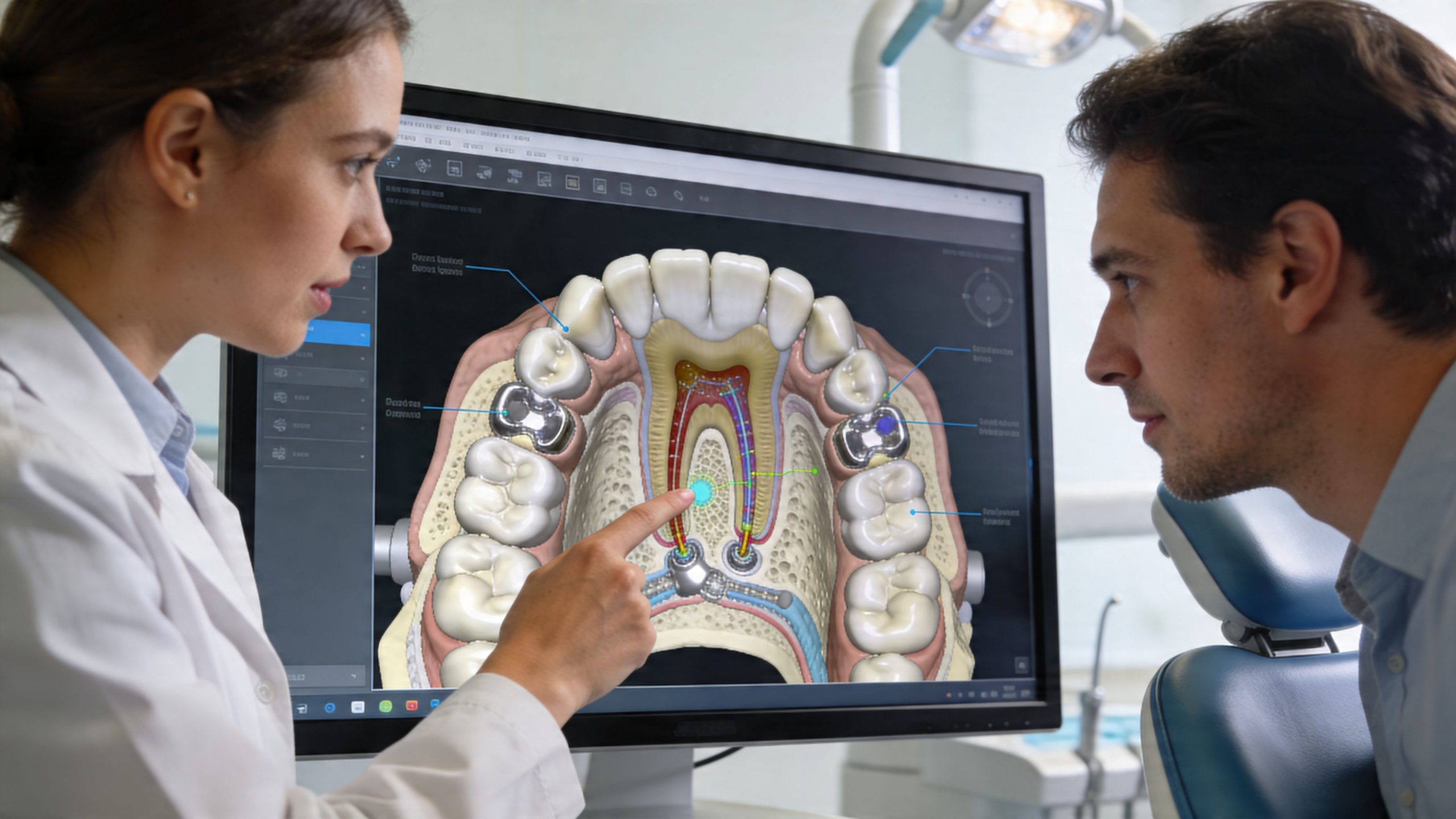
The aim is to get the teeth looking straighter in a way the mouth can support. That may mean restoring damaged teeth, rebuilding a stable bite, or replacing missing teeth before deciding how to refine the appearance.
When a crown changes the conversation
A crown is often the better option for a tooth that is heavily filled, fractured, worn, or structurally weak. In those situations, shape matters, but strength matters first.
A well-planned crown can improve how a tooth sits within the smile line and how it meets the opposing tooth. It does not move the root or solve crowding across the arch. It does restore a tooth that may not be a good candidate for bonding or a veneer.
This is usually the point where treatment stops being about one uneven tooth and starts being about how the whole bite works.
Why veneers are not always the right shortcut
Veneers can improve shape, size, and colour very effectively. They are less suitable when teeth are sitting in the wrong positions and the bite is already under pressure.
I tell patients this plainly. Covering crowded or twisted teeth may make the front look neater in photos, but it can leave the underlying forces unchanged. If the bite is unstable, those forces still have to go somewhere, and the restored teeth often wear that burden.
That is why some patients need tooth movement first, while others need restorative treatment instead of cosmetic camouflage.
Missing teeth, implants, and full-arch planning
A missing tooth changes more than the gap you can see. Neighbouring teeth can tilt or drift, the opposing tooth can over-erupt, and the bite can become less balanced over time.
For some patients, creating or protecting the right space is part of planning for an implant. For others with multiple failing or missing teeth, a broader rebuild may be more realistic than trying to straighten isolated teeth. If you are weighing up replacement options, our guide on whether dental implants are worth it explains the main pros, limits, and long-term considerations.
In more advanced cases, All-on-4 can be part of that discussion. It sits well beyond the usual aligner-or-veneer decision and is considered when the problem is widespread tooth loss, failing dentition, or a bite that cannot be predictably stabilised with smaller fixes.
Comfort still matters with complex care
More involved treatment can feel like a lot, especially for anxious patients or anyone trying to fit appointments around work and family life in the Inner West. The plan has to be clinically sound, but it also has to be manageable.
Biolase laser technology can help in procedures where soft tissue precision and a gentler approach are useful. For patients who are nervous about longer visits or more invasive care, careful sequencing and sedation options may also make treatment much easier to handle.
At The Smile Spot, that practical side of planning matters. A busy professional may need discreet staged treatment with fewer disruptions. An anxious patient may need shorter visits, clearer steps, and a slower pace. Those details often shape which option is most appropriate.
Signs a broader treatment plan may be the better fit
A wider plan is worth discussing if any of these apply:
- Your bite feels uneven or uncomfortable when you chew or close.
- A tooth is missing, breaking down, or likely to fail, not just sitting out of line.
- Several teeth are crowded, worn, heavily restored, or damaged.
- You want a result that lasts well under daily function, not only a cosmetic improvement at the front.
The key question is what the mouth needs next. Sometimes that is a simple cosmetic fix. Sometimes the straightest-looking answer is not the healthiest one.
Maintaining Your New Smile and Long-Term Care
Getting a straighter smile is only half the job. Keeping it stable is what protects the time, cost, and effort you’ve already put in.
For aligner patients, the biggest issue is relapse. Teeth can shift back if retainers aren’t worn as instructed. This isn’t a minor detail after treatment. It’s part of treatment.
If you had clear aligners
Retainers matter because the teeth need ongoing support in their new positions. The early period after movement is especially important.
A simple maintenance routine usually includes:
- Wearing retainers exactly as advised. Don’t reduce wear on your own timeline.
- Cleaning retainers properly. A clean retainer sits better and is more comfortable to wear.
- Attending review visits. Small changes are easier to manage when noticed early.
If you chose veneers or bonding
Cosmetic work needs protecting too. Bonding can stain and chip. Veneers are durable, but they still need care.
Useful habits include:
- Being mindful with staining drinks like coffee and tea, especially with bonding.
- Avoiding nail biting and chewing hard objects that can damage edges.
- Keeping up with daily hygiene so the teeth and gums around restorations stay healthy.
Long-term view: the most beautiful result is the one that still works well years later.
Why regular maintenance visits still matter
Whether you’ve had aligners, bonding, veneers, crowns, or implant treatment, regular check-ups and cleans are what help preserve the result. These visits let a dentist monitor movement, assess restorations, and catch small changes before they become expensive problems.
That’s especially important when treatment was done to correct mild crookedness. Small aesthetic improvements can remain stable for a long time, but only if the surrounding teeth, gums, and bite stay healthy.
A straight smile should still feel easy to clean, comfortable to bite with, and natural in daily life. If it doesn’t, it’s worth checking early rather than waiting for the issue to become more obvious.
Start Your Smile Journey at The Smile Spot in Dulwich Hill
There isn’t one universal answer to how to fix crooked teeth without braces. Some smiles need genuine tooth movement. Some only need cosmetic refinement. Some need a staged plan because the teeth, gums, and bite are all part of the picture.
That’s why the first appointment matters so much. It gives you a realistic sense of what will work, what won’t, and what trade-offs come with each option. For one person, clear aligners may be the most conservative path. For another, bonding or veneers may be enough. For someone with missing teeth or a failing bite, a broader restorative plan may make more sense.
Patients in Dulwich Hill often want something practical. They want discretion, comfort, and a plan that fits around real life. They also want honesty. If a quick cosmetic fix is likely to create trouble later, it’s better to know that upfront.
For local patients, booking with a Dulwich Hill dentist is the easiest way to get a personalised assessment based on your teeth, your goals, and your comfort level. That includes options for anxious patients, gentle care with modern technology, and planning that takes both appearance and long-term health into account.
A straighter smile without traditional braces is often possible. The key is choosing the option that suits your mouth, not just the one that sounds fastest.
If you’re ready to find out which brace-free option fits your smile, book a consultation with The Smile Spot. A personalised assessment can show whether clear aligners, cosmetic treatment, or a more extensive restorative plan is the right next step for you.