Some people start looking into All-on-4 after one bad meal. You avoid the crunchy foods, chew on one side, and hope nobody notices when your denture shifts as you speak. Others get there after years of patching one tooth after another, only to realise they are spending more time and money maintaining failing teeth than enjoying them.
If that sounds familiar, you are not alone. Full-arch tooth replacement can feel like a big, technical subject. It also feels personal. You want to know what it is, how it works, whether it will hurt, how long it lasts, and what it may cost in Sydney.
The simple answer to what is all-on-4 dental implants is this. It is a way to replace a whole row of missing or failing teeth with a fixed set of teeth supported by four dental implants. For many people, it offers a more stable and natural-feeling option than removable dentures.
Reclaiming Your Smile With an Advanced Solution
A lot of people in Sydney's Inner West reach this point. You stop biting into a crusty roll at lunch in Newtown. You choose the softer option when you eat out in Leichhardt. You smile in photos, but a little more carefully than you used to.
When several teeth are missing or failing, the problem rarely stays inside your mouth. It affects what you eat, how clearly you speak, and how relaxed you feel around other people. If you wear a denture, you may also be planning your day around comfort, adhesive, and the worry that it could shift at the wrong moment.
All-on-4 offers a more stable way to rebuild a full smile. Instead of replacing teeth one by one, it supports a complete arch of fixed teeth on four carefully placed implants. The goal is simple. Give you teeth that feel secure enough for everyday life again.
That matters because people usually want the practical benefits first. They want to chew without hesitation, talk without feeling self-conscious, and stop thinking about their teeth every time they leave home. Confidence often comes back after that, once your mouth feels dependable again.
You might also be wondering whether this treatment is mainly for older people who already have dentures. It is not. Many patients still have natural teeth when they first ask about All-on-4, but those teeth may be worn down, loose, repeatedly breaking, or affected by advanced gum disease. In some cases, replacing the full arch is the steadier long-term option than continuing a cycle of repairs.
For Inner West patients, there is another layer to the decision. You are not only asking what All-on-4 is. You are also asking what it may cost in NSW, whether your private health fund may help with parts of treatment, how healing fits around work and family, and where to find a team that explains the process clearly. Those are sensible questions, and they should be part of the conversation from the start.
Why this treatment gets attention
All-on-4 draws interest because it addresses several day-to-day problems at once:
- It replaces a full arch of teeth rather than dealing with one failing tooth at a time.
- It is fixed in place, so it does not need to be removed like a traditional denture.
- It can improve comfort with eating and speaking, which many patients find helps them feel more like themselves again.
- It often allows for provisional teeth soon after implant placement, so you are not left feeling toothless during treatment.
If you want to see what implant treatment can look like in real life, these dental implants before and after examples can make the outcome easier to picture.
At The Smile Spot, that discussion also includes the tools used to support healing, such as Biolase laser technology, and how your treatment plan is designed for your bone, bite, and goals rather than treated like a one-size-fits-all fix.
A good All-on-4 consultation should leave you understanding the procedure, the likely costs, the healing process, and whether it suits your mouth, your health, and your goals.
Understanding the All-on-4 Concept
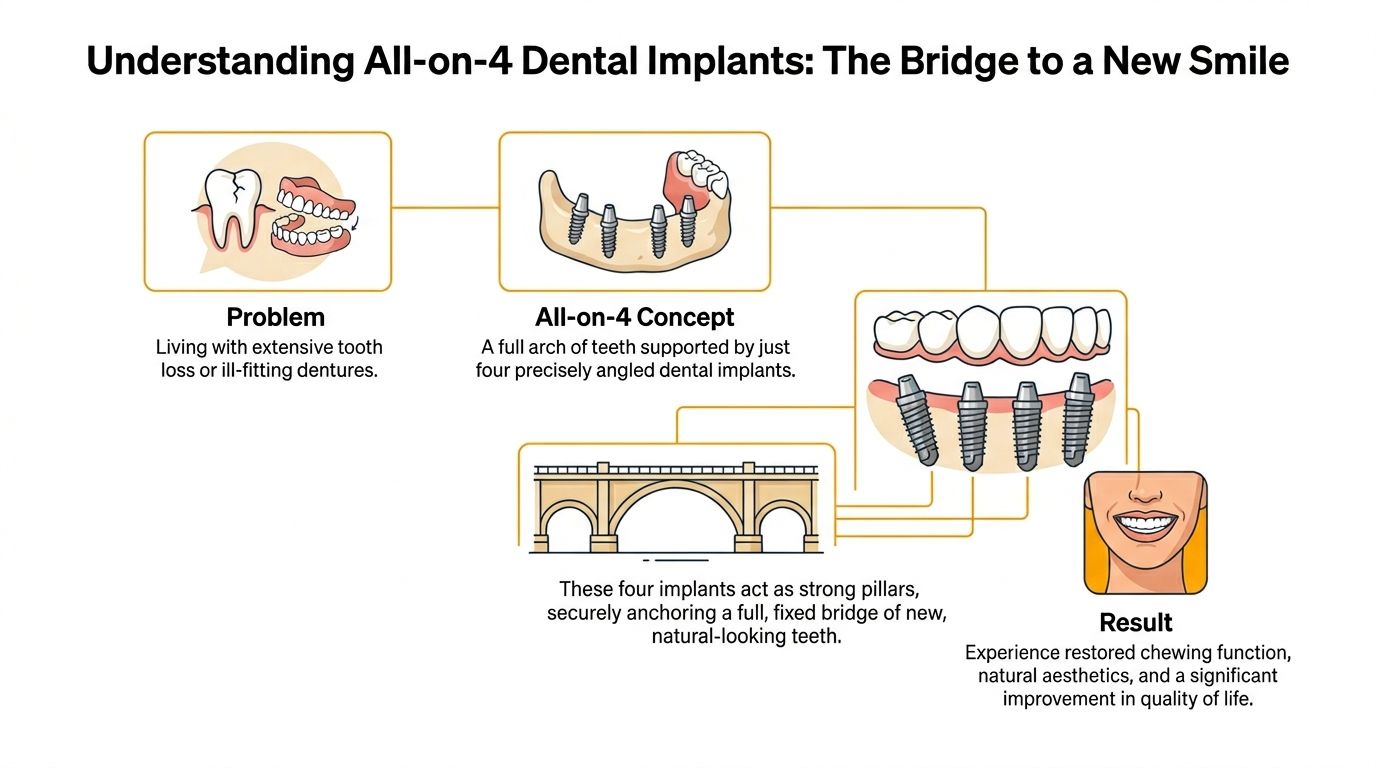
All-on-4 works like a bridge supported by four strong pillars.
The bridge is your new full arch of teeth. The pillars are the four implants placed into your jawbone. Rather than putting an implant under every missing tooth, the dentist uses four titanium implants in strategic positions to support the whole set.
Why only four implants can support a full arch
Many people get confused here. It sounds surprising that four implants can hold an entire row of teeth.
The reason is placement. The All-on-4 technique strategically places four titanium implants, two vertically in the anterior jaw where bone density is highest and two posteriorly at a 30-45 degree angle, to support a fixed prosthesis of 10-14 teeth, maximising bone utilisation and often eliminating bone grafting needs, as described in this clinical overview of the technique from the PMC article on the All-on-4 concept.
The angled back implants are the clever part. They help the dentist use available bone more effectively and avoid important anatomical structures such as the sinus area in the upper jaw or the nerve canal in the lower jaw.
The two main parts
It helps to think of All-on-4 as having two separate components.
| Component | What it is | What it does |
|---|---|---|
| Implants | Small titanium posts placed in the jaw | Act like artificial tooth roots and anchor the arch |
| Prosthesis | The custom-made full arch of teeth | Restores your smile, bite, and appearance |
The implants are hidden under the gums. The visible part is the bridge of teeth attached to them.
Why the angled implants matter
With traditional approaches, some people need bone grafting before implants can be placed. That adds treatment steps and healing time.
All-on-4 often avoids that because the rear implants are tilted into stronger available bone. That design is one of the reasons this treatment is so widely discussed for people with some degree of bone loss.
A few key ideas make the concept easier to grasp:
- Front bone is often denser: This gives the straight front implants a stable base.
- Rear implants are angled: This improves support while working around anatomy.
- The bridge spreads chewing forces across the arch: You do not need one implant per tooth.
- Everything is planned as one system: Implants, bite, bridge shape, and long-term maintenance all matter.
What it feels like in real life
From a patient’s point of view, the biggest difference is that the teeth are fixed. You do not remove them at night. You clean around them carefully, but they stay in place.
That fixed feeling is why many people describe All-on-4 as much closer to having real teeth than wearing a traditional denture.
Your All-on-4 Treatment Timeline From Start to Finish
The treatment feels much less overwhelming when you break it into stages. Most patients do best when they know what happens first, what happens on surgery day, and what healing looks like afterwards.
Step one is consultation and digital planning
The first appointment is about diagnosis, not pressure.
Your dentist examines your teeth, gums, bite, and medical history. If you still have teeth, the conversation usually centres on whether they are maintainable or whether a full-arch replacement would give you a better long-term result. Imaging is then used to assess bone levels and plan implant positions precisely.
This planning stage matters because All-on-4 is not guesswork. Implant angle, bone availability, and the future shape of the prosthetic teeth all need to line up.
Common questions at this stage include:
- Will I need teeth removed first
- Do I have enough bone
- Can I have treatment if I am anxious
- Will I be asleep or awake
- How long before I can eat normally
If dental treatment makes you nervous, it can help to learn about comfort options in advance, including full anesthesia dentist care and when it may be considered.
Step two is the procedure day
This is the part many people worry about most. In reality, it is usually far more organised and controlled than patients expect.
If failing teeth are still present in the arch, they may be removed. The implants are then placed into the planned positions. Two usually go toward the front of the jaw and two toward the back at an angle.
A major feature of All-on-4 is immediate loading. That means a functional provisional prosthesis can often be delivered within 24 hours of surgery, according to the Nobel Biocare All-on-4 treatment concept manual. In plain language, many patients leave with a fixed temporary set of teeth very quickly instead of waiting months without teeth.
Here is the video many patients find useful before a consultation:
What “same-day teeth” really means
This phrase creates a lot of confusion.
It does not usually mean your final permanent bridge is fitted on day one. It means you are often given a fixed provisional set of teeth soon after surgery so you can smile, speak, and function during healing.
That temporary bridge is important. It lets you get through the healing phase with dignity and confidence while protecting the implants and soft tissues.
Same-day teeth are real teeth for real daily function, but they are usually the provisional stage, not the final long-term bridge.
Step three is early healing
After surgery, your body begins the process of osseointegration, which means the bone bonds with the implant surface.
During this period, your dentist usually recommends a softer diet and careful cleaning. The exact instructions vary from person to person, but the principle is simple. The implants need a stable healing environment.
Some clinics also use technologies such as Biolase laser dentistry to support soft tissue management and a gentler post-operative experience. For anxious patients or those worried about discomfort, this can be part of a more comfortable treatment plan.
Step four is the final restoration
Once healing is progressing well and the implants are stable, your final teeth are designed and fitted.
This stage is more detailed than many people expect. The dentist looks at:
- Smile appearance
- Tooth shape
- Bite balance
- Speech
- Cleaning access
- Material choice, such as acrylic or zirconia depending on the case
The final prosthesis should not just look good in photos. It should function comfortably in daily life.
What your timeline may feel like
Emotionally, many patients describe the timeline like this:
- Before treatment: Worry, uncertainty, and frustration.
- After planning: Relief, because there is a clear path.
- Right after surgery: Tired, but hopeful.
- During healing: Adjusting to the temporary teeth and new routines.
- After the final fit: A sense that life becomes simpler again.
That is why a good All-on-4 process is never only surgical. It is guided, staged, and closely monitored from beginning to end.
Is All-on-4 the Right Choice For You
Not everyone who asks about All-on-4 is the right candidate. That is normal. The best treatment depends on your mouth, your health, and what outcome you want.
You may be a strong candidate if
All-on-4 is often considered for people who fit one or more of these situations:
- You are missing most or all teeth in one arch
- You wear a denture and want something fixed
- You have several failing teeth with a poor long-term prognosis
- You have some bone loss and have been told traditional implant treatment may be more complex
- You want a full-arch solution rather than multiple individual treatments spread over time
This treatment can be especially helpful when the problem is not just one bad tooth, but an entire arch that is breaking down.
You may need extra assessment if
Some factors do not automatically rule you out, but they do need careful planning.
These can include:
| Factor | Why it matters |
|---|---|
| Smoking | Can raise the risk of implant-related complications |
| Uncontrolled diabetes | May affect healing and infection risk |
| Active gum disease | Needs to be managed before and after treatment |
| Teeth grinding | Can place extra force on the prosthesis |
| General health conditions | May affect surgery planning and recovery |
Good questions to ask at your consultation
A productive consultation is not about being sold a procedure. It is about getting clear answers.
Ask things like:
- Are my remaining teeth worth saving
- Would All-on-4 be better than a partial approach
- Do I have enough bone for this design
- What kind of maintenance will I need
- What are the alternatives in my case
The right candidate is not just someone who wants fixed teeth. It is someone whose dental condition, bone support, health, and expectations all line up with the treatment.
When another option may suit you better
Sometimes another path is more sensible.
If you have only a few missing teeth, a smaller implant treatment or bridge may be enough. If your medical risk is high or your oral hygiene is likely to be difficult long term, your dentist may suggest a different option that is easier to maintain.
The best clinicians are honest about that. Trust usually starts there.
Key Benefits and Important Long-Term Considerations
A lot of Inner West patients ask the same practical question after they understand how All-on-4 works. Will it make daily life easier, and will it still serve me well years from now?
That is the right question to ask.
The main benefit is that All-on-4 gives you a full arch of fixed teeth that is anchored to implants, rather than sitting on the gums like a denture. In day-to-day life, that often means more confidence when you eat with friends in Newtown, speak at work, or laugh without worrying that your teeth may shift. For many people, the change is as much about peace of mind as appearance.
Why many patients find it easier to live with than dentures
A removable denture works like a plate resting on soft tissue. An All-on-4 bridge is secured to implants in the jaw, so the support comes from underneath rather than just from pressure on the gums.
That difference can affect several parts of daily life:
- The teeth stay in place: You do not take them out each night.
- Less rubbing on the gums: Many patients find this more comfortable than a loose plate.
- Speech often feels more natural: There is usually less worry about movement while talking.
- Eating can feel more predictable: A fixed bridge generally gives better stability for chewing.
- Bone loss can sometimes be managed more efficiently: The angled implant design may allow treatment in cases where more extensive grafting might otherwise be discussed.
Long-term performance matters too. Reported long-term outcomes for this treatment have been strong, with a 95 to 98 per cent implant survival rate at 10 years, according to this discussion of long-term success of All-on-4 implants.
Long-term success depends on what happens after surgery
This treatment is fixed, but it is not maintenance-free.
Your bridge still needs to be cleaned carefully, especially underneath where food and plaque can collect. The implants and surrounding gums still need review appointments. The teeth themselves can also wear over time, just like other dental restorations. If something starts to feel rough, loose, sore, or harder to clean, it is much easier to deal with early than after months of irritation.
That is one reason practices that plan carefully for healing and follow-up can make such a difference. At The Smile Spot, technology such as Biolase laser can support gentler tissue management and faster healing in suitable cases, which matters if you want the treatment to feel smoother from the beginning, not just look good at the end.
Local health factors matter in Sydney and NSW
Patients in Sydney's Inner West are not all starting from the same place, and your long-term outlook depends on your own health picture. The Nobel Biocare All-on-4 treatment concept explains the treatment framework often used for full-arch rehabilitation, and it reinforces a point dentists see every day. Success depends on matching the design to the person.
For example, a history of smoking, gum disease, osteoporosis, teeth grinding, or inconsistent dental care does not always rule treatment out. It does mean your planning, maintenance schedule, and material choices may need more attention. In a Sydney practice, that local, individual approach matters far more than a one-size-fits-all promise.
What helps All-on-4 last well
The best way to view All-on-4 is like a high-quality car. The engineering may be excellent, but it still needs servicing if you want it to perform reliably for years.
Long-term success usually depends on:
- Good home cleaning: You need to clean around and under the bridge, not just brush the visible surfaces.
- Regular professional maintenance: Your dentist checks the implants, gums, bite, and prosthesis for early signs of wear or inflammation.
- Managing health risks: Smoking, uncontrolled diabetes, untreated gum disease, and heavy grinding can all affect the result.
- Fixing small issues promptly: A minor adjustment or repair is easier than waiting until damage spreads.
If you want a broader patient-friendly discussion of lifespan and maintenance, How Long Do All On 4 Implants Last? is a useful companion read. For a local overview focused on implant longevity, see our guide on how long dental implants can last with proper care.
A good All-on-4 result is not only about the surgery. It is about how comfortably and confidently your new teeth keep working for you over the years.
All-on-4 Costs and Payment Options in the Inner West
If you live in Sydney’s Inner West, cost is usually one of the first things you want to pin down. That is sensible. Before you commit to treatment, you need to know the likely fee range, what is included, and what your out-of-pocket cost could look like after any health fund benefits.
What All-on-4 usually costs in NSW
In NSW, the cost for All-on-4 typically ranges from $25,000 to $40,000 per arch, and eligible patients may receive 50 to 70 per cent back for specific item numbers through private health funds, according to Aspen Dental’s overview of All-on-4 dental implant costs and rebates.
That is a broad range because full-arch treatment is not a single fixed product. Your fee can change based on whether teeth need to be removed first, the type of final bridge selected, the imaging required, whether sedation is planned, and how much design and laboratory work goes into your new teeth.
For Inner West patients, the most helpful question is not only “What is the price?” but “What does that figure cover?”
What a quote should include
Two clinics can both say “All-on-4”, yet the quotes may cover different parts of treatment. One may bundle everything into a single figure. Another may list the surgery first, then add the temporary teeth, final bridge, or sedation later.
Ask for a written breakdown that clearly states whether the fee includes:
- Consultation and diagnostic records
- Implant placement surgery
- Temporary fixed teeth
- Your final full-arch bridge
- Review visits after surgery
- Sedation or theatre fees, if those apply to your case
This is a bit like comparing two renovation quotes for the same kitchen. The cheaper quote is not automatically better if it leaves out the cabinetry, appliances, or installation.
How private health funds usually fit in
Private health insurance can help in some cases, but the rebate is rarely as simple as patients expect. Cover depends on your policy, annual limits, waiting periods, the item numbers claimed, and whether implants, prosthetics, or both are included.
Pre-authorisation matters here. If your provider has not confirmed what they will contribute before treatment starts, the gap can be larger than expected.
For a more local explanation of pricing, inclusions, and the questions to ask before you sign anything, see our guide to All-on-4 dental implant costs in Australia.
Payment options that can make treatment easier to manage
Very few patients treat this as a casual expense. Most plan for it carefully, especially if they are balancing family costs, work, and other medical bills.
Common options include:
| Option | What to ask |
|---|---|
| Private health fund | Does my policy pay towards both implant surgery and the final prosthesis? |
| Payment plans | Can payments be spread across the planning, surgery, and final-teeth stages? |
| Finance options | What are the interest rates, fees, approval steps, and total repayment amount? |
At The Smile Spot, patients in the Inner West often also want to know whether newer technology affects value, not just price. Tools such as Biolase laser treatment may support gentler healing in selected cases, which can matter if you are trying to minimise downtime and get back to normal life sooner.
If you are still weighing whether a fixed implant option is worth the higher upfront investment, this article on comparing dental implants to dentures can help frame the day-to-day trade-offs.
Clear financial planning builds confidence. You should leave your consultation knowing the likely fee range, what is included, what your fund may contribute, and how the payment schedule will work for you.
Comparing All-on-4 to Dentures and Traditional Implants
If you are choosing between dentures, traditional full-arch implants, and All-on-4, it helps to focus on one simple question first. Do you want teeth that come out, or teeth that stay in place?
That question shapes almost everything else. How you eat. How your teeth feel when you speak. How much surgery may be involved. How treatment fits into your budget and your day-to-day life here in Sydney’s Inner West.
The big-picture differences
A conventional denture sits on top of the gums. It can restore appearance and basic function without surgery, which is why some patients still prefer it. But because it is not fixed to the jaw, it can shift, rub, or feel less secure with harder foods.
Traditional full-arch implant treatment also gives you fixed teeth, but it usually uses more implants across the jaw. That can be an excellent option in the right mouth, particularly if bone volume, bite forces, and treatment goals support a more extensive plan.
All-on-4 sits between those two approaches in a very practical way. It uses four implants to support a full fixed arch, and the back implants are often placed at an angle to make better use of the bone you already have. For many Inner West patients, that matters because it may reduce the need for extra procedures and can simplify the treatment plan without giving up the goal of fixed teeth.
If you would like a broader patient guide on comparing dental implants to dentures, that resource explains the everyday trade-offs in plain language.
All-on-4 vs alternatives at a glance
| Feature | All-on-4 Implants | Traditional Full Implants (6-8) | Conventional Dentures |
|---|---|---|---|
| How it is supported | Four implants support a full fixed arch | More implants support a full fixed arch | Rests on gums, removable |
| Feel in daily life | Fixed and stable | Fixed and stable | Can move or rub |
| Bone grafting | Often avoided because rear implants are angled | More likely to be needed in some cases | Not applicable |
| Treatment pace | Often allows a provisional bridge very quickly | May involve more stages depending on the case | Usually quicker initially |
| Cleaning and maintenance | Daily cleaning and professional reviews required | Daily cleaning and professional reviews required | Must be removed and cleaned |
| Surgery involved | Implant surgery for one arch on four implants | Implant surgery with more implants | No implant surgery |
| Best for | Patients wanting a fixed full-arch solution with fewer implants | Patients suited to a more extensive implant approach | Patients wanting a removable non-surgical option |
How patients usually weigh the decision
Dentures often appeal to patients who want the lowest upfront cost and no implant surgery. The trade-off is that daily life can feel less predictable. Foods like steak, apples, or crusty bread may become harder to manage, and some people never fully get used to the movement.
Traditional full-arch implants can suit patients who want a highly customised fixed result and are comfortable with a broader surgical plan. In some cases, they also involve more healing stages.
All-on-4 is often the option patients ask about when they want a fixed smile, but also want to keep the treatment efficient and grounded in what is realistically achievable. It is a bit like rebuilding a house on well-placed supports instead of adding extra posts everywhere. The planning has to be precise, but the design can still be strong and practical.
Cost is part of this comparison too, especially in NSW where fee ranges, health fund rebates, and staging can affect what feels realistic for your household. If affordability is one of your main concerns, it can help to review dentists with payment plans near me before your consultation so you know what questions to ask.
The best option is the one that matches your health, your goals, and what you want your everyday life to feel like after treatment.
Why Choose The Smile Spot for Your All-on-4 Journey
Choosing All-on-4 is a big decision. Choosing the team who plans and delivers it matters just as much.
Patients in Dulwich Hill and the Inner West often want three things from a clinic. Experience, clear communication, and a comfortable treatment process. The Smile Spot brings those together through long-standing clinical leadership under Dr. Dimitrios Thanos, a principal dentist who has served patients since 1996, along with modern tools such as Biolase laser dentistry and sedation options for anxious patients.
That combination matters in full-arch care. You want careful planning, a calm environment, and a team that explains things in plain English. You also want practical support around fees and staging, especially for a treatment that can feel daunting at first.
If affordability is part of your decision, it is also helpful to explore options with dentists with payment plans near me, so the path feels manageable as well as clinically sound.
The best next step is a personalised consultation. That is where your scans, your goals, and your health can be assessed properly, and where you can get an honest answer about whether All-on-4 is the right fit for you.
If you are ready to replace loose dentures or failing teeth with a more stable, confident smile, book a consultation with The Smile Spot. The team can talk you through your options, explain whether All-on-4 suits your situation, and help you understand the treatment, costs, and comfort choices in clear, practical terms.