You look in the mirror before work, or angle your face slightly when someone pulls out a phone for a group photo. Maybe it’s staining that’s built up over time, a small chip on a front tooth, an old crown that doesn’t quite blend in, or a gap you’ve noticed for years. None of that is unusual. Many people feel broadly healthy but still wish they felt more relaxed about their smile.
That’s one reason cosmetic dental treatment has become far more common. The global cosmetic dentistry market was valued at USD 32.36 billion in 2025 and is projected to reach USD 98.31 billion by 2034, reflecting growing demand for aesthetic dental care, with teeth whitening identified as the most popular procedure in Grand View Research’s cosmetic dentistry market overview.
Your Guide to a More Confident Smile
A confident smile rarely means “perfect teeth”. It generally means smiling without thinking about it first.
Someone might avoid showing their teeth when laughing at dinner in Marrickville, cover their mouth during a work call, or feel distracted by dark staining every time they order coffee. Another person may have one worn edge or a front tooth that shifted over time. These are small details clinically, but they can feel large emotionally because they’re visible every day.

Cosmetic dentistry exists to address those concerns in a planned, practical way. It can involve brightening teeth, reshaping worn edges, replacing missing teeth, or improving balance and symmetry so the smile looks more natural and feels more like you. It isn’t only for dramatic makeovers, and it isn’t reserved for celebrities.
For many Inner West patients, the first useful step is seeing what’s realistically possible. Looking through smile transformation examples before and after treatment can help you understand the range of outcomes, from subtle refinements to more extensive changes.
Cosmetic treatment works best when it solves a specific concern you notice often, not when it chases an unrealistic idea of perfection.
If you’re new to this area of dentistry, the terminology can sound heavier than the treatment itself. Veneers, whitening, crowns, implants, laser dentistry. Each option has a different purpose, and choosing well starts with understanding what problem each one solves.
What Cosmetic Dentistry Is Really About
Cosmetic dentistry changes appearance, but that’s only part of the story. The deeper aim is often comfort in social situations, less self-consciousness, and a stronger sense that your smile matches how you feel inside.
That matters because appearance-based dental concerns can influence behaviour in quiet ways. People may smile with lips closed, avoid close-up photos, or hold back in conversations without fully realising why. Treating the concern doesn’t just alter teeth. It often changes how freely a person interacts with others.
Research summarised in this discussion of confidence and quality-of-life outcomes after cosmetic treatment reported Rosenberg Self-Esteem Scale scores improving from 18.2 to 24.6 after treatment, and 90% of patients reported improved social confidence after receiving veneers. Those figures line up with what many dentists see in practice: the visual change matters, but the emotional relief matters just as much.
Appearance and identity
A smile sits at the centre of the face, so even a modest improvement can feel significant. That’s why cosmetic choices are personal. One patient wants brighter teeth but doesn’t want anyone to notice they’ve had treatment. Another wants to repair chips and uneven edges so their smile looks tidier in photos. Someone else may want a fuller, more balanced shape after years of grinding.
Beauty ideals also differ across cultures and personal preferences. If you’re interested in how appearance standards can vary, Buy Me Japan's beauty guide offers useful context on how people think about refinement, symmetry, and natural-looking beauty.
It’s not only about whiteness
A brighter smile can help, but cosmetic dentistry is broader than whitening. Dentists also look at:
- Proportion so teeth suit your face and lip line
- Surface texture so restorations don’t look flat or artificial
- Symmetry so one side of the smile doesn’t draw attention for the wrong reason
- Colour matching so new work blends with surrounding teeth
If veneers are part of that discussion, it helps to understand how they can correct shape, colour, and minor alignment concerns with a conservative approach. A focused look at porcelain and composite veneer options in Dulwich Hill can make that easier to picture.
A good cosmetic result doesn’t announce itself. It simply looks right on your face.
Exploring Your Cosmetic Treatment Options
Some treatments are quick and conservative. Others rebuild a damaged or incomplete smile over a longer period. The right choice depends on what bothers you, what your teeth and gums can support, and how much change you want.
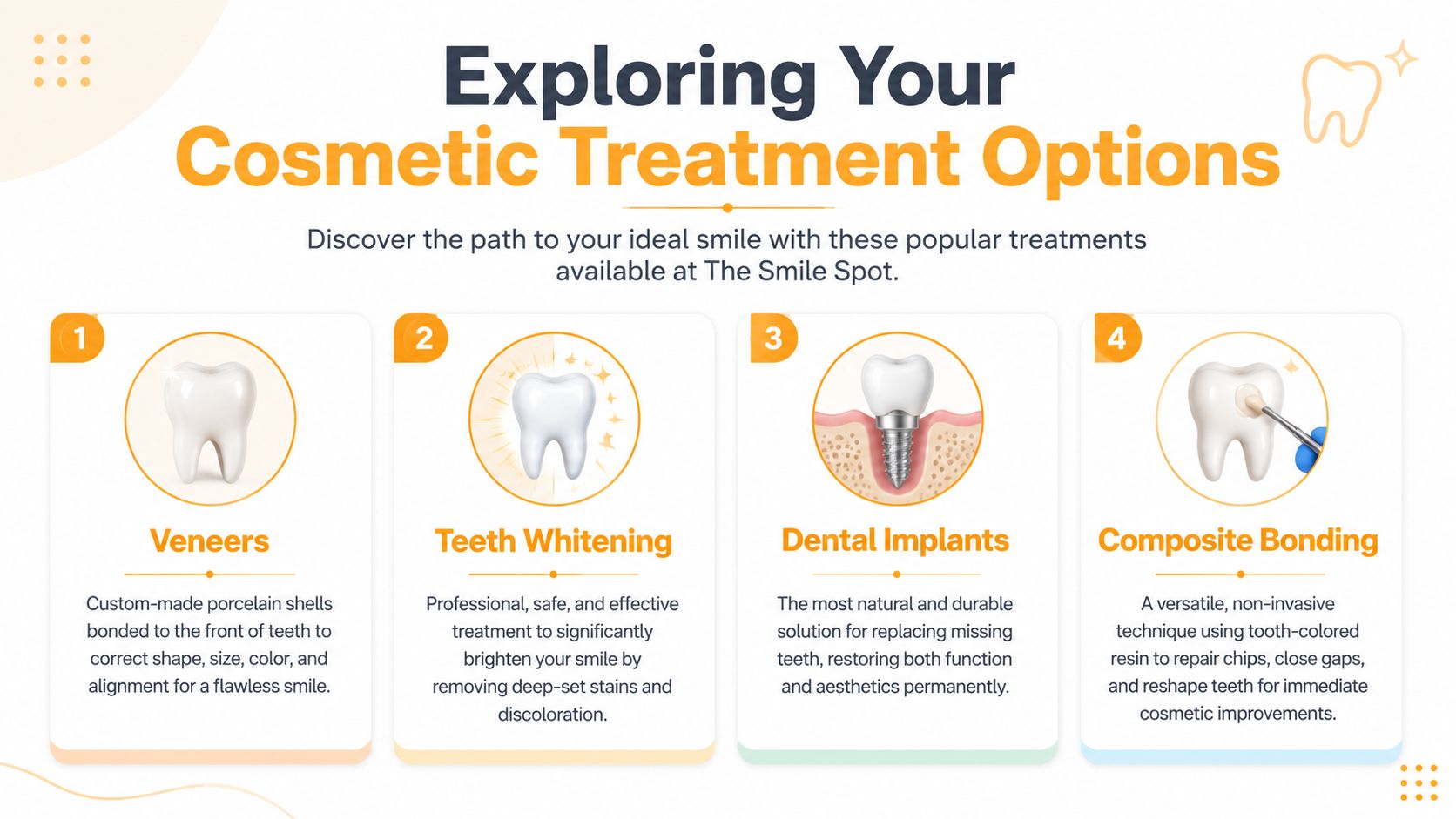
Veneers
Veneers are thin coverings placed on the front surface of teeth to improve shape, size, colour, and overall balance. They’re often chosen for front teeth that are stained, worn, slightly uneven, chipped, or separated by small gaps.
Materials matter here. Porcelain options such as E.max are popular because they can deliver strength and a lifelike finish. Some practices also offer Zirkonzahn Skin veneers for highly aesthetic cases, while composite veneers can be useful when a simpler or more repairable option is preferred.
Veneers are usually best for patients who want a noticeable but natural-looking refinement in the visible part of the smile. They aren’t the right solution for every bite problem, and they work best when the underlying teeth and gums are healthy.
Teeth whitening
Professional whitening is the simplest cosmetic dental treatment for many people. It targets staining from coffee, tea, red wine, smoking, and general age-related darkening. The main advantage is obvious: it can lift the whole smile without changing tooth shape.
What confuses many patients is the difference between shop-bought products and professional care. Professional whitening is planned around your current shade, your level of sensitivity, and the condition of your enamel and gums. It’s also more predictable.
For a deeper look at how in-chair and take-home approaches differ, this guide to professional teeth whitening treatment options is a helpful starting point.
Crowns and bridges
A crown covers a tooth that’s damaged, heavily restored, worn down, or structurally weakened. While crowns are often thought of as restorative, they’re also a cosmetic solution because they improve visible shape, colour, and contour.
A bridge replaces one or more missing teeth by anchoring to neighbouring teeth. It can restore the look of a complete smile when implants aren’t the preferred path.
Crowns and bridges tend to be the better conversation when the issue isn’t just appearance, but also durability. If a tooth has a large crack, an old filling, or significant wear, a veneer may be too conservative and a crown may provide better support.
Dental implants
Implants replace missing teeth in a way that supports both function and appearance. They’re designed to act like an artificial tooth root, with the visible restoration built on top.
This option is often the most natural-feeling choice for a single missing tooth because it doesn’t rely on adjacent teeth for support in the way a bridge does. Cosmetic benefits include a more complete smile, better balance, and avoiding the “gap” effect that draws attention during speech or laughter.
Implants can also play a major role in larger smile rehabilitation when several teeth are missing.
Laser-assisted cosmetic care
Laser dentistry sounds high-tech because it is, but the patient benefit is very practical. It can mean gentler treatment, more precision, and a smoother experience for people who feel nervous about dental work.
One area where this matters is whitening. According to the clinical data summarised in this paper on laser-assisted dental treatment, Biolase laser systems can achieve 6 to 8 VITA shades of improvement in a single 45-minute session, reduce treatment time by up to 50%, and minimise gingival irritation to less than 5% of cases compared with 15 to 20% with non-laser methods.
That doesn’t mean every patient gets the same result. It does mean the technology can support faster, more comfortable treatment when used appropriately.
Cosmetic Dental Treatments at a Glance
| Treatment | Best For | Typical Timeline | Longevity |
|---|---|---|---|
| Veneers | Chips, shape concerns, gaps, uneven colour | Usually planned over multiple visits | Long-term with good care |
| Teeth whitening | General staining and dullness | Often one in-chair visit or a take-home plan | Needs maintenance over time |
| Crowns | Damaged or heavily worn visible teeth | Usually multiple visits | Long-term with good care |
| Dental implants | Missing teeth | Multi-stage treatment | Designed as a long-term solution |
| Composite bonding | Small chips, edge reshaping, minor gaps | Often completed quickly | May need touch-ups over time |
How dentists narrow down the choice
A good recommendation usually comes from three questions:
What exactly bothers you most
If the answer is colour, whitening may be enough. If the answer is shape or uneven edges, veneers or bonding may suit better.Is the tooth healthy and strong enough
A tooth with major structural damage often needs a crown rather than a purely cosmetic covering.Do you want subtle improvement or full redesign
Some patients want nobody to notice they’ve had treatment. Others want a more dramatic smile change. Both are valid, but they lead to different planning decisions.
Your Journey to a New Smile The Consultation
The first consultation is less intimidating than many people expect. In most cases, it begins with a conversation rather than a procedure.
You’ll usually be asked what you’d like to change, how long it has bothered you, and whether you want a small refinement or a broader smile makeover. That part matters because two people can point to the same front tooth and want completely different outcomes. One may want a subtle polish. Another may want a full reshaping plan.
What happens at the appointment
After discussing your goals, the dentist examines your teeth, gums, and bite. Photos and X-rays may be used if they’re needed to understand what’s happening beneath the surface or to assess the health of supporting structures.
Then the discussion becomes more specific. If your teeth are healthy but stained, whitening may be enough. If there’s a chip plus old wear plus crowding, the dentist may explain several options and the trade-offs of each.
Practical rule: The best cosmetic plan starts with diagnosis, not design. Healthy gums, stable teeth, and a comfortable bite come first.
Questions worth asking
Patients often feel more settled when they know what to ask. Useful questions include:
- What are my options for this specific concern, and why do you recommend one over another?
- Will the result look natural next to my surrounding teeth?
- How much tooth preparation is needed for this treatment?
- What maintenance will I need after it’s finished?
A good cosmetic consultation shouldn’t feel rushed or judgemental. If it’s been years since your last dental visit, that’s something dentists see every week. The goal is to understand your starting point clearly and give you a realistic plan, not to make you feel behind.
Understanding Costs and Health Fund Benefits
Cost is often the question people leave until last, even though it’s one of the main reasons they delay treatment. It’s better to address it early.

Research highlighted in this review of barriers to dental care access notes that affordability is a significant barrier to accessing dental care in Australia, which is why information about payment plans, transparent fee structures, and navigating private health fund rebates is so important for Inner West communities.
Why prices vary
There isn’t one standard fee for cosmetic dental treatment because the final cost depends on several factors:
- Type of treatment such as whitening, veneers, crowns, or implants
- Number of teeth involved in the smile plan
- Materials used such as porcelain or composite
- Complexity of the bite and underlying dental health
- Whether preparatory care is needed before cosmetic work can begin
That’s why online price hunting can be misleading. Two patients asking for “veneers” may need very different levels of planning and preparation.
What private health funds may help with
Private health fund support can be confusing because cover depends on your policy and on whether the procedure is considered cosmetic, restorative, or part of general dental care.
In practical terms, it helps to:
- Check your extras policy before booking treatment
- Ask which item numbers may apply to the proposed care
- Clarify annual limits and waiting periods so there are no surprises
- Request a written treatment plan if you want to compare out-of-pocket costs clearly
If you’re trying to understand flexible payment options in a local setting, this article on finding dentists with payment plans near you gives useful context.
Some patients also begin with a general exam and clean before deciding on cosmetic work. That can be a sensible way to spread decisions out and make sure any treatment starts from a healthy baseline.
A short explainer can make the financial side feel less opaque:
Clear pricing matters because uncertainty stops people from asking about treatment they may actually be ready for.
Maintaining Your Beautiful Results Long Term
Cosmetic treatment doesn’t end when the appointment ends. The result you keep depends on the habits you build afterward.
The good news is that maintenance is usually straightforward. It’s mostly about protecting surfaces, reducing unnecessary wear, and keeping gums healthy so the cosmetic work continues to look balanced.
Daily care by treatment type
If you’ve had whitening, your main job is limiting new staining where you can. Coffee, tea, red wine, and tobacco can gradually darken teeth again. You don’t need to avoid them forever, but rinsing with water afterwards and keeping up with cleans helps.
If you’ve had veneers, treat them like natural teeth. Brush gently with a non-abrasive toothpaste, floss carefully, and avoid using your front teeth to open packaging or bite hard objects. If you’d like a closer look at expected wear and lifespan, this article on how long porcelain veneers last is worth reading.
Protecting shape and colour
For crowns and implants, plaque control matters just as much as it does for natural teeth. The restoration itself doesn’t decay the same way a natural tooth does, but the surrounding gum tissue still needs regular attention.
A few habits make a big difference:
- Use a night guard if you grind because repeated clenching can damage edges and strain restorations
- Attend regular check-ups so small problems are caught early
- Don’t ignore gum bleeding because inflamed gums can spoil the look of even beautiful dental work
- Report roughness or a changed bite if something starts to feel off after treatment
Cosmetic results last longest when the bite is stable, the gums stay healthy, and home care stays consistent.
How to Choose the Right Dentist in the Inner West
Choosing a cosmetic dentist isn’t only about photos on a website. You’re trusting someone to balance appearance, function, comfort, and long-term health.

One useful test is whether the dentist talks only about the final look, or also about the process of getting there. Mainstream cosmetic dentistry information often overlooks anxious patients, yet comfort-focused care matters a great deal. As discussed in this article on patient considerations in cosmetic dentistry, clinics that use sedation and minimally invasive tools such as Biolase lasers are addressing an important gap in patient care.
What to look for
A strong shortlist usually includes these points:
- Experience with a range of cosmetic options so the recommendation fits your teeth, not a one-size-fits-all system
- Modern diagnostic and treatment technology for planning and precision
- A calm approach with anxious patients including gentle techniques and sedation where appropriate
- Clear communication about limitations, maintenance, and realistic outcomes
For local patients, practical details matter too. Convenient hours, easy booking, and a location that fits normal life make it more likely you’ll complete treatment and maintain it properly.
Questions to ask at the first visit
Ask simple, direct questions:
- Do you offer more than one cosmetic option for my concern?
- How do you make treatment easier for nervous patients?
- What will look most natural for my face and existing teeth?
- How will this choice affect maintenance later on?
A good answer should be clear, unhurried, and specific to you.
Frequently Asked Questions
Do cosmetic dental treatments hurt
Most cosmetic procedures are more comfortable than people expect. Whitening may cause temporary sensitivity for some patients. Veneers, crowns, and implants are planned carefully, and dentists can use local anaesthetic, gentle techniques, and in some cases sedation to keep treatment manageable.
Will my new dental work look natural
That’s the standard you should expect. Natural-looking cosmetic dentistry depends on shade matching, shape, texture, and proportion. The best results don’t look bulky, flat, or overly white. They suit your face and blend with nearby teeth.
How long do results last
It depends on the treatment and how you care for it. Whitening usually needs maintenance because teeth can restain over time. Veneers, crowns, and implants are longer-term solutions, but they still depend on good oral hygiene, a stable bite, and regular check-ups.
Am I too old to consider cosmetic treatment
No. Adults of many ages explore cosmetic dental treatment. What matters more than age is the condition of your teeth, gums, and bone support, plus your goals. Sometimes a very small change is enough to make a smile feel fresher and more balanced.
What if I’m embarrassed about the state of my teeth
You’re not the first person to feel that way, and dentists hear it often. The most useful first step is an assessment. Once the current condition is clear, your options become much easier to understand.
If you’re ready to talk through your options for cosmetic dental treatment, The Smile Spot offers a calm, practical starting point for patients in Dulwich Hill and the Inner West. Whether you’re considering whitening, veneers, crowns, implants, or a more complete smile plan, booking a consultation can help you understand what’s suitable, what’s realistic, and what will feel right for you.