Full mouth dental implants in Australia typically cost AUD 25,000 to AUD 35,000 per arch, and a full mouth restoration for both arches usually sits around AUD 50,000 to AUD 70,000. If you're in Sydney or the Inner West, the final figure can shift depending on the implant system, the bridge material, the amount of surgery involved, and whether you need preparatory treatment first.
For many people, this search starts the same way. Teeth have been failing for years, dentures don't feel secure, eating has become awkward, and every website seems to give a different number. That uncertainty is stressful because you're not just pricing teeth. You're trying to work out what life will feel like after treatment, and whether the investment makes sense.
That question is becoming more common locally. Australian Bureau of Statistics data discussed here notes that 25% of adults over 65 in NSW have lost all their teeth, and that this has contributed to a 30% rise in full mouth implant procedures since 2018. Patients are moving toward implant solutions because they want stability, confidence, and something that feels closer to natural teeth.
If you're comparing options and trying to separate marketing from reality, this guide will help. It explains what drives full mouth dental implants cost, which treatment types are available, what usually affects the quote in Sydney, and how people in the Inner West often make treatment more manageable. If you're also researching broader pricing for implants, our guide to affordable dental implants in Sydney is a useful starting point.
Your Guide to Full Mouth Dental Implant Costs in Sydney
Losing most or all of your teeth affects more than appearance. People often stop chewing confidently, avoid certain foods, cover their mouth when speaking, and gradually accept a lower quality of life than they should. The cost question matters, but so does understanding what you're paying for.
In practical terms, full mouth dental implants cost in Sydney isn't one single fee. It's a treatment plan made up of diagnostics, surgery, implant components, temporary teeth, healing reviews, and the final prosthesis. A simple case and a complex case won't cost the same, even if both are described online as "full mouth implants".
Why Sydney quotes can feel confusing
Many articles use broad national averages, which don't help much when you're trying to budget for treatment in Dulwich Hill, Marrickville, Ashfield, or nearby suburbs. Sydney clinics often use premium implant systems, digital planning, and higher-end laboratory work. That improves precision and predictability, but it also affects fees.
A transparent quote should tell you:
- What type of full-arch treatment you're having. All-on-4, a traditional multi-implant bridge, or an implant-supported overdenture are different treatments with different costs.
- What material will be used for the final teeth. Acrylic and zirconia aren't the same in feel, durability, or price.
- What is included in the surgical phase. Extractions, sedation, imaging, and temporary teeth may or may not be bundled.
- What could be added later. Bone grafting, sinus lift procedures, or extra review appointments can change the total.
Good implant treatment starts with diagnosis, not a discount. If the quote comes before the scan and examination, it isn't a real quote yet.
What matters most to Inner West patients
Most patients want four straight answers. How much will it cost, how long will it take, will it look natural, and will it let me eat normally again. Those are the right questions.
The answer depends on your bone, bite, general oral health, and whether a fixed or removable option suits you best. The most useful approach is to compare treatment types side by side, then work backwards into the cost drivers.
What Determines Full Mouth Dental Implant Costs
The biggest mistake people make is looking only at the headline number. Two quotes can look similar at first glance, but include very different things.
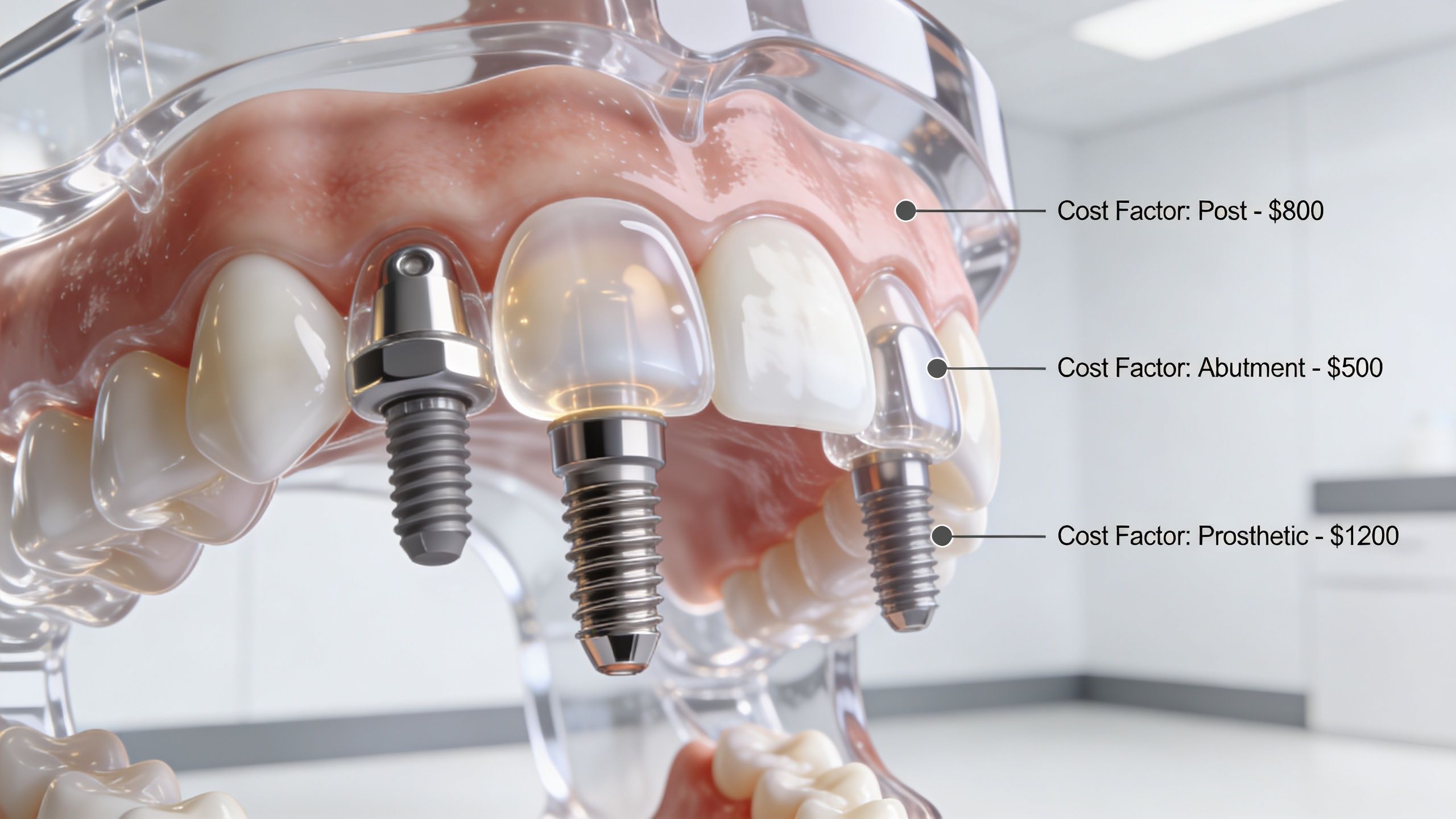
The implants and surgical planning
In metro NSW, material choice matters. Premium systems such as Nobel Biocare or Straumann implants cost AUD 1,500 to 2,500 each, and specialist surgical fees can sit at AUD 3,000 to 5,000 per arch. These cases rely on CBCT-guided surgery, which is a major reason long-term success rates sit at 95% to 98% in the cited Australian benchmarks. This local pricing and planning detail is outlined in our background on the endosseous dental implant.
CBCT planning isn't a luxury add-on. It lets the dentist assess bone volume, angulation, nerve position, and where implants can be placed safely. For full-arch work, that level of planning reduces surprises and helps avoid poor implant positioning, which is one of the costliest mistakes to correct later.
The bridge material and lab work
The visible teeth are only part of the restoration. Full-arch prosthetics involve significant laboratory work, design, fit, and adjustment. The final bridge may be acrylic-based or zirconia-based, and the difference isn't just cosmetic.
Acrylic options can be suitable in some situations, especially as provisional teeth. Zirconia is commonly chosen when patients want a more durable final result and a refined appearance. As a rule, stronger and more aesthetic materials increase the lab component of the quote.
Practical rule: Ask whether your quote includes both the temporary bridge and the final bridge. Some patients assume "teeth on implants" means the finished prosthesis is already included.
Preparatory treatment that can change the total
Some mouths are ready for implants with minimal preparation. Others aren't. If teeth need to be removed first, infection managed, or bone support improved, the fee changes.
Here are common variables patients should ask about:
- Extractions. Removing failing teeth can be part of the same treatment plan, but it needs to be listed clearly.
- Bone grafting. Some protocols reduce the need for grafting, but it can still be necessary in selected cases.
- Sinus lift procedures. Where upper jaw bone is limited, additional surgery may be required before or during implant placement.
- Sedation. Patients with dental anxiety often prefer sedation, and that may be charged separately.
- Follow-up care. Review visits, adjustments, and maintenance can be bundled or itemised.
A cheap-looking quote often leaves several of these items outside the main fee.
Experience and case complexity
There is also a real difference between straightforward and demanding cases. Severe wear, collapse of the bite, long-term denture use, or advanced bone loss usually require more planning and more clinical time. That doesn't mean treatment isn't possible. It means the quote should reflect the work needed to do it properly.
A detailed consultation should leave you knowing exactly what you're paying for, why it's recommended, and what alternatives exist if the ideal plan isn't the right fit financially.
Comparing Your Full Mouth Implant Options and Their Costs
Not every patient needs the same style of full-arch restoration. The best option depends on bone availability, expectations, maintenance preference, and budget.
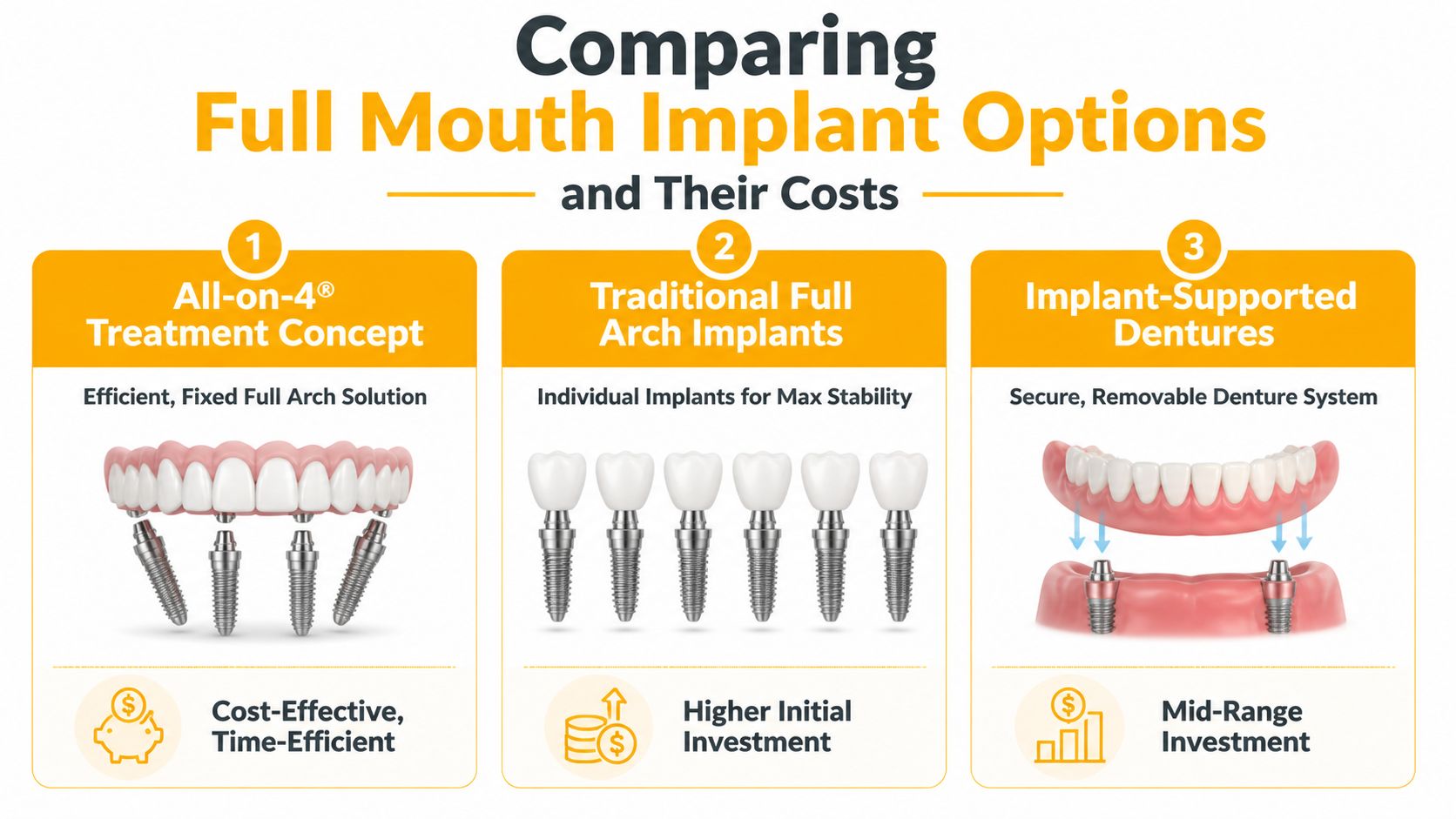
All-on-4 and similar fixed full-arch systems
For many Sydney patients, All-on-4 is the most practical balance of stability, efficiency, and cost. The typical fee is AUD 25,000 to AUD 35,000 per arch, and one reason it can be more cost-effective is that traditional methods using 6 to 8 implants per arch can exceed AUD 40,000 per arch. That comparison is drawn from this overview of All-on-4 dental implant pricing.
The concept uses four strategically placed implants to support a fixed bridge. For the right patient, that means fewer implants, less surgical complexity, and often less need for added grafting. If you're new to the concept, our article on what All-on-4 dental implants are explains how the treatment works in plain language.
Traditional full-arch implant bridges
Some patients are better suited to a more traditional full-arch design with a greater number of implants. This can make sense where bone quality, bite forces, or restorative goals call for extra support.
The trade-off is straightforward. More implants usually mean a higher surgical fee, more components, and a larger lab bill. The upside is that in selected cases, the design may offer advantages in load distribution and prosthetic planning. It isn't automatically "better". It's just different, and sometimes more appropriate.
Implant-supported overdentures
An implant-supported overdenture is the removable option. It clips onto implants for stability, then comes out for cleaning. For many people, it's a meaningful step up from a loose conventional denture without the cost of a fully fixed bridge.
The verified range is AUD 15,000 to 25,000 per arch. These overdentures typically use 2 to 4 implants and provide 80% more bite force than conventional dentures, while also helping reduce bone loss over time according to the cited Australian Prosthodontic Society data.
Side-by-side comparison
| Option | Typical cost | Daily experience | Best suited to |
|---|---|---|---|
| All-on-4 fixed bridge | AUD 25,000 to 35,000 per arch | Fixed in place, closest to natural teeth in day-to-day feel | Patients wanting a fixed full-arch solution with fewer implants |
| Traditional full-arch implants | Can exceed AUD 40,000 per arch | Fixed in place, more complex surgical design | Patients needing or preferring more implants for support |
| Implant-supported overdenture | AUD 15,000 to 25,000 per arch | More secure than a denture, but removable | Patients wanting lower cost and improved stability |
The right choice isn't the most expensive one. It's the option that matches your anatomy, goals, and ability to maintain it well over time.
Navigating Insurance and Financing For Your New Smile
Once patients understand the treatment options, the next concern is usually affordability. That's sensible. Full mouth implant treatment is a major investment, and it's not something one pays for casually.
What private health funds may cover
In Australia, major health funds may rebate 40% to 60% of the cost for full-arch procedures under Major Dental cover, provided waiting periods have been served. For eligible low-income residents in the Inner West, including Dulwich Hill postcode 2203, the NSW Health Chronic Dental Scheme may subsidise a portion of treatment. Those pathways are outlined in this summary of full-mouth implant cost and rebates.
That doesn't mean every policy covers every part of treatment. Health fund benefits depend on your level of extras cover, annual limits, item numbers, and whether your waiting periods are complete. Before committing, ask your clinic for a written treatment plan you can submit to your fund.
Payment plans and staged treatment
Many patients don't proceed because they're only thinking in terms of the full amount upfront. In real clinical practice, there are often more flexible pathways.
These commonly include:
- Health fund claims first. Your rebates reduce the gap before you look at financing.
- Structured payment plans. Some clinics offer staged payments that align with treatment milestones. If you're comparing providers, our guide to dentists with payment plans near me can help you know what to ask.
- Phased treatment. In selected cases, treatment can be sequenced so the most urgent stage is completed first.
- Wider financial planning. For people balancing family costs, mortgage pressure, and healthcare decisions at the same time, professional advice can help. Resources such as financial planning for Australian professionals can be useful when you're weighing a significant health investment against other long-term priorities.
What works and what doesn't
The plans that work best are the ones built around a written diagnosis and a realistic budget. The plans that don't work are usually rushed decisions based on a headline promotion, without clarity around inclusions, maintenance, or likely extras.
A better question than "What's the cheapest way to do this?" is "What's the most predictable option I can realistically maintain?" That approach usually leads to a better result and fewer financial surprises.
The Treatment Journey Timeline and Recovery
The process feels far less daunting when you know the sequence. Full-arch implant treatment is methodical. Each stage has a job, and skipping steps is rarely where good outcomes come from.
Consultation and planning
The first phase is assessment. This includes the clinical exam, photographs, and a CBCT scan so the dentist can evaluate bone levels, implant positions, and any risks that need planning around. It also establishes whether a fixed bridge or a removable overdenture is the better fit.
For patients who want a clearer idea of the healing period after surgery, our guide to dental implants recovery time explains what to expect in everyday terms.
Surgery and temporary teeth
On the surgical day, failing teeth may be removed if required, implants are placed, and a temporary prosthesis may be fitted depending on the plan and the stability achieved at surgery. This provisional phase matters more than patients realise. It protects healing tissues and lets the bite and smile be tested before the final bridge is made.
Recovery in the first days is usually about rest, soft food, careful cleaning, and following instructions precisely. Mild swelling, tenderness, and a change in diet are normal parts of the process. What matters most is avoiding pressure on the implants while the bone starts to integrate.
Healing is a partnership. The surgery matters, but home care, food choices, and review visits matter just as much.
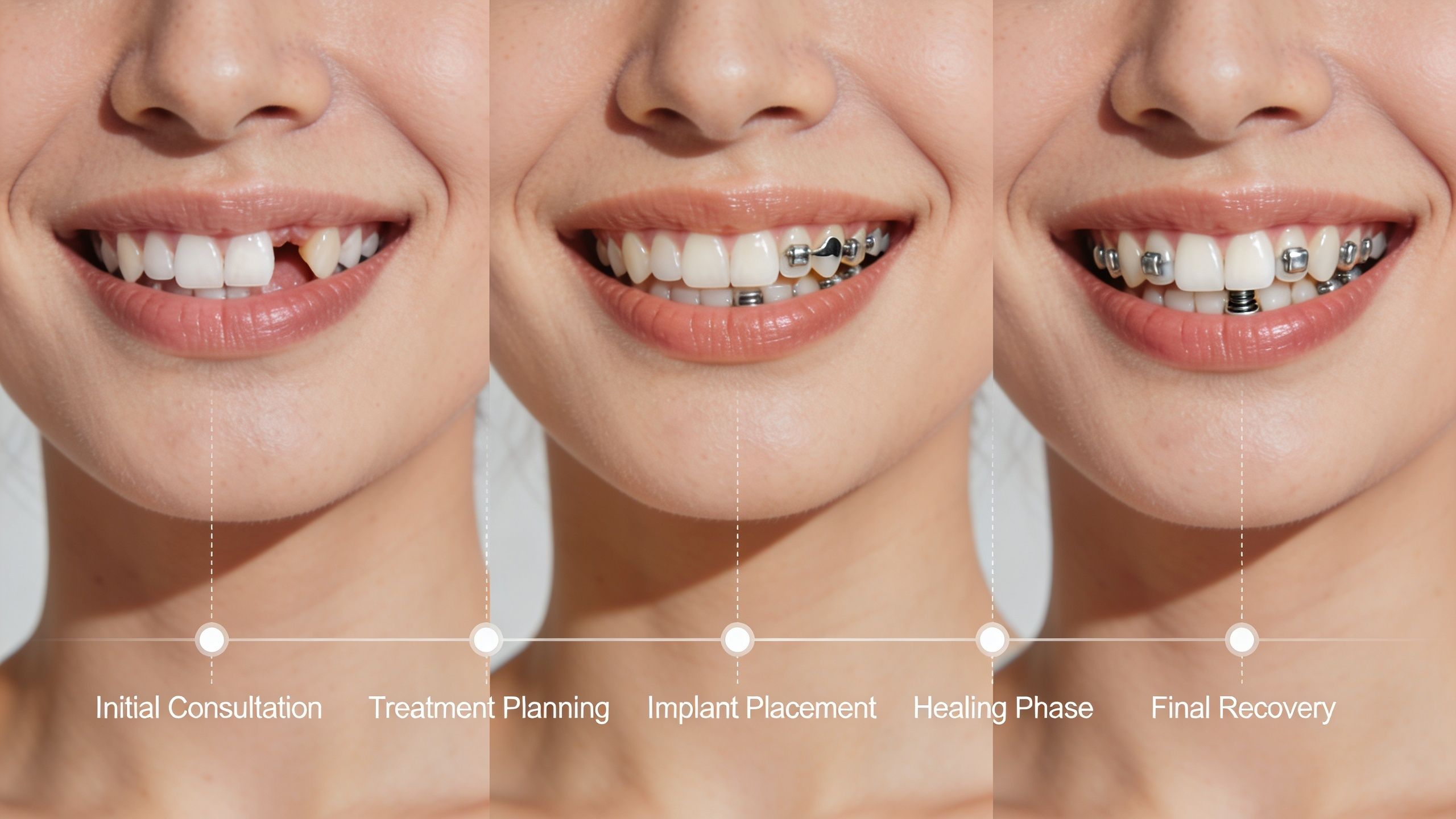
The treatment sequence is easier to understand when you can see it visually:
Healing and the final bridge
In verified Australian treatment data, final zirconia prostheses are typically fitted after 3 to 6 months of osseointegration, with the total treatment period often sitting at 3 to 6 months for these protocols. During this phase, the goal is stability, not speed.
Modern techniques can make the experience gentler. In practices using Biolase laser support for flapless or minimally invasive care, healing may be more comfortable and soft tissue management can be more controlled. What patients usually notice is that each review has a purpose. The team checks healing, confirms implant stability, adjusts the temporary if needed, and only moves to the final stage when the foundation is ready.
How to Get an Accurate Implant Quote in Sydney
A proper implant quote isn't a number typed onto a form. It's a diagnosis, a sequence, and a list of inclusions.
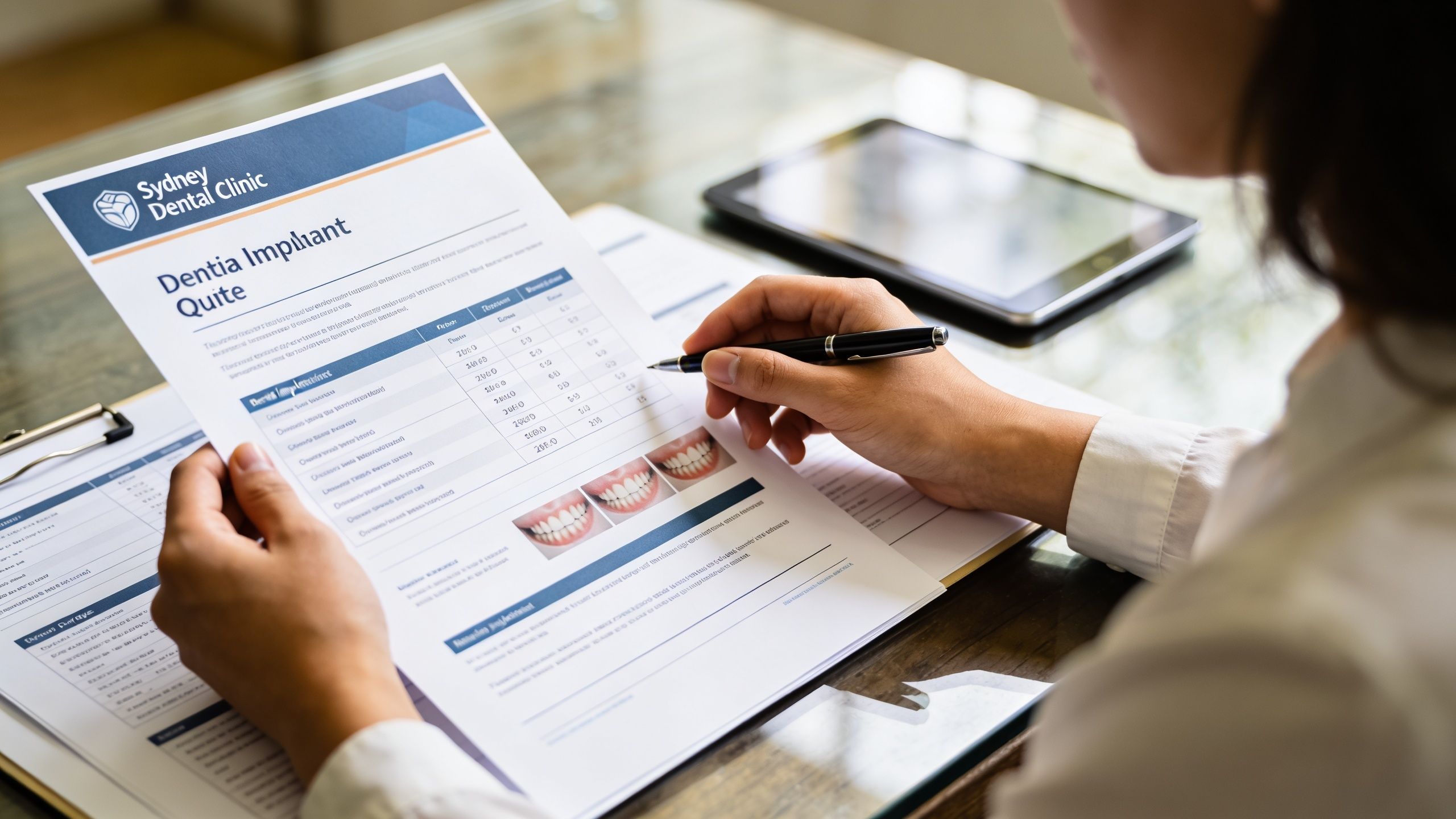
What should be included
A reliable quote should state the proposed treatment type, whether the fee is per arch or full mouth, and whether temporary and final prostheses are both included. It should also make clear if extractions, sedation, CBCT imaging, and review appointments are part of the fee or additional.
Use this checklist during your consultation:
- Ask what the quote covers from start to finish. You want to know whether planning, surgery, temporary teeth, final teeth, and follow-up visits are included.
- Ask what might change the price later. Bone grafting, sinus treatment, or extra restorative work should be identified early if possible.
- Ask who is providing each part of treatment. Surgical and restorative steps may be done by one clinician or shared across providers.
- Ask what type of final bridge you're being quoted for. A zirconia bridge and a provisional acrylic bridge are not interchangeable.
What a thorough consultation looks like
The most valuable consultations are calm, detailed, and specific to your mouth. The dentist should examine your bite, discuss your goals, review your scans, and explain the pros and cons of each option in plain English.
If a clinic advertises one fixed price before looking at your bone, bite, and health history, treat that number as marketing, not a treatment plan.
If you're seeking an individualized plan in the Inner West, a thorough consultation with Dr. Dimitrios Thanos and his team should leave you with a written roadmap, not guesswork.
Frequently Asked Questions About Full Mouth Implants
Are full mouth implants always fixed?
No. Some full-arch treatments are fixed bridges, while others are removable implant-supported overdentures. The best choice depends on your bone support, your expectations, and how comfortable you are cleaning around the restoration.
Is a removable option still worthwhile?
Yes, for the right person it can be an excellent solution. Implant-supported overdentures cost AUD 15,000 to 25,000 per arch, use 2 to 4 implants for snap-on stability, and provide 80% more bite force than conventional dentures, while also helping reduce bone loss over time according to the verified Australian Prosthodontic Society data.
Why do two clinics sometimes give very different quotes?
Because they may not be quoting for the same thing. One quote may include diagnostics, surgery, temporary teeth, and the final bridge. Another may only cover part of the process. Material choice, sedation, and whether additional procedures are needed can also change the figure.
Am I too old for full mouth implants?
Age alone usually isn't the deciding factor. General health, healing ability, medications, bone quality, and your ability to maintain the implants matter more than the number on your birthday card.
Do implants feel like natural teeth?
They don't feel identical to natural teeth because they're a prosthetic restoration, but a well-designed fixed full-arch bridge can feel very secure and natural in daily use. Most patients notice the biggest difference when eating, speaking, and smiling without movement or worry.
If you're ready to get clear answers about your options, the team at The Smile Spot can help you understand your treatment choices, your likely costs, and what a realistic plan looks like for your smile in the Inner West.