
Root canal treatment has a high success rate of around 95%, and specialist care using surgical microscopes reports 94 to 96% long-term success over 10 to 15 years or more. That's a far cry from the old horror stories people still hear, and it's why a root canal is often the most predictable way to save a natural tooth.
What matters, though, is what that number means for your own tooth. A healthy outcome depends on more than the procedure itself. The starting condition of the tooth, the way it's cleaned and sealed, the final restoration, and the way you look after it afterwards all shape the result.
The Truth About Root Canal Treatment
A root canal isn't a last-ditch gamble. In everyday practice, it's a routine, well-established treatment designed to remove infection from inside a tooth and keep that tooth in function for years.
In Australia, root canal therapy has a reported success rate of 86 to 98%, with primary endodontic treatments achieving 86.02%, and specialist endodontists using surgical microscopes reporting 94 to 96% success rates over 10 to 15 years or more according to Australian endodontic treatment success data. Those are strong numbers by any clinical standard.
The bigger problem is usually delay. Patients often wait until pain becomes severe, swelling appears, or chewing becomes difficult. If you're trying to cope while arranging an appointment, practical guidance on immediate dental pain management can help you manage the short term safely, but it doesn't replace proper treatment.
Why root canal treatment works
A tooth needs a root canal when the pulp inside becomes infected or badly inflamed. The goal is simple. Remove the infected tissue, disinfect the canal system, seal it thoroughly, and restore the tooth so bacteria can't get back in.
That sounds technical, but the principle is straightforward. Clean out the problem inside the tooth, then protect the tooth from future contamination and fracture.
Practical rule: The success of a root canal doesn't come from one dramatic step. It comes from a chain of small things done well, from diagnosis through to the final restoration.
What patients often get wrong
Many people assume root canal treatment is unreliable because they've heard of one case that failed. That's not how treatment outcomes should be judged. Every procedure in dentistry has trade-offs, but the evidence supports root canal therapy as a strong tooth-saving option when the tooth is restorable.
If you're unsure whether your symptoms point to this treatment, these signs you need a root canal are a useful place to start. The sooner a dentist can assess the tooth, the more options you usually have.
Success vs Survival A Crucial Distinction
When people ask about the root canal success rate, they usually mean one thing. Will my tooth stay in my mouth and let me chew normally?
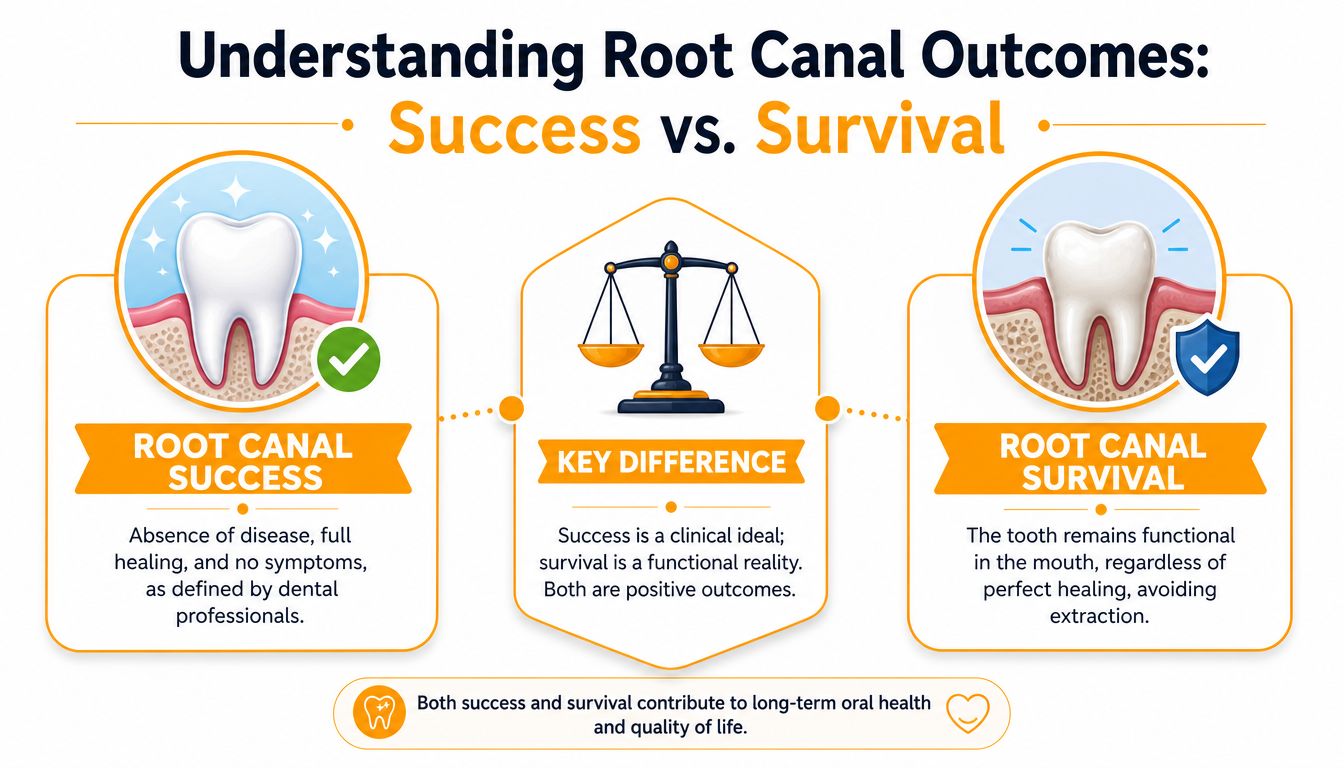
Dentists use two related terms that sound similar but mean different things. Success usually means the tooth has healed fully, symptoms have settled, and follow-up imaging shows no sign of ongoing disease. Survival means the tooth is still in the mouth and functioning, even if it doesn't meet the strictest clinical definition of complete healing.
Why this distinction matters
Consider repairing a car engine. A mechanic might call the job a complete success if the engine runs smoothly, all warning lights are off, and every system tests perfectly. Most drivers ask a simpler question. Does the car start, drive reliably, and get me where I need to go?
Teeth are similar. A root canal-treated tooth can remain comfortable and useful for a long time, even if a follow-up X-ray doesn't show textbook-perfect healing by the strictest criteria. That doesn't mean the treatment was pointless. It means the outcome has to be judged in more than one way.
What patients should ask
A better conversation with your dentist is helpful. Instead of asking only “What's the success rate?”, it's often more useful to ask:
- How healthy is the tooth now and how much sound structure remains
- What does healing look like in my case on both symptoms and X-rays
- Will the tooth need a crown or other protection after treatment
- What are the alternatives if the long-term outlook is less favourable
For many patients, the practical goal is keeping the natural tooth stable and functional. That's why root canal treatment often compares favourably with extraction when the tooth can still be predictably restored. If you're weighing both paths, this discussion of root canal vs extraction can help frame the decision.
Success is the clinical ideal. Survival is the everyday reality. Both matter, but they answer different questions.
Why the distinction reduces fear
People get anxious when they hear a treatment “failed” because they imagine immediate pain, swelling, or total loss of the tooth. In practice, a tooth may continue to function for years while being monitored, or it may need further care without becoming a crisis.
That's one reason blanket statements about root canals can mislead. A single number can't tell the whole story. The more useful approach is to understand what outcome is being measured, then match that to your own priorities and the condition of the tooth.
A Deep Dive into Root Canal Statistics
The strongest reassurance comes from long-term data, not just short-term comfort after the appointment. Root canal treatment performs well on that front.
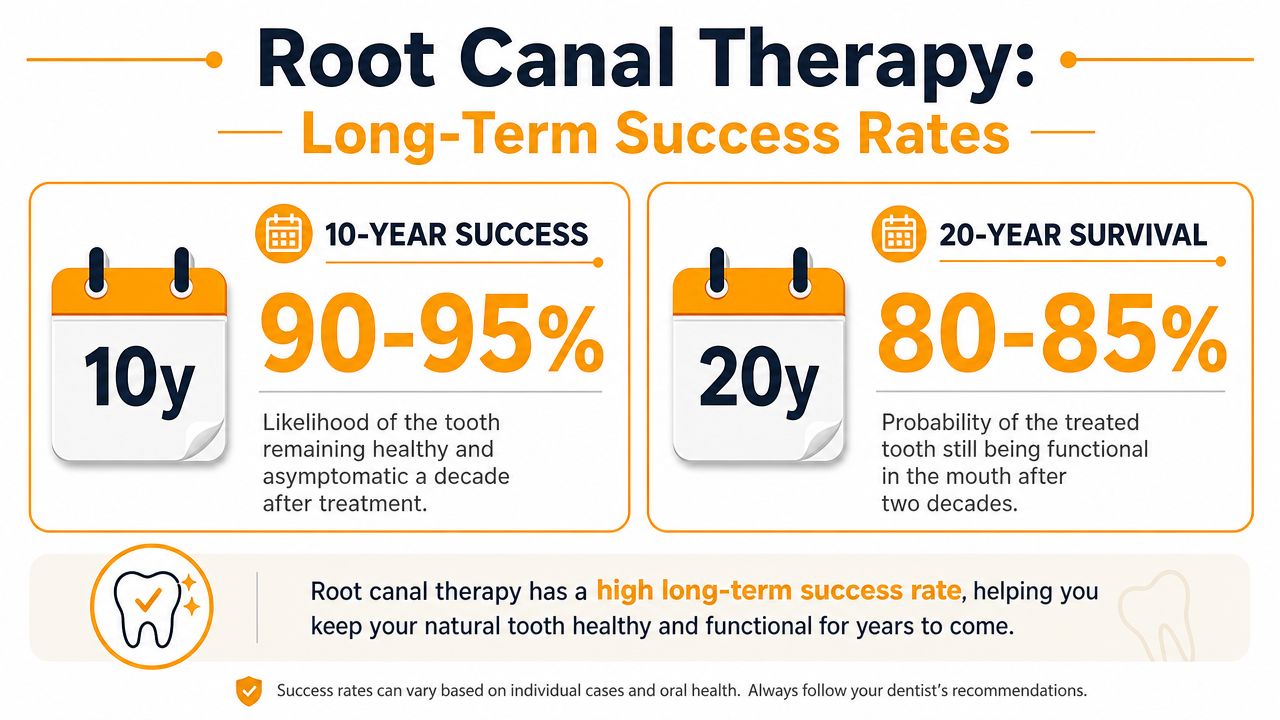
Long-term findings show that root canal treatment success rates are 93 to 94% at the 10-year mark and remain around 81% after 37 years. The same source reports a 97% retention rate after 10 years, and notes that restorations with crowns nearly double survival rates, based on long-term root canal survival and tooth preservation data.
What the numbers mean in real life
A decade is a long time in dentistry. Teeth crack. Fillings wear. Gums change. Biting forces don't get gentler. So when a treatment still shows high success and retention after 10 years, that tells you it's doing more than giving temporary relief.
The 37-year figures matter for a different reason. They show a gradual decline, not a sudden collapse. That's what you'd expect from any restored tooth over time. The important point is durability. A properly treated tooth can continue serving a patient for many years.
Why one study can show different rates
This point often confuses readers. Some studies use strict radiographic standards. Others focus more on whether the tooth remains functional and symptom-free. That difference changes the reported rate.
The same long-term evidence base notes that strict radiographic criteria can bring success down compared with looser definitions, while survival remains strong. That doesn't mean one measure is honest and the other isn't. It means they're measuring different outcomes.
Here's a simple comparison of the numbers patients usually care about most:
| Outcome measure | Reported figure |
|---|---|
| 10-year success | 93 to 94% |
| 37-year success | Around 81% |
| 10-year retention in one study | 97% |
The crown effect is hard to ignore
The most clinically useful point in this data isn't just the success rate itself. It's the role of the restoration afterwards. When a tooth has had root canal treatment, especially a back tooth, the internal infection may be gone, but the structure is often weaker than before.
Key takeaway: Cleaning the root canal deals with infection. Restoring the tooth properly helps it survive chewing forces over the long term.
That's why a good root filling and a good final restoration should be seen as one treatment sequence, not two unrelated events. Patients sometimes feel fine after the root canal and delay the next step. That's where avoidable problems can start.
What this should tell patients
The root canal success rate isn't just “good for a dental procedure”. It's strong over years, and even decades, when the case is well selected and the tooth is restored properly. That should change how people think about treatment.
A root canal isn't just an emergency fix to stop pain. In the right tooth, it's a long-term investment in keeping your natural dentition.
Key Factors That Shape Your Outcome
Two patients can both have root canal treatment and end up with different outcomes. That isn't random. The result usually follows a handful of practical factors that can be assessed and managed.
Modern root canal treatment performed by endodontic specialists demonstrates a 94 to 96% long-term success rate when surgical microscopes are utilised, and for most back teeth, placement of a dental crown is essential to protect the weakened tooth structure from fracturing, according to specialist root canal treatment guidance.
The quality of the treatment itself
Good root canal therapy is precise work. The infected pulp has to be removed gently, the full canal length identified accurately, the canal system shaped and disinfected thoroughly, and the space sealed three-dimensionally so bacteria can't return.
Specialists often use surgical microscopes because the inside of a tooth is small and complex. Extra canals, unusual anatomy, and deep molar access all become easier to manage with magnification. That doesn't mean every tooth needs a specialist, but complex teeth benefit from experience and visibility.
The starting condition of the tooth
A straightforward front tooth and a heavily broken-down molar aren't the same case. The amount of remaining tooth structure matters. The presence of extensive decay, cracks, or a large existing restoration changes the prognosis.
So does the level of infection before treatment. Teeth treated earlier generally give a more predictable path than teeth that have been painful, abscessed, or structurally compromised for a long time.
The final restoration
This is the point many patients underestimate. Once the root canal is complete, the job is only partly done. The tooth still needs a strong coronal seal and, in many back teeth, a crown to protect against fracture under biting pressure.
A root canal-treated molar without proper protection can fail mechanically even when the canal treatment itself was excellent. In plain terms, the infection can be gone and the tooth can still split.
If a back tooth needs a crown after root canal treatment, that recommendation isn't cosmetic. It's structural.
What you can control as a patient
Patients do have influence over the root canal success rate. Not over every detail, but over the factors that commonly make the difference between a stable result and a preventable setback.
- Act early: Don't wait for recurring pain to “settle down on its own”. Earlier assessment usually preserves more of the tooth.
- Finish the plan: If your dentist recommends a permanent restoration, especially a crown, follow through promptly.
- Protect the tooth: Avoid treating a temporary filling like a finished tooth. Hard chewing on it is a common mistake.
- Keep the mouth healthy: New decay, gum disease, and poor plaque control can undermine a well-treated tooth.
- Discuss bite forces: If you clench or grind, ask whether the tooth needs extra protection.
Gum health matters here too, because the tooth doesn't exist in isolation. If supporting tissues are inflamed, long-term stability becomes harder. This overview of root planing and scaling explains how periodontal care supports the wider foundation around teeth.
What doesn't work
A few shortcuts repeatedly cause trouble. Delaying the final restoration. Ignoring a cracked cusp because the tooth no longer hurts. Assuming antibiotics alone solve the problem. Returning to normal chewing before the tooth is properly protected.
Root canal treatment works best when infection control, restoration quality, and follow-up all line up. When one of those pieces is weak, the overall result becomes less predictable.
Ensuring Success and Recognising Failure
Once the root canal is finished, the next phase is about healing, protection, and observation. Most teeth settle well, but the way you treat that tooth in the following days and weeks matters.
What to do after treatment
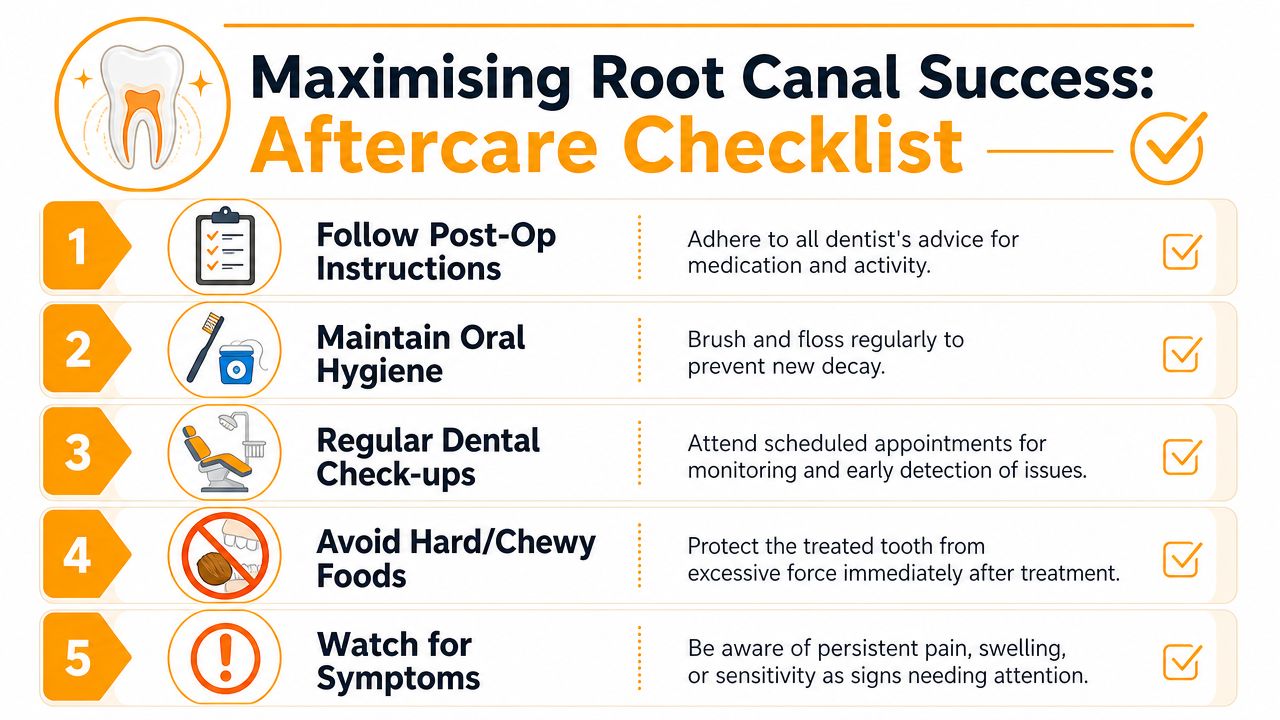
A sensible aftercare routine is simple, but it needs consistency.
- Follow the instructions you were given: Take any prescribed or recommended medication as directed and don't improvise.
- Chew carefully: If the tooth has only a temporary restoration, keep heavy biting off that side until it's permanently restored.
- Brush and floss normally: Clean teeth heal better in a cleaner environment.
- Turn up for reviews: Follow-up helps your dentist confirm the tooth is settling as expected.
- Report changes early: New pain, swelling, or a bite that suddenly feels wrong should be checked.
For patients who want to understand the sequence in more detail, these RCT treatment steps make the process easier to visualise.
What normal healing feels like
Some tenderness when biting is common for a short period after treatment. The tissues around the root have often been inflamed before the appointment, and they need time to settle. Mild jaw soreness can also happen if the mouth has been open for a while, especially during treatment on a back tooth.
What you don't want is pain that escalates, swelling that appears or worsens, or a tooth that becomes progressively harder to bite on. Those patterns deserve review.
A short explainer can also help settle nerves:
Signs that need attention
Some warning signs are obvious. Others are easy to dismiss. Patients should contact their dentist if they notice:
- Persistent swelling: Especially if it returns after seeming to settle
- Pain on biting that doesn't improve: This can point to ongoing inflammation, reinfection, or fracture
- A pimple-like bump on the gum: This may indicate drainage from infection
- Looseness or cracking sensation: Structural issues matter as much as infection
- Ongoing bad taste or discharge: Not every failing tooth is dramatically painful
If you're unsure whether symptoms fit an infection pattern, this guide to dental abscess warning signs is a practical reference.
A failing root canal doesn't always announce itself with severe pain. Sometimes the first clue is a change in bite comfort, swelling, or a recurring gum spot.
If a root canal fails
Failure doesn't automatically mean extraction. The first step is diagnosis. The dentist needs to work out whether the issue is persistent infection, a leaking restoration, a missed canal, new decay, or a fracture. Those problems don't all lead to the same solution.
Comparative studies found that primary endodontic treatment achieved an 86% success rate, while nonsurgical retreatment reached 78.2% and surgical endodontic treatment 63.4%, based on comparative endodontic treatment outcome research. That tells us two things. First, retreatment can still help. Second, getting the first treatment and restoration right matters because the original procedure gives the best chance.
| Treatment Type | Reported Success Rate |
|---|---|
| Primary endodontic treatment | 86% |
| Nonsurgical retreatment | 78.2% |
| Surgical endodontic treatment | 63.4% |
The practical takeaway is clear. Don't treat the first root canal as a temporary fix. Treat it as something worth doing thoroughly, then protect the result properly.
Your Path to Success at The Smile Spot
At The Smile Spot, root canal care is approached as a full treatment journey, not a one-visit procedure in isolation. That starts with diagnosis, because a sore tooth can come from pulp infection, a crack, bite trauma, gum disease, or a combination of problems. The aim is to identify what's happening before any drilling begins.

Treatment planning then focuses on what gives the tooth the best chance. That includes careful cleaning and shaping, thorough disinfection, and a clear plan for the final restoration. The clinic's use of Biolase laser dentistry supports minimally invasive care and helps with disinfection in suitable cases, which is particularly valuable for anxious patients who want a gentler experience.
How care is tailored
Some teeth are straightforward. Others are not. A front tooth with clean access and strong remaining structure is very different from a calcified molar, a retreatment case, or a tooth with suspected complex anatomy.
That's why case selection matters. When a tooth is appropriate for treatment in-house, the focus is on comfort, clarity, and careful follow-through. When a case is better managed by a specialist endodontist, referral is part of good care, not a sign of hesitation. Patients are best served when the right clinician handles the right case.
What patients can expect
Clear communication changes the whole experience. Patients want to know what the tooth needs, how long it may take, what to expect afterwards, and whether a crown is likely. They also want honesty about trade-offs. If the tooth is restorable, root canal treatment is often the conservative choice. If the prognosis is poor because of a deep crack or severe structural loss, that should be said plainly.
If you'd like to understand how this type of care is delivered in practice, read more about dentistry for root canal.
If you've got tooth pain, swelling, or you've been told you may need a root canal, The Smile Spot in Dulwich Hill can help you understand your options clearly and act early to protect your tooth. Book an appointment to get a proper diagnosis, a practical treatment plan, and gentle care focused on long-term success.