
You're usually not reading about dentistry for root canal because you're curious. You're reading because a tooth has started waking you up at night, hurting when you bite, or sending a sharp jolt when you drink coffee. You may also be wondering whether treatment will hurt, whether the tooth can still be saved, and whether you should see a general dentist or a specialist.
Those are sensible questions. Root canal treatment is a routine part of modern dentistry in Australia. Its purpose is straightforward: treat infection or inflammation inside the tooth and save the natural tooth rather than remove it. That matters because keeping your own tooth helps maintain chewing function and long-term oral health, as explained in Australian consumer guidance on root canal treatment and tooth preservation in this overview of common root canal myths.
Is a Root Canal Necessary Signs and Symptoms
A root canal becomes necessary when the pulp inside the tooth is inflamed or infected. That soft tissue contains nerves and blood vessels. Once bacteria reach it, the tooth can't settle down on its own.
The usual triggers are familiar. A deep cavity can let bacteria travel into the centre of the tooth. A crack or large chip can expose the inner tooth. Trauma can damage the pulp even if the outside of the tooth looks mostly intact. In each case, the issue isn't just the enamel you can see. The problem is what's happening deeper inside the tooth.

Symptoms that deserve prompt assessment
Some symptoms are stronger warning signs than others. If you recognise several of these together, it's worth arranging an assessment quickly, especially if the pain is building.
- Throbbing toothache: Pain that lingers, pulses, or seems to flare without a clear trigger often points to inflammation inside the tooth.
- Pain when biting: If pressure causes a sharp or deep ache, the nerve or surrounding tissues may be involved.
- Hot or cold sensitivity that doesn't fade: Brief sensitivity can happen with worn teeth. Lingering sensitivity is more concerning.
- Swelling near one tooth: A pimple-like swelling on the gum, local tenderness, or puffiness can suggest infection.
- Tooth darkening: A tooth that turns grey or darker than the others may have had trauma or internal damage.
- A bad taste or unpleasant smell: This can happen when infection is draining.
Practical rule: Pain that keeps you awake, pain with swelling, or pain that's getting worse isn't something to monitor for weeks.
What doesn't usually work
Patients often hope the problem will settle with time, softer foods, or avoiding the sore side. That may reduce the symptoms briefly, but it doesn't remove infected pulp. Antibiotics also aren't a substitute for proper dental treatment when the source is inside the tooth. They may play a role in some cases, but they don't clean and seal the canals.
What helps is a proper diagnosis. That usually means an exam, tests on the tooth, and X-rays to see what's happening around the roots. If you're dealing with sudden severe pain and need urgent guidance, this article on when to look for emergency dental clinics near you is a useful starting point.
What to Expect During Your Root Canal Treatment
Most anxiety comes from not knowing what's going to happen. The actual process is methodical and much less dramatic than people imagine.
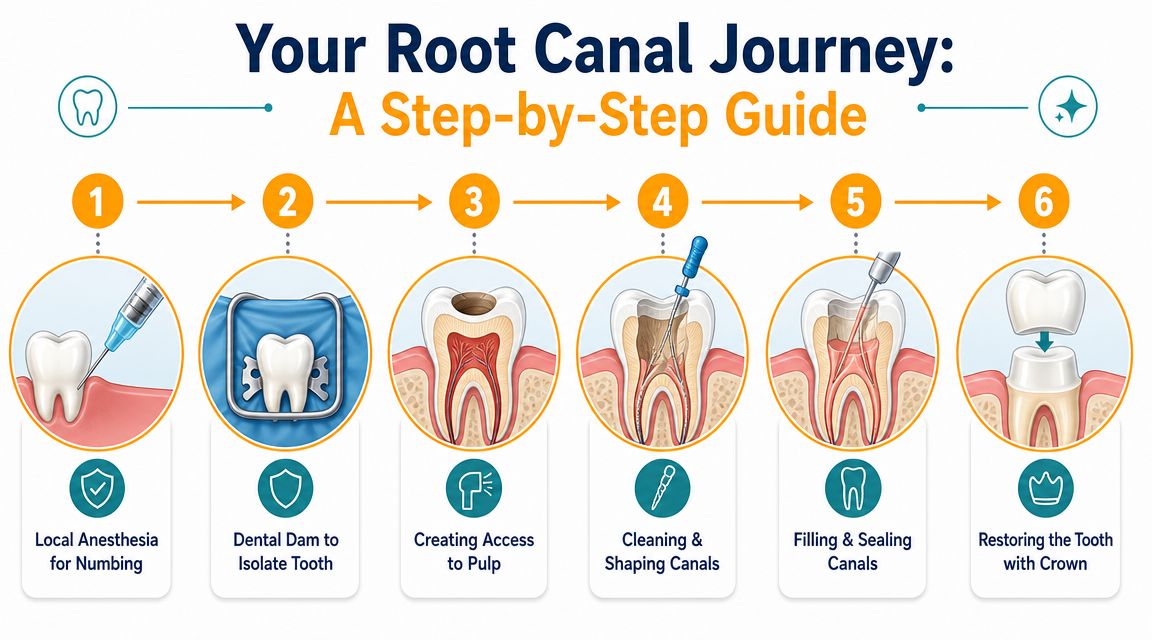
This image gives you the broad sequence first.
The appointment starts with planning
The first step is diagnosis and treatment planning. The tooth is examined, symptoms are reviewed, and digital X-rays are taken. In more involved cases, the anatomy of the canals matters a great deal. A recent consensus review on root canal difficulty notes that treatment becomes harder as infection burden and anatomical complexity increase, and that curvature is a major driver of complications. The same review explains that radiographs are used to assess canal curvature and that root canal length is typically 16–25 mm, with canals shorter than 16 mm or longer than 25 mm considered technically more difficult for treatment planning and obturation in complex cases, as outlined in this consensus paper on root canal difficulty and anatomy.
That matters for patients because the visit length, number of appointments, and whether referral is sensible often depend on the shape of the canal system, not just how sore the tooth feels.
What happens in the chair
Once treatment begins, the goal is simple. Get you numb, keep the area clean, remove the diseased tissue, and seal the inside of the tooth properly.
Local anaesthetic is placed
The tooth and surrounding area are numbed thoroughly. If the tooth is very inflamed, extra steps may be used to achieve profound numbness.The tooth is isolated
A rubber dam is placed around the tooth. It keeps saliva and bacteria out of the field and stops instruments or irrigants from affecting the rest of the mouth.A small access opening is made
This gives access to the pulp chamber and canals inside the tooth.
Before going further, it can help to see the procedure laid out visually.
The canals are cleaned and shaped
Fine instruments are used to remove infected tissue and prepare the canals so they can be disinfected and filled.The canals are filled and sealed
Once clean, the canals are filled with a biocompatible material to reduce the chance of reinfection.The tooth is restored
A filling may be placed first, but many root canal treated teeth also need a crown for long-term protection, especially back teeth that take heavy chewing force.
A root canal doesn't make a weak tooth strong by itself. The final restoration is what protects the tooth from fracture during normal function.
Why the crown often matters
After root canal treatment, the tooth no longer has a living pulp. It can still function very well, but it may be more vulnerable to structural damage if there's already a large filling or lost tooth structure. That's why the restoration phase is part of the treatment, not an optional extra for many teeth.
If you'd like a clearer sense of how the final protective layer works, this guide to dental crowns and bridges explains when crowns are used and why they can be important after root canal therapy.
Pain-Free Root Canals and Modern Technology
The pain people fear usually comes from the infection or inflammation, not from the root canal itself. The treatment is what removes that source.
A modern root canal should feel controlled and well managed. Local anaesthetic is the foundation. When the tooth is fully numb, patients typically feel pressure and vibration, not sharp pain. For very anxious patients, sedation can make the experience calmer and much easier to get through.
What modern tools change
Technology doesn't replace skill, but it can make treatment more conservative and more precise. In endodontic care, tools such as operating microscopes, ultrasonic instruments, and laser dentistry are used to manage complex canals and hidden anatomy more carefully. A review of laser use in endodontics also notes that laser-assisted care can reduce discomfort and may lead to faster healing for many patients, which is why these technologies matter to nervous patients and to people with difficult canal systems, as described in this clinical review of lasers and advanced endodontic tools.
That's especially relevant if your fear is based on an old dental experience. The combination of strong local anaesthetic, better imaging, improved visibility, and minimally invasive tools changes the feel of treatment.
What helps anxious patients most
Not every anxious patient needs the same approach. Comfort usually improves when the treatment plan matches the reason for the fear.
- If your concern is pain: thorough numbing and clear communication matter most.
- If your concern is the sounds or time in the chair: sedation may be the better solution.
- If your concern is recovery: minimally invasive techniques and careful aftercare usually make a bigger difference than trying to “push through” with a very inflamed tooth.
Patients often cope better when they know they can pause, ask questions, and agree on a clear comfort plan before treatment starts.
If dental anxiety has delayed care for you, this article on dental sedation near you outlines the kinds of support that can make treatment more manageable.
General Dentist vs Endodontist for Your Care
Not every root canal needs a specialist. Many can be managed well by an experienced general dentist. The key question isn't status. It's case complexity.
An endodontist is a dentist who focuses on root canal treatment and related procedures. That extra level of training matters most when the anatomy is difficult, the diagnosis is uncertain, or previous treatment has failed.
When specialist care makes sense
Patient demand has shifted toward specialist care in more complex situations. Based on insurance claims processed from 2020–2024, endodontists increased their share of endodontic treatments from 34.6% to 44.4%, and they complete 2–3 additional years of specialised training beyond dental school. That trend reflects the value of specialist management for technically demanding cases such as retreatments and curved canals, as noted in this AAE report on rising specialist demand.
Choosing your root canal provider
| Situation | Typically Handled by General Dentist | May Require an Endodontist (Specialist) |
|---|---|---|
| Straightforward tooth pain with clear diagnosis | Yes | Sometimes |
| Single-rooted tooth with accessible canals | Often | Less commonly |
| Very curved or narrow canals | Sometimes | Often |
| Previously treated tooth that still hurts | Sometimes | Often |
| Hidden canal suspected | Sometimes | Often |
| Unclear source of pain | Sometimes | Often |
| Need for surgical endodontic care | Rarely | Yes |
A practical way to decide
A general dentist is often the right starting point because diagnosis comes first. Once the tooth is assessed, the decision becomes clearer.
You're more likely to benefit from endodontic care when the tooth has unusual anatomy, limited access, severe infection, or a history of prior root canal treatment. In those situations, specialist instruments, microscopes, and a narrower treatment focus can improve the chance of preserving the tooth.
The Big Decision Root Canal vs Tooth Extraction
This is usually the hardest choice. You're not just choosing between two procedures. You're choosing between keeping your natural tooth and removing it, then deciding whether and how to replace it.
In most cases, saving a restorable natural tooth is the first option worth serious consideration. Australian dental guidance emphasises that endodontic treatment aims to preserve the natural tooth. At the same time, endodontic outcomes aren't always one-and-done, because some teeth may later need further treatment or surgery if infection persists or hidden anatomy was missed, as explained in this guidance on endodontic surgery and treatment options.
When saving the tooth is usually the better path
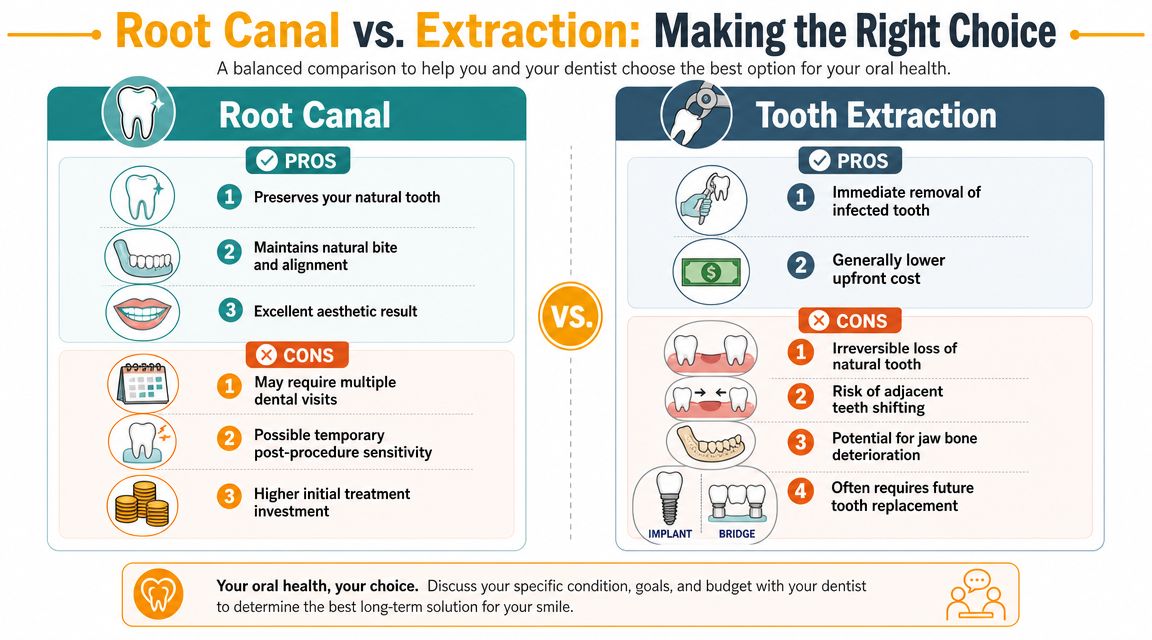
A root canal is often the better choice when the tooth can be restored predictably and the surrounding bone and gum support are sound. Keeping the tooth helps preserve normal biting patterns and avoids a gap in the arch.
Root canal treatment can also be the faster path back to function when compared with extraction followed by replacement planning. An extraction may solve the pain source quickly, but the tooth is then gone permanently. If you don't replace it, nearby teeth can drift and the bite can change over time.
When extraction may be more realistic
Sometimes a tooth is too damaged to justify root canal treatment. A severe crack extending in the wrong direction, very limited remaining tooth structure, or poor long-term restorability can make extraction the more predictable option.
Patients often focus only on the first appointment. That's understandable, but it can lead to a short-term decision that creates a longer treatment path.
- Root canal path: preserve the tooth, then protect it with the right restoration.
- Extraction path: remove the tooth, then decide between living with a gap, a bridge, a denture, or an implant-supported replacement.
The better question isn't “Which procedure is cheaper today?” It's “Which option gives this tooth region the best long-term function with the least compromise?”
The decision framework patients actually need
Ask these practical questions during your consultation:
Can the tooth be restored well?
If there isn't enough healthy tooth left, saving it may not be sensible.What happens if I extract and don't replace it soon?
For some teeth, that matters a great deal.How many stages will each option involve?
Root canal plus crown is one pathway. Extraction plus replacement is another, and it may take longer overall.What are the maintenance demands?
Every option needs follow-up care. Natural teeth, crowns, implants, and bridges all require maintenance.
If your current recommendation is removal, this guide on molar extraction near you helps explain the practical side of that process.
Your Recovery Costs and Insurance in the Inner West
Recovery after root canal treatment is usually manageable when expectations are clear. Tenderness rather than dramatic pain is typically noticed, especially when biting on the treated tooth in the first few days. That soreness often relates to inflammation around the root, not to the inside of the tooth being “alive” again.
Recovery that tends to go smoothly
A few practical habits make a real difference after treatment:
- Eat gently at first: Choose softer foods until the tooth feels more settled, especially if a temporary restoration is in place.
- Use the tooth as advised: If your dentist tells you not to chew on that side until the final restoration is completed, take that seriously.
- Keep the area clean: Brush and floss normally unless you've been given a specific modification.
- Call if something feels wrong: Swelling, escalating pain, or a bite that feels high should be checked.
What affects cost
Root canal costs vary because cases vary. The main factors are usually which tooth is involved, how complex the canal anatomy is, whether the tooth has had prior treatment, and whether a crown is needed afterwards.
That's why a meaningful estimate usually comes after examination and X-rays, not before. For patients using private health insurance, rebates depend on the level of dental cover and the item numbers involved. It's worth bringing your health fund details so the clinic can explain what can be claimed and what your likely gap will be.
If you're comparing health cover in a broader family context, it can also help to understand how dental benefits are packaged inside wider policies. For readers who want a plain-language example from another market, this guide to comprehensive family coverage in Florida is useful for seeing how medical, dental, and vision benefits are often explained together.
Paying for treatment without surprises
The right financial conversation is a practical one. Ask for the treatment stages, what's included in each, whether the final restoration is quoted separately, and whether payment plan options are available. If that's relevant to you, this guide to dentists with payment plans near you is a helpful place to start.
A well-run root canal discussion should leave you with two things: a clinical plan and a cost plan. You need both.
If you've got tooth pain, swelling, or a tooth that may still be saveable, The Smile Spot can help you understand your options clearly. The team provides family dental care in Dulwich Hill with a focus on gentle treatment, modern technology, and practical advice for Inner West patients who want to relieve pain and make the right long-term decision for their smile.