If you're searching for orthodontic braces Sydney patients can trust, you're probably already weighing more than one issue at once. You may want straighter teeth, but you're also thinking about cost, whether braces will affect work or school, how visible they'll be, and whether aligners might be an easier option.
That mix of questions is normal. In Sydney, orthodontic treatment is a significant investment, and the headline price you see online rarely tells the full story. What matters more is whether the treatment fits your bite, your schedule, and your budget over time.
For Inner West families and busy adults, the best decision usually comes from looking at the whole picture. That includes the type of appliance, how complex the tooth movement is, what's included in the quote, and whether the provider explains the process clearly. A useful starting point is understanding how dentistry and orthodontics work together when planning long-term oral health, not just cosmetic change.
Your Journey to a Straighter Smile Starts Here
A straighter smile often starts with a simple goal. You want to feel more confident when you speak, laugh, or appear in photos. But once you start comparing options across Sydney, the choices can become confusing very quickly.
Some practices focus on appearance. Others focus on speed. Many list a starting price, but not what happens if your case is more complex, if you need longer treatment, or if retainers and review visits sit outside that initial figure. That's where people often feel stuck.
For most patients, the right orthodontic plan isn't just about choosing braces or aligners. It's about choosing a treatment path that matches your clinical needs and your day-to-day life in the Inner West. A parent may be planning around school and sport. An adult may be thinking about meetings, presentations, eating out, and keeping appointments around work.
Practical rule: The most helpful consultation is the one that explains what you need, what you don't need, and what the full commitment looks like before treatment begins.
That's also why it helps to approach orthodontic care in stages. First, understand the available appliances. Then look at the treatment journey. After that, compare costs, not just the advertised ones. Once those pieces are clear, the decision becomes much easier.
Your Guide to Orthodontic Options in Sydney
Sydney patients usually compare four main orthodontic options. Each has a different balance of visibility, flexibility, and suitability for complex tooth movement.
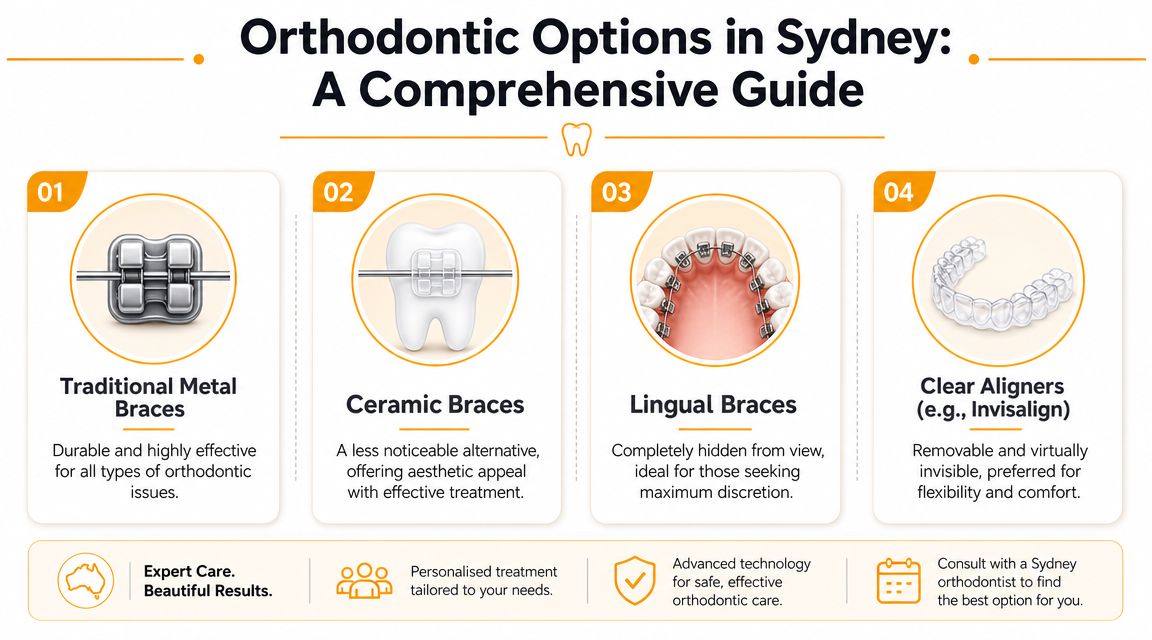
According to Sydney braces and aligners cost benchmarks, metal braces typically range from AUD $3,000 to $9,000, ceramic braces about AUD $6,000 to $12,000, lingual braces AUD $4,500 to $15,000, and clear aligners AUD $4,000 to $12,000. Final costs depend on complexity and duration.
Traditional metal braces
Metal braces remain the most established fixed option. They use visible brackets and wires, but they're durable and effective across a wide range of cases.
They're often the most practical choice when tooth movement is more demanding or when bite correction is a major part of treatment. They also remove one common problem with removable appliances, which is patient compliance. Once fitted, they keep working.
Ceramic braces
Ceramic braces work in a similar way to metal braces but use tooth-coloured or less noticeable brackets. For adults and older teens, that cosmetic difference can matter a lot.
The trade-off is usually cost. Ceramic systems tend to sit above metal braces in Sydney pricing, and they're often chosen by patients who want a fixed appliance without the more obvious look of stainless steel.
Lingual braces
Lingual braces sit behind the teeth rather than on the front surfaces. That makes them the least visible fixed option in everyday conversation.
They're appealing to adults who want maximum discretion, but they're not the simplest path. Access is more demanding, appointments can feel more involved, and not every clinic provides them. If this option interests you, it helps to compare it with other discreet pathways such as adult orthodontic treatment options before deciding.
Hidden treatment isn't always the easiest treatment. The best appliance is the one that gives predictable control for your specific bite.
Clear aligners
Clear aligners are removable trays designed to move teeth in stages. Patients often like them because they're discreet, easy to remove for eating, and simpler to clean around than fixed brackets.
That said, removable treatment places more responsibility on the patient. Aligners only work as planned if they're worn consistently. They can be an excellent option for the right case, but they're not automatically the right answer for everyone.
Quick comparison
| Option | Main strength | Main trade-off | Often suits |
|---|---|---|---|
| Metal braces | Strong control, broad suitability | Most visible | Complex and routine cases |
| Ceramic braces | Less noticeable fixed treatment | Higher cost than metal | Adults wanting a discreet fixed option |
| Lingual braces | Hidden from view | More specialised and technique-sensitive | Adults prioritising discretion |
| Clear aligners | Removable and flexible | Requires strict wear discipline | Mild to moderate cases and lifestyle-focused adults |
The Typical Orthodontic Treatment Journey
Orthodontic treatment works best when patients know what to expect before the first bracket or first aligner tray goes in. The process is usually more predictable than people think, but it does require consistency.
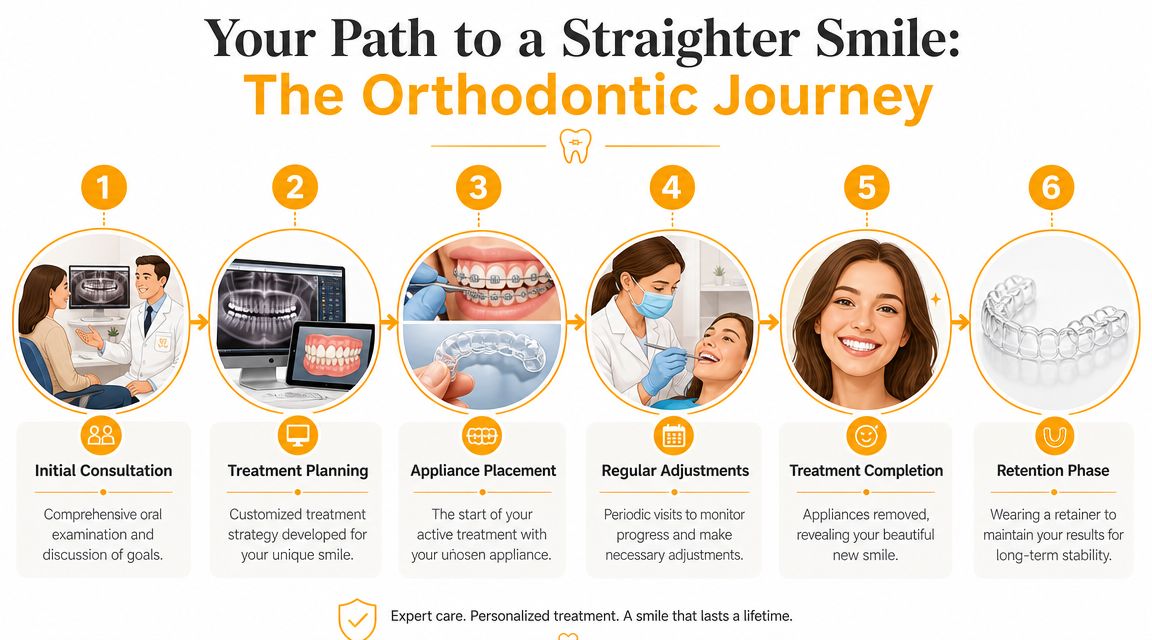
Consultation and planning
The first stage is an assessment of your teeth, bite, jaw relationship, and treatment goals. During this stage, the discussion should move beyond “I want straighter teeth” to the more useful questions. Is the issue crowding, spacing, bite function, or all three? Is your preferred appliance also a clinically suitable one?
Planning matters because orthodontic treatment is controlled movement, not cosmetic guesswork.
Fitting the appliance
Once the plan is confirmed, the appliance is placed. With fixed braces, brackets are attached to the teeth and joined with an archwire. With aligners, you receive a sequence of trays and instructions for wear.
A Sydney clinical explanation of metal braces notes that they are a force-controlled system where brackets, an archwire, and periodic adjustments apply continuous pressure that remodels surrounding bone and moves teeth over time, which is why regular review visits are essential for predictable results.
Review appointments and active movement
This is the part many patients underestimate. Braces don't move teeth on their own once fitted. They need monitoring and adjustment so the force stays controlled and the movement stays on track.
During active treatment, expect a routine of check-ins, small changes, and occasional short periods of tenderness after adjustments. That's normal. The aim is steady, biologically safe progress.
Missing review visits doesn't just slow treatment. It can change how efficiently the system works.
Finishing and retention
When the active phase ends, the braces come off or the final aligner stage is completed. That isn't the end of treatment. Teeth need support to hold their new positions.
Retention is what protects the result you've paid and waited for. Patients who do well long term are usually the ones who take this phase seriously.
A simple way to think about the journey is this:
- Assessment first. Diagnose the bite and choose the right appliance.
- Active treatment next. Move teeth in a controlled way through reviews and adjustments.
- Retention last. Maintain the result so teeth don't drift back.
Understanding the Real Cost of Braces in Sydney
A common starting point is a number. That's understandable. But the true cost of braces in Sydney is rarely the same as the first advertised figure.

The broader Australian picture is useful here. Orthodontic cost guidance in Australia notes that complete orthodontic treatment often ranges from AUD 3,000 to AUD 10,000, that metal braces commonly take 12 to 24 months, and that many clinics offer interest-free payment plans over 18 to 24 months to make treatment more manageable.
Headline price versus full treatment cost
A starting price can be useful for comparison, but it doesn't answer the question patients actually care about, which is: what will I likely pay out of pocket from beginning to end?
That total can change depending on the treatment length, appliance type, review schedule, and whether items such as retainers, emergency visits, or post-treatment reviews are included. Consequently, two quotes that look similar at first can end up feeling quite different.
When you compare quotes, ask for clarity on:
- What the fee covers. Does it include planning, active treatment visits, and retention?
- What might sit outside the main quote. Ask specifically about breakages, emergency appointments, and retainers.
- How treatment length affects price. Longer or more complex treatment usually means more appointments and more chair time.
Where health funds fit in
Private health insurance can help some patients, but it shouldn't be assumed. Extras policies often come with annual limits, waiting periods, and orthodontic rules that differ by fund.
That means the practical question isn't “Do you take my health fund?” It's “What rebate, if any, am I personally eligible for, and when?” A clinic can usually help with item numbers and receipts, but the fund decides the benefit.
Sydney families also need to remember that orthodontics is usually not something most adults can rely on Medicare to cover. That makes up-front budgeting more important.
If staged payments matter to you, it's worth reviewing how an Invisalign payment plan or similar orthodontic finance arrangement works before committing to treatment.
Why payment plans matter
Payment plans don't reduce the fee itself, but they can change whether treatment feels achievable. Spreading costs across the active treatment period often fits household budgeting far better than trying to manage a large lump sum.
For busy families, that can be the difference between delaying treatment and starting at the right time.
Here's a practical way to assess affordability:
| Question | Why it matters |
|---|---|
| Is the quote comprehensive? | It reduces surprises later |
| Is the payment plan interest-free? | It affects monthly budgeting |
| Are retainers included? | Retention is part of the full treatment result |
| What happens if treatment runs longer? | Complexity can affect final cost |
A short overview of treatment finance can also help when you're comparing options:
How to Choose the Right Orthodontist in the Inner West
Choosing a provider isn't just about finding someone who offers braces. It's about finding someone who can explain why a particular treatment suits your bite, your goals, and your timeframe.
One Australian study highlighted a major gap in patient understanding. A national review reported that over 90% of Australians don't know the difference between a general dentist providing orthodontics and a specialist orthodontist, which is why asking about qualifications, experience, and technology matters.
Questions worth asking at the first visit
A good consultation should leave you clearer, not more confused. Ask direct questions and pay attention to how directly they're answered.
Useful questions include:
- Who is planning my treatment? Ask about the clinician's training and orthodontic experience.
- Why is this option being recommended? The answer should refer to your bite, not just appearance.
- What technology do you use? Scans, imaging, and planning tools affect precision and communication.
- How are anxious patients supported? Comfort matters, especially for children and adults who avoid dental care.
- How easy is scheduling? Evening or Saturday options can make treatment far more practical.
What quality care looks like in practice
In the Inner West, convenience often matters nearly as much as technique. Parents are fitting appointments around school. Adults are booking around work, commuting, and family commitments.
That's why practical details count. Clear fee discussions. Reliable review scheduling. A team that can explain treatment in plain language. If you're comparing clinics, it's also sensible to look at resources discussing an orthodontist for adults so you know what to ask from the first consultation.
One local option is The Smile Spot in Dulwich Hill, where Dr Dimitrios Thanos has practised since 1996 and the clinic offers orthodontic services alongside family dentistry, late appointments, Saturday availability, and sedation options for anxious patients. Those practical supports don't replace clinical judgement, but they do make treatment easier to maintain.
The right provider should make the treatment plan feel specific to you, not copied from a template.
Braces vs Aligners Which Is Right for You
A lot of adults walk into a consultation assuming aligners will be the better option because they're less visible. Sometimes that's true. Sometimes it isn't.
The primary question is not which treatment looks more modern. The essential question is which one gives the most predictable result for your teeth and bite without creating avoidable frustration in daily life.
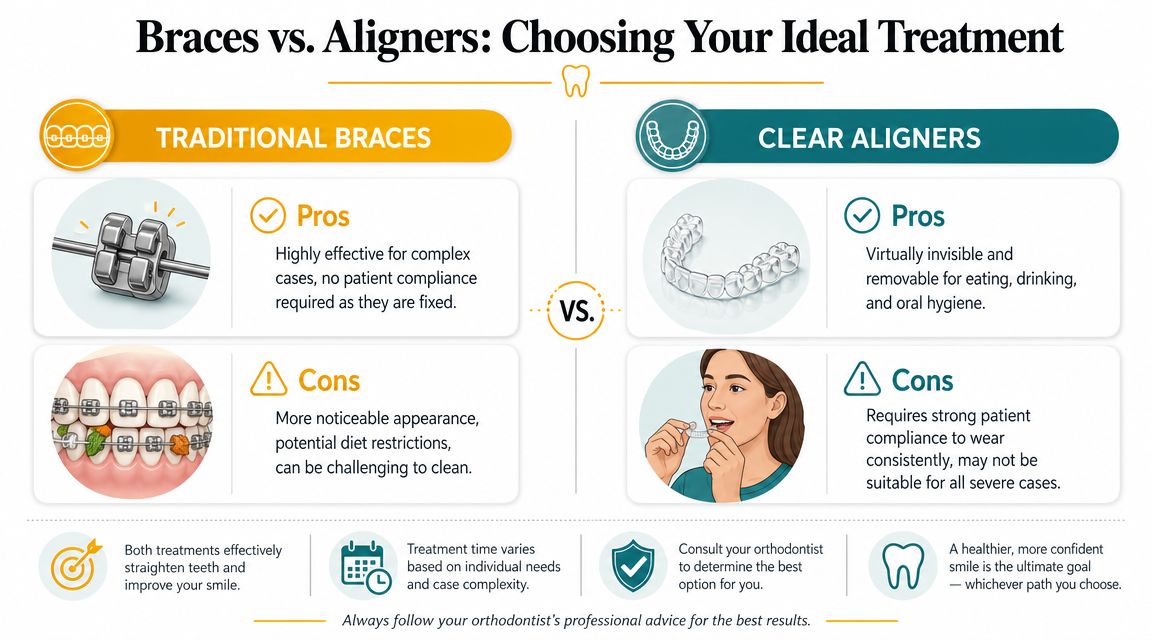
Sydney guidance on discreet orthodontics points out that clear aligners may be less effective for complex bite problems, while lingual braces require specialised training, which is why a thorough consultation is needed to match treatment to clinical and lifestyle demands.
When braces make more sense
Fixed braces usually give better control when the case is more complex. If the issue involves a significant bite problem, more demanding movement, or a need for constant force without relying on patient wear habits, braces often make treatment more predictable.
They also suit patients who know they don't want the responsibility of removing, storing, cleaning, and remembering aligners throughout the day.
When aligners may suit better
Aligners can be a strong choice for adults who want flexibility. They're easier to remove for meals, they simplify brushing and flossing, and they're less obvious in social or professional settings.
But they only work well when the patient works with them. If trays are left out too often, treatment slows or becomes less predictable.
A practical comparison for busy adults
| Question | Braces | Aligners |
|---|---|---|
| Do you want a fixed system? | Yes | No |
| Is your case potentially complex? | Often a strong option | May be less suitable |
| Do you want easy removal for meals? | No | Yes |
| Will you reliably wear trays as directed? | Not required | Essential |
| Is discretion your top priority? | Less discreet | More discreet |
For adults who want to avoid fixed appliances altogether, it also helps to read about ways to fix crooked teeth without braces before assuming every non-braces option will suit every bite.
Convenience on paper isn't the same as suitability in the mouth.
Common Questions About Getting Braces in Sydney
Do braces hurt?
They usually cause pressure and tenderness rather than sharp pain. Most patients notice this more when braces are first fitted or after adjustments. The feeling usually settles as your mouth adapts.
How do I clean my teeth with braces?
Clean more carefully, not just more often. Brush around brackets and along the gumline, and use aids that help reach under wires and between teeth. The goal is to stop plaque building up in spots that become harder to clean once braces are on.
Can I still play sport?
Yes, but protection matters. If you or your child plays contact sport, ask about a suitable mouthguard. Orthodontic appliances and sports impacts aren't a combination to take lightly.
Will braces affect what I eat?
With fixed braces, you'll usually need to be more careful with hard, sticky, or chewy foods because they can damage brackets or wires. Aligners are removed for meals, but they still require discipline around wear and cleaning.
How long do I wear retainers after treatment?
Retention isn't optional. The exact plan depends on your case, but retainers are what help keep teeth in their new positions after active movement ends. This is one of the most important parts of long-term success.
Is there a best age to get braces?
There isn't one universal age. Children, teens, and adults can all benefit from orthodontic treatment. The best timing depends on the bite, growth stage, oral health, and what kind of movement is required.
If you're weighing up orthodontic treatment for yourself or your child, booking a consultation at The Smile Spot is a practical next step. You can discuss braces, aligners, likely treatment pathways, and what a full cost estimate may include, with care designed for families and busy adults in Dulwich Hill and the Inner West.