
You notice it in photos first. Not every photo, just the ones taken from slightly below, or when you smile without thinking about it. One front tooth sits a little forward. The lower teeth look more crowded than they used to. You've probably had the same thought many adults have. “I should've fixed this years ago.”
That thought usually comes with a second one. “Maybe I've left it too late.”
You haven't. Adult orthodontic treatment is a normal part of modern dentistry, and for many people it fits into a wider plan that includes healthier gums, easier cleaning, less uneven wear, and a smile that feels more settled and confident. If you're looking for an orthodontist for adults, the first useful step often isn't choosing brackets or aligners. It's understanding what your teeth, gums, bite, and existing dental work need as a whole.
That matters even more for adults in Dulwich Hill and the Inner West. Many people aren't starting with a blank slate. They may already have fillings, crowns, a bridge, some gum recession, or cosmetic goals they want to coordinate properly. Straightening teeth in isolation can work. Straightening teeth as part of a broader dental plan usually works better.
Is It Too Late to Straighten My Teeth?
A common adult orthodontic story starts without fanfare. Someone had braces recommended as a teenager and never went ahead. Or they did have treatment years ago, stopped wearing the retainer, and watched the teeth drift. Or the issue was always mild enough to ignore until now.
Then something changes. A work event. A wedding. A milestone birthday. A cracked tooth that reveals uneven bite pressure. Suddenly the question feels less cosmetic and more practical.
What most adults are really asking
When adults ask whether it's too late, they're rarely asking about age alone. They're asking several things at once:
- Will it still work for me
- Will it look obvious
- Will it interfere with work or social life
- Will the result be worth the time and money
The reassuring answer is that adult treatment is often very achievable. Teeth can be moved safely in adulthood. The key difference is that the planning needs to respect adult realities, including restorations, gum health, wear patterns, and lifestyle.
Many adults don't need a dramatic change. They need a controlled, well-planned correction that improves function and appearance without disrupting daily life.
That's one reason the old idea that braces are only for teenagers doesn't hold up anymore. Adults now have more discreet options, more digital planning tools, and more flexibility in how treatment is delivered.
Straight teeth aren't the only goal
For some people, the issue is obvious crowding. For others, it's a bite that feels off, food trapping between overlapping teeth, or one tooth taking more force than it should. Adult orthodontics can play a role in all of those situations.
If your concern is mild and you're wondering whether you need full orthodontic treatment at all, it helps to understand how to fix crooked teeth without braces. Sometimes the answer is aligners. Sometimes it's contouring, bonding, or another cosmetic approach. The right path depends on what's causing the problem.
The important point is simple. Age usually isn't the barrier. Diagnosis is. If your teeth and supporting tissues are suitable, treatment can still be a very realistic option.
Why More Adults Are Straightening Their Smile
A common adult orthodontic conversation starts like this. “I don't mind a small gap or a bit of crowding, but food keeps getting stuck there,” or “I've chipped the same tooth twice and my bite feels uneven.” The cosmetic concern is real, but it often sits alongside a practical problem that needs proper diagnosis.
In Australia, adult orthodontics is no longer unusual. Adults account for roughly 25 to 30% of all orthodontic patients, and about 150,000 to 180,000 adults per year have initiated orthodontic care over the past decade, according to the AAO patient numbers report. In day-to-day practice, that reflects what many adults want now: treatment that improves appearance, comfort, and long-term dental stability together.

The health reasons matter more than many people expect
Many adults first ask about straightening because they want to feel better about their smile. After an assessment, the conversation often shifts to function. Alignment can make daily cleaning easier, reduce strain on overloaded teeth, and create better conditions for future dental work.
A better-aligned smile can help with:
- Cleaning access. Overlapping teeth can create tight areas where plaque builds up more easily.
- Tooth wear. A poor bite can overload certain teeth and contribute to chipping or flattening.
- Gum support. When teeth are easier to clean, gum inflammation becomes easier to control.
- Future treatment planning. Alignment can create better conditions for veneers, crowns, or implant work.
For adults, orthodontics often needs to fit into a bigger plan. At The Smile Spot, that matters because the starting point is not just choosing braces or aligners. It is checking the gums, existing fillings and crowns, bite forces, and any cosmetic goals, then coordinating treatment in the right order.
Confidence matters, and so does coordination
Wanting to smile more freely is a legitimate reason to ask about treatment. Adults usually describe this in practical terms. They want to stop covering their mouth in photos, feel more at ease at work, or finally correct a feature they have noticed for years.
Confidence and function are often linked. If a smile looks more balanced and also feels easier to maintain, the result tends to last better.
Practical rule: If the appearance or position of your teeth affects how you eat, clean, speak, or smile, it is worth a proper assessment.
The best adult result is rarely about chasing perfection. It is about getting teeth into a position that looks natural, works comfortably, and supports the rest of your dental health. If you want a wider view of how alignment fits into smile planning, orthodontics and smile design at The Smile Spot gives useful context.
Your Guide to Modern Orthodontic Treatments
A common adult scenario is this. You want straighter teeth, but you also have a crown, a few old fillings, a busy work calendar, and no interest in choosing the wrong appliance and finding out six months later. The treatment itself matters, but so does who is coordinating it.
At The Smile Spot, adult orthodontic planning starts with the whole picture. The choice is not only between braces and aligners. It also needs to fit your bite, gum health, existing dental work, appearance goals, and any cosmetic or restorative treatment you may want later.
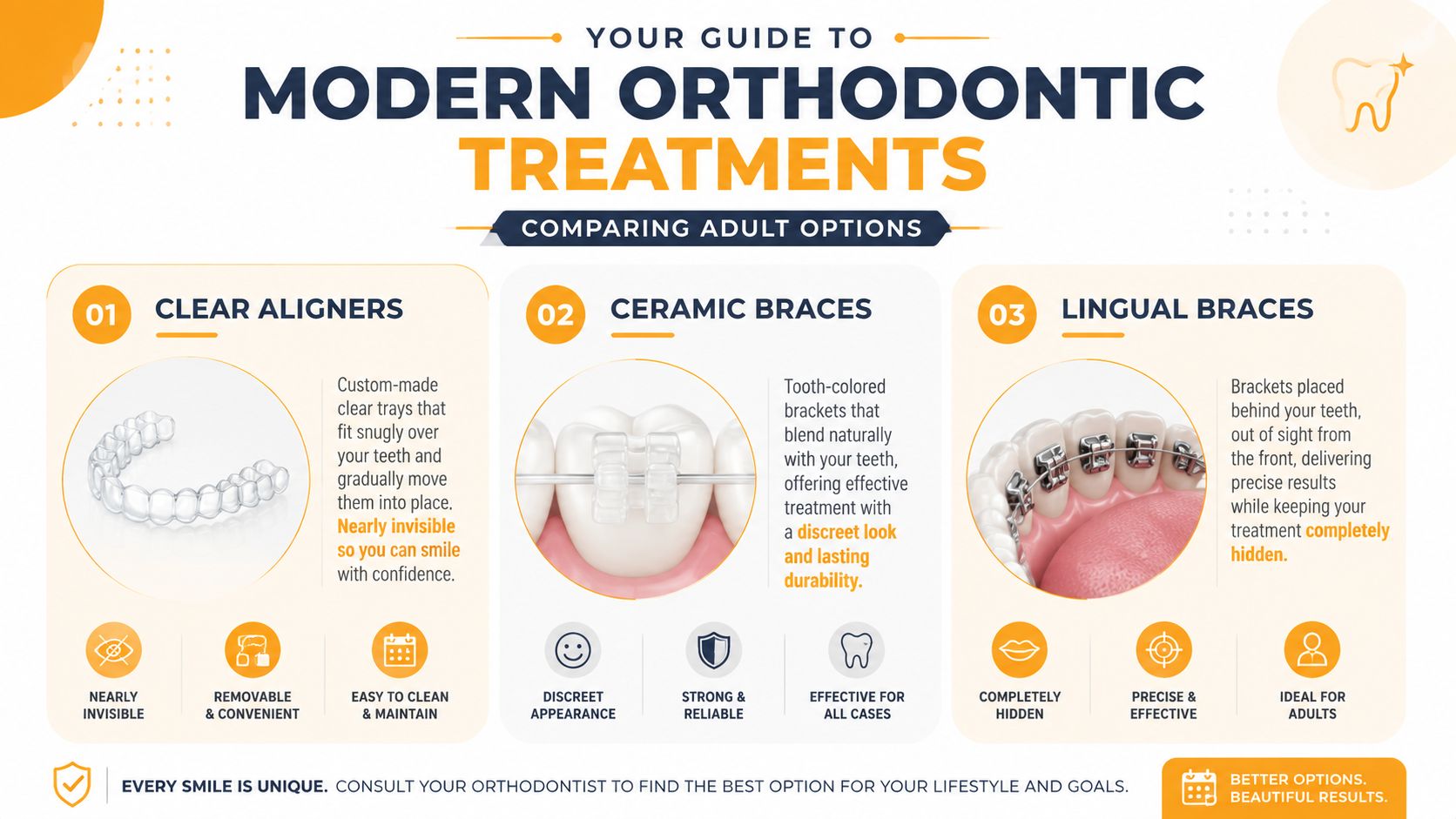
The main treatment options
Metal braces remain one of the most predictable options for more difficult tooth movement. They give strong control when teeth need to rotate, move vertically, or when the bite needs more than a minor adjustment. The downside is obvious. They are the most visible option, and cleaning around brackets takes effort.
Ceramic braces use the same fixed approach with brackets that blend in better with the teeth. For many adults, that makes them easier to accept day to day. They still show up at close range, and the brackets can be a little bulkier than people expect.
Lingual braces sit on the inside surfaces of the teeth, so they are much harder to see. That appeals to adults in public-facing roles who want a fixed appliance without the look of braces. They can affect speech early on, and not every bite is suitable for them.
Clear aligners are often the best fit for adults who want flexibility. You can remove them for meals, brushing, and important events. They are also the option most likely to disappoint if wear time slips. In practice, good aligner results depend on routine and consistency.
Comparing Adult Orthodontic Options
| Treatment Type | Best For | Visibility | Average Treatment Time |
|---|---|---|---|
| Metal braces | More complex crowding and bite correction | High | Often around 12 to 24 months |
| Ceramic braces | Adults wanting fixed treatment with a subtler look | Moderate | Often around 12 to 24 months |
| Lingual braces | Adults wanting hidden fixed appliances | Very low | Varies by case |
| Clear aligners | Adults wanting removable, discreet treatment | Very low | Often around 6 to 18 months |
Those ranges are guides, not promises. In adult cases, the final timing depends on how much movement is needed, whether the bite needs correction, and how well treatment fits around the rest of your dental care.
Where faster treatment fits, and where it doesn't
Adults often ask one practical question first. How long will this take?
Some newer systems aim to shorten treatment or make appointments more efficient, but speed has to stay secondary to control and stability. If teeth are moved faster than the gums, bone, or bite can tolerate, the result is harder to maintain. In coordinated adult care, the better question is whether treatment can be made more efficient without creating new problems.
Digital planning helps here. Better scans, clearer staging, and more accurate appliance design can reduce guesswork and improve communication between the dentist, orthodontic provider, and patient. If you want to see how that technology supports treatment planning, digital scans and dental 3D printing in modern dentistry explains the process clearly.
This short explainer gives a practical sense of what adults often compare when choosing treatment.
What tends to work best for adults
The right appliance is the one that suits the case and the person wearing it.
- Clear aligners suit adults who want discretion and can wear them as directed every day.
- Fixed braces suit adults who need more precise control or would rather not rely on remembering tray wear.
- Lingual or ceramic options suit adults who place a higher value on appearance during treatment and accept the extra trade-offs in comfort, cost, or maintenance.
The mistake is choosing on appearance alone. A better adult plan weighs visibility, cleaning, speech, reliability, work demands, travel, and the condition of existing crowns, bridges, or implants. That is where a trusted general dentist adds real value. The Smile Spot can assess the whole mouth first, then coordinate orthodontic treatment so the final result works well with your long-term dental health, not just the alignment on its own.
Are You a Good Candidate for Adult Orthodontics?
You look in the mirror and wonder whether straightening your teeth is still realistic now that you have crowns, old fillings, or a bit of gum recession. For adults, the essential question is whether the teeth and supporting structures are healthy enough for safe movement, and whether the plan fits with the rest of your dental work.
That is why an adult orthodontic assessment should start with the whole mouth, not just the front teeth.

What a dentist checks first
At The Smile Spot, the first step is to check whether orthodontic treatment makes sense alongside your general dental health and any cosmetic goals you already have. Straightening teeth can be a very good option for adults, but only after the supporting details are clear.
A proper assessment usually looks at:
- Gum health. Active gum disease should be treated before teeth are moved.
- Bone support. Teeth need stable support if movement is going to be safe and last well.
- Decay and older restorations. Fillings, crowns, and worn edges may need attention before treatment starts.
- Bite pattern. The way your teeth meet affects what should be moved, and what should be left alone.
- Previous dental work. Veneers, bridges, implants, and root canal treated teeth all influence planning.
This matters more in adults because the case is rarely just about alignment. It is often about sequencing. Sometimes the right plan is orthodontics first, then bonding or veneers. Sometimes it is the reverse. A general dentist helps coordinate that decision early so the final result looks good and functions properly.
Adult treatment needs careful planning
Adult teeth can still move predictably, but the mechanics usually need closer control than they do in younger patients. Existing crowns, gum recession, bone levels, and non-moving implants can all change how forces are applied and how quickly a case should progress.
One detail catches many adults off guard. Implants stay exactly where they are. If a front implant is already in place, the rest of the orthodontic plan has to work around it. The same applies to bridges and some cosmetic dental work. These factors do not rule treatment out, but they do change the plan.
In practice, this approach requires more attention to records, monitoring, and coordination between providers. For adults in the Inner West, that coordinated strategy is often the difference between a result that looks straighter and one that also fits the bite, protects the gums, and works with future dental treatment.
Existing dental work does not automatically rule you out
Many adults assume they have missed their chance because they have had a lot of dentistry done already. That is often not the case.
You may still be a suitable candidate if you have:
- Crowns or veneers, if they are assessed properly before movement starts
- Bridges, if the tooth movement is planned around them
- Dental implants, with the understanding that the implant itself will not move
- Worn or chipped teeth, where better alignment may help reduce uneven loading
The safest place to start is an examination that is calm, thorough, and honest about the trade-offs. If dental visits make you nervous, this guide to choosing a gentle dentist near you can help you know what to expect from an assessment appointment.
Understanding the Timeline and Costs of Treatment
Adults usually ask two questions early. How long will treatment take, and what will it cost.
The answer depends on the bite, the amount of movement needed, the type of appliance, and whether the teeth and gums are ready to move straight away. In adult cases, the timeline is often shaped by planning decisions made before the first aligner or bracket goes on. That is one reason a coordinated assessment at The Smile Spot can save time later. It helps set the orthodontic plan alongside any restorative, gum, or cosmetic work that may affect the sequence.

What the treatment journey usually looks like
Most adult treatment follows a clear progression, even though the exact timing varies from person to person.
Assessment and planning
This stage covers examination, photos or scans, imaging, and a discussion about what you want to change. It also identifies anything that should be treated first, such as gum inflammation, decay, or a crown that may affect tooth movement.Pre-treatment dental care if needed
Some patients can start orthodontics quickly. Others need a short preparation phase first. A scale and clean, filling, gum treatment, or review of older dental work can make treatment safer and more predictable.Active orthodontic treatment This is the period when teeth are moving. With aligners, progress depends heavily on wear time. With braces, the review schedule and the biology of tooth movement still set the pace.
Refinement
Fine-tuning is common. A small number of extra aligners or minor finishing adjustments can improve the final result.Retention
Teeth can drift after treatment. Retainers are part of the treatment, not an optional extra.
A mild alignment case may be shorter than a case that also involves bite correction, space management, or planning around crowns, bridges, or implants. Adults often care just as much about timing between stages as the total months involved, especially if whitening, composite bonding, or replacement of a missing tooth is also part of the end goal.
Costs need a straight answer
Fees vary for the same reason treatment length varies. A limited cosmetic tidy-up is different from full orthodontic correction with more reviews, more planning, and more finishing work.
What matters is clarity at the start. Patients should know what is included, what may change the fee, and whether other dentistry is likely to sit before, during, or after orthodontic treatment.
A practical cost discussion usually covers:
- The appliance chosen, because clear aligners, fixed braces, and more complex systems are priced differently
- The complexity of the case, including bite issues and any challenges created by existing dental work
- Whether other treatment is needed first, such as periodontal care or replacement planning
- How payments are staged, so the cost is easier to budget for over time
- What retainers and refinement include, because these details affect the true total
For many adults, staged payments make treatment realistic. This guide to an Invisalign payment plan explains the kinds of fee questions worth asking before you commit.
If you are comparing providers, local research can also shape expectations around access and decision-making. Transactional LLC on local visibility growth looks at how patients tend to find and assess orthodontic providers in their area.
The right plan is not always the cheapest one. It is the one that fits your dental health, your cosmetic goals, and your budget without creating problems that need to be fixed later.
Your First Step Your Local Dentist in Dulwich Hill
You notice the crowding more in photos now. You may also have a crown, an old filling, some gum tenderness, or a tooth that has chipped over time. For many adults, straightening teeth is only one part of the plan, and the first appointment should reflect that.
A good starting point is a full assessment with your general dentist. Adult orthodontic treatment often sits alongside other decisions about gum health, bite stability, worn teeth, whitening, bonding, veneers, or replacing missing teeth. If those pieces are looked at separately, treatment can become harder to stage and easier to get wrong.
Why the first assessment matters
Before teeth are moved, it helps to know what else has to be protected, repaired, or timed properly. Adults often already have dental work in place, and that changes planning.
A general dentist can identify issues early and help answer practical questions such as:
- Do the gums need treatment before tooth movement starts
- Will an existing crown, bridge, or implant limit what can be moved
- Should whitening or composite bonding wait until after alignment
- Is there wear, clenching, or bite strain that needs to be factored into the plan
The distinction is important. The aim is usually a result that looks better, functions better, and is easier to maintain, and not limited to teeth that appear straighter.
What coordinated care looks like
At The Smile Spot, an adult orthodontic assessment can be part of a broader discussion about your overall dental health and the finish you want at the end of treatment. That may include preventive care, restorative work, cosmetic planning, and options such as Biolase-supported dentistry where appropriate.
In this model, a local dentist keeps the sequence clear. The orthodontic provider focuses on moving teeth into the planned position. The general dentist monitors gum health, checks how existing dental work fits into the plan, and times any whitening, bonding, veneers, or replacement work so the final result feels consistent rather than pieced together later.
I find that adults value this most when they are trying to avoid redoing treatment. A crown placed too early, whitening done at the wrong stage, or unresolved gum inflammation can complicate what should have been a straightforward course of care.
A well-run adult case feels organised from the start. You should know who is managing each step, and why the order matters.
Questions worth asking before you commit
Ask questions that reveal how carefully the case is being planned.
- Who is responsible for coordinating orthodontics with my other dental treatment
- What needs to be healthy before treatment begins
- How will existing crowns, bridges, or implants affect the plan
- If I want whitening, bonding, or veneers, when should that happen
- Who reviews the bite and the long-term maintenance plan at the end
If you are comparing local providers, it can also help to see how practices present themselves online. This article on Transactional LLC on local visibility growth gives context on how clinics build local visibility, which can help you judge whether the message you see online matches the kind of adult care and coordination you want.
For many adults in Dulwich Hill and the Inner West, the best first move is not choosing braces or aligners. It is getting a proper diagnosis with a dentist who can coordinate the whole sequence, protect your existing dental work, and help shape the final result around health, function, and appearance.
Frequently Asked Questions About Adult Orthodontics
Will orthodontic treatment hurt
Most adults experience pressure and some soreness when treatment starts or changes are made. That usually settles. The feeling is more like tightness than sharp pain, and it tends to be manageable with simple self-care and a soft-food day or two.
Will braces or aligners affect my speech
They can at first. Aligners may give you a slight lisp for a short time. Lingual braces can affect tongue space more noticeably early on. Most adults adapt quickly because speech adjusts with use.
What will I be able to eat
With aligners, you remove them for meals. With fixed braces, you'll need to be more careful with hard, sticky, or chewy foods because they can damage brackets or wires. Good hygiene matters with every option, but especially with fixed appliances.
Can I have orthodontics if I already have crowns or implants
Often, yes. Crowns and bridges can usually be worked around with careful planning. Implants won't move, so they have to be treated as fixed points in the plan. That's why adult cases benefit from thorough assessment before treatment begins.
What is a retainer, and do I really need one
A retainer holds the teeth in their new position after active treatment finishes. Yes, you do need it. Teeth can drift if retention is ignored, even after a very successful result.
If you're considering adult orthodontic treatment in Dulwich Hill or the Inner West, the most useful first step is a thorough dental assessment that looks at your smile, bite, gums, and existing dental work together. The team at The Smile Spot can help you understand whether treatment is suitable, what should happen first, and how orthodontics may fit with your wider dental and cosmetic goals.