
A cracked molar at dinner. A filling that gives way on a Friday afternoon. A toothache that starts as a dull throb and then keeps you awake at 2 am. Often, the initial thought isn't about whether they need walk in dental care. They start by asking a simpler question. “Who can help me today?”
That moment is stressful because dental problems rarely arrive neatly. You're in pain, you're trying to work out whether it can wait, and you may be worried about cost, time off work, or whether turning up without an appointment is even possible. The good news is that there is usually a clear next step once you know what kind of problem you're dealing with.
That Sudden Toothache What Do You Do Now
One common scenario goes like this. You bite into something harder than expected, feel a sharp crack, and suddenly one side of your mouth becomes the centre of your attention. Or the opposite happens. Nothing dramatic at all. A tooth that's been “a bit sensitive” for weeks suddenly becomes painful enough that drinking water hurts.

In that situation, individuals often weigh three options. Wait and hope it settles. Go to hospital. Search for a local dentist who can see them the same day. That's where walk in dental care becomes useful. It sits between routine dentistry and a hospital emergency department. It's designed for problems that are urgent, uncomfortable, and disruptive, but still best treated by a dentist.
What people usually get wrong
The biggest mistake is delay. Pain can ease temporarily even when the underlying problem is getting worse. A cracked tooth may stop hurting after the initial shock, but still leave the nerve exposed. A swelling may seem small in the morning and become much more difficult by night.
Practical rule: If the problem is affecting eating, sleeping, speaking, or concentrating, it's time to contact a dentist the same day.
The second mistake is assuming every urgent dental issue belongs in hospital. Hospitals are important for medical emergencies. They are not usually where definitive dental treatment happens. If your issue is a tooth, restoration, gum infection, or sudden pain without a medical red flag, an urgent dental appointment is often the faster path to relief.
If you're in the Inner West and trying to work out what to do next, this guide on emergency dental clinics near me can help narrow the immediate choice.
Understanding Walk-in Dental Care
Walk in dental care is best understood as the dental version of urgent care. It's not the same as a routine check-up booked weeks ahead, and it's not the same as a hospital emergency department handling major trauma or medical instability. Its role is straightforward. Assess the problem quickly, control pain, identify the cause, and provide treatment that's either definitive on the day or safely stabilises the tooth until the next step.

What “walk-in” usually means in practice
In Australia, the term can be a little misleading. Government and public-clinic pathways often triage same-day dental access rather than operating as a true open-door service, which means calling ahead may be the fastest way to get care rather than arriving unannounced, as noted in public clinic guidance on free and low-cost dental clinics.
That matters because a phone call lets the clinic do three practical things:
- Prioritise urgency so severe pain, swelling, trauma, or bleeding is identified early.
- Prepare the right slot so you're seen by the right clinician with the right equipment available.
- Guide you before arrival if you need to store a knocked-out tooth properly or control bleeding.
A useful analogy is this. A scheduled dental exam is like a planned GP appointment. Walk-in dental care is like urgent care for a sudden but focused problem. A hospital emergency department is for situations where breathing, swallowing, major injury, or broader medical safety is the concern.
What it is not
It isn't a shortcut for all dental needs. If you want a routine scale and clean, cosmetic advice, or a long treatment discussion, a standard appointment is usually better. Urgent care works best when the goal is immediate problem-solving.
Same-day dental care works best when the problem is specific, recent, and hard to ignore.
If you need local urgent help, a dedicated emergency dentist in Dulwich Hill is the sort of service designed for this exact gap.
Is It an Emergency A Guide to Your Next Step
The hardest part for many patients isn't the pain. It's deciding where to go. A useful way to think about it is to separate dental urgency from medical danger.
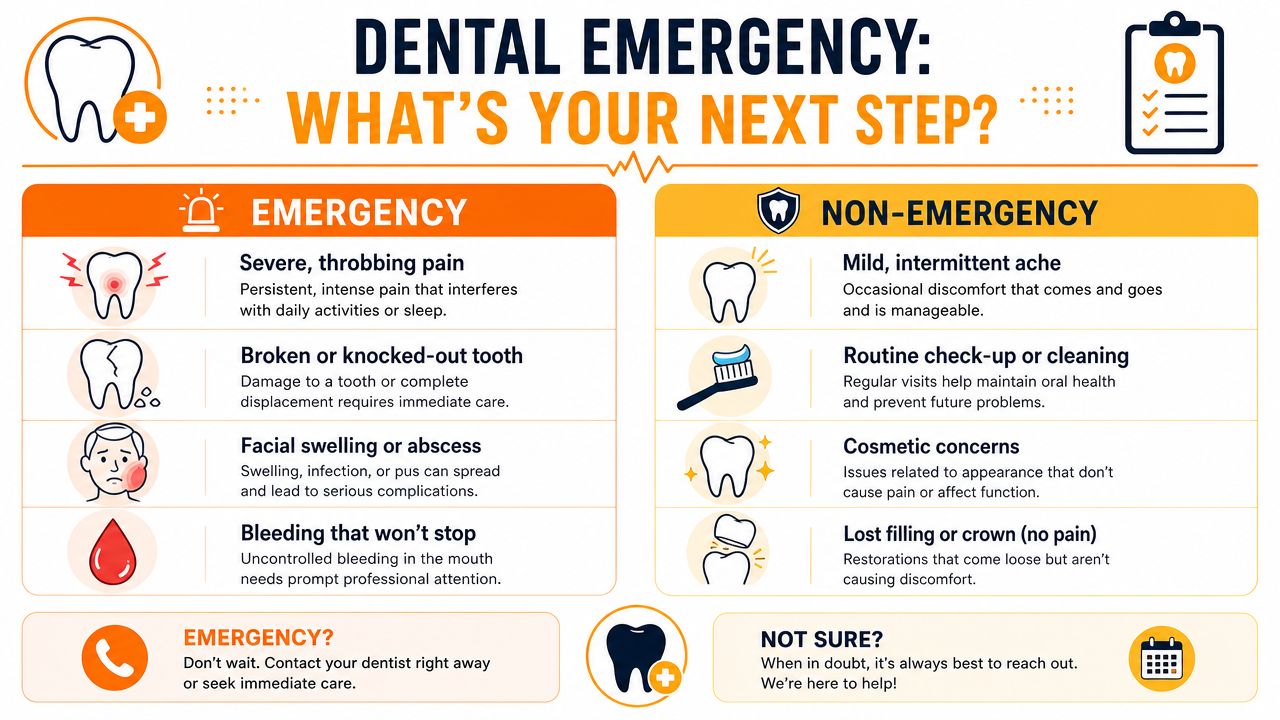
Choose urgent dental care when the issue is in the mouth and needs a dentist
These are the problems that usually belong in a same-day dental chair, not a waiting room in hospital:
- Severe toothache that doesn't settle and is stopping you from eating or sleeping
- A broken, chipped, or cracked tooth with pain, sensitivity, or a sharp edge
- A lost filling or crown that leaves the tooth exposed or painful
- Swelling around a tooth or gum that suggests infection
- A knocked-out tooth or a tooth pushed out of position after trauma
- Pain after a recent dental procedure that feels stronger than expected
Walk-in dental care is especially justified for time-sensitive trauma. Guidance on dental emergencies and what to do notes that for a knocked-out tooth, rapid action, ideally within the hour, materially improves the chance of saving it. That's why delay can turn a salvageable tooth into an extraction.
If a permanent tooth has come out, hold it by the crown, not the root. If it's dirty, rinse it gently. Try to keep it moist in milk or water and get dental advice immediately.
Here's a short explainer discussing the same decision clearly:
Go to hospital when the problem is bigger than the tooth
Hospital emergency care is the right choice if you have signs that the issue may affect your airway, your general medical safety, or involve major facial injury.
| Situation | Best next step |
|---|---|
| Trouble breathing or swallowing | Hospital emergency department |
| Facial swelling spreading quickly | Hospital emergency department |
| Uncontrolled bleeding that won't stop with pressure | Hospital emergency department |
| Suspected jaw fracture or major facial trauma | Hospital emergency department |
| Localised tooth pain, broken tooth, lost crown, dental swelling | Urgent dentist |
If swelling is affecting your breathing, swallowing, or ability to open your mouth properly, don't wait for a routine dental slot.
Some painful teeth turn out to involve the nerve rather than just the outer tooth structure. If that sounds familiar, these signs you need a root canal can help you recognise what's going on.
Common Services and Transparent Costs
Once people decide to seek care, the next concern is usually practical. What can be done today, and what will it cost?
What can often be treated on the day
An urgent dental visit usually focuses on one of two goals. The first is immediate relief. The second is stabilising the problem so it doesn't worsen.
Common same-day care may include:
- Assessment and diagnosis with an exam and, where needed, X-rays
- Pain-focused treatment such as draining infection, smoothing a sharp fracture, or placing a temporary restoration
- Repair work for a broken filling, crown, or chipped tooth when the situation allows
- Tooth extraction when the tooth can't be predictably saved or the infection requires it
- Initial root canal treatment when pain is coming from an inflamed or infected nerve
- Advice and medication planning when the next stage of treatment needs to be sequenced carefully
Not every emergency is solved permanently in one visit. That isn't failure. It's often the safest approach. A very inflamed tooth, for example, may need pain relief and stabilisation first, followed by definitive treatment once the area settles.
Why transparent fees matter in urgent care
Cost anxiety delays treatment. In Australia, 21.5% of people aged 15 and over delayed or avoided dental care because of cost, and the figure was 30.9% among people aged 15 to 24, according to the national oral health findings cited in this dental care cost avoidance summary. That's one reason urgent dental problems often begin as smaller issues that were put off too long.
Clear pricing helps patients make decisions faster. Instead of wondering whether they can afford to even be assessed, they can understand the immediate outlay and the likely next steps. The Smile Spot publishes a $240 care package for exam, X-rays, scale, and fluoride. That package isn't a universal emergency fee for every scenario, but it's a useful example of upfront pricing in a clinic setting.
A good urgent visit should reduce uncertainty, not add to it. That includes the financial conversation.
Private health funds can often be used for urgent dental treatment, depending on your cover. If you're worried about staging treatment sensibly, this guide on dentists with payment plans near me is worth reviewing before you put the problem off any longer.
Your Urgent Care Visit at The Smile Spot
An urgent appointment feels easier when you know what will happen before you arrive. Most good emergency dental visits follow the same broad sequence. Contact, triage, assessment, treatment, then a clear plan.

Before you leave home
If you can call first, do it. That gives the clinic a chance to ask what happened, how severe the pain is, whether there's swelling or trauma, and whether you need immediate medical care instead. It also helps staff reserve the right amount of time.
Bring any relevant information with you:
- Your medication list if you take regular medicines
- Private health fund details if you plan to claim
- The broken piece, crown, or tooth if it has come out and can be transported safely
- A support person if you're very anxious or uncomfortable driving
What happens once you're in the chair
The first priority is sorting out what's causing the pain. That means a focused history, examination, and imaging when clinically needed. Urgent care works well when the process is organised. Australian urgent-care models rely on exactly that kind of structured triage and same-day treatment pathway, as described in emergency department referral guidance for dental care.
From there, treatment depends on the diagnosis. Some patients need a simple repair. Others need a tooth opened to relieve pressure, an extraction, or temporary stabilisation so they can return for more definitive care. If anxiety is part of the problem, that should be addressed early, not treated as an afterthought.
The Smile Spot in Dulwich Hill offers late evening and Saturday appointments, along with options such as sedation and Biolase laser dentistry where clinically appropriate, which can be helpful for anxious patients and for treatment approaches that aim to be more minimally invasive.
The best urgent visit is calm, efficient, and specific. You should leave knowing what was done, what still needs attention, and what to expect over the next day or two.
If nerves are a major barrier, this page on dental sedation near me explains how sedation can fit into dental treatment planning.
After the Emergency From Relief to Recovery
Urgent treatment is only the first chapter. The pain may be gone, but the reason it started still needs a proper plan.
Relief is not always the final fix
A temporary filling can protect a tooth, but it may still need a crown or root canal. Draining an infection can settle the immediate pressure, but the source of the infection still has to be treated. Even an extraction may create a later decision about replacing the tooth so neighbouring teeth don't drift and bite forces stay balanced.
That's why continuity matters. A lot of patients think the emergency appointment is the whole job. Often it's the point where treatment becomes possible again because the crisis has been brought under control.
What follow-up should include
A strong follow-up plan is usually simple and specific:
- A clear diagnosis in plain language, not just “we fixed it for now”
- A definitive treatment recommendation so you know the long-term answer
- Timing guidance on what needs doing soon and what can wait briefly
- Discussion of payment options if cost was one reason the issue was delayed
- A return visit to check healing or complete the next stage
A major gap in patient understanding of walk-in care is what happens after the first visit. Guidance discussing urgent dental access notes that continuity, including a treatment plan, payment options, and follow-up, is critical to stop a one-off urgent problem from becoming repeated crisis care, as outlined in this resource on dental care access and follow-up planning.
If you've needed walk in dental care once, that doesn't mean something has gone wrong with you. It usually means a problem reached the point where it could no longer be ignored. The value of follow-up is making sure you don't have to go through the same scramble again.
If you need same-day dental advice in Dulwich Hill or the Inner West, The Smile Spot offers urgent appointments, clear treatment planning, and practical options for moving from immediate relief to lasting care.