
Getting everyone to the dentist can feel harder than the treatment itself. One child needs a first check-up, another has a sports mouthguard to replace, a parent keeps putting off a sore tooth, and a grandparent wants to ask about dentures or implants. In most families, dental care slips when life gets busy.
That's why a single dental home matters. Good family dental care isn't only about convenience. It's about having one practice that understands how oral health changes across different ages, keeps records in one place, notices patterns early, and helps the whole household stay on track before small issues turn into bigger ones.
Your Partner in Family Dental Health in Dulwich Hill
For Inner West families, the simplest system is usually the one that works best. If your dentist can see children, teenagers, adults, and older relatives in the same practice, bookings become easier, advice stays consistent, and follow-up care is less likely to fall through the cracks.
That continuity matters more than many people realise. A toddler's first visit is about comfort and habit-building. A school-aged child may need monitoring for decay risk or developing bite issues. Adults often need maintenance, fillings, crowns, or gum care. Older patients may be thinking about worn teeth, missing teeth, bridges, dentures, or implants. These needs are different, but they connect.
A family-focused clinic should make that connection practical.
- One place for records: Your dental history, X-rays, treatment notes, and preventive plan stay together.
- One team for changing needs: The advice given to a child can support what parents are already doing at home.
- One routine to manage: Booking several family members through one practice usually means fewer missed appointments and less back-and-forth.
In Dulwich Hill and the surrounding Inner West, families often want care that feels local, steady, and straightforward. That means clear explanations, gentle treatment, and a clinic that can handle both routine care and more involved work when needed.
A good family dentist doesn't just treat the tooth in front of them. They help the household build habits that hold up over time.
If you want to understand who's providing that care and how the practice works, the about page for The Smile Spot gives a useful overview of the clinic and its approach.
What Is Family Dental Care Really
Family dental care is often described as “dentistry for all ages”, but that definition is too thin. Value is continuity. A family dentist works more like a family GP than a one-off provider. They see how habits, risks, and treatment needs change over time, and they aim to keep problems from developing in the first place.
The starting point is prevention. The World Health Organization says oral diseases affect nearly 3.7 billion people globally, and untreated dental caries in permanent teeth is the most common health condition worldwide. The same WHO oral health fact sheet also notes that these diseases are largely preventable, with protective measures including fluoride exposure and brushing twice daily with fluoride toothpaste, which is why regular professional care sits at the centre of family dentistry according to the WHO oral health fact sheet.
The three parts that matter
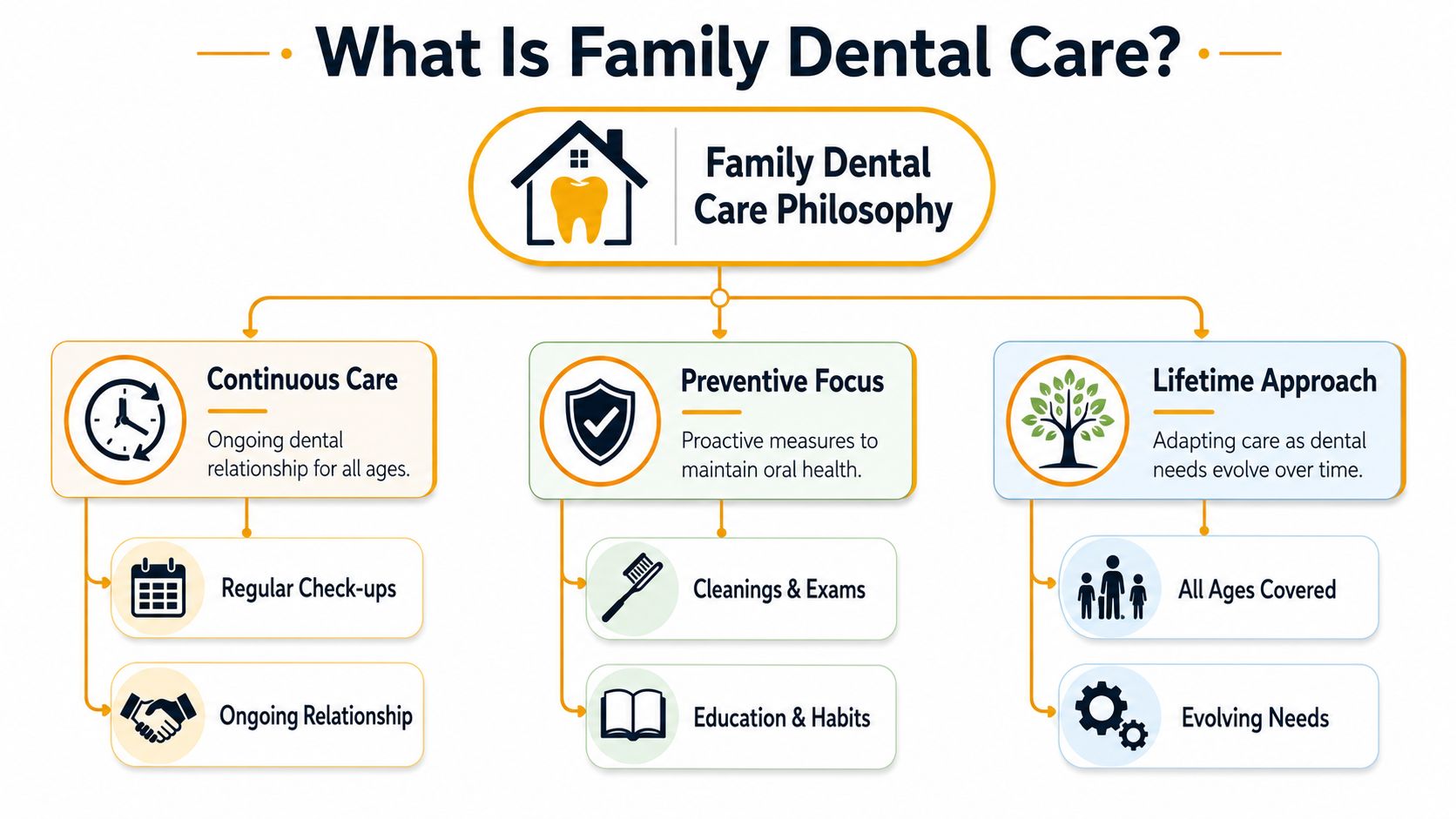
Family dentistry works best when three ideas stay together.
| Pillar | What it means in practice | Why it matters |
|---|---|---|
| Continuous care | Regular visits with the same practice over time | Early changes are easier to spot |
| Preventive focus | Check-ups, cleans, fluoride, home-care guidance | Less chance of avoidable treatment later |
| Lifetime approach | Care adapted for children, teens, adults, and seniors | Needs change, but prevention still matters |
A practice that only reacts to pain isn't really delivering family dental care. Pain usually arrives late. By the time a tooth hurts, the treatment options are often narrower and more invasive than they would have been earlier.
What does and doesn't work
What works is usually very simple and very consistent.
- Regular reviews: These help catch decay, gum problems, wear, and bite changes early.
- Fluoride-based prevention: This supports enamel and lowers risk when used appropriately.
- Clear home-care coaching: Families do better when the advice is specific and realistic.
What doesn't work is the “wait and see unless it hurts” approach. That often leads to rushed decisions, emergency visits, and treatment under pressure.
For a closer look at how prevention fits into day-to-day oral health, The Smile Spot has a helpful article on preventive dental care.
Dental Care for Every Age and Stage
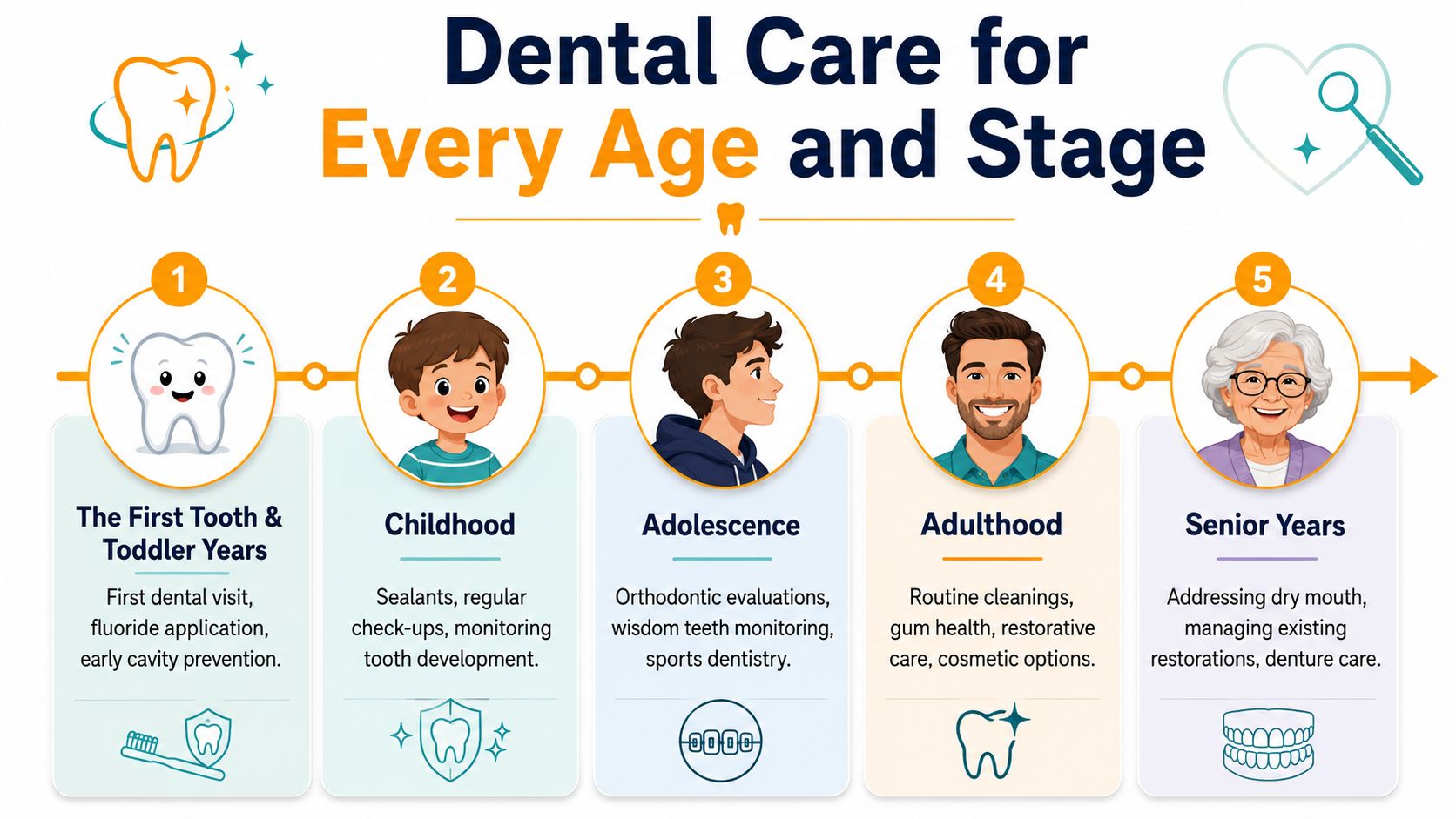
A child with newly erupted teeth, a teenager with crowding, a busy parent with bleeding gums, and a retiree thinking about tooth replacement don't need the same care. Family dental care works because it changes with the person in the chair.
One pattern is worth noting. In mature dental systems, children are more likely than adults to attend routinely. U.S. surveillance data showed 86.9% of children had a recent dental visit, compared with 65.5% of adults, which highlights why family practices need to support ongoing care for parents as well as kids in the CDC dental visit data.
The first tooth and toddler years
Early visits are less about treatment and more about normalising the dental environment. The goals are to check development, discuss brushing, talk about diet, and make the child comfortable sitting in the chair.
At this stage, parents should focus on:
- Brushing support: Young children need hands-on help, not reminders from across the room.
- Diet habits: Frequent sugary snacks and drinks are a common problem.
- Positive exposure: Short, calm visits usually build better long-term cooperation than waiting for a problem.
Childhood and the mixed dentition years
Once primary and permanent teeth are both present, things get busier. Dentists watch eruption patterns, plaque control, early decay, and whether fissure sealants or additional fluoride support may help.
This is also the age where school, sports, and routine changes can interrupt good habits. The best plan is usually a realistic one. If brushing is rushed in the morning, build more structure into the evening routine instead of pretending both are going perfectly.
Practical rule: If your child can't brush thoroughly on their own yet, they still need supervision even if they insist they've “already done it”.
Families looking for age-specific guidance can read more about paediatric dental care.
Teenage years
Teenagers often look independent while still needing close monitoring. Orthodontic concerns may become clearer, wisdom teeth may need review later on, and sport-related dental injuries become more relevant.
This stage also brings a few common trade-offs:
- Appearance starts to matter more, so teens may be more motivated to improve their smile.
- Home care can get worse if routines become irregular.
- High-acid drinks, late-night snacking, and skipped brushing can undo a lot of earlier good work.
Adulthood and senior years
Adults often delay care because they're managing everyone else first. That's a mistake. Gum disease, cracked fillings, grinding, wear, and missing teeth are easier to manage when picked up early. Waiting for pain rarely saves time or money.
For older adults, the focus often shifts toward preserving function and comfort. Existing crowns, bridges, fillings, and dentures may need review. Dry mouth can complicate decay risk. Some people need repair work. Others want a more stable long-term solution such as implants.
The key across every life stage is the same. Dentistry works best when it's planned before it becomes urgent.
Common Dental Services for Your Family
Family dentistry works best when care matches the stage your household is in. A six-year-old who needs fissure protection, a teenager with a sports injury risk, a parent putting off a broken filling, and a grandparent thinking about replacing missing teeth do not need the same plan. They need the right treatment at the right time, in one clinic that can follow the bigger picture over years.
The core services usually fall into two groups. First, the work that helps families avoid trouble. Second, the work that repairs damage once a tooth, gum, or bite problem has already developed. The trade-off is simple. Preventive care is usually smaller, easier, and less expensive. Delayed care often leads to more appointments, more cost, and fewer conservative options.
Preventive care and early repair
Routine care includes examinations, cleans, fluoride where needed, and X-rays when they will change diagnosis or treatment. These visits are not just administrative check-ins. They are where dentists pick up early decay, gum inflammation, eruption issues, grinding wear, and cracks before they turn into painful or costly problems. If you want a practical overview of what happens at one of these visits, this guide to a dental check-up and clean appointment explains it clearly.
For families, the most common treatments in this category include:
- Check-ups and cleans: Used to review teeth, gums, plaque build-up, and changes since the last visit.
- Fluoride treatment: Helpful for children and adults with higher decay risk, dry mouth, braces, or a history of frequent cavities.
- Fissure seals: Often useful for children once adult molars come through, because deep grooves are harder to clean well.
- Custom mouthguards: A sensible step for school sport and weekend sport, especially where contact or falls are common.
- Fillings: Best done while damage is still limited and the tooth has enough healthy structure left.
Small problems stay small only if they are found early.
Restorative and advanced options
Once a tooth is badly broken down or infected, treatment decisions become more practical and more case-specific. Dentists weigh how much sound tooth remains, how well the tooth can function after repair, the condition of the surrounding gum and bone, and whether the result is likely to last. Saving a tooth is often preferable, but not every tooth is a good long-term candidate.
Common services at this stage include:
- Crowns: Used when a tooth needs more support than a filling can provide.
- Root canal treatment: Chosen when the nerve is infected but the tooth can still be retained with a reasonable prognosis.
- Extractions: Sometimes the safer option when decay, fracture, or infection is too advanced.
- Bridges: A fixed way to replace a missing tooth in selected cases.
- Wisdom teeth assessment and removal: Considered when wisdom teeth are causing repeated pain, swelling, decay, or pressure on nearby teeth.
- Dental implants: A stable option for replacing one or more missing teeth when bone and general oral health are suitable.
- All-on-4 treatment: Considered for adults with many failing or missing teeth who want a more fixed full-arch solution.
Some families also ask about treatment technology and comfort. Laser dentistry can support selected procedures with less tissue trauma in the right case, but it is not a replacement for careful diagnosis or sound treatment planning. The method matters less than whether the treatment suits the problem.
A short visual explanation can help if you're comparing treatment paths:
For urgent problems outside routine hours, some patients also look into 24 hour emergency dental services. Within a family clinic, though, the broader goal is consistency. Children grow into teenagers, parents eventually need more restorative work, and older adults may need tooth replacement or maintenance of existing crowns, bridges, or implants. A clinic such as The Smile Spot can provide routine care, restorative treatment, wisdom teeth management, veneers, implants, and All-on-4 under one roof, which makes long-term planning easier for families.
Gentle Care for Anxious Patients and Dental Emergencies
Fear is one of the main reasons people delay treatment. That fear isn't limited to children. Adults often carry memories of uncomfortable dental visits, difficulty getting numb, embarrassment about the state of their teeth, or worry that they'll be judged for leaving things too long.
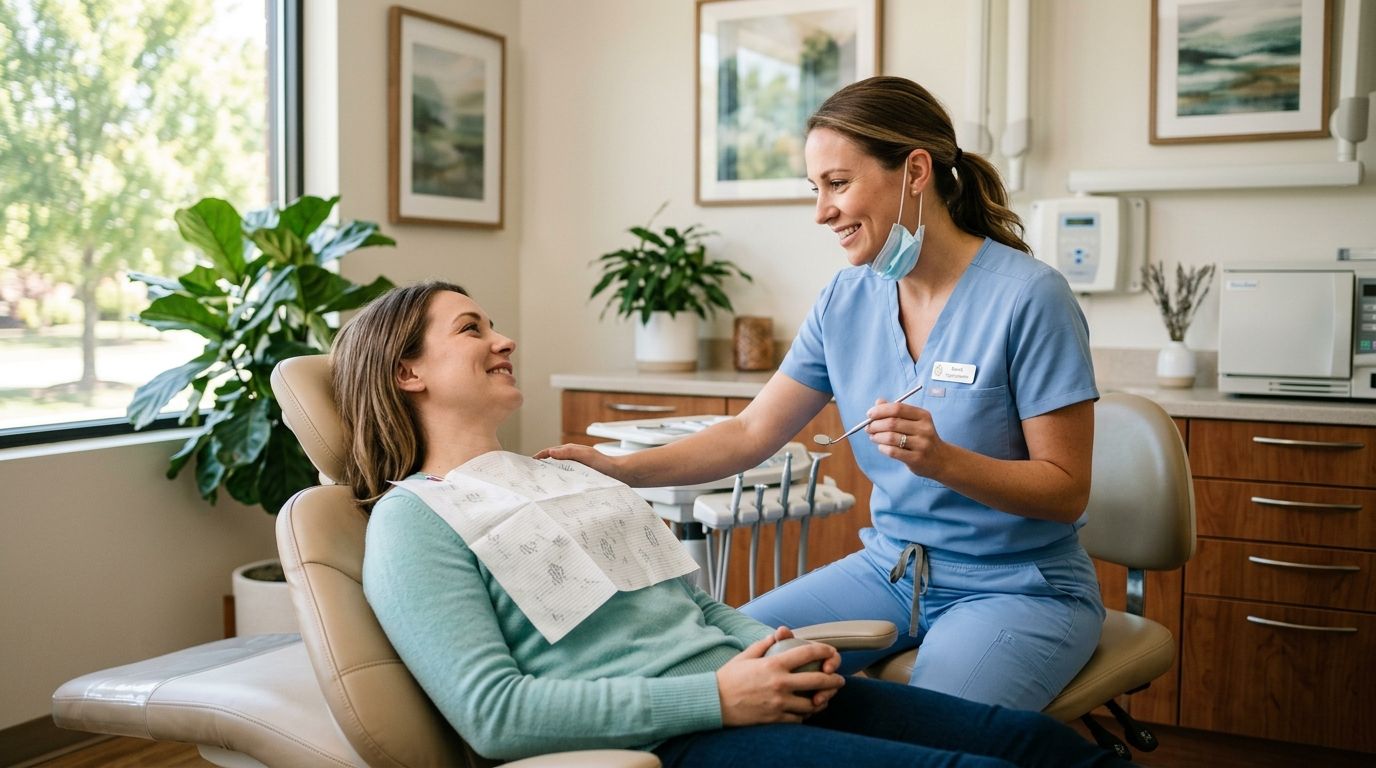
A gentle approach changes the experience. Patients usually cope better when the dentist explains what's happening in plain language, pauses when asked, and agrees on a clear step-by-step plan before starting. Sedation can also be appropriate for some patients when anxiety is the main barrier to necessary care.
What helps anxious patients most
The most effective strategies are rarely dramatic. They're practical.
- Tell the team early: Say you're anxious before the appointment starts.
- Agree on stop signals: A simple hand signal gives you more control.
- Ask for staged care: Some people do better breaking treatment into shorter visits.
- Discuss sedation: It's not for everyone, but it can make necessary care possible.
For patients who've been avoiding treatment, reading about a gentle dentist near me can make the first step feel more manageable.
If anxiety is stopping you from booking, the right goal isn't to “be brave”. It's to make the visit manageable enough that you can actually get care.
Knowing what counts as an emergency
Some problems shouldn't wait. Severe toothache, swelling, facial trauma, a knocked-out tooth, a broken tooth with pain, or signs of infection need prompt assessment. Even when the problem starts small, dental pain can escalate quickly.
If you're trying to understand urgent treatment pathways more broadly, this guide to 24 hour emergency dental services gives a useful overview of what emergency support is designed to handle.
In practice, families do best when they don't try to self-diagnose for too long. Temporary measures at home may help with comfort, but they don't replace an examination when pain, swelling, or trauma is involved.
How to Choose the Right Family Dentist in the Inner West
Choosing a family dentist shouldn't come down to who has the first available slot. You're choosing a long-term clinical relationship, and that affects prevention, comfort, and the quality of decisions made over time.
Access matters more than people think. The Australian Institute of Health and Welfare reports that 1 in 5 children aged 5 to 14 had untreated tooth decay in 2022 to 2023, with worse outcomes in lower socioeconomic areas, which is one reason an accessible, prevention-focused clinic matters so much for families as discussed in this Australian oral health review.
What to look for in real life
A useful test is whether the practice can look after your family through ordinary care and the more complicated moments.
| What to check | Why it matters |
|---|---|
| Care for all ages | You won't need to move between multiple clinics as needs change |
| Strong preventive approach | Good habits and early diagnosis reduce avoidable treatment |
| Comfort with anxious patients | Fear is a real barrier, not a minor issue |
| Range of restorative options | Fillings, crowns, extractions, and tooth replacement should be available when needed |
| Practical access | Convenient hours and local access make attendance more likely |
Questions worth asking before you book
Not every practice is the right fit for every household. Ask direct questions.
- Can they care for children and adults in the same practice?
- How do they handle anxious patients?
- What happens if someone in the family needs urgent treatment?
- Do they explain options clearly, including when treatment can be staged?
- Are fees discussed upfront?
A good family dentist doesn't push every patient into the same pattern. Some people need tighter monitoring. Some need phased treatment. Some need the simplest possible plan to get back into care after a long gap.
For families around Dulwich Hill, Marrickville, Ashfield, Summer Hill, and nearby suburbs, local trust still matters. A dentist who has served the area for years usually understands the practical issues families face. Time, anxiety, budgets, and busy schedules all affect treatment decisions.
Your Visit to The Smile Spot A Practical Guide
A common family scenario is simple enough. One child needs a school holiday check-up, a parent has been ignoring a broken filling, and nobody wants three separate trips across the Inner West. A good first visit should reduce that load, not add to it.
At The Smile Spot, the starting point is practical. The clinic offers a $240 care package with an exam, X-rays, scale, and fluoride application, plus a reduced rate for children. That suits many households because home care and fluoridated water help, but they do not replace regular checks, professional cleaning, or advice that changes with age. A six-year-old, a teenager in braces, and an adult considering implants rarely need the same plan.
Making the booking process easier
The families who attend consistently usually make the process easier before they book. If appointments keep getting pushed aside by sport, school, and work, it helps to manage family schedules on iPhone so everyone can see what is already locked in.
A few small steps make the first visit run more smoothly:
- Book with purpose: If two or more family members are due, ask about grouping appointments.
- Have your health fund details ready: The clinic accepts most private health funds.
- Use the hours that suit real family life: Late evening and Saturday appointments can be easier for working parents and school-aged children.
- Choose online booking if phone calls are hard to fit in: That often cuts down on delays and missed messages.
The best first appointment is the one your family can attend calmly and on time.
If you have delayed dental care for a while, start with a check-up. That gives you a baseline, shows what can wait and what should be treated sooner, and helps you plan care in stages if needed. For Inner West families, that kind of clarity matters. It is often the difference between keeping up with routine care and only coming in when something hurts.