
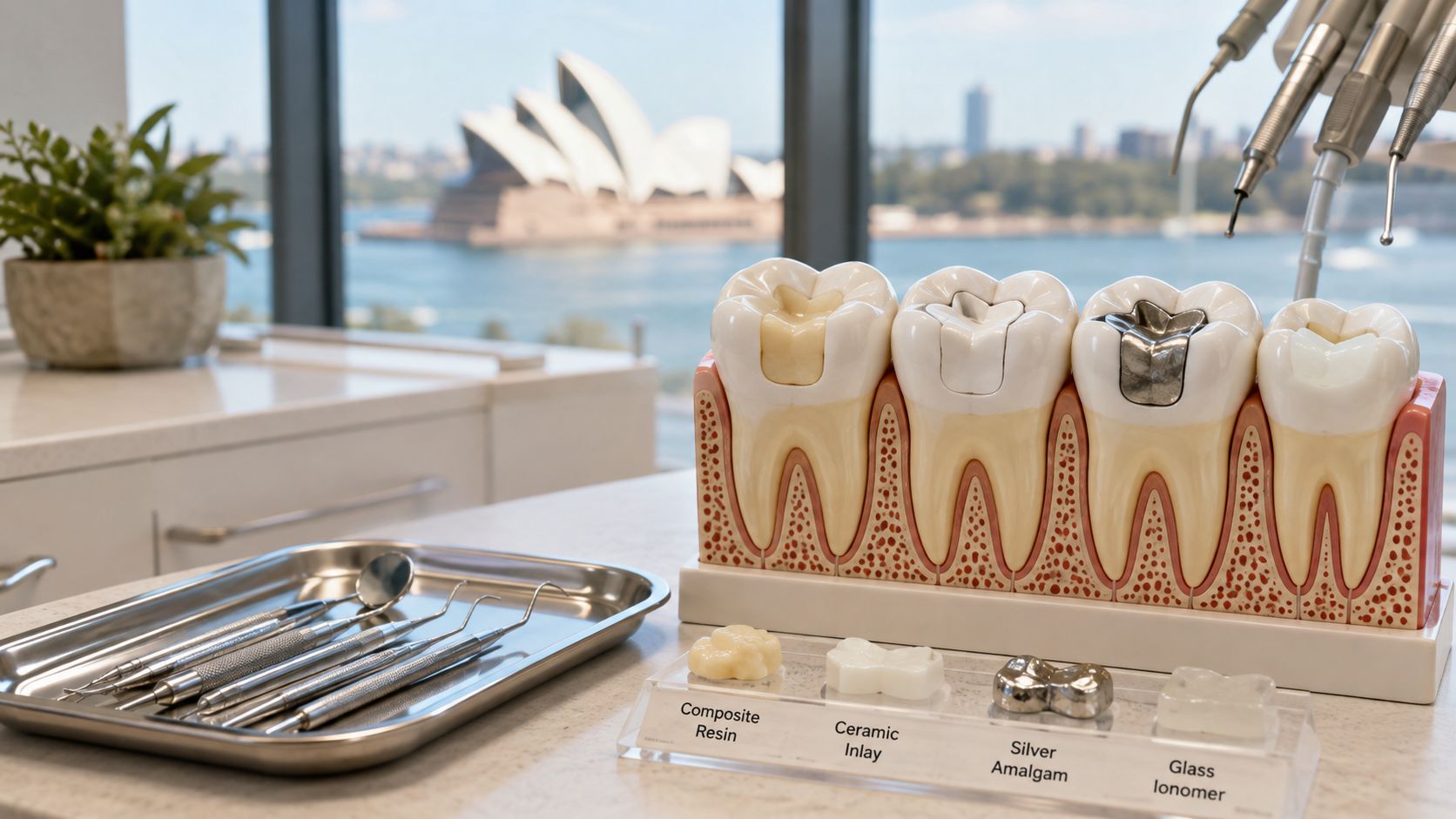
Many hear the word filling and assume the answer is automatic. A dark spot, an X-ray shadow, a rough edge, drill and fill. In real Sydney practice, that's not always the right call. Some early lesions can be watched, stabilised, and even managed with preventive care, while deeper decay needs restoration before it turns into a bigger repair.
That distinction matters for anyone looking into teeth filling Sydney treatment, because the decision affects cost, tooth preservation, and how soon you need to sit in the chair. It also affects whether you're paying for a simple composite repair or allowing a lesion to grow into a more complex restoration. The practical question isn't just “Do I need a filling?”, it's “What's the least invasive treatment that still protects the tooth properly?”
Does Every Cavity Actually Need a Filling
A cavity doesn't automatically mean a drill. Early enamel changes can sometimes be monitored if the lesion is inactive, the surface is intact, and the person's caries risk is controlled. That's the part many patients never hear, because a lot of dental advice jumps straight to treatment without explaining the decision-making behind it.
What dentists actually look for
Dentists weigh lesion depth, activity, symptoms, and the patient's broader caries risk. A spot that sits in enamel and hasn't started breaking down may be managed with fluoride, diet changes, and stronger home care, especially if there's no pain or softening. Once decay reaches dentine, or the lesion is clearly active, a filling becomes much more likely because the tooth no longer has the same chance of stabilising on its own.
Practical rule: If the surface is intact and the lesion looks stable, monitoring can be reasonable. If the tooth is sensitive, soft, or breaking down, treatment usually needs to happen sooner.
That's why a second opinion can be sensible when you're unsure. It's not about delaying care for the sake of it, it's about making sure the tooth needs restoration now. Good preventive care still matters either way, and habits around brushing, flossing, and decay control make the biggest difference after the initial diagnosis. A useful starting point is this guide on how to prevent tooth decay.
The more a lesion progresses, the less conservative the repair tends to be. That's the clinical trade-off. Early action may avoid a bigger restoration later, but rushing into drilling when monitoring would do can remove healthy tooth structure unnecessarily.
Comparing Filling Materials for Sydney Patients
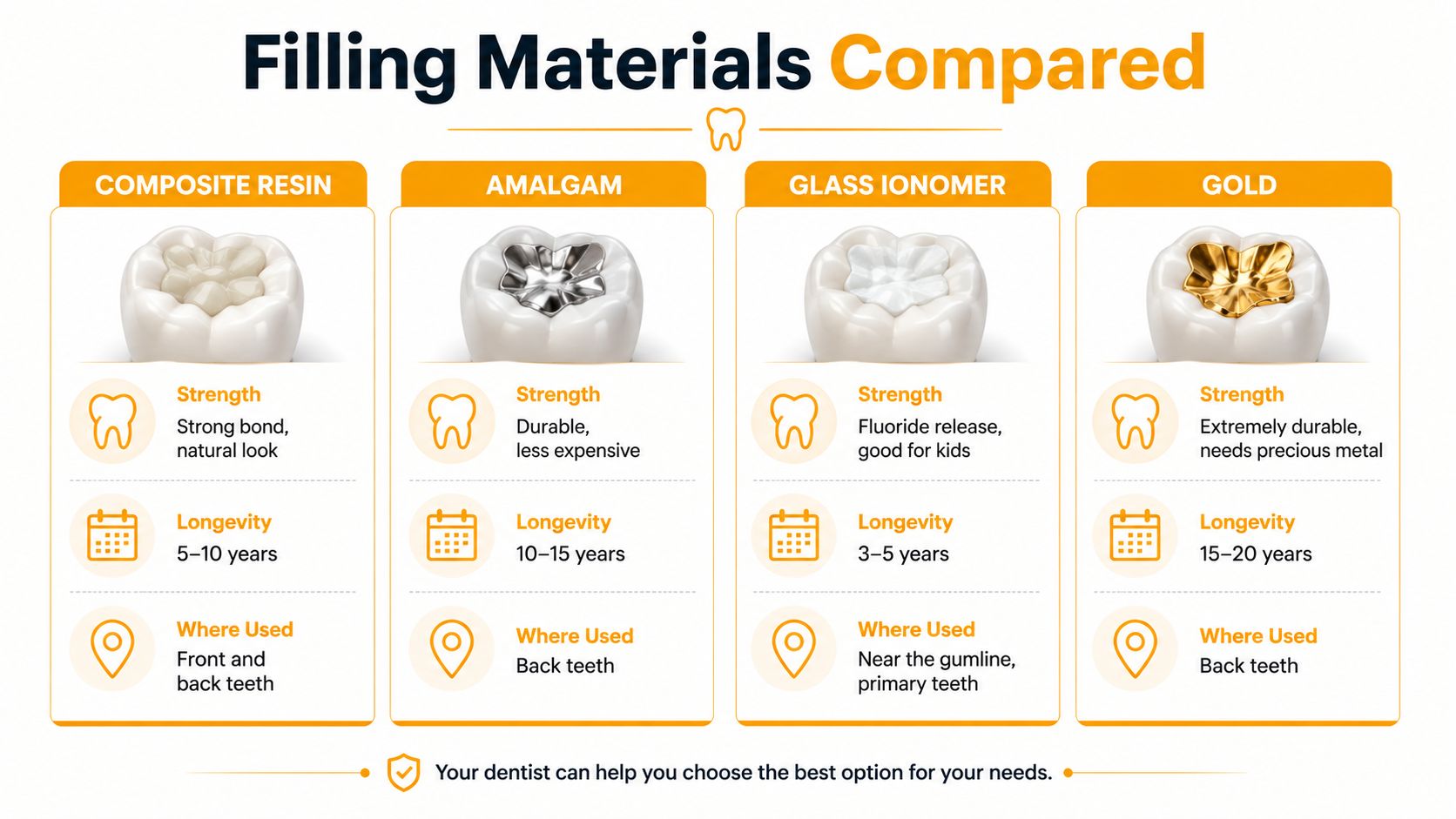
Material choice isn't just about colour. In the chair, the decision depends on where the tooth sits, how much force it takes, how much tooth structure is missing, and how much precision the restoration needs. Sydney clinics commonly work with composite resin, amalgam, ceramic, and glass ionomer, and each one solves a different problem.
The main options in plain language
Composite resin is the default choice for most visible teeth because it blends with natural enamel and bonds directly to tooth structure. That makes it useful for front teeth and many back teeth too, especially when the cavity is moderate and isolation is good. It also suits patients who want a more natural look, which is why it comes up so often in cosmetic and restorative discussions, including composite bonding.
Amalgam is less common now, but it still has a place in some mouths where durability matters and aesthetics matter less. It's usually considered when the tooth is under heavy chewing load and the patient prioritises function over colour match.
Ceramic inlays and onlays are more extensive indirect restorations. They're used when a standard filling won't be strong enough or when the cavity is too large for a direct composite repair to be ideal. The trade-off is simple, they preserve function and shape very well, but they cost more and take more planning.
Glass ionomer is often used where fluoride release is helpful or where a short-term or less load-bearing restoration makes sense. It's common in selected children's cases and temporary situations, but it's not the first pick for every adult tooth.
| Material | Best For | Typical Lifespan | Aesthetics | Relative Cost |
|---|---|---|---|---|
| Composite resin | Visible teeth, moderate cavities, natural appearance | Moderate to good | High | Moderate |
| Amalgam | Heavy chewing areas, functional repairs | Good | Low | Lower to moderate |
| Ceramic | Larger restorations, indirect repairs, high wear areas | High | High | High |
| Glass ionomer | Selected children's cases, temporary or low-load areas | Lower | Moderate | Lower |
Bottom line: The material matters, but the tooth's size, position, and the quality of the seal matter just as much.
What Happens During a Filling Appointment
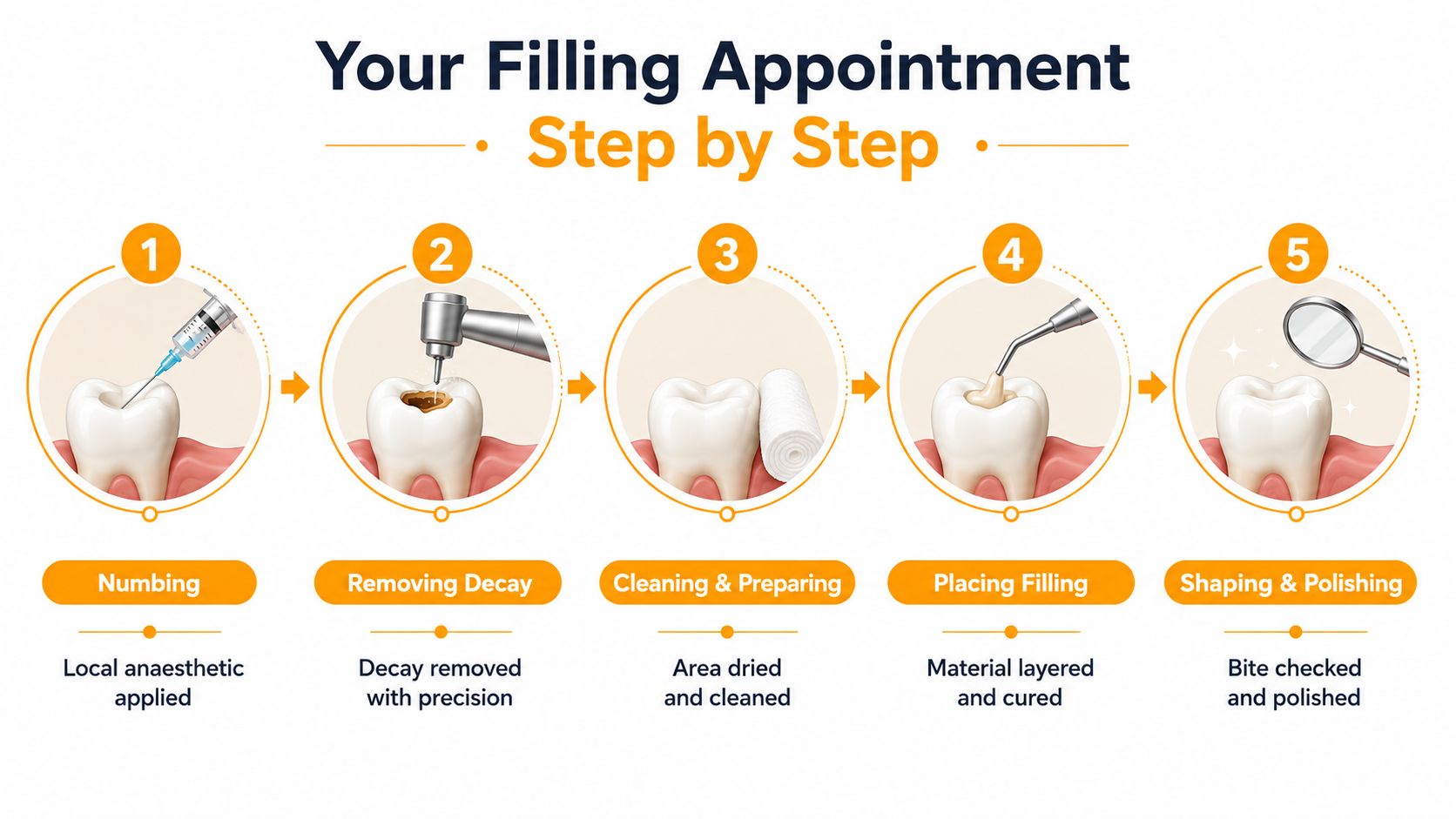
A filling appointment is usually more routine than patients fear, but the sequence matters. The dentist first checks the tooth, often with an X-ray if needed, then confirms whether the plan is a direct filling or something more substantial. If numbing is required, local anaesthetic comes first, and the area should feel progressively numb rather than painful.
The appointment from start to finish
After the tooth is numb, the decayed tissue is removed and the cavity is cleaned. For composite restorations, moisture control is critical because bonding fails more easily if saliva or blood gets into the area. That's why dentists use isolation techniques carefully, especially in the back of the mouth where access is tighter.
Then the filling material is placed, shaped, and hardened. Composite is usually built in layers, which gives the dentist more control over form and bite. Once the material is set, the bite is checked and adjusted so the tooth doesn't feel high or uneven when you close down.
Some anxious patients do better with extra comfort measures, and gentle technique makes a real difference. Biolase laser dentistry can also be part of a minimally invasive approach in selected cases, especially when the aim is to reduce fear and keep treatment conservative.
A smooth appointment usually feels unremarkable by design. That's what good dentistry should do. The process should end with a restoration that feels natural, doesn't catch on the tongue, and lets you chew without worrying about the bite.
Understanding Teeth Filling Costs in Sydney
Filling prices in Sydney don't come from a single flat fee. They depend on how many tooth surfaces need repair, which tooth is involved, how much time the dentist needs, and where the practice is located. A simple one-surface composite in inner Sydney can sit around $200–$280, while a two-surface restoration may run around $240–$360, and a three-surface composite around $290–$420 according to a Sydney market guide on filling complexity and location, which also notes that more extensive restorations can reach $340–$430+ and ceramic inlays roughly $950–$1,600 (Sydney filling cost guide).
Why the same cavity can cost differently
The first cost driver is surface count. A one-surface filling is simpler because the dentist removes less compromised tooth structure and spends less time shaping the restoration. Once the repair spans multiple surfaces, the procedure becomes more technical, because the margins are larger and the tooth's anatomy is harder to rebuild accurately.
The second driver is tooth position. Posterior teeth, especially molars, are more expensive to restore than front teeth in some Sydney practices because they're harder to isolate and finish, and they take more chewing force. One CBD dentistry page puts posterior fillings on average $10–$25 above anterior fillings, and lists a typical local range of $150–$350 for composite and glass ionomer fillings, with onlays around $650–$990 (Sydney CBD dentistry pricing).
The broader Sydney range is consistent with other local guides. One source places single-surface composite fillings at about $180–$350, multi-surface fillings at $250–$500+, and amalgam at about $130–$280 where still placed (Sydney filling cost guide). Another local article reports Sydney filling costs of $200–$350, while citing an Australian Dental Association benchmark of $220 for a simple filling and $475 for a more complex filling (Sydney cost overview).
| ADA Item | Surfaces | Typical Sydney Cost |
|---|---|---|
| 521 | One | $200–$250 |
| 522 | Two | $240–$310 |
| 523 | Three | $290–$370 |
| 525 | Four or more | $340–$430 |
If you're comparing clinics, ask for itemised fees before you book. A transparent practice should explain whether the quote reflects surface count, tooth position, or a more advanced indirect restoration. For patients who want to plan treatment around budget, this payment plans guide is a useful place to understand how some practices structure out-of-pocket costs.
Aftercare and When to Seek Follow-Up Treatment
A filling doesn't end when you leave the chair. The next day often tells you whether the tooth has settled well or needs a quick review. Mild sensitivity to cold, pressure, or biting can happen after treatment, especially if the decay was close to the nerve or the bite needs a tiny adjustment.
A common post-filling pattern
A patient comes in with a sore molar, gets a composite filling, then notices the tooth feels a bit odd for a day or two. That can be normal. If the sensation fades, the tooth is usually adapting. If the tooth starts hurting more when biting, or the edge feels sharp, the filling may need adjustment.
Broken or fallen-out fillings should be checked promptly, because the exposed tooth can trap plaque and let decay restart at the margins. That's one of the reasons brushing and flossing matter so much after the repair, not just before it. A rough edge or a missing section is more than an inconvenience, it becomes a plaque trap and a potential leakage pathway.
If a filling feels high, cracked, or missing, don't wait for it to “settle”. A quick review is usually easier than replacing a larger repair later.
Long-term maintenance depends on the material and the tooth. A restoration is not permanent in the way many patients hope it is. It needs periodic review, and replacement becomes more likely if the tooth has repeated decay, heavy bite forces, or ongoing clenching.
For patients who want to understand when discomfort points to something bigger, this guide on signs you need a root canal helps separate routine sensitivity from problems that need faster attention.
Choosing a Dentist in Dulwich Hill and the Inner West
A filling is not always the first answer, and the right clinic should be able to say that clearly. In some cases, a tooth can be monitored if the decay is small, the surface is easy to keep clean, and the tooth is not showing signs that it is breaking down quickly. For Dulwich Hill and nearby Inner West families, that kind of judgement matters as much as convenience, comfort, and clear communication. If you are working around school drop-offs, a commute, or a crowded week, late evening or Saturday appointments can make it easier to get treatment done before a small problem turns into a bigger one.
What to look for locally
Look for a clinic that explains treatment options in plain English, uses digital imaging where appropriate, and takes anxiety seriously. Patients who feel tense in the chair usually do better with a dentist who works gently, checks in often, and offers sedation options when suitable, rather than trying to push through fear. Family-friendly care matters too, because fillings for children and adults often need a different pace, different chair-side communication, and sometimes a different material choice.
Clear fees are another useful sign. A clinic that accepts most private health funds and explains what drives the quote makes it easier to plan treatment without surprises. For fillings, that breakdown should usually reflect the number of surfaces involved, the tooth's position, and how hard it is to isolate and shape the restoration. Back teeth, tight contacts, and harder-to-reach areas often take more time and skill than a simple front-tooth repair, even before material choice is considered. If you are comparing websites, a well-structured patient journey matters more than polished slogans, and the guide by Wise Web gives a useful look at how clear dental websites help patients find the information they need.
Finding a family dentist near you should also mean finding someone who explains when a filling is the right call and when a tooth needs monitoring, a larger repair, or a different plan altogether. The Smile Spot fits naturally into that local picture because it offers restorative care, including colour-matched fillings, alongside broader family dentistry for the Inner West. If you are comparing options for a filling in Dulwich Hill, Marrickville, Earlwood, Ashfield, Summer Hill, Lewisham, Petersham, or Hurlstone Park, choose the clinic that makes the next step feel clear and manageable.
Common Questions About Teeth Fillings in Sydney
Private health insurance may help with fillings, but the rebate depends on your level of extras cover and item number. For kids, some fillings can be covered through eligible government programs, but the material choice still depends on the tooth, the child's age, and how well the tooth can be isolated.
Children don't always need the same material adults do. Glass ionomer is sometimes useful because of fluoride release and simpler placement, but it's not the only answer, especially if the tooth needs more strength or the cavity is in a load-bearing spot.
If a tooth has too much damage for a standard filling, dentists usually consider a larger restoration such as an onlay or a crown rather than forcing a weak direct repair. That's the point where the repair stops being a small filling problem and becomes a structural one.
Replacing old amalgam with composite for cosmetic reasons can be appropriate in some cases, but the tooth has to be assessed first. A conservative replacement plan matters, because removing an old filling can also remove healthy tooth structure if it's done without a clear reason.
If you want a dentist who explains fillings clearly, treats anxious patients gently, and plans restorative care around how your tooth looks and functions, book with The Smile Spot. The clinic offers family-focused care in Dulwich Hill, with fillings, emergency appointments, and transparent treatment planning for patients across the Inner West.