You look in the mirror before work and keep noticing the same thing. A small chip on a front tooth. A faint stain that whitening never quite lifted. A little gap that isn't a health problem, but still catches your eye in every photo.
That's usually how this conversation starts. Not with a dramatic dental issue, but with a detail that feels bigger each time you see it. For many people in Dulwich Hill and the Inner West, the core question isn't whether they want to improve their smile. It's whether dental bonding or veneers make more sense for the way they live, spend, and care for their teeth.
Both can improve appearance beautifully. Both can be the right choice. But they solve different problems in different ways. If you're weighing a quick targeted fix against a more extensive cosmetic change, it helps to understand the practical differences before making a decision. If you're still exploring broader cosmetic dental treatment options, this comparison will help narrow the field.
Considering a Smile Enhancement
A patient often comes in thinking they need “veneers” when what they really want is a tidy repair on one tooth. Another arrives assuming bonding will do the job, but they're hoping for a more even, brighter smile across several front teeth. The treatment name matters less than the outcome you're trying to achieve.
A chipped edge after biting something hard is one situation. A front tooth that has never matched the others in shape or colour is another. Mild wear, a single dark spot, or a narrow gap can sometimes be handled conservatively. A smile that feels uneven across multiple teeth usually needs a more planned cosmetic approach.
Practical rule: If the concern is small and localised, the simpler treatment often gives the better result. If the concern is spread across several visible teeth, a patch-style approach usually starts to show its limits.
Bonding and veneers diverge in their applications. One is often best for selective improvement. The other is usually chosen for a broader redesign. The right choice depends on what you want your smile to look like next month, and what you want it to still look like years from now.
Understanding Your Two Main Options
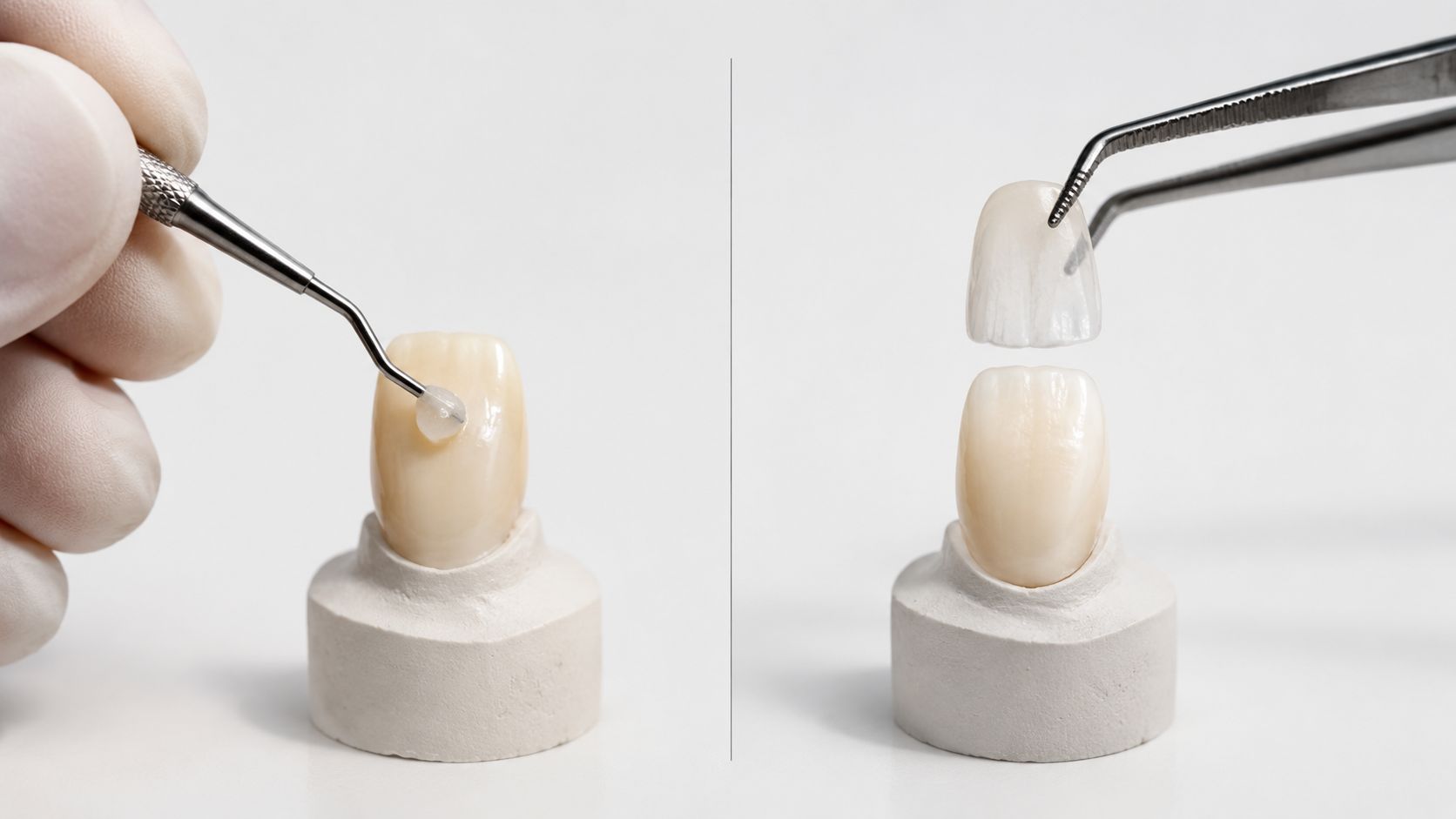
Dental bonding and veneers both improve the front surface of teeth, but they're built on different ideas. Bonding is more like sculpting. Veneers are more like refacing.
How dental bonding works
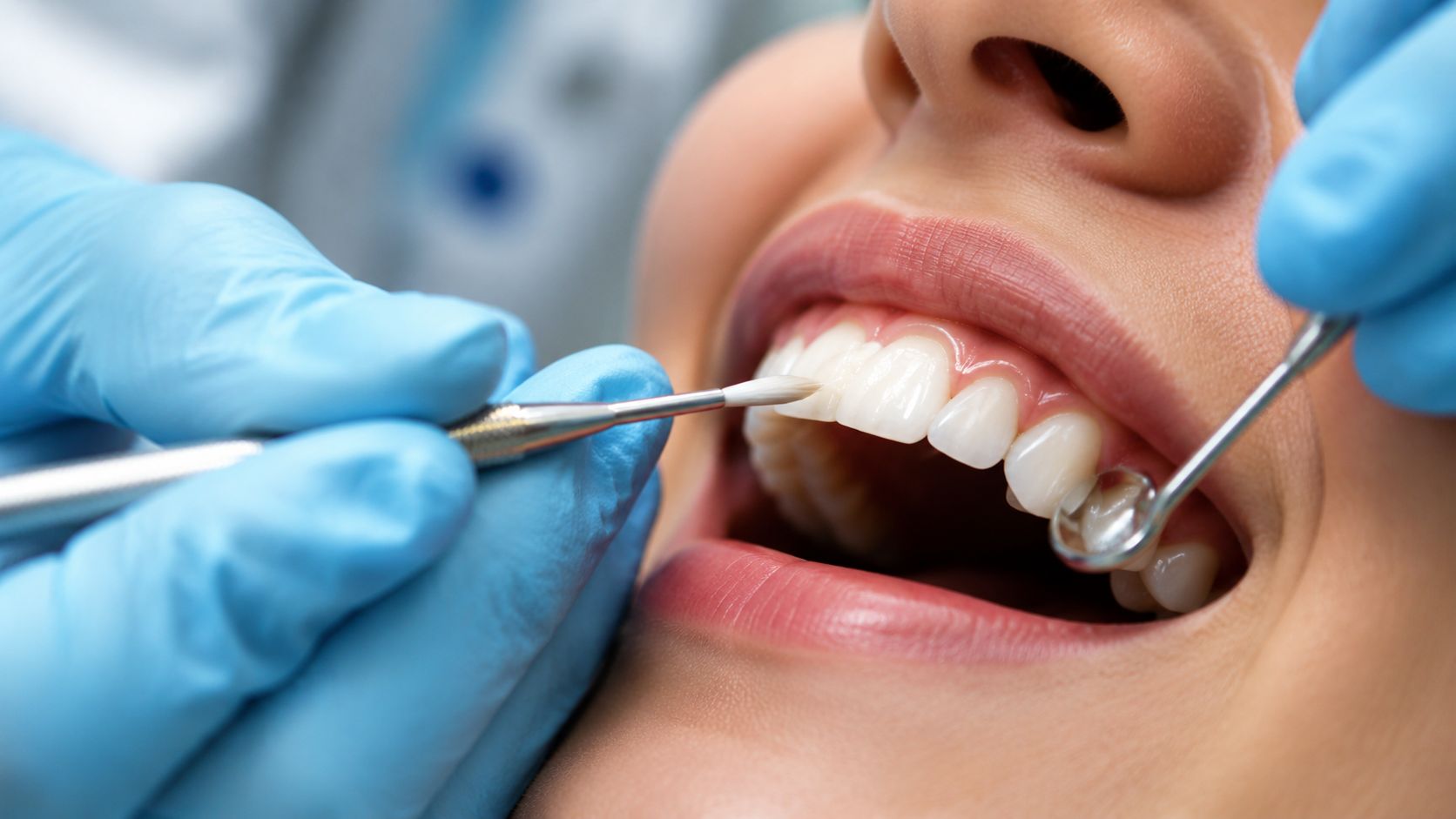
With bonding, the dentist places tooth-coloured composite resin directly onto the tooth, shapes it by hand, and hardens it in place. That direct approach is why bonding is commonly used for a chipped corner, a small gap, a worn edge, or a limited area of discolouration.
It's a hands-on procedure. Shade selection, contour, edge length, and surface texture all matter. A good bonding result doesn't just fill space. It has to blend with the adjacent teeth and sit naturally in the smile.
Many patients like bonding because it's conservative and efficient. In the right case, it can freshen a smile without committing to a larger cosmetic plan. If you'd like to see the sort of changes possible with this approach, these dental bonding before and after examples help illustrate the range.
How veneers work
Veneers take a different path. They are custom-made shells, usually porcelain or ceramic, designed to cover the front of the tooth. Rather than shaping the material directly on the tooth in its final form, the dentist prepares the teeth, records the shape through impressions or digital scans, and has the veneers fabricated before bonding them into place.
That's why veneers are better understood as refacing. They don't just patch a flaw. They create a new visible surface with planned colour, shape, symmetry, and proportion.
In practice, veneers are often chosen when someone wants more consistency across several teeth. They can be useful when the issue isn't just one chip or one mark, but a combination of wear, uneven shapes, persistent colour concerns, or an overall smile line that feels off.
Why the distinction matters
Bonding is direct, adaptable, and useful for small-scale changes. Veneers are designed, fabricated, and usually better suited to a more complete cosmetic result.
Neither option is automatically “better”. The better option is the one that matches the amount of change you need.
A Detailed Comparison of Bonding and Veneers
A common Dulwich Hill scenario is this. Someone comes in wanting to fix a chipped front tooth or improve a few uneven edges, and the first question is about price. That matters, but it is rarely the deciding factor on its own. The better question is how long you want the result to last, how much maintenance you are willing to accept, and whether the goal is a small repair or a more complete cosmetic redesign.
Here is the practical comparison.
| Feature | Dental Bonding | Porcelain Veneers |
|---|---|---|
| Treatment style | Directly applied and shaped on the tooth | Custom-made shell bonded to the tooth |
| Best for | Small chips, slight gaps, localised reshaping | Broader smile redesign across visible teeth |
| Time commitment | Usually completed in one appointment | Usually planned over more than one visit |
| Material | Composite resin | Porcelain or ceramic |
| Tooth alteration | Usually minimal | Often involves preparation before placement |
| Look and finish | Natural when used selectively | Highly refined and consistent across multiple teeth |
| Maintenance reality | More likely to need touch-ups over time | Usually chosen for longer-term stability |
| Upfront cost | Lower | Higher |
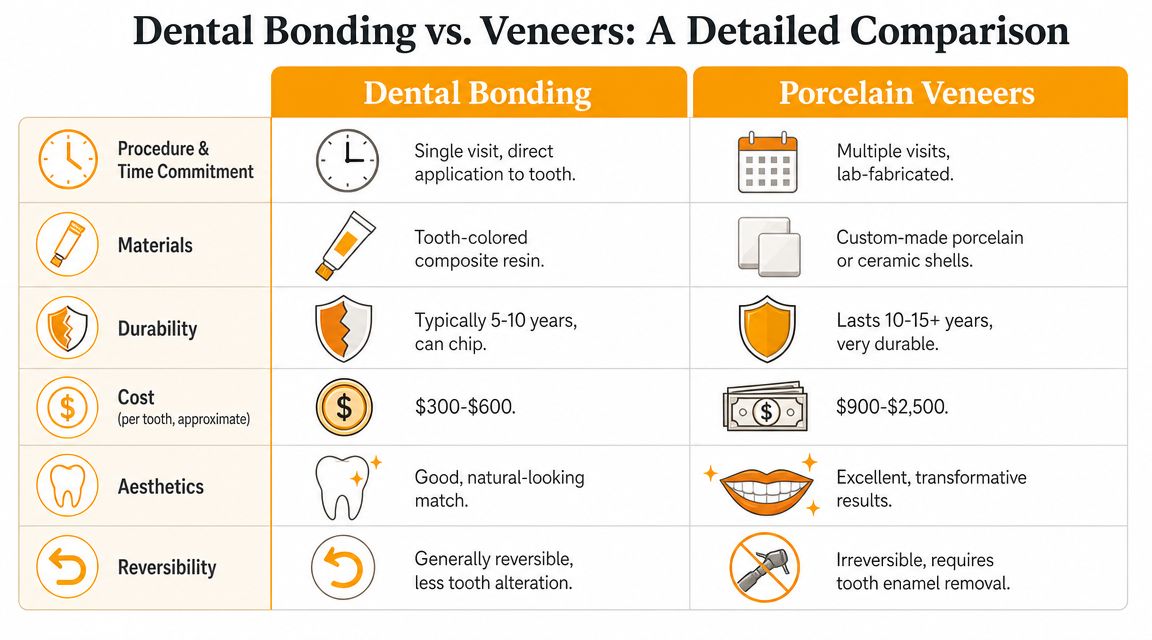
Procedure and time commitment
Bonding is usually the faster option. In many cases, it can be completed in one visit because the composite is placed and shaped directly on the tooth during the appointment. Veneers usually take more than one visit because they involve planning, tooth preparation, records such as scans or impressions, and fabrication before final placement. The Australian Dental Association patient information on veneers outlines that veneers are a more involved process than a simple cosmetic repair.
For a small defect on one or two teeth, that shorter timeline can make bonding very appealing. For a case involving several front teeth, the extra planning time with veneers is often what gives the final result its balance and consistency.
Materials and what that means in practice
Composite resin is flexible in the hands of an experienced dentist. It can be added in small amounts, adjusted on the spot, and used very conservatively. That makes it useful for chips, edge wear, minor shape changes, and small gaps.
Porcelain is different. It is fabricated outside the mouth, which gives more control over shape, translucency, surface texture, and colour matching across several teeth. That is one reason patients who want a more uniform cosmetic result often lean toward veneers.
Patients looking at a resin-based option somewhere between simple patching and a full porcelain case often ask about composite veneers in Dulwich Hill. They can suit the right case, but they still carry the maintenance pattern of composite rather than porcelain.
Aesthetic result
Bonding can look excellent. On the right tooth, in the right amount, it can be difficult to spot.
Veneers usually have the advantage when the goal is a cleaner, more even finish across multiple visible teeth. This is less about vanity and more about material behaviour. Porcelain tends to hold its polish and colour stability better over time, while composite is more prone to picking up wear and staining. In day-to-day practice, that difference becomes more obvious after a few years than it does on the day the treatment is completed.
Durability and expected lifespan
At this point, the long-term value question becomes more useful than the starting fee.
Bonding often suits patients who accept that touch-ups, polishing, repairs, or replacement may be part of the plan over time. Porcelain veneers usually involve a higher initial cost, but they are often chosen because they hold their appearance longer and need fewer small repairs in routine use. Neither option lasts forever. Bite forces, grinding, diet, home care, and how the teeth meet all affect longevity.
I usually tell patients to judge this as a maintenance decision as much as a cosmetic one. If you are the sort of person who chips nails, grinds teeth, bites into hard foods with the front teeth, or wants the lowest possible upkeep, that matters just as much as the appearance.
Initial cost and why veneers cost more
The price difference in Australia is real, and it reflects how the treatment is made rather than simple mark-up. Bonding is usually less expensive because it is completed directly by the dentist in the chair, often in one visit, without laboratory fabrication. Veneers cost more because they involve design, preparation, records, lab work, fit checks, and a more detailed finishing process. The Australian Health Practitioner Regulation Agency registered dentist search will not tell you fees, but it is a good reminder to compare treatment plans from properly registered providers rather than comparing price alone.
Over a longer period, the cheaper option upfront is not always the lower-cost option overall. Composite repairs can be very worthwhile, but if they need repeated maintenance across several front teeth, the total cost and inconvenience can rise. Veneers ask for more investment at the beginning, yet in the right case they can offer better value over a longer replacement cycle.
What works and what doesn't
- Bonding works well for small chips, modest gaps, minor edge reshaping, and selective repairs where preserving tooth structure is the priority.
- Bonding works less well for patients trying to create uniformity across many visible teeth or for cases where frequent maintenance would become frustrating.
- Veneers work well for broader cosmetic changes involving colour, shape, symmetry, and consistency across the smile.
- Veneers work less well for a tiny isolated defect where a conservative direct repair would do the job with less intervention.
The best choice depends on the scale of change you want and the level of maintenance you are prepared to live with. That is the part many quick price comparisons miss.
Who Is the Ideal Candidate for Each Treatment
A patient often sits down wanting a nicer smile and asks a simple question. “Should I do bonding or veneers?” The better question is which option suits the problem in front of us, and which one you will still feel good about maintaining a few years from now.

When bonding is usually the better fit
Bonding suits patients with a small, localised issue. A chipped front tooth, a slight gap, a worn corner, or one tooth that looks a little out of balance are common examples. In those cases, composite can improve the appearance with very little intervention to the natural tooth.
It is often the sensible choice if you want to keep healthy enamel intact and avoid a larger cosmetic plan than you need. For many patients, that conservative approach matters as much as the fee.
Bonding is usually a good fit if your priority is:
- Repairing one or two small defects
- Keeping treatment to a single visit where possible
- Testing a cosmetic change before committing to more involved work
- Accepting that touch-ups may be part of the long-term upkeep
That last point matters. A patient who is happy to return for polishing or small repairs can get very good value from bonding. A patient who wants the result to stay uniform with less maintenance often feels better served by veneers.
When veneers are often the better choice
Veneers are better suited to smiles that need a broader change across several visible teeth. That may involve uneven shapes, worn edges, patchy colour, old restorations that no longer match, or a smile that lacks symmetry.
They also make more sense where consistency is the goal. If four, six, or eight front teeth all need improvement, bonding each tooth individually can become a more maintenance-heavy path over time. Veneers usually ask for more planning and a higher initial spend, but in the right case they can provide a more stable cosmetic result.
Alignment also needs an honest look. Mild crookedness can sometimes be disguised cosmetically, but camouflage is not the same as correcting position. If that is part of your concern, our guide on ways to fix crooked teeth without braces can help you understand where cosmetic treatment ends and alignment treatment begins.
Match the treatment to the scale of change
A single chipped edge and a full smile redesign are different jobs. They should not get the same default recommendation.
Bonding is usually the better candidate choice when the improvement is modest, the tooth is otherwise healthy, and preserving structure is the main goal. Veneers are usually the better candidate choice when several front teeth need to look brighter, more even, and more consistent, and when the patient wants a result that is less likely to need frequent patching.
In practice, the ideal candidate is not just choosing a material. They are choosing the kind of maintenance cycle they are comfortable with. That is often the deciding factor once the initial excitement about cost wears off.
The Long-Term Commitment Maintaining Your Smile
The part many articles skip is the part that matters most after treatment. You don't live with the upfront fee for years. You live with the maintenance.
Bonding can be a very sensible treatment. But it usually asks more of you over time. Composite is more likely to pick up staining from coffee, tea, and red wine, and it can chip at edges if you bite hard objects or grind. That doesn't mean it fails quickly in every case. It means you should expect maintenance to be part of the bargain.
The real cost isn't only the first appointment
In an Australian study, tooth-coloured composite resin restorations had a mean annual failure rate of about 5.5%, while ceramic restorations were about 1.6%, as discussed in this article reviewing the long-term value trade-off. That's the clearest reason to think beyond the initial quote.
A cheaper treatment at the start can become less economical if it needs earlier repair, polishing, replacement, or repeated patching. For a patient who wants a result to keep looking stable over a decade or more, that difference matters.
What maintenance looks like day to day
The practical side is straightforward.
- With bonding, be careful with hard foods and habits that put force on the front teeth. Keep staining drinks in mind. Expect that small repairs may be needed earlier than with porcelain.
- With veneers, protect them from grinding and clenching, keep home care excellent, and don't use your teeth as tools. The investment is higher, so protecting it matters.
A nightguard is often worth discussing for anyone with signs of wear or clenching, especially if cosmetic work is going on the front teeth.
Maintenance mindset: Don't ask only, “What will this cost me now?” Ask, “What will this ask of me over the next several years?”
If your priority is the lowest starting cost, bonding may still be the right answer. If your priority is fewer interruptions and a longer replacement cycle, veneers often represent stronger long-term value. If you're weighing that longer view, this guide on how long porcelain veneers last adds useful context.
Making the Right Choice at The Smile Spot
The decision usually becomes clearer once you stop treating bonding and veneers as competing products and start treating them as tools for different jobs.
Bonding is often the smart choice for a small chip, a minor gap, or a single tooth that needs reshaping. It's efficient, conservative, and usually easier on the initial budget. Veneers are often the better investment when the goal is a broader cosmetic result, especially across several visible teeth, and when long-term stability matters more than speed.
There isn't one universal winner in the dental bonding vs veneers debate. There's only the treatment that best fits your teeth, your habits, your expectations, and your timeline. A good consultation should make that feel simpler, not more confusing.
At The Smile Spot, that discussion is grounded in what's clinically sensible and what's realistic for daily life. Dr. Dimitrios Thanos and the team take a patient-centred approach, looking at the condition of your teeth, the scale of the cosmetic change you want, and the maintenance commitment each option involves before recommending a path forward.
If you're ready to talk through dental bonding vs veneers with a local team that serves Dulwich Hill and the Inner West, book a consultation with The Smile Spot. You'll get clear advice, a customized recommendation, and a transparent explanation of which option makes the most sense for your smile.