Breakfast becomes a strategy session. You choose the softer toast. You cut fruit smaller than you used to. At lunch, you avoid the crusty roll, the steak sandwich, the laugh that might shift your denture at the wrong moment. By dinner, it's not just about teeth anymore. It's about confidence, comfort, and the mental load of managing something that never quite feels secure.
That's where many people start asking about implant supported dentures. Not because they want something fancy, but because they're tired of adapting their life around loose dentures. They want to eat in public without thinking about it. They want to speak clearly. They want to smile without checking whether everything still feels in place.
For many adults in Dulwich Hill and the Inner West, this treatment changes daily life in a practical way. It isn't only about replacing missing teeth. It's about reducing movement, restoring function, and making the day feel simpler again.
Reclaiming Your Smile Beyond Traditional Dentures
Conventional, gum-supported dentures can work reasonably well for some people. But when they slip, rub, click, or lift at the edges, the problem shows up in small moments all day long.
A patient might tell you they've stopped ordering certain foods. Another might say they keep their hand near their mouth when laughing. Some become so used to denture adhesive, sore spots, and caution while chewing that they forget those compromises aren't normal. They're the consequence when a prosthesis relies mainly on gum support and suction.
What people usually notice first
The first frustration is often movement. A lower denture can feel especially unpredictable because the tongue, cheeks, and floor of the mouth are all working around it. Even when it doesn't fully dislodge, it can shift enough to make speech feel less natural and meals less enjoyable.
Then confidence starts to shrink around that problem.
- Speaking changes because you start anticipating slippage.
- Food choices narrow because chewy, crunchy, or fibrous foods become difficult.
- Social comfort drops because you're always monitoring the denture.
- Soreness builds when pressure points keep returning.
A denture doesn't need to fall out to affect your life. If you're thinking about it all the time, it's already limiting you.
Implant support changes the experience because the denture is no longer relying only on the soft tissues underneath. It gains a more secure foundation. For many people, that's the difference between “managing” their teeth and feeling comfortable using them.
Why this option feels different
The most important shift is emotional as much as mechanical. A stable denture often means less self-consciousness at work, at family dinners, and out with friends. Patients commonly describe relief before they describe aesthetics. They feel steadier, less restricted, and more like themselves.
That's why this treatment matters. It doesn't just replace teeth. It can give back parts of daily life that loose dentures gradually took away.
What Are Implant Supported Dentures
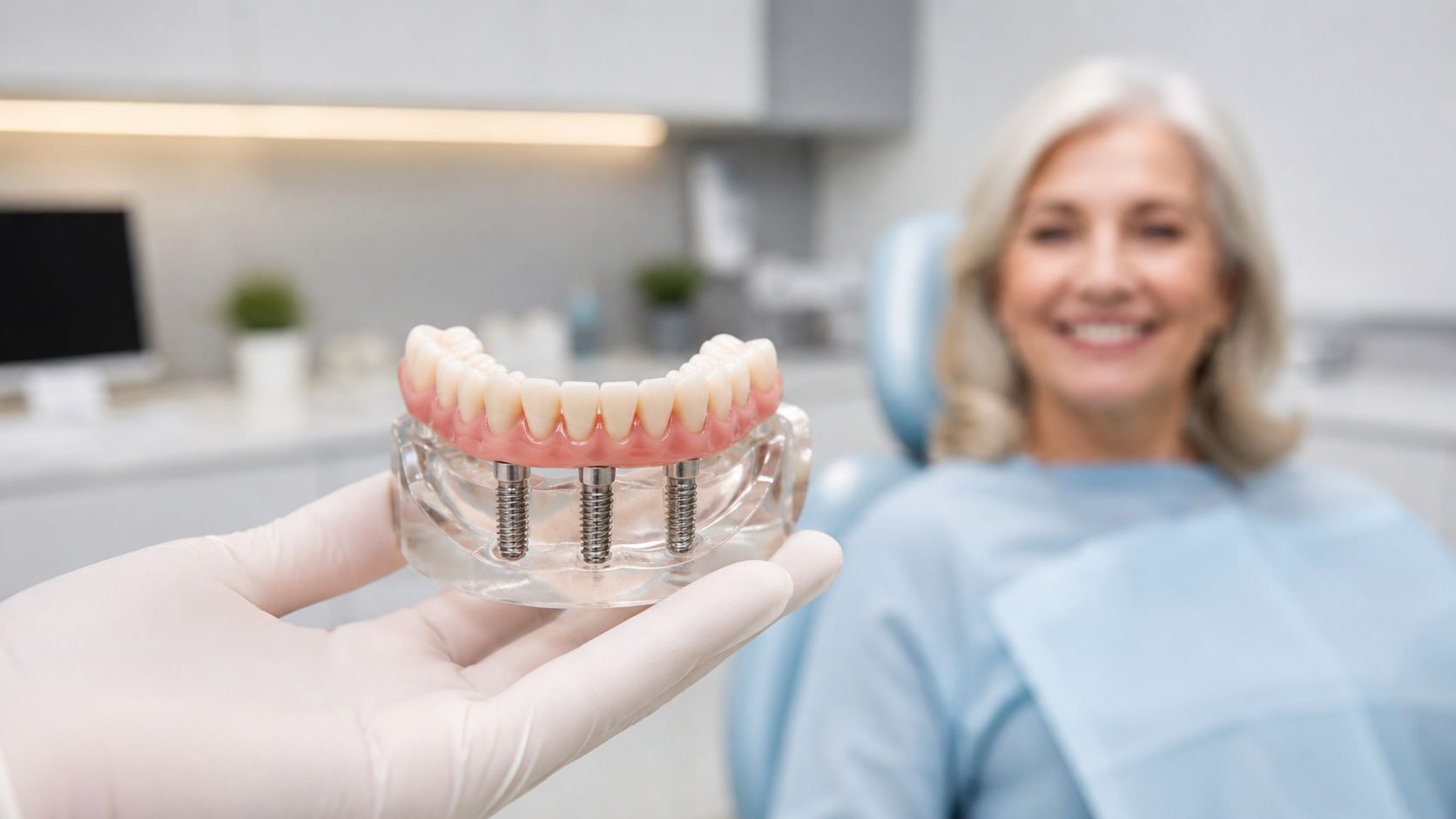
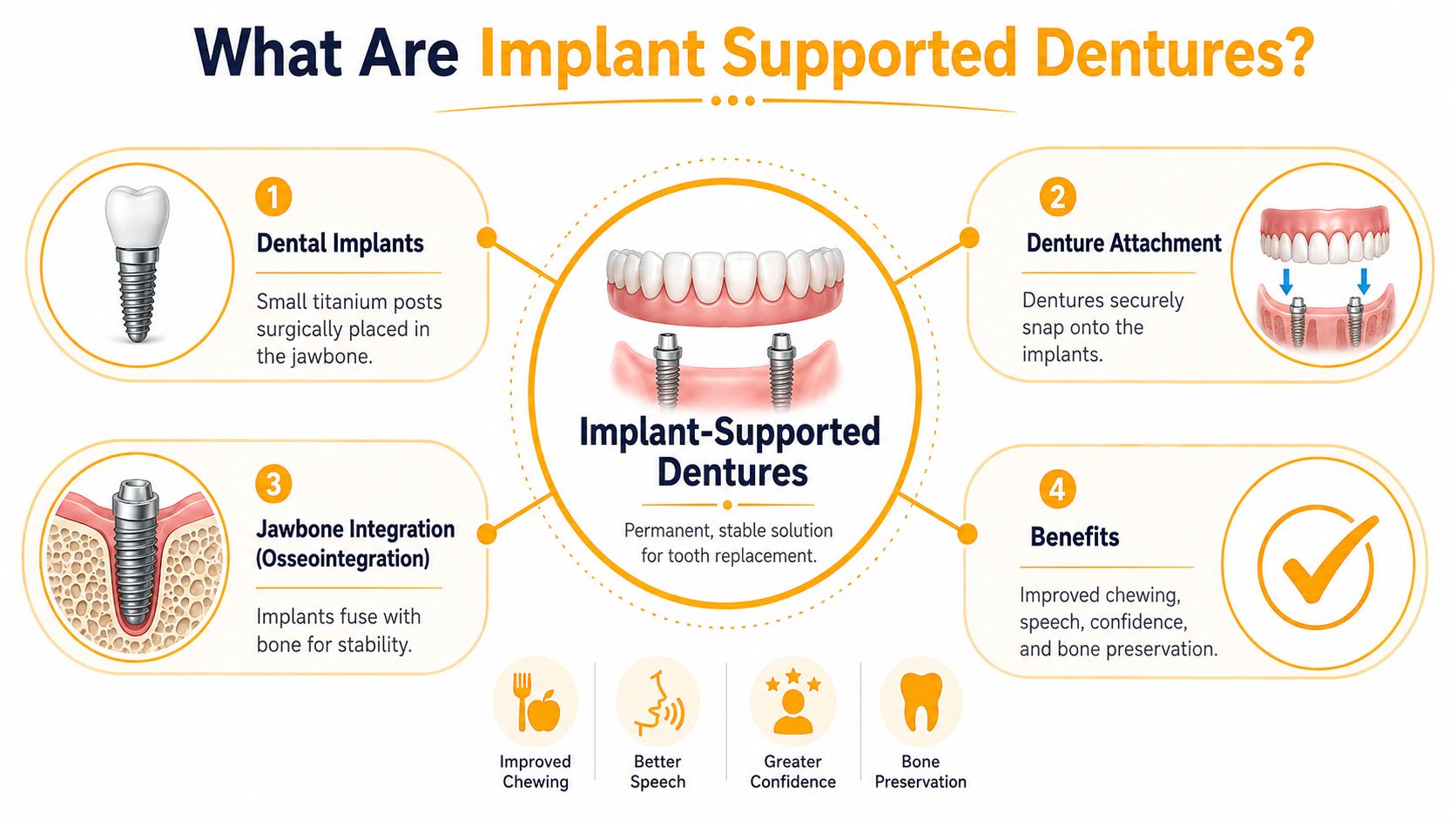
Implant supported dentures are dentures that attach to dental implants placed in the jawbone. The simplest way to think of them is this: instead of the denture sitting on the gums and hoping suction keeps it stable, it connects to fixed anchors underneath.
A useful analogy is press-studs on clothing. When the denture clicks onto the implants, it gains retention from those anchor points rather than depending only on the shape of the gum.
The three parts that matter
There are a few components, but patients don't need to get lost in the terminology.
The implant
This is the small titanium post placed into the jawbone. It acts like an artificial tooth root.The connector
This joins the implant to the denture system and allows the denture to attach securely.The denture
This is the visible replacement for missing teeth and surrounding gum structure, custom-made to fit your mouth and bite.
The key difference isn't complexity. It's stability.
What makes them more secure
After placement, the implants need time to fuse with the bone. Guidance commonly used in this area describes a healing phase of about 4 to 6 months before the denture is attached, and full-arch support is commonly described as being retained by 4 to 6 implants in many cases, as discussed in this overview of implant denture timing and support. In practical terms, those implants act as anchors that improve chewing stability and reduce movement.
That's why patients often find these dentures feel like a different category of treatment, not just a slightly better version of the same thing.
If you'd like a broader explanation of how implant fixtures integrate with bone, this article on endosseous dental implants gives helpful background.
What they are not
Implant supported dentures are not the same as replacing every missing tooth with an individual implant crown. They're also not always permanently fixed in place. Some are removable for cleaning, while others are only removed professionally.
Practical rule: The right system is the one that gives enough stability for your lifestyle without creating a cleaning routine you won't realistically maintain.
That balance matters more than marketing language.
Exploring Your Implant Denture Options
Not all implant denture systems feel the same day to day. The best choice depends on how much stability you want, how easy cleaning needs to be, your jaw anatomy, and what level of treatment is realistic for your budget and long-term maintenance.
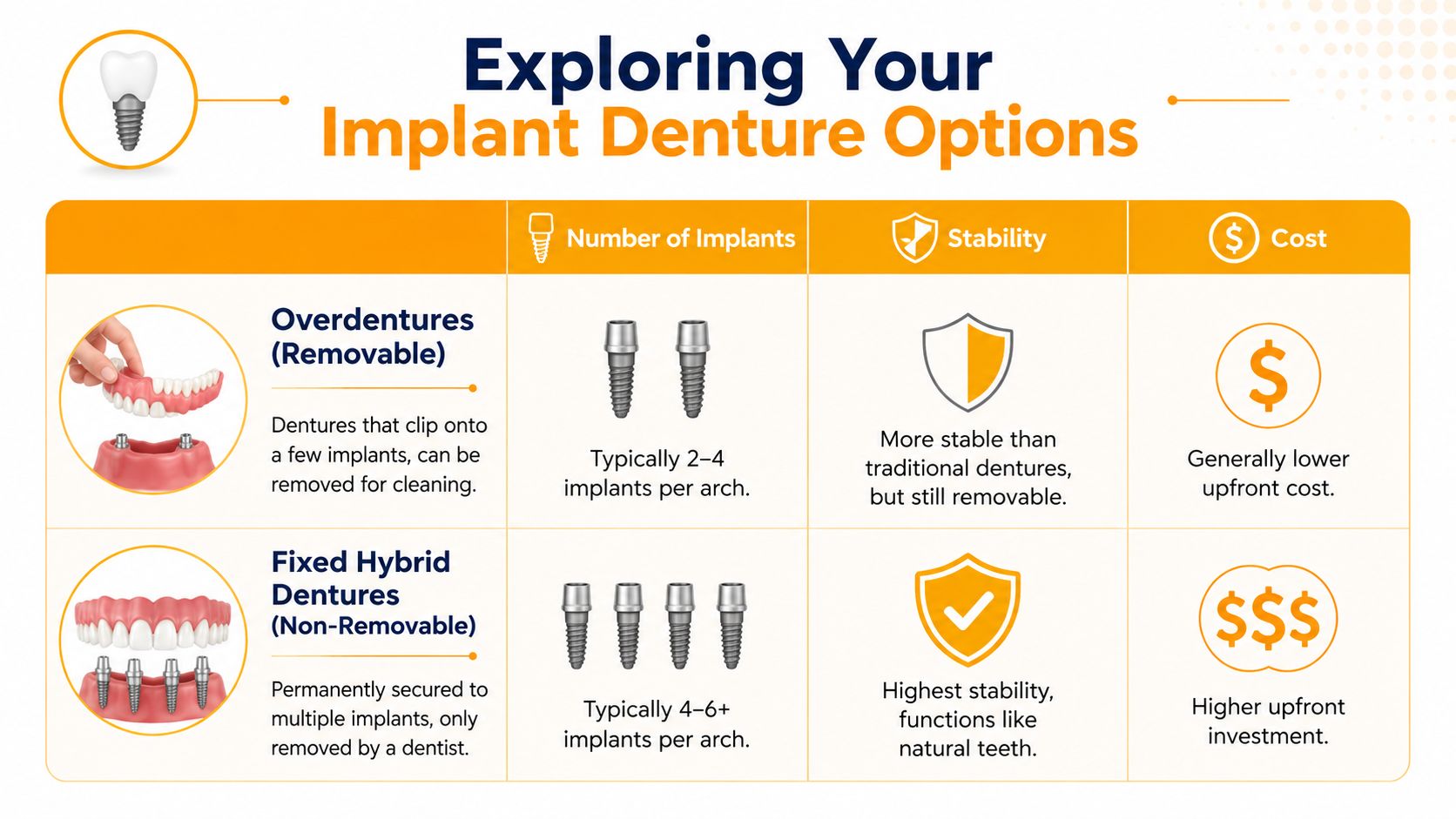
Removable overdentures with ball attachments
This is often the most straightforward entry point into implant support. The denture snaps onto attachments connected to implants, then comes out for cleaning.
For many lower-jaw cases, a commonly cited protocol uses 2 implants in the mandible, while 4 implants may be used for a higher-stability bar-retained overdenture, as described in this review of overdenture design and biomechanics. That same review explains why this matters mechanically. The denture doesn't just stay in place better. It also redistributes biting forces between implants and the residual ridge.
Daily experience with this type is usually:
- More secure than a conventional denture but still removable
- Easier to clean at home because you can take it out
- A practical option for many older adults or anyone who values simpler maintenance
This option often suits patients who want a major improvement without moving to a fully fixed full-arch reconstruction.
Bar-retained overdentures
A bar-retained denture connects across implants with a bar, and the denture clips onto that framework. It usually offers a firmer, more planted feel than simpler stud-style attachments.
That added stability can be valuable for people who've struggled with persistent movement, especially in the lower arch. But a bar system can also demand careful hygiene around the attachment areas, so it's not automatically the best choice for every patient.
Here's a practical comparison:
| Option | Daily feel | Cleaning | Typical fit for |
|---|---|---|---|
| Ball-retained overdenture | Secure snap fit | Removed at home | Patients wanting simplicity |
| Bar-retained overdenture | More stable and guided | Removed at home, more detailed cleaning | Patients wanting stronger retention |
| Fixed full-arch prosthesis | Most tooth-like stability | Cleaned in place, professionally removable | Patients wanting a non-removable feel |
Fixed full-arch solutions
A fixed full-arch prosthesis stays in place and is only removed by the dentist for maintenance. Patients often describe this as the closest experience to having a stable set of teeth that remains in the mouth full time.
That doesn't mean it's ideal for everyone. Cleaning is different. Repairs can be more involved. Some people are better served by a removable overdenture that gives excellent function but remains easier to maintain over time.
If you're comparing removable implant dentures with a fixed full-arch option, this guide to All-on-4 dental implants is a useful next read.
The “best” implant denture isn't the most expensive one. It's the one that matches your bite forces, anatomy, hygiene habits, and expectations.
Your Treatment Journey Step by Step
The process is methodical for a reason. Implant supported dentures need a strong foundation first, then a prosthesis that fits that foundation accurately. When patients understand the sequence, the treatment usually feels far less daunting.
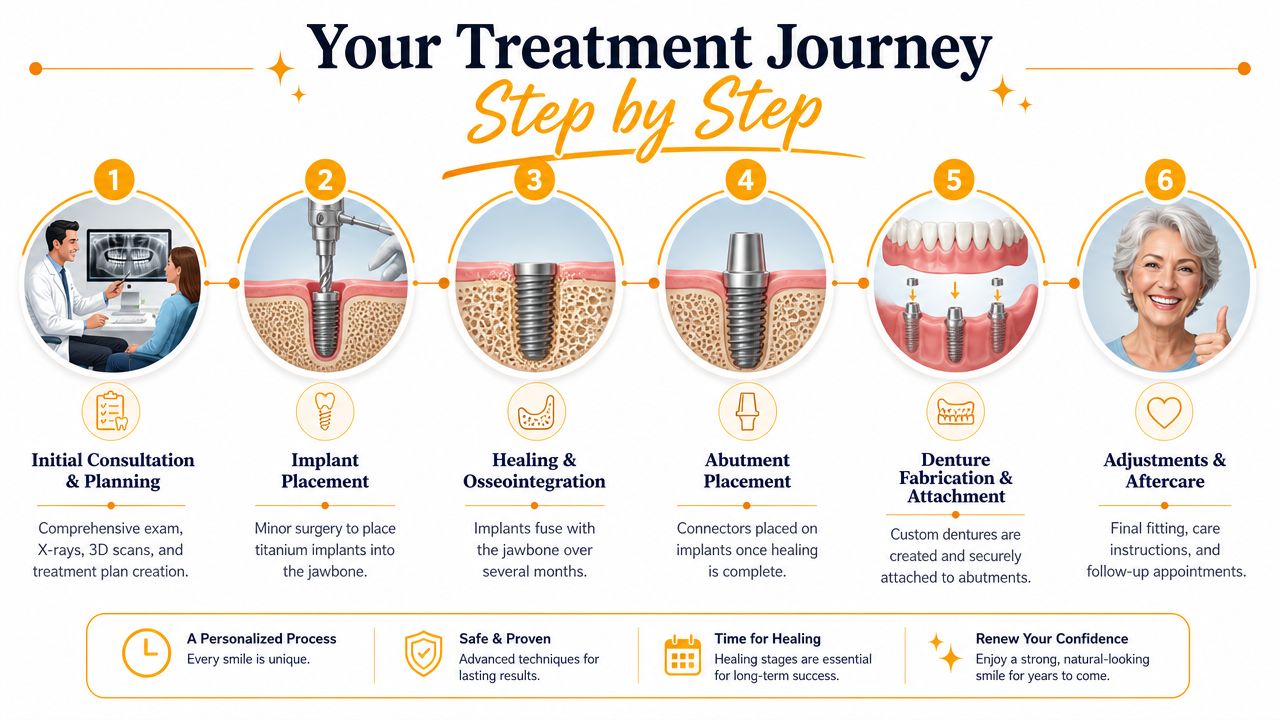
A visual overview helps make that journey easier to picture.
Consultation and planning
The first stage is assessment. That includes examining the mouth, reviewing existing dentures if you have them, checking the bite, and evaluating bone volume and general oral health. If teeth need removal or the ridge needs additional preparation, that changes the sequence.
This is also where the discussion becomes personal rather than theoretical. Some patients care most about retention. Others want the easiest cleaning routine possible. Some need a phased approach.
Implant placement and healing
Implant placement is the surgical phase. After that, the body needs time to do its part. Guidance for implant overdenture treatment commonly places the overall treatment process at about 4 to 8 months, including healing time for the implants to fuse with the jawbone, as outlined in this explanation of the staged process.
That waiting period is not wasted time. It's what gives the restoration its long-term stability.
Later in the journey, many patients find it helpful to understand what the healing window feels like from a recovery perspective. This guide to dental implant recovery time explains that in more detail.
A short video can also make the process easier to visualise before a consultation.
Final attachment and refinement
Once healing is satisfactory, the attachment components and final denture are fitted. This stage isn't just a handover. It includes checking pressure areas, speech, bite balance, and the way the denture seats onto the implants.
Patients should expect an adjustment period, but not the same kind of adaptation that happens with a loose conventional denture. The aim is controlled retention with comfort.
A simple version of the pathway looks like this:
- Assessment first so the treatment matches the bone, bite, and health history
- Surgery with a plan rather than rushing to immediate loading in unsuitable cases
- Healing before force because stable integration matters more than speed
- Fitting and follow-up to fine-tune comfort, attachment function, and cleaning technique
The Life-Changing Benefits Beyond a Stable Bite
The first thing people ask for is stability. The deeper value usually shows up afterwards.
Once a denture stops moving around, daily life becomes less tactical. Meals feel easier. Speech becomes more relaxed. Social situations stop feeling risky. You're not constantly checking whether the denture still feels centred, whether adhesive is holding, or whether a certain food is worth the trouble.
What changes in real life
The most obvious shift is eating. People often return to foods they had privately avoided for years. That matters for enjoyment, but it also matters for nutrition and routine. If chewing is easier, meals become less of a compromise.
Speech can improve for the same reason. A denture that isn't lifting or sliding is less likely to interfere with how words feel as they're formed. That's especially important for anyone who spends a lot of time talking at work or socially.
Other changes are more subtle:
- Less movement means less mental load throughout the day
- Better retention often reduces reliance on adhesives
- A more secure fit can support facial confidence when smiling and laughing
- Long-term function feels more predictable than with tissue-supported dentures alone
Many patients don't say, “I want implants because of biomechanics.” They say, “I want to eat, talk, and go out without worrying.”
Why reliability matters
Confidence comes more easily when the treatment itself is dependable. An Australian prosthodontic follow-up study reported a 98.14% implant survival rate with 159 implants followed and 3 failures, alongside 100% prosthesis success over the study period, as published in The International Journal of Prosthodontics via PubMed Central. That kind of outcome matters because it shows these restorations can perform very reliably when they're properly planned and maintained.
For patients, that translates into something simple. You're not only investing in a denture that feels better on day one. You're investing in a treatment approach with strong clinical support behind it.
The difference from other tooth replacement paths
Single implants can be excellent when only one or a few teeth are missing. Conventional dentures can still be appropriate in some situations. But for patients missing many or all teeth, implant supported dentures sit in an important middle ground.
They can offer far better security than a conventional plate while remaining more practical, and in some cases easier to clean, than a full fixed arch. That's why they're often such a strong option for people who want a real lifestyle improvement without choosing the most extensive treatment available.
Understanding Costs and Your Long-Term Investment
Cost matters. It shapes timing, treatment choices, and whether someone proceeds now or puts the decision off until things become harder.
That's one reason transparent conversations are so important. In Australia, adults spent about $8.0 billion out-of-pocket on dental care in 2022–23, according to the cited Australian dental spending figure referenced in the verified data. That figure helps explain why people often hesitate over advanced restorative treatment even when they know it would improve daily life.
What actually affects the fee
There isn't one standard price for implant supported dentures because several variables change the scope of care.
- The type of prosthesis matters. A removable overdenture and a fixed full-arch restoration are different treatments.
- The number of implants changes planning, surgery, components, and laboratory work.
- Preparatory care can add complexity if extractions, bone support procedures, or replacement of existing failing dental work are needed.
- Material and attachment choice affects both upfront fees and future maintenance.
That's why a meaningful quote follows diagnosis, not marketing.
Why patients often view it as long-term value
People don't choose this treatment just to own a more advanced denture. They choose it because instability has a cost too. It affects what they eat, how they socialise, and how much energy they spend managing their mouth every day.
A useful way to think about the investment is to look beyond the procedure itself:
| Short-term question | Long-term value question |
|---|---|
| What will this cost now? | What will daily comfort and function be worth over time? |
| Can I manage the treatment plan? | Will this reduce repeated frustration and compromise? |
| Is a simpler option cheaper today? | Will that option still suit my needs in the years ahead? |
If you're weighing broader budget considerations, this guide to full mouth dental implants cost gives useful context around what drives treatment fees.
The best cost discussion is practical, honest, and personalised. It should include what you need now, what can be staged, and what maintenance will look like later.
Aftercare and Choosing Your Dulwich Hill Dentist
Implant supported dentures still need care. They don't get decay, but the surrounding tissues and attachment components need regular attention. Long-term success depends on how well the denture is cleaned, how the implants are monitored, and whether wear is picked up early.
For removable systems, daily cleaning is usually straightforward because the denture comes out. For fixed systems, cleaning in place is more technique-sensitive and usually requires more commitment from the patient.
What good aftercare looks like
A realistic maintenance plan should be simple enough to follow consistently.
- Clean the prosthesis thoroughly using the method recommended for your attachment type
- Keep the implant areas clean so soft tissue inflammation doesn't build around them
- Attend review appointments so attachment wear, tissue health, and fit changes can be checked
- Report changes early if the denture feels looser, rubs, or becomes harder to seat
A removable overdenture can be the better long-term choice for some people, especially older adults, because it's often easier to clean and maintain over time, as discussed in this overview of why removable options may suit some patients better than fixed ones.
That's why provider judgement matters. The right dentist doesn't just ask what looks best. They also look at dexterity, hygiene ability, medical history, and the maintenance burden you're realistically willing to take on.
Choosing a local provider
You want a dentist who can plan the case carefully, explain trade-offs clearly, and support you after delivery rather than treating the fitting as the end of the job.
For Inner West patients, convenience matters too. Follow-up appointments, maintenance visits, and occasional adjustments are part of responsible implant care. Being able to return to a trusted local clinic makes that process easier and more consistent.
If you're looking into care options nearby, the Dulwich Hill dental implants page is a useful place to start.
The most successful implant denture cases are rarely the most aggressive ones. They're the ones matched properly to the person who has to live with them every day.
If loose dentures are affecting what you eat, how you speak, or how confident you feel in public, The Smile Spot can help you explore your options with clear advice and a personalised treatment plan. Whether you're considering a removable overdenture or a fixed full-arch solution, the team can talk you through what suits your mouth, your lifestyle, and your long-term goals.