

Hearing the words “you need a surgical extraction” can make your stomach drop. Many patients hear the word surgical and immediately picture something dramatic, painful, or risky. In reality, it usually means your dentist needs a more precise way to access a tooth safely, especially if it's broken, impacted, or difficult to reach.
If you're reading this with a sore jaw, a problem wisdom tooth, or a referral in your hand, the uncertainty is often the hardest part. You want clear answers. Is the tooth definitely beyond saving. Should a general dentist handle it, or do you need someone with more surgical experience. And if you're already anxious, how do you get through it comfortably.
Understanding Surgical Tooth Extractions
A surgical tooth extraction is a controlled dental procedure used when a tooth can't be removed in the usual straightforward way. That might be because the tooth has broken near the gumline, never fully erupted, or has roots that make simple removal unsafe.
Many people are surprised to learn how routine this is in complex dental care. In Australian hospital data, about 4 in 5 tooth extractions were surgical, with 148,501 surgical extractions recorded in 2022–23, according to Australian tooth extraction statistics. That doesn't mean every dental extraction is major surgery. It means surgical access is commonly needed for difficult cases, especially wisdom teeth and damaged teeth.
A common starting point is an X-ray. Before anyone decides whether an extraction is simple or surgical, your dentist usually needs to see the shape of the roots, the surrounding bone, and the tooth's position. If you'd like to understand what that imaging shows, this guide to an OPG dental X-ray can help make the picture much less mysterious.
What “surgical” usually means: the dentist is creating safe access, not making the experience harsher.
For anxious patients, that distinction matters. A surgical extraction isn't labelled that way because it's automatically more painful. It's labelled that way because the dentist may need to gently lift the gum, remove a small amount of bone, or divide the tooth into smaller parts so it comes out with less strain on the surrounding tissues.
That approach is often the safer, kinder option.
Simple vs Surgical Extraction What Is the Difference
It's similar to removing a plant. If the plant is sitting loosely in soft soil, you can lift it out without much effort. If it has deep, hooked roots under pavers, you need to uncover the area first so you don't tear everything around it.
That's the difference between a simple extraction and a surgical extraction.
What makes an extraction simple
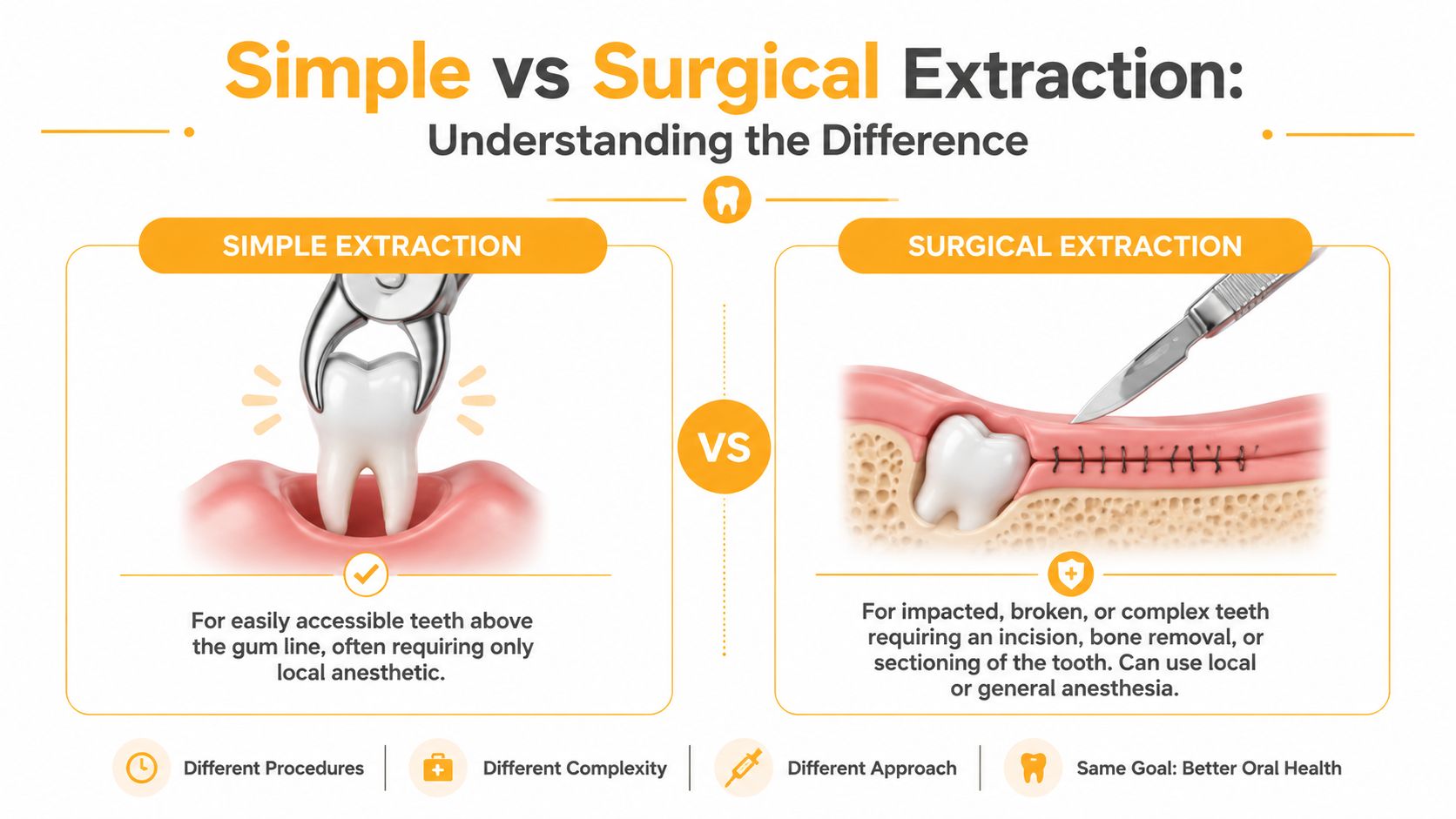
A simple extraction is used when the tooth is visible and your dentist can loosen and remove it with forceps or elevators alone. The tooth is accessible, and there's no need to cut gum tissue or bone to reach it.
This is often the sort of situation people imagine when they hear “pulling a tooth”. If you're comparing everyday extraction scenarios, this article on molar extraction near me gives useful context.
What makes an extraction surgical
The formal distinction is practical, not dramatic. The ADA guide defines a surgical extraction by the need for soft-tissue and/or bone cutting to access the tooth or root, as explained in the ADA Guide to Extractions. If a tooth can be removed with forceps or elevators alone, it's simple. If an incision and flap are required, it's surgical.
Here's a quick comparison:
| Type | What the dentist needs to do | Typical situation |
|---|---|---|
| Simple extraction | Loosen and remove the tooth without cutting gum or bone | Tooth is fully accessible |
| Surgical extraction | Create access through gum tissue, bone, or both | Tooth is impacted, broken, or difficult to reach |
Why the extra steps can be gentler
Patients often assume “more steps” means “more trauma”. Often, the opposite is true. If a tooth is stubborn, forcing it out in one piece can put more pressure on the bone and nearby teeth.
A surgical extraction dentist may instead:
- Lift the gum carefully so the area is visible
- Remove a small amount of bone only where needed
- Section the tooth into smaller pieces so each part comes out more smoothly
A surgical extraction is about access and control. It isn't a sign that something has gone wrong.
That's why the term matters. It tells you how the dentist plans to remove the tooth safely, not how frightening the experience should be.
When Is a Surgical Tooth Extraction Necessary
Most surgical extractions fall into a few common patterns. The tooth is there, but it isn't easy to reach, easy to grip, or safe to remove in one movement.
Situations that often need surgical access
A dentist may recommend a surgical extraction when:
- The tooth is impacted. It may be trapped partly or fully under the gum or bone, which is common with wisdom teeth.
- The tooth has broken down badly. If only the root or a small fragment remains above the gumline, there may be nothing solid to hold onto.
- The roots are complex. Some roots are curved, spread apart, or positioned in a way that makes simple elevation risky.
- The tooth is fragile. Heavily restored or weakened teeth can fracture during removal, which changes the plan from simple to surgical.
- The surrounding anatomy matters. Your dentist may need better visibility and control because of neighbouring teeth, bone shape, or other structures.
Why a proper diagnosis matters
Many patients understandably experience confusion. A painful tooth doesn't always mean extraction is the best answer. Sometimes a tooth can be treated, monitored, or restored instead.
That point matters because requests for extraction aren't always based on clear clinical need. A PLOS ONE study reported that many oral surgeons and dentists receive extraction requests without a clear clinical indication, as described in the PLOS ONE study on extraction requests. For patients, the takeaway is simple. You want a dentist who asks, “Can this tooth be saved?” before asking, “When can we take it out?”
Who should do it
The right provider depends on the tooth and the patient.
A general dentist may be the right first stop if the case looks manageable and you already have someone you trust. An oral surgery referral may be wiser if the tooth is significantly impacted, your case is medically more complex, or you need a higher level of sedation support. In urgent situations such as severe swelling, uncontrolled pain, or signs of spreading infection, an emergency pathway may be the safest move.
If a dentist recommends referral, that usually reflects careful judgement, not alarm.
A good assessment doesn't rush. It looks at the tooth, your medical history, your anxiety level, and whether keeping the tooth is still realistic.
The Surgical Extraction Procedure Step by Step
The unknown is often what makes people tense. Once you know the sequence, the appointment usually feels far more manageable.
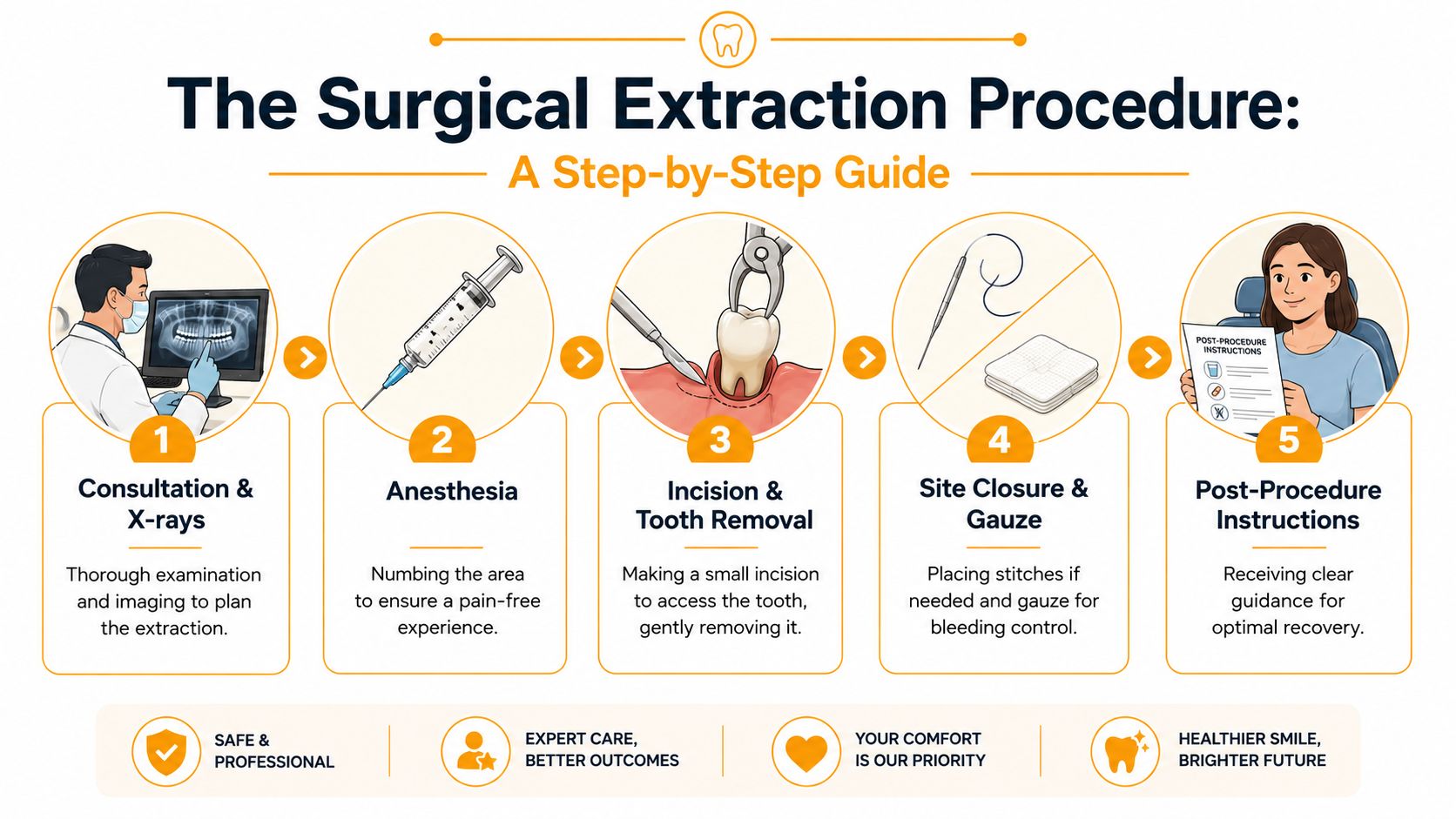
To help you visualise the process, here's a simple overview.
Before anything starts
Your dentist begins with an examination and imaging. The goal is to understand where the tooth sits, how the roots are shaped, and what access will be needed. If the problem involves a third molar, this article on wisdom tooth surgery may answer some of the questions patients commonly ask before treatment.
Then comes the anaesthetic plan. For many people, local anaesthetic is enough. The area becomes thoroughly numb, so you may feel pressure and movement, but you shouldn't feel sharp pain.
A short visual explanation can also help if you prefer seeing the procedure in sequence.
What happens during the extraction
The clinical sequence is deliberate. StatPearls describes the evidence-based approach as preoperative radiography, flap reflection, selective bone removal, and tooth sectioning when needed, as outlined in StatPearls on exodontia and extraction techniques.
In patient language, that usually means:
The area is numbed fully
Your dentist checks that the tooth and surrounding tissues are properly anaesthetised before starting.A small opening is made if needed
If the tooth is hidden or partly covered, the gum is gently moved aside to create clear access.A little bone may be removed
Only the amount needed to expose the tooth safely. This isn't about making a bigger wound. It's about avoiding unnecessary force.The tooth may be divided into sections
This sounds alarming until you know why it's done. Removing a difficult tooth in smaller pieces is often gentler than trying to lever out the whole tooth at once.The area is cleaned and closed
Stitches may be placed to help the gum sit neatly and support healing.
The safety details patients never see
Some of the most important parts of surgery are the parts you won't notice.
StatPearls notes that elevators should be positioned with care, with the inner tip on tooth tissue and the outer tip on alveolar bone, not against neighbouring teeth. That matters because the instrument works like a lever. Good technique protects the teeth next door.
The same clinical guidance recommends surgical handpieces for bone removal because they don't expel air, and sterile saline is used for bur cooling. Those choices reduce complication risk and help keep the procedure controlled.
Practical rule: a careful surgical extraction uses visibility, planning, and precision to reduce trauma, not increase it.
Your Comfort Is Our Priority Sedation and Pain Management
You are lying back in the chair, and the part that worries you most is not the tooth. It is the fear that you might feel trapped, tense, or unable to cope once things begin. That is a very common concern, and it is one of the first things a careful surgical extraction dentist plans for.
Comfort starts with clarity. Before any instruments are used, you should know what you are likely to feel, what you should not feel, and what options exist if anxiety is high.
What pain control usually feels like
Local anaesthetic is the starting point for almost every surgical extraction. Its job is simple. It blocks pain in the area being treated.
Patients are often surprised by one detail. You can still notice pressure, pushing, or vibration even when the tooth and gum are fully numb. That can feel strange, like someone working on a door hinge while the alarm system is switched off. You sense movement, but not sharp pain.
If you do feel pain, you should say so straight away. A good dentist does not expect you to push through it.
When sedation may help
Sedation is less about being brave and more about matching the treatment to the person. Some patients do well with local anaesthetic alone. Others feel so tense that their body stays on high alert, which makes the whole visit harder than it needs to be.
The American Dental Association explains that dentists may use minimal, moderate, deep sedation, or general anaesthesia depending on the procedure and the patient's needs, as outlined in its sedation and general anesthesia guidelines. For surgical extractions, that decision depends on the tooth, your medical history, and how strongly anxiety affects you in the chair.
Sedation may be worth discussing if you:
- Feel panicky during dental treatment
- Need a difficult or impacted tooth removed
- Have a strong gag reflex
- Find it hard to stay still because of fear
- Have health or medication factors that call for a carefully planned approach
If anxiety tends to snowball before appointments, this guide on overthinking symptoms and solutions may help you recognise what is happening and talk about it more clearly.
Comfort includes more than sedation
Sedation is only one part of a good experience. The other part is how your dentist and team look after you minute by minute.
That includes explaining each stage in plain language, checking that the numbness is complete, agreeing on a hand signal for pauses, and giving you time to settle before starting. Those details matter because anxiety often comes from uncertainty. When you know what is happening, your nervous system has less to fight against.
Some patients like to read about dental sedation options for anxious patients before their consultation so they can arrive with specific questions.
Useful questions include:
- Which sedation option fits my level of anxiety
- Will I be awake, sleepy, or fully asleep
- What do I need to do before the appointment
- How will discomfort be managed after the extraction
- Will I need someone to drive me home
The best comfort plan is personal. The right choice depends on the procedure, your health, and how your body responds to dental treatment.
Needing extra support is not a problem to apologise for. It is information your dentist can use to make treatment safer, calmer, and easier for you.
Aftercare and Recovery What to Expect
The procedure is over, but your body still has a job to do. Recovery after a surgical extraction is a lot like letting fresh cement set. The area needs time, protection, and a bit of patience.
The first day
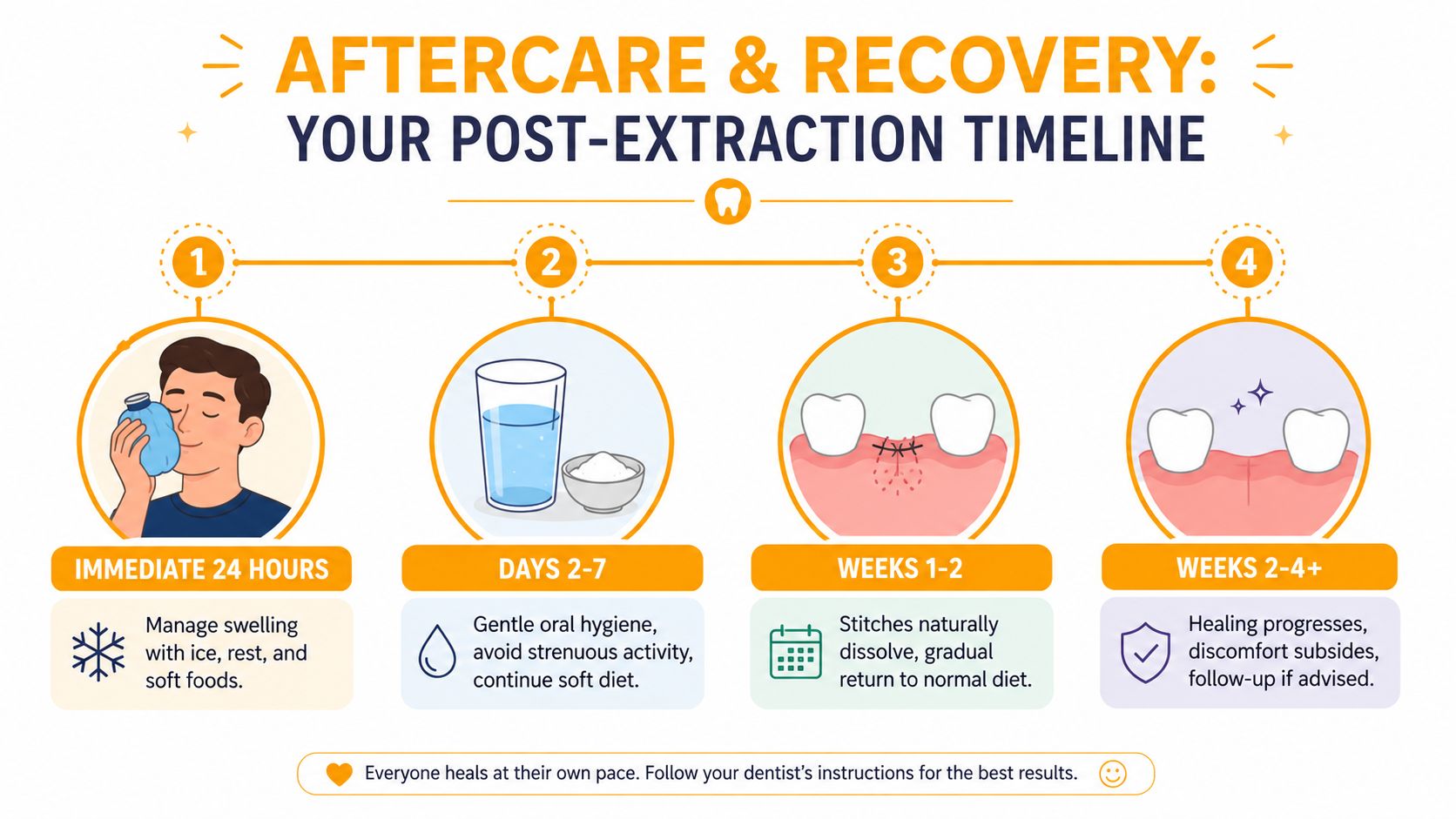
The main goal on day one is protecting the blood clot. That clot is your body's natural bandage. If it stays in place, healing usually starts well.
Keep firm pressure on the gauze for as long as your dentist advises. Rest with your head slightly raised, keep activity light, and give yourself permission to have a quiet day. Many patients feel relieved to learn that a little oozing early on can be normal.
A few simple rules make a big difference:
- Do rest and avoid heavy exercise
- Do use a cold pack on the outside of the face in short intervals
- Do take pain relief exactly as prescribed or recommended
- Don't use a straw, because suction can disturb the clot
- Don't spit or rinse hard
- Don't touch the area with fingers or your tongue unless your dentist has told you to check it
Days two to seven
This stage can be confusing. Some patients expect each day to feel better than the last, then worry when swelling or soreness becomes more noticeable before it settles. That pattern can still fall within normal healing.
Guidance from the UK National Health Service explains that discomfort and swelling often become more obvious during the first few days before easing, which is outlined in this NHS advice after tooth removal. Knowing that can prevent a lot of unnecessary panic.
Food, cleaning, and pacing yourself matter here. Choose soft foods that are easy to chew, such as yoghurt, eggs, mashed vegetables, or lukewarm soup. Brush the rest of your teeth gently so your mouth stays clean, but be careful around the surgical site. If your dentist has advised rinsing with warm salty water after the first day, do it gently, not vigorously.
If your extraction involved wisdom teeth, these wisdom teeth removal recovery tips can help you plan meals, cleaning, and rest for the first week.
What healing usually looks like
Normal recovery often includes:
- Mild bleeding or pink saliva early on
- Swelling of the cheek or jaw
- Jaw stiffness
- Tenderness that improves with your pain plan
- A white or yellow healing layer over the socket
That last one often worries people. In many cases, it is part of normal healing, not infection.
When to call your dentist
Contact your dentist promptly if you notice:
- Bleeding that stays heavy or does not settle
- Pain that becomes stronger instead of gradually easing
- Swelling that keeps increasing after the first few days
- Fever, pus, or a bad taste that does not go away
- Difficulty opening your mouth, swallowing, or anything that feels wrong to you
Good aftercare is not complicated. It is consistent.
Clear post-op instructions, follow-up support, and easy access to your dental team matter just as much as the procedure itself. That is one reason patients often look for clinics that communicate well online and dominate dental search results, because being easy to reach before and after treatment can make the whole experience feel safer and calmer.
Your Trusted Surgical Extraction Dentist in Dulwich Hill
Choosing a surgical extraction dentist isn't just about finding someone who can remove a tooth. It's about finding a clinician who will first decide whether extraction is necessary, explain the options clearly, and carry out treatment with calm, precise technique.
In Dulwich Hill and the Inner West, patients often want that mix of experience and reassurance. Dr. Dimitrios Thanos has led The Smile Spot since 1996, and the practice combines long clinical experience with modern tools, including Biolase laser dentistry for minimally invasive treatment support. For patients, that means care designed to reduce stress, improve comfort, and support smoother healing where appropriate.

Practical details matter too. Flexible hours, emergency appointments, transparent fees, and online booking make it easier to deal with a dental problem before it turns into a bigger one. That's especially important when you're juggling work, family, or an urgent toothache.
There's also value in choosing a clinic that communicates well online before you ever walk through the door. If you're curious how modern practices dominate dental search results and make information easier for patients to find, that background can be surprisingly useful when you're judging whether a clinic feels clear and trustworthy.
The right practice should never make you feel pushed into treatment. You should feel listened to, properly assessed, and supported from diagnosis through recovery.
If you need answers about a difficult tooth, wisdom tooth pain, or a possible surgical extraction, book a consultation with The Smile Spot. You'll get a careful assessment, clear guidance on whether extraction is the right choice, and a treatment plan built around safety, comfort, and your peace of mind.