
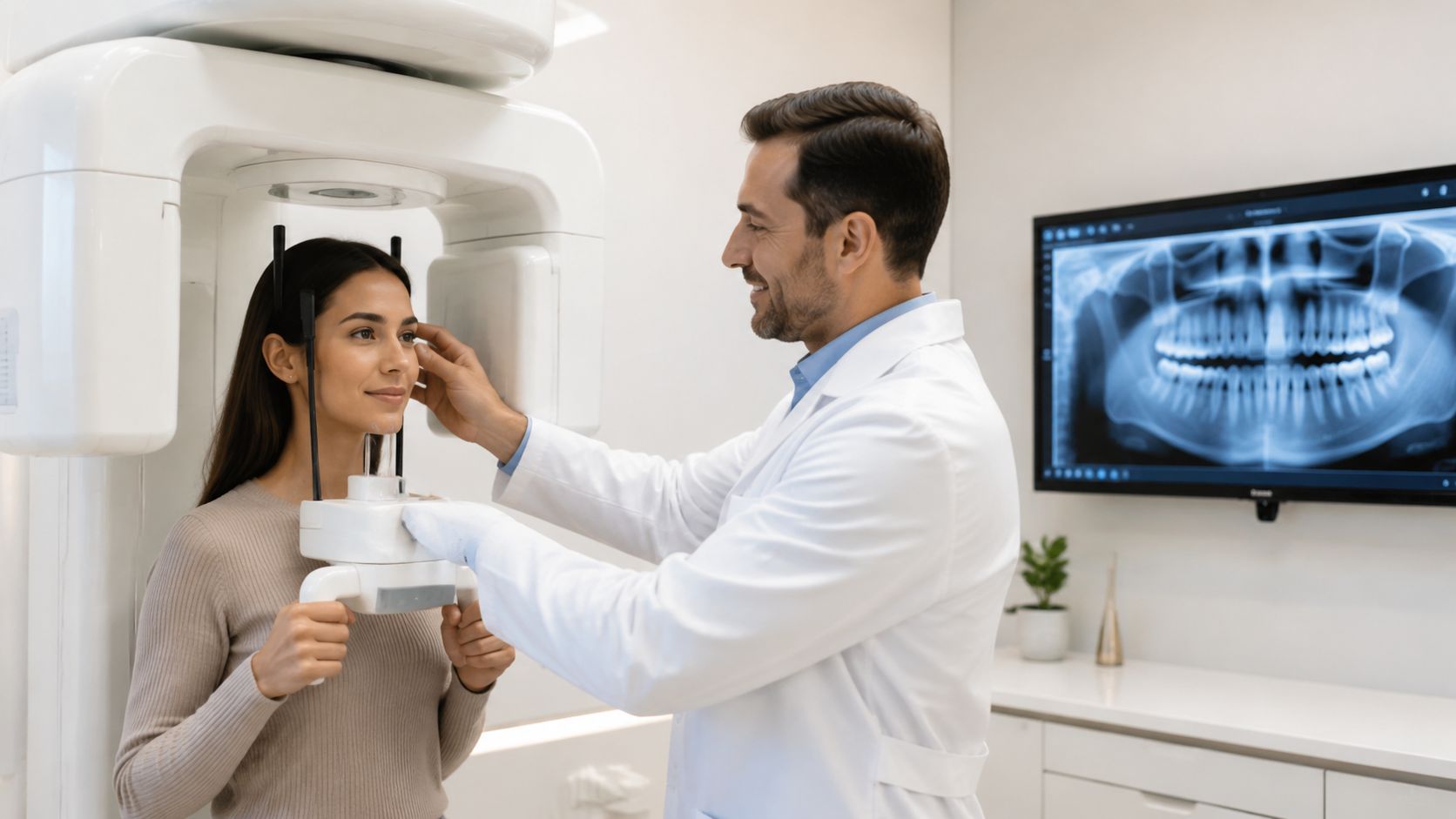
You've just had a check-up, your dentist has looked around, and then you hear a term that sounds more technical than reassuring: “We'd like to take an OPG.”
If you're wondering what that means, why you need it, and whether it's a big deal, you're not alone. Most patients haven't heard the full name before. They just know it's an X-ray that seems to show more than the little ones taken inside the mouth.
That's exactly what it does. An OPG dental X-ray is a broad, panoramic image of your teeth and jaws. It helps your dentist step back and see the full layout in one go. If you're dealing with wisdom teeth, planning braces, thinking about implants, or starting as a new patient, that bigger view can be very useful.
Your First Look at the Bigger Picture
A common moment for an OPG comes during a routine appointment. You might go in expecting a standard examination and clean, then your dentist suggests a “panoramic X-ray” to get a wider view. If you've only ever had small dental X-rays before, that can sound a bit unexpected.
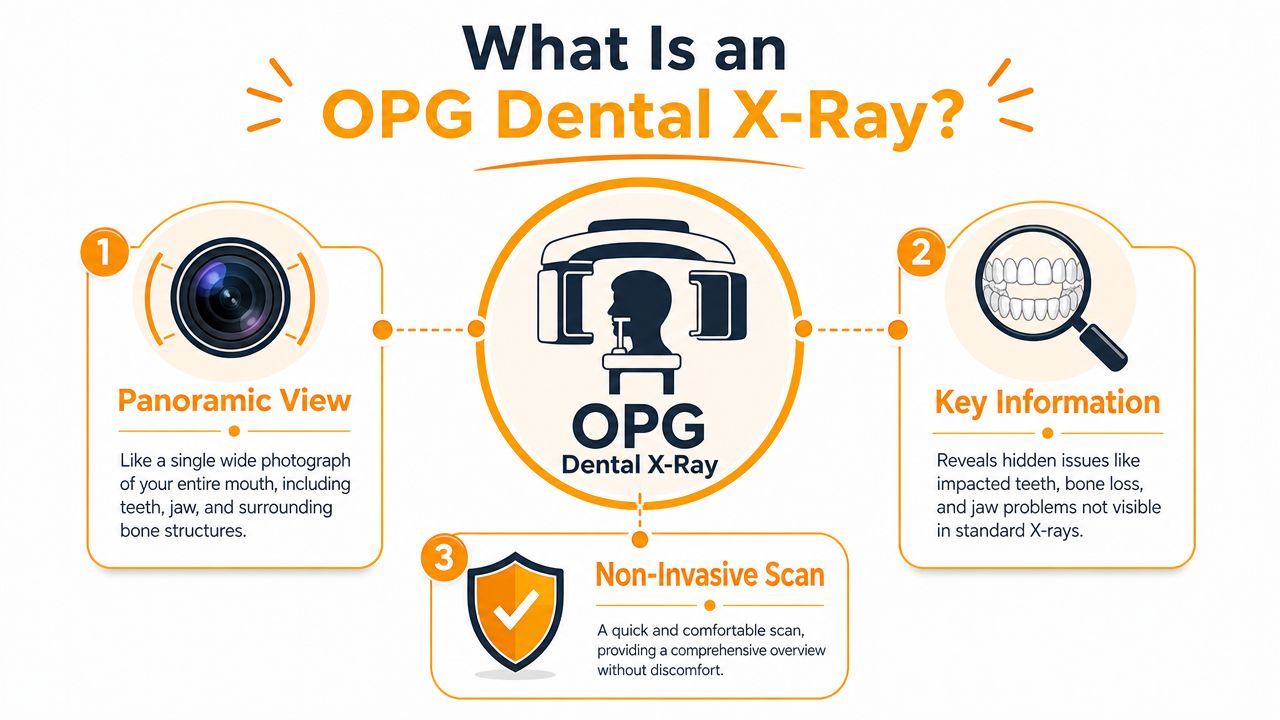
An OPG is a single wide image of your teeth, jaws, and nearby structures. Instead of showing one or two teeth in close detail, it shows the entire oral region. That's why many dentists use it when a close-up alone won't answer the complete diagnostic question.
For example, if a wisdom tooth is pushing sideways, if adult teeth are still developing, or if there may be something happening in the jawbone, a panoramic image can reveal the overall pattern much more clearly. It's often the first step in understanding what's going on before any treatment decisions are made.
If you've come across this recommendation during a routine check-up and clean visit, it usually means your dentist wants better context, not that something is automatically wrong.
Most of the time, an OPG is about clarity. It helps your dentist see the full picture so you get a treatment plan that makes sense.
Patients often worry that “bigger picture” means a bigger procedure. It doesn't. The scan is simple, quick, and done while you stand in an open machine. No needles, no drilling, and no recovery time.
What Is an OPG Dental X-Ray
The name OPG stands for orthopantomogram. In everyday language, it's a panoramic dental X-ray. Consider the contrast between a comprehensive photo and a portrait photo. A portrait gives detail in one small area. A comprehensive photo shows the whole scene.
That's what an OPG does for your mouth. It captures the mandible, maxilla, all teeth, and surrounding structures in a single 2D image. This makes it especially useful when your dentist needs to assess the relationship between many parts of the mouth at once, not just one tooth.
What an OPG can show
An OPG can help your dentist look at:
- All teeth together so they can see erupted, unerupted, or impacted teeth in one image
- Upper and lower jaws to check shape, symmetry, and overall bone patterns
- Wisdom teeth position when extraction or monitoring is being considered
- Jaw joints and nearby structures when symptoms involve the wider bite or jaw area
- Infection, cysts, or developmental issues when a broad overview is more useful than a close-up
It's especially helpful when several parts of the mouth may be involved at once, such as orthodontic planning, implant assessment, or a new patient baseline.
What an OPG does not do well
This part matters because it's where patients often get confused. An OPG is excellent for gross anatomy, meaning the broad layout of the mouth and jaws. It is not the best image for very fine detail.
The Australian Health Facility Guidelines recognise orthopantomogram imaging as a standard diagnostic dental-room function, and they note that panoramic imaging is designed for broad coverage, while structures outside the focal trough are blurred. That's why dentists often combine it with bitewings or periapicals when they need high-resolution caries or endodontic assessment, as outlined in the Australian Health Facility Guidelines for an OPG room.
Practical rule: An OPG is the map. Smaller dental X-rays are the zoomed-in street view.
So if your dentist orders an OPG and then also recommends other X-rays, that isn't duplication. It means each image is answering a different question.
The OPG Procedure Step by Step
For most patients, the best part of the OPG is how straightforward it feels. It's nothing like a long medical scan. You stay standing, the machine remains open around you, and the process is over quickly.
What happens when you arrive
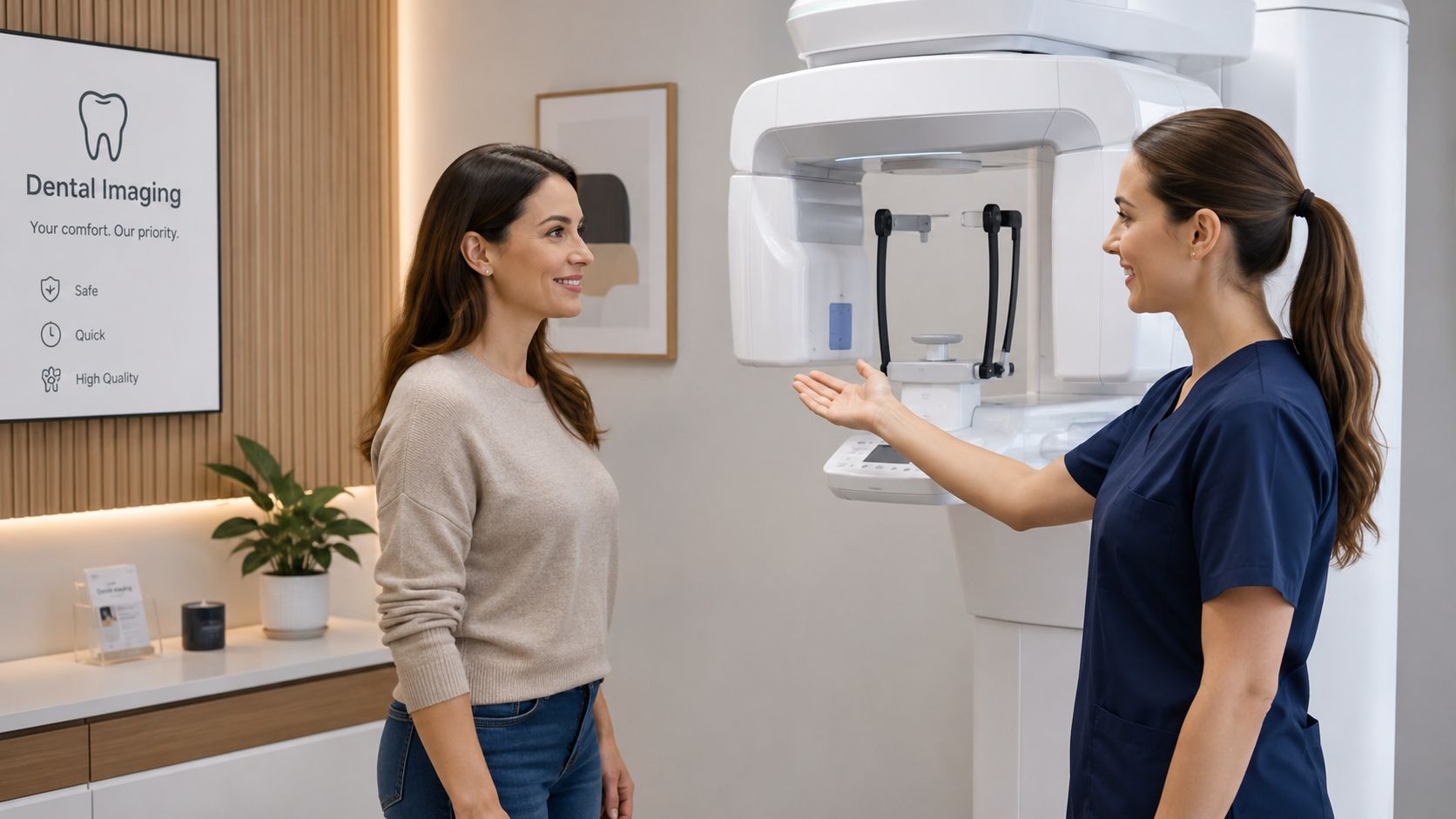
When it's time for the scan, a staff member will take you to the imaging area and explain what to do. You may be asked to remove earrings, necklaces, glasses, removable dentures, or other metal items around the face and neck so they don't interfere with the image.
Then you'll be positioned at the machine. Depending on the unit, you'll either stand or sit upright. You'll usually rest your chin lightly on a support and bite gently on a small guide to help line everything up correctly.
During the scan
Once you're in position, the key job is simple. Stay still.
The machine moves around your head in a smooth arc while the image is taken. You won't feel anything. There's no sensor inside the mouth like there is with some smaller dental X-rays, which many patients find more comfortable.
A helpful visual can make the process easier to picture:
How long it takes
In clinical workflow, an OPG is typically about 3 to 5 minutes total, with the actual exposure often lasting only seconds, according to this overview of how OPG imaging works in practice.
That short timing is one reason dentists often use it for baseline imaging and planning across multiple areas of treatment.
What it feels like
It is often described as easy. There's no enclosed tunnel, no injection, and no downtime afterwards. If you're someone who dislikes intraoral X-rays because of gagging or discomfort, an OPG is often much easier to tolerate.
A few practical tips can help:
- Wear simple jewellery if possible, since you may need to remove items near your head and neck.
- Follow the positioning instructions closely because even small movement can blur the image.
- Tell the team if you feel nervous so they can talk you through it before the scan starts.
Why Your Dentist Recommends an OPG
Dentists don't order an OPG just because it's available. They order it when a wider view is likely to change the quality of diagnosis or planning. It's often the image that connects separate symptoms into one clear picture.
Common reasons for an OPG
Wisdom teeth assessment
This is one of the most common reasons. An OPG can show whether wisdom teeth are impacted, angled, partially erupted, or close to important structures. If you're preparing for extractions, this broad view helps your dentist decide whether the tooth looks straightforward or more complex. If you want extra reading before a consultation, this guide to wisdom teeth removal gives a helpful patient-friendly overview. You can also read about local concerns around recovery and symptoms in this article on wisdom tooth removal pain.Orthodontic planning
For children, teens, and adults considering braces or aligners, the dentist or orthodontist needs to see how teeth are developing and how they sit within the jaws. Missing teeth, crowded eruption paths, and impacted teeth may not be obvious from a visual exam alone.Implant planning
Before replacing a missing tooth, your dentist needs a broad look at the jawbone and surrounding structures. An OPG often acts as the first planning image before deciding whether more detailed imaging is needed.
Why it matters so much in younger patients
Australian evidence shows that OPGs are the dominant extraoral dental image in paediatric and adolescent practice. In a 2011 to 2020 study of 9,680 dental images, 78% were orthopantomograms, 0.4% were CBCT scans, and orthodontic indications accounted for about one-third of all extraoral X-rays, according to this Australian study on dental imaging in children and adolescents.
That matters for families because it shows how commonly panoramic imaging is used to assess growth, eruption patterns, and orthodontic needs.
Other situations where an OPG helps
Sometimes the question isn't “Which tooth hurts?” It's “What's happening across the whole jaw?”
Your dentist may also recommend an OPG to:
- check for jaw pathology such as cysts or other hidden changes
- investigate infection that may involve more than one area
- look at jaw symmetry or developmental anomalies
- establish a baseline record for a new patient when a full overview is helpful
The value of the OPG is that it helps your dentist organise the next step properly. Sometimes that next step is simple treatment. Sometimes it's monitoring. Sometimes it's a referral or more detailed imaging.
OPGs Compared to Other Dental X-Rays
One of the easiest ways to understand an OPG is to compare it with the smaller X-rays your dentist may also take. Patients sometimes assume one type should replace the others. In reality, each one has a different job.
The main difference
An OPG is best when your dentist needs a full-arch overview. Bitewings and periapicals are better when your dentist needs a small-area close-up.
Here's a simple comparison.
| X-Ray Type | Primary Use | What It Shows |
|---|---|---|
| OPG | Broad screening and treatment planning | Both jaws, all teeth, and surrounding structures in one panoramic image |
| Bitewing | Detecting decay between teeth and checking bone levels | Crowns of upper and lower back teeth in a small area |
| Periapical | Looking closely at one tooth and its root | A single tooth from crown to root tip and surrounding bone |
Why you may need more than one type
If your dentist suspects decay between teeth, a bitewing is usually more useful than an OPG. If they're checking the root of one painful tooth, a periapical is often the better tool. If they want to assess overall eruption, jaw structure, wisdom teeth, or broad treatment planning, the OPG is often the right first step.
That's why a patient might have an OPG and still need smaller images afterwards. The panoramic image identifies the bigger issue. The close-up image helps confirm the details.
This is especially true in root canal assessment. If the question is whether a specific tooth has infection near the root tip, your dentist often needs a more localised image. This overview of dentistry for root canal treatment explains why close-detail imaging matters in that setting.
A key limitation with wisdom teeth and nerve risk
Transparency is important. An OPG can show warning signs that a lower wisdom tooth may be close to the inferior alveolar nerve, but it cannot always prove the exact three-dimensional relationship.
A radiology explainer notes that OPG signs such as interruption of the canal's white borders, root deflection, canal narrowing, or canal diversion are strong predictors of a close nerve relationship, but they are still predictors, not definitive proof. In high-risk cases, further imaging may be needed, as explained in this review of OPG signs and nerve proximity.
What that means for you
If your dentist says, “The OPG suggests we need a closer look,” that's not a problem with the scan. It means the scan has done its job. It has screened the area, flagged a possible risk, and helped your dentist decide whether a more advanced image is worth it.
The OPG is often the first decision-making image, not always the last one.
That's particularly relevant for wisdom teeth surgery and implant planning, where the exact position of a nerve or the true shape of the bone may need more than a 2D view.
OPG Safety and How to Prepare
Radiation is usually the first safety question patients ask, and that's a fair concern. The good news is that the dose from an OPG is low.
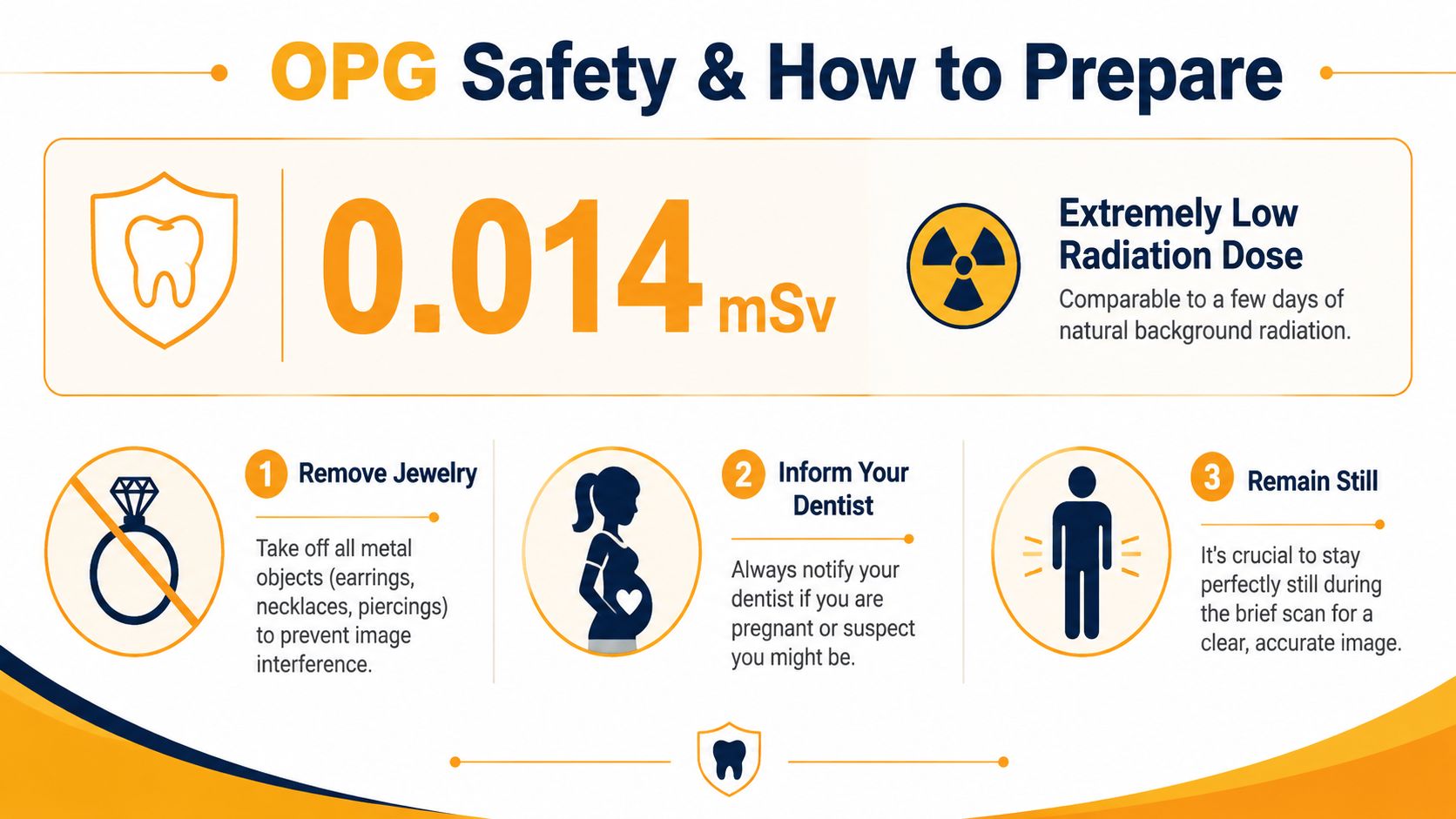
The radiation dose reported for an OPG is about 0.014 mSv, which is lower than a standard chest X-ray at 0.02 mSv, and the IAEA places panoramic examinations in the broader range of 4 to 30 μSv, according to the RACGP review on interpreting an orthopantomogram. That's one reason OPGs are widely used as a practical first-line extraoral dental radiograph.
How dentists think about safety
Dentists don't take X-rays casually. An OPG is recommended when the image is likely to help with diagnosis, planning, or prevention in a meaningful way. The benefit is that one panoramic image can answer questions that might otherwise require guesswork.
If you're anxious about any part of dental care, including imaging and treatment planning, it can help to discuss comfort options early. Some patients also find reassurance in learning about dental sedation options before more involved treatment.
How to prepare for an OPG
Preparation is minimal. Most patients can walk in, have the scan, and get on with their day.
A simple checklist:
- Tell your dentist about pregnancy or possible pregnancy so they can decide the best timing for the scan.
- Remove metal items such as earrings, necklaces, glasses, hair accessories, or removable appliances if requested.
- Stand still and follow instructions because clear positioning improves the quality of the image.
- Ask questions beforehand if you're unsure what the scan is for. Understanding the reason usually makes the process easier.
Is there anything to avoid?
There's generally no special fasting, medication change, or recovery needed for an OPG. You can usually eat, drink, drive, and return to normal activity afterwards.
The main challenge is remaining motionless for a short period.
Your OPG Results at The Smile Spot
Once your OPG has been taken, the useful part begins. Your dentist reviews the digital image and explains what they can see in plain language. That may include the position of wisdom teeth, the shape of the jawbone, signs of infection, eruption patterns, or areas that need a closer look.
A good consultation doesn't just point at shadows on a screen. It connects the image to your symptoms, your goals, and the next sensible step. If you've been having pressure at the back of the mouth, your dentist might focus on third molars. If you're exploring tooth replacement, they may use the image to talk through bone support and treatment sequencing.
How the OPG guides treatment planning
An OPG often acts as the first planning image for:
- Wisdom teeth decisions, especially when angulation or jaw position matters
- Orthodontic assessment, where eruption and spacing need to be seen together
- Implant planning, where the wider anatomy matters before moving into detailed site planning
- General screening, when a broad baseline helps identify hidden issues
If you're considering replacement for missing teeth, it can also help to see how image-based planning fits into the bigger process. This article on dental implants before and after gives useful context around treatment outcomes and planning stages.
What happens next
Sometimes the result is reassuring. The image confirms that things look stable, and no immediate treatment is needed.
Other times, the OPG leads to a specific plan. That may involve discussing dental implants, All-on-4, or wisdom teeth removal depending on what the scan shows.
The key point is simple. The OPG helps your dentist move from uncertainty to a plan that's more precise, more efficient, and easier for you to understand. If you're due for imaging as part of a preventive visit, you can start with a comprehensive check-up.
Frequently Asked Questions About OPGs
How much does an OPG cost?
Fees can vary between clinics, and cover depends on your private health fund and your level of extras cover. The best option is to ask the clinic for the exact fee and whether a rebate may apply in your situation.
How often should I have an OPG?
There isn't one fixed schedule for everyone. Dentists recommend OPGs based on clinical need. You might have one as a new patient baseline, for wisdom teeth assessment, for orthodontic planning, or when symptoms suggest a wider view would help.
Is an OPG safe during pregnancy?
If you're pregnant or think you might be, tell your dentist before the scan. In many cases, elective imaging may be delayed if it isn't urgent. If imaging is clinically necessary, your dentist will weigh the benefits and timing carefully and explain the safest approach.
Is an OPG painful?
No. The scan is non-invasive and usually very comfortable. You stand still while the machine rotates around your head. There are no needles, and there's no recovery afterwards.
Will I need other X-rays too?
Possibly. An OPG gives the broad overview, but your dentist may still recommend bitewings or periapicals if they need detailed information about decay, roots, or a specific tooth.
If you've been told you need an OPG and want clear advice from a friendly local team, The Smile Spot can help. Whether you're checking wisdom teeth, planning implants, or starting with a full dental assessment, booking a consultation is the easiest way to understand what's needed and what happens next.