You notice the gap every time you look in the mirror. Maybe it's a front tooth lost to trauma, an old tooth that couldn't be saved, or a space that shows whenever you talk and smile. You want it fixed, but you don't want surgery if there's a simpler option.
That's where Maryland bridges teeth conversations usually begin. People aren't asking for a technical label. They're asking a much more practical question. Can I replace this tooth without drilling down healthy teeth or committing to an implant right away?
For the right person, a Maryland bridge can be a smart middle ground. It's conservative, neat, and often more affordable upfront than other fixed options. But the right decision isn't just about the starting fee. It's about how the bridge behaves over time, what maintenance looks like, and whether it suits your bite, habits, and age.
If you're anxious about treatment, it also helps to know that conservative options often feel more approachable than major restorative work. Patients who prefer a low-stress dental experience often start by looking for a gentle dentist near me before they compare replacement options.
A Gentle Solution for a Missing Tooth
A Maryland bridge is often chosen when someone has one missing tooth, usually toward the front, and wants a fixed replacement without heavy preparation on the neighbouring teeth. That's the appeal. Instead of reshaping the teeth beside the gap for full crowns, the bridge uses slim bonded retainers on the back surfaces.
That difference matters more than is often appreciated. If the adjacent teeth are healthy and largely untouched, preserving them is usually a strong priority. Once a tooth is significantly reduced for a crown, that change can't be undone. A Maryland bridge keeps the conversation focused on replacing the missing tooth while interfering as little as possible with the teeth next to it.
It also suits a very specific real-world problem. A missing front tooth changes how people smile, pronounce certain sounds, and feel in social settings. Adults often want a presentable, fixed solution quickly. For younger patients, the issue is often timing. They may need something conservative while the mouth is still developing.
A good tooth replacement doesn't just fill a space. It needs to match the stage of life the patient is in.
In practice, Maryland bridges teeth treatment works best when expectations are clear from the start. It's not the strongest option for every bite. It's not a set-and-forget appliance. But when used in the right case, it can be elegant and effective.
What Exactly Is a Maryland Bridge
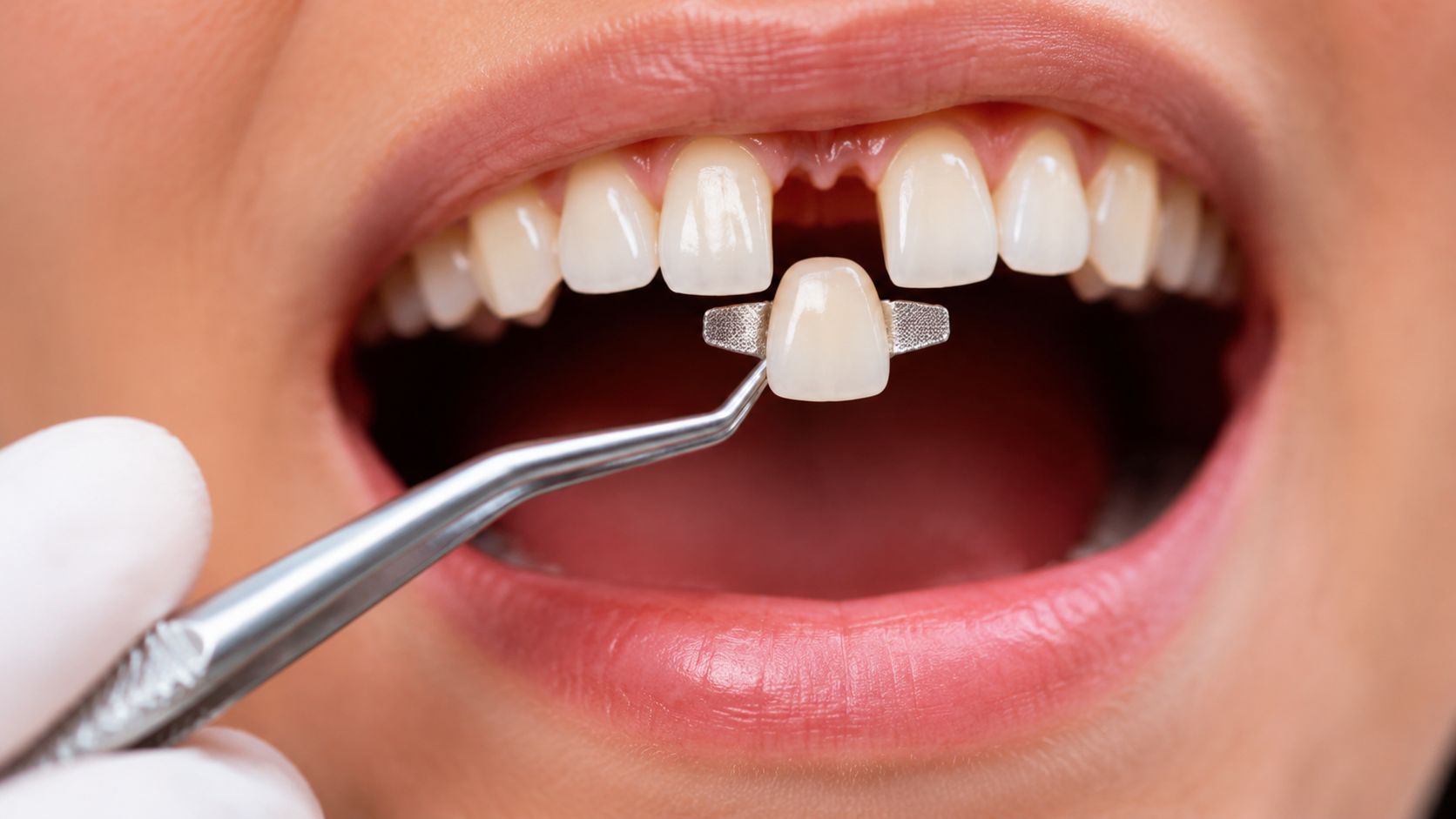
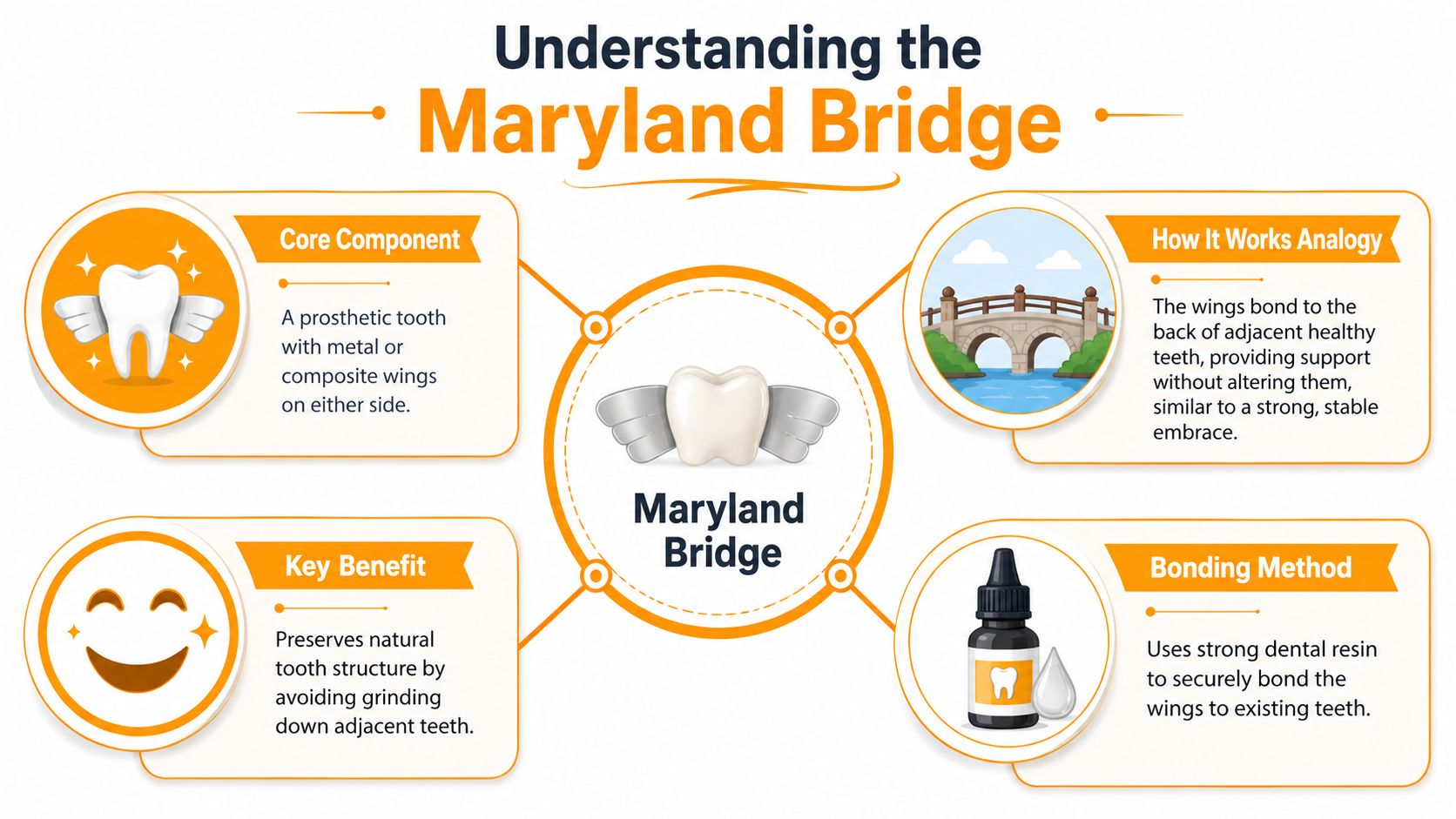
A Maryland bridge is a resin-bonded fixed partial denture. In plain terms, it's an artificial tooth attached to one or two thin “wings” that bond to the backs of nearby teeth. Those wings act a bit like a custom bracket. They hold the replacement tooth in place without wrapping the support teeth in full crowns.
How it stays in place
The simplest way to picture it is this. A traditional bridge grips from the outside with crowns. A Maryland bridge holds from the inside with bonded retainers. That's why it's commonly discussed for front teeth, where chewing forces are usually lower and preserving enamel matters.
The bridge is custom-made so the replacement tooth sits naturally in the gap and the retainer wing or wings fit closely against the back of the adjacent tooth or teeth. Bonding is the critical step. Success depends on case selection, bite design, the quality of enamel available for bonding, and how carefully the bridge is made and fitted.
Why it became popular
Maryland bridges were first developed in the 1970s at the University of Maryland. Their conservative design, which leaves neighbouring tooth structure largely intact, makes them ideal for replacing single anterior missing teeth, especially in adolescents where trauma is a common cause of tooth loss, as noted in this overview of Maryland bridges and conservative tooth replacement.
That last point is important. A child or teenager who loses a front tooth may not be an implant candidate yet. A conservative fixed option can restore appearance and function without pushing treatment too far, too early.
What a Maryland bridge is made from
The visible part is the replacement tooth, designed to blend with the smile. The retainer structure may involve metal or ceramic depending on the case and design goals. What matters most to patients is usually not the material label but the trade-off:
- Minimal preparation: Healthy neighbouring teeth are preserved.
- Fixed rather than removable: It stays in place, unlike a plate.
- Best for selected cases: It isn't ideal where bite forces are high.
- Technique-sensitive: Design and bonding quality matter a lot.
If you've heard people compare Maryland bridges teeth options with regular bridges, this is the key difference to remember. A traditional bridge relies on crowns for support. A Maryland bridge relies on bonded wings and careful case selection.
The Maryland Bridge Procedure at The Smile Spot
The process is usually more straightforward than patients expect. In a well-selected case, the appointment sequence is focused on planning, precision, and bonding rather than major drilling.
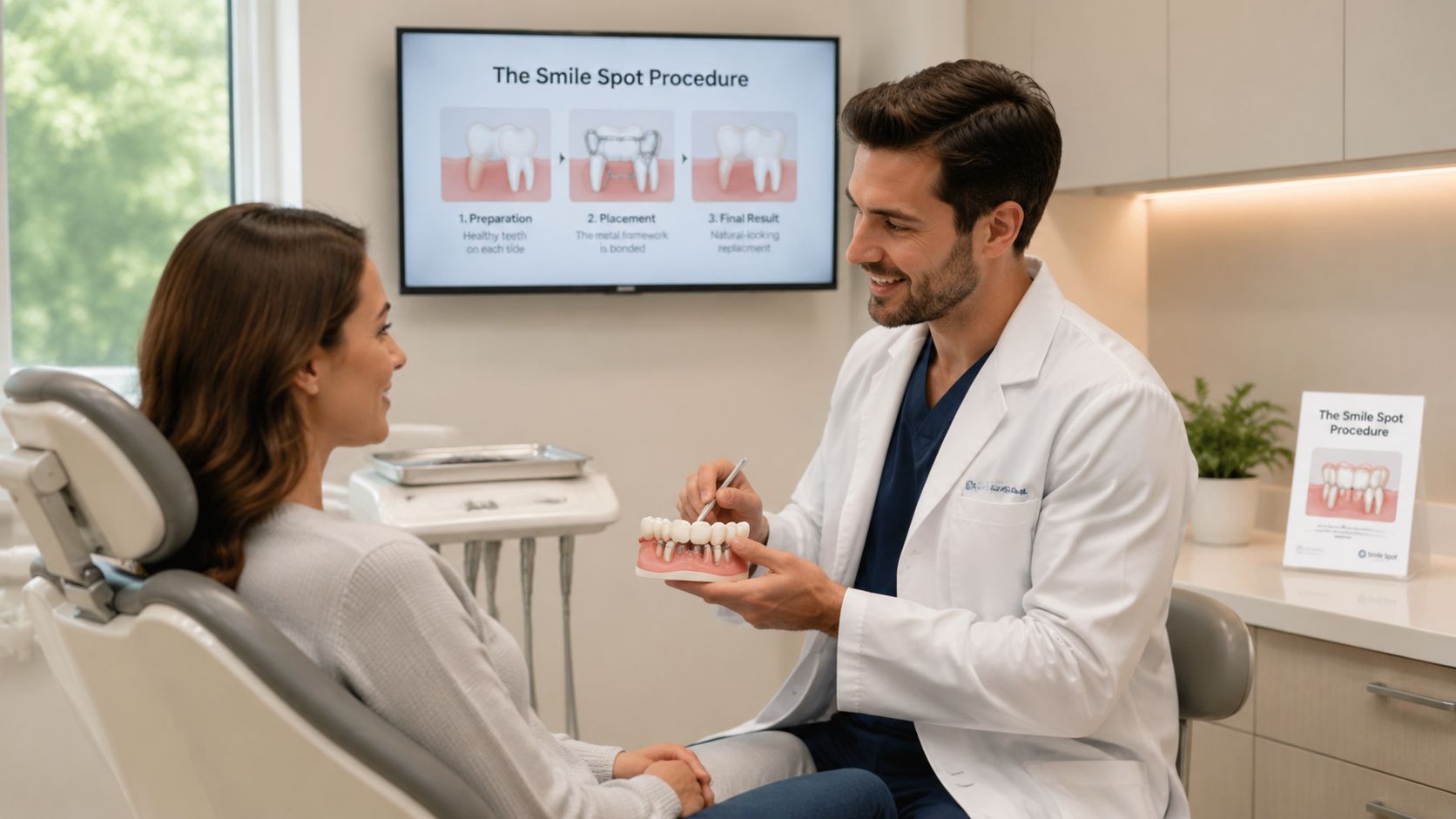
Step one starts with the bite, not the gap
The missing tooth gets the attention, but the bite decides whether the bridge is likely to work well. The first visit usually checks the space, the condition of the neighbouring teeth, enamel quality, gum health, and how the upper and lower teeth meet. If the bridge would sit in a high-stress position, another option may be safer.
Imaging can be part of this planning stage, especially when the case needs a broader view of roots, spacing, or surrounding structures. If you've never had one before, an OPG dental X-ray is one of the tools that can help assess the wider picture.
Minimal preparation is the point
In many Maryland bridge cases, preparation is light. Sometimes there's only minor adjustment to create room and improve the path of placement. That's one reason patients often find this option less confronting than a traditional bridge.
For optimal strength, the wings of a Maryland Bridge require a minimum thickness of 0.5 mm. They are typically fabricated from non-precious metal, sandblasted, and bonded with a special MDP-containing resin cement to ensure a durable, long-lasting bond to the tooth enamel, following Australian Dental Association guidelines, as described in this discussion of Maryland bridge design and bonding protocol.
That sounds technical, but the practical point is simple. These bridges don't succeed by accident. Small design details affect whether the bridge stays put.
Fabrication and fitting
Once the design is approved, a laboratory makes the bridge to fit the exact space and support teeth. At the fit appointment, the bridge is checked for seating, appearance, and bite. The bonding stage has to be controlled and dry. Any contamination can weaken the result.
This is where good workflow matters. Many dental practices now review how they present procedures and educate patients online as carefully as they manage treatment in the chair. If you're curious how practices are improving communication and patient experience, this overview of 2026 dental marketing strategies gives useful context.
Later in the process, the final bond is placed only when the fit and bite are right.
Practical rule: The best Maryland bridge is the one that's kept out of heavy bite contact and bonded to healthy enamel.
Maryland Bridge vs Implants and Traditional Bridges
Most patients weighing Maryland bridges teeth treatment are really deciding between three options. They want to know what costs less upfront, what lasts, what involves surgery, and what puts nearby teeth at risk.
The answer depends on the case, but the trade-offs are clear enough to compare.
Comparing Tooth Replacement Options
| Feature | Maryland Bridge | Traditional Bridge | Dental Implant |
|---|---|---|---|
| Initial cost in Australia | AUD $1,200 to $2,500 according to this guide on Australian bridge and implant costs | AUD $1,800 to $5,000 in the same Australian cost guide | Can cost significantly more than a Maryland bridge in the same source |
| Tooth preparation | Minimal preparation of neighbouring teeth | Requires significant reshaping of adjacent teeth for crowns | Doesn't rely on adjacent teeth, but involves implant surgery |
| Best use case | Usually one missing front tooth | Broader use where more strength is needed | Suitable when a long-term standalone replacement is appropriate |
| Treatment style | Fixed and conservative | Fixed and more invasive to adjacent teeth | Surgical, staged treatment |
| Maintenance reality | Bond integrity and bite management matter | Hygiene around crowns and under the bridge matters | Requires ongoing maintenance of implant and surrounding tissues |
| Long-term trade-off | Lower upfront fee, but may need rebonding | Stronger support, but healthy teeth are sacrificed | Higher entry cost, often chosen for independence from neighbouring teeth |
What works well for each option
A Maryland bridge works well when the adjacent teeth are healthy, the missing tooth is at the front, and the patient values preserving enamel. It's also a practical choice when surgery isn't desirable or timing matters.
A traditional bridge works better when strength is the priority and the neighbouring teeth already need crowns anyway. In that situation, the extra preparation may be easier to justify because those teeth already require significant restoration.
An implant is often the most independent option because it doesn't borrow support from nearby teeth. If you're comparing fixed options at that level, this guide on whether dental implants are worth it is useful background reading.
The cost question patients should really ask
The mistake is focusing only on the first invoice. The better question is this: what will this option ask of me over the next ten years?
For some Inner West patients, a Maryland bridge is still the right answer because it gets them a fixed tooth replacement with minimal intervention. For others, repeated maintenance would become frustrating. Upfront affordability matters, but so does tolerance for follow-up care, the way you bite, and whether you grind your teeth.
If the neighbouring teeth are untouched and beautiful, preserving them has real value. If your bite is heavy and unstable, that same conservative choice may become the wrong one.
Ideal Candidates Lifespan and Long-Term Care
The ideal Maryland bridge patient is usually not “anyone missing a tooth”. The best candidates are more specific than that.

Who tends to suit this option
This bridge is commonly a strong fit for:
- Adolescents with a missing front tooth: Maryland bridges were developed as a conservative solution and are especially useful where trauma has caused loss of a single anterior tooth.
- Adults who want to avoid surgery: Some patients want a fixed option but aren't ready for an implant pathway.
- People with healthy support teeth: Clean enamel and relatively unrestored adjacent teeth help bonding.
- Short-to-medium term planners: Some patients want a conservative solution now while keeping future options open.
It's less attractive for people with heavy bite forces, obvious grinding, poor enamel for bonding, or a gap positioned where the bridge will take repeated functional stress.
Lifespan and what the numbers really mean
Clinical data gives a balanced picture. The Maryland Bridge exhibits a 10-year overall survival rate of 77%, with debonding at 21%, tooth discolouration at 18%, and caries at 7%. If the bridge is rebonded after dislodgement, survival can improve to 87% after 8 years under risk, according to this clinical review of resin-bonded bridge survival and complications.
That doesn't mean the bridge “fails” the first time it loosens. It means maintenance is part of the situation. For the right patient, rebonding can keep the bridge serving well. For the wrong patient, recurrent debonding becomes a warning sign that the design or case selection was never ideal.
Cleaning and daily habits matter
Long-term success depends on ordinary daily behaviour more than is generally anticipated.
- Use a soft toothbrush: Aggressive scrubbing around the retainers can be counterproductive.
- Clean under and around the pontic carefully: Ask your dentist to show you the safest method for your specific design.
- Don't test it with hard foods: Biting directly into very hard items with the bridge tooth isn't wise.
- Address grinding early: If you clench or grind, a night guard may protect both the bridge and the supporting teeth.
For general bridge support teeth, clinical studies indicate a weighted mean survival rate per year of 99.0%, and among studies with 5 or more years of follow-up, 97.9%, with an estimated failure rate per 100 fixed dental prosthesis years ranging from 1.78 to 2.07, based on this evidence summary of fixed dental prosthesis support survival. Maryland bridges, though, need to be judged on their own bonded-retainer behaviour, not grouped blindly with every other bridge type.
The Inner West maintenance reality
Busy adults often like the lower upfront fee. Parents often like the conservative approach for a teenager. Both groups should still plan for reviews and possible maintenance. If a bridge feels loose, don't push it down, glue it yourself, or ignore it for weeks. Prompt assessment gives the best chance of simple rebonding rather than a bigger remake.
If you're comparing restorations more broadly, this guide on how long crowns last helps frame the maintenance side of fixed dental work.
A Maryland bridge is cost-effective when it stays in the lane it was designed for. Front tooth, controlled bite, healthy enamel, good follow-up.
Your Maryland Bridge Questions Answered
Can a Maryland bridge be whitened later
No, the bridge itself won't whiten like natural enamel. If you're planning teeth whitening, it's better to discuss timing before the final bridge shade is chosen. That helps avoid a mismatch between the replacement tooth and the surrounding teeth.
What happens if my Maryland bridge falls off
Don't try to reattach it at home. Keep the bridge safe and contact your dentist promptly. A loose Maryland bridge may be suitable for rebonding if the bridge and support teeth are still in good condition. Delaying review can make the situation more complicated, especially if the bond surface becomes contaminated or the fit changes.
Is it covered by private health insurance in Australia
Often, yes, but it depends on your policy. In Australia, dental bridges are typically classified as major dental under private health insurance, and rebates can range from $1,000 to $2,000, with a 12-month waiting period often applying, according to this overview of Australian dental bridge insurance rebates.
The practical step is to check item numbers and annual limits with your fund before treatment begins. Major dental benefits can be useful, but they don't always remove the gap payment.
Is a Maryland bridge a permanent solution
It's better to think of it as a fixed long-term option for the right case, not a forever guarantee. Some patients keep them going well for years with good maintenance. Others eventually move to another solution because of bite changes, recurrent debonding, or changing priorities.
Are Maryland bridges teeth suitable for everyone missing one tooth
No. They're most suitable when the missing tooth is toward the front, the adjacent teeth are healthy, and the bite is favourable. If the supporting conditions aren't right, a traditional bridge or implant may be the more predictable option.
If you're weighing up a Maryland bridge and want advice that's practical, not pushy, book a consultation with The Smile Spot. A personalised assessment can show whether a Maryland bridge is the right fit for your bite, budget, and long-term plans in Dulwich Hill and the Inner West.