You're probably here because you've caught your smile in the mirror, or in a photo, and thought, “My teeth look a bit duller than I'd like.” Then you start searching and suddenly you're buried in whitening toothpastes, strips, take-home kits, in-chair whitening, LED lights, UV lights, and laser treatments. It's a lot.
That confusion is completely normal. Individuals don't just want a brighter smile. They want to know what works, what feels comfortable, and whether the result will look natural rather than chalky or overdone.
Laser dental bleaching sits at the professional end of whitening treatment. It's designed for people who want a stronger, more controlled approach than supermarket products can offer. The part that often causes the most uncertainty isn't the idea of whitening itself. It's the technology. The word “laser” can sound intense if you haven't had it explained properly.
In reality, the process is far less mysterious than it sounds. Think of it as a carefully supervised whitening treatment where a dentist uses the right kind of energy to help the whitening gel work more effectively. The goal isn't just speed. It's precision, comfort, and a cleaner result.
Your Guide to a Radiant Smile with Laser Whitening
A bright smile can change the way you feel when you talk, laugh, or pose for a photo. But if you've ever tried to compare whitening options, you'll know they can blur together quickly. One product promises convenience. Another promises dramatic results. A third says it's gentle. It's easy to end up unsure which claims matter.
That's where laser dental bleaching stands out. It isn't just another whitening product with a different label. It's a professional treatment carried out under dental supervision, using a whitening gel and laser energy together to lift stains more efficiently than products you use on your own at home.
Why patients often feel uncertain
Most hesitation comes from a few very human questions:
- Will it hurt: People worry the treatment will feel hot, sharp, or uncomfortable.
- Will it look natural: No one wants an unnaturally white smile that doesn't suit their face.
- Will it work on my teeth: Staining can come from coffee, tea, ageing, or other causes, and not every type responds the same way.
- Will I waste money: Many people have already tried strips or whitening toothpastes without seeing much change.
Those are sensible concerns. Whitening isn't only about colour. It's also about confidence, safety, and having realistic expectations.
Practical rule: The best whitening treatment isn't the one with the flashiest marketing. It's the one that matches your teeth, your sensitivity level, and your goals.
Laser whitening tends to appeal to people who want noticeable change without the drawn-out routine of trays or strips. It's also popular with patients who feel more reassured when a dentist is guiding the process from start to finish.
What usually helps anxious patients most is understanding what's happening in the chair. Once the process is broken down into simple steps, the whole experience feels much less intimidating.
How Laser Dental Bleaching Works
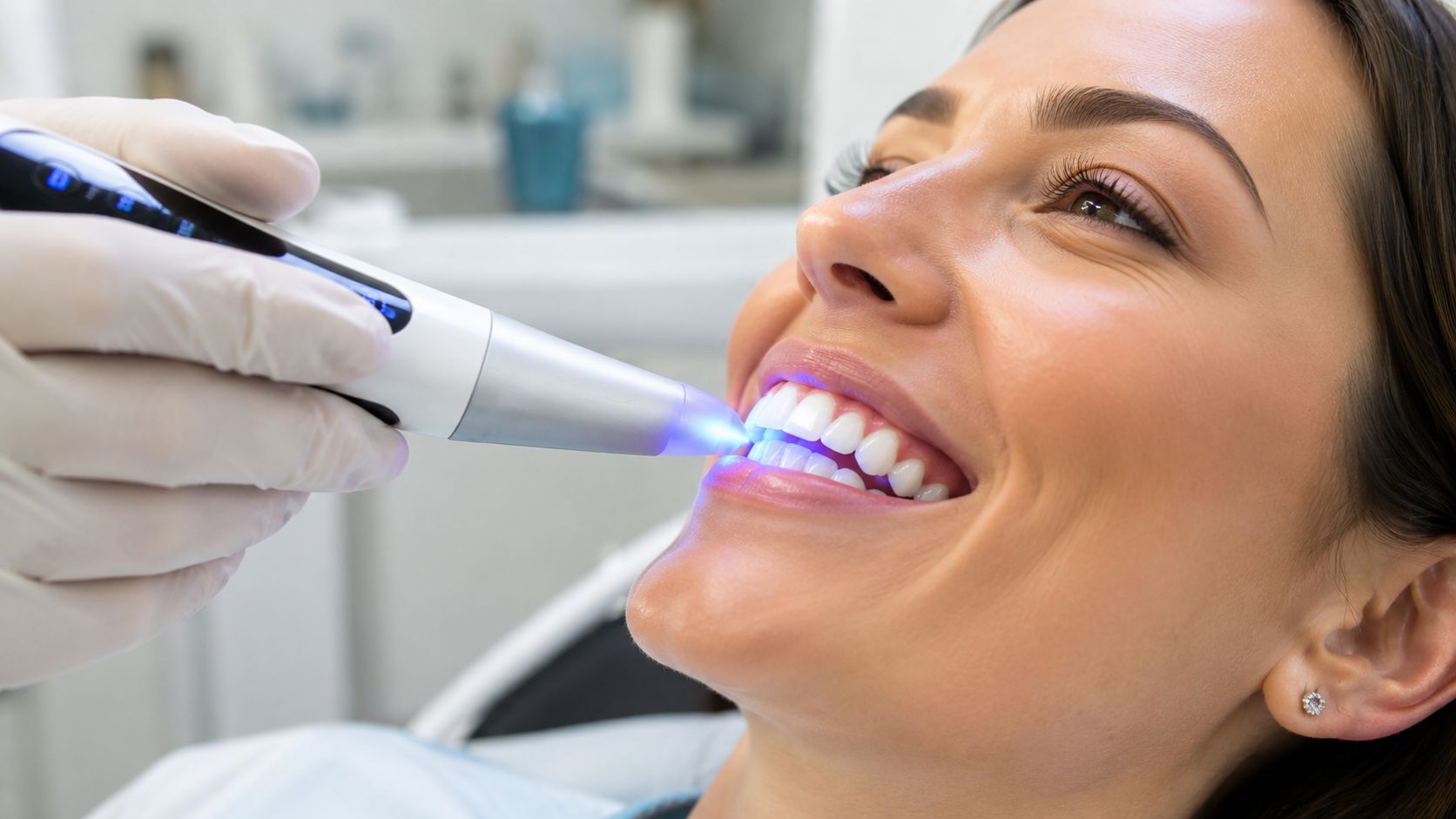
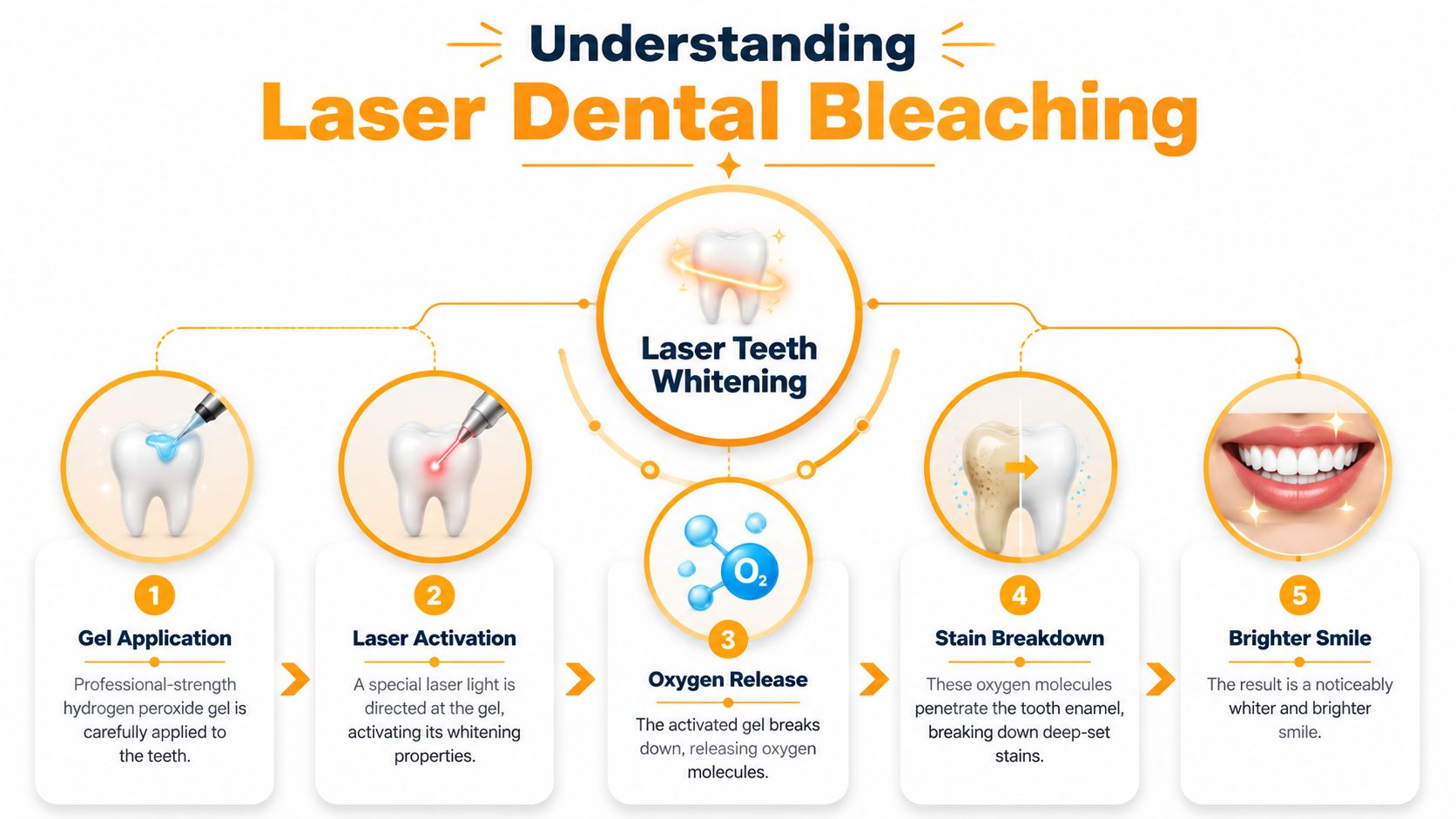
Laser dental bleaching works by combining a professional-strength whitening gel with targeted light energy. The gel is usually based on hydrogen peroxide. Once it's placed on the teeth, the laser activates it so the whitening reaction happens more efficiently.
A simple way to picture this is to think about soaking a stained shirt. The cleaning product matters, but how it's activated matters too. In whitening, the gel does the stain-lifting work, and the laser helps it get started and keep moving in a more focused way.
What the whitening gel actually does
Tooth stains can sit on the surface or settle deeper into the tooth structure. Whitening gel releases oxygen as it breaks down. Those oxygen molecules move into the enamel and help break apart stain compounds, so the teeth reflect light differently and appear whiter.
That's the chemical side of bleaching. The laser doesn't replace the gel. It supports it.
Why the laser matters
This is the part many people mix up. Not all “light-assisted” whitening is the same. Some systems use LED or UV-style light. A true dental laser delivers energy in a more controlled and precise way.
At The Smile Spot, this treatment is connected with advanced Biolase technology, which many patients recognise from modern laser dentistry in Dulwich Hill. That matters because laser systems are designed for precision, and precision often goes hand in hand with a smoother patient experience.
If you're interested in how medical lasers are used more broadly in clinical care, this overview of Laser Treatments gives useful context on why focused energy can make treatment more targeted.
The laser is best understood as an activator, not a scrubber. It doesn't scrape stains off the teeth. It energises the gel so the gel can do its work more effectively.
Why this feels different from DIY whitening
Home products often rely on weaker ingredients, longer wear time, and repetition. Laser dental bleaching is different because the treatment is supervised, isolated to the teeth being treated, and adjusted in real time. If a patient feels sensitivity, the dentist can respond immediately. If one area needs closer attention, the application can be refined on the spot.
That level of control is one reason professional laser whitening feels less guesswork-driven than trying one strip, one toothpaste, and one online kit after another.
Your Laser Whitening Journey Step by Step
If you're feeling nervous, it often helps to know what the appointment feels like in real time. Most patients find the process far more straightforward than they expected. It's closer to a carefully managed cosmetic appointment than anything dramatic.
Before whitening begins
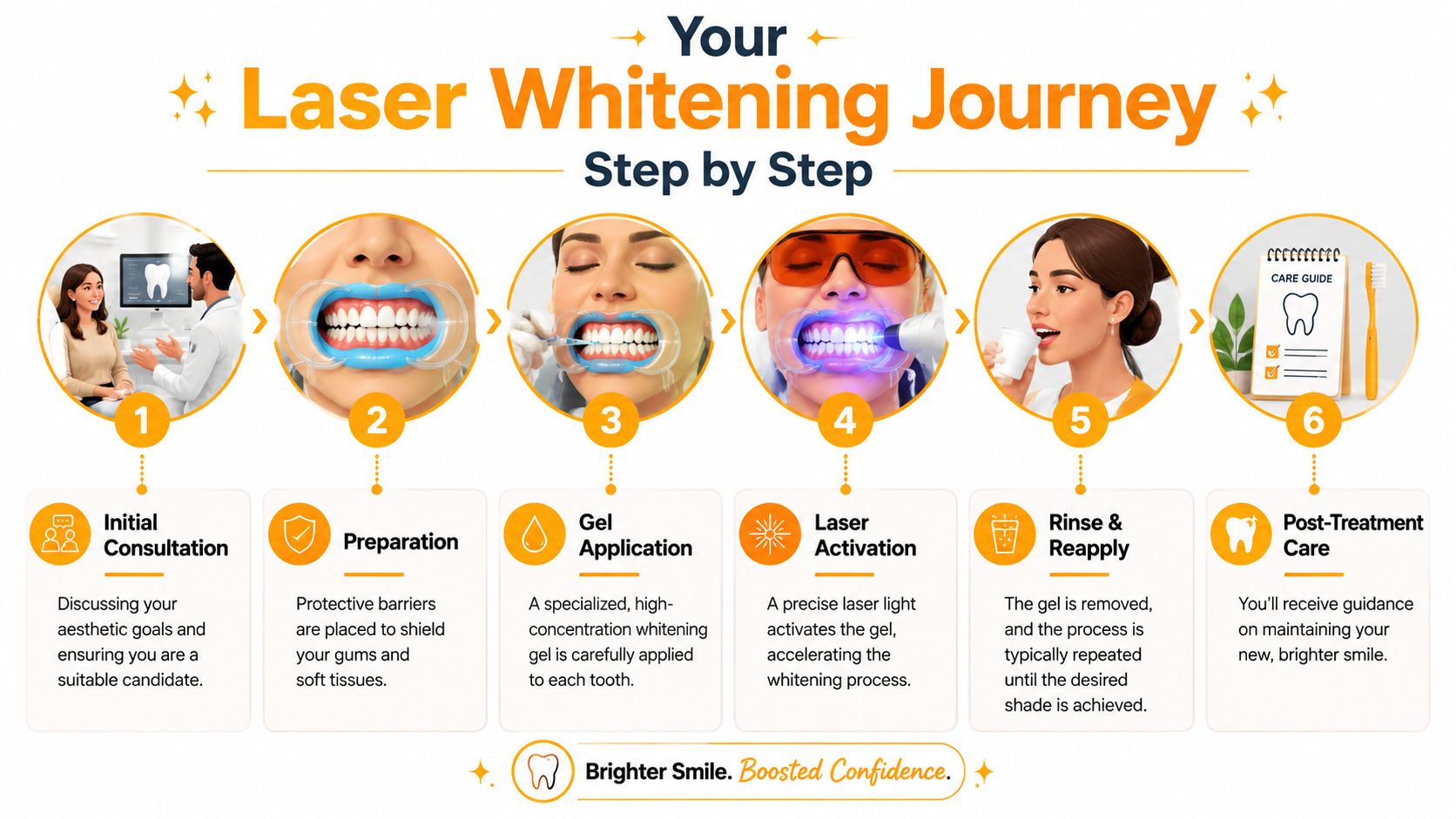
The first step is checking whether your teeth and gums are suitable. A dentist will look for things like untreated decay, gum irritation, exposed root surfaces, or dental work on front teeth that could affect the final appearance. Whitening is cosmetic, but it still needs a healthy foundation.
This is why a recent professional clean can be helpful. If there's plaque or surface build-up, it can interfere with how evenly the gel contacts the teeth. If you haven't had one for a while, it helps to understand what happens during a check-up and clean appointment before booking whitening.
Getting comfortable in the chair
Once you're ready to begin, the preparation stage is all about protection and comfort. Your lips and cheeks are gently moved away from the teeth so the working area is visible. A protective barrier is placed over the gums so the whitening material stays where it should.
Patients often worry this will feel awkward. In practice, it usually feels more like holding still for a cosmetic treatment than having invasive dental work. You may notice the mouth feels held open, but you shouldn't feel the whitening gel touching soft tissue because those tissues are shielded.
To help you visualise the appointment, this short video gives a useful overview of the in-chair experience.
The whitening cycles
The gel is applied carefully across the teeth being treated. Then the laser is directed at the gel in short cycles. During these cycles, most patients describe the sensation as warmth, pressure from keeping still, or “not much at all.”
Here's what commonly happens during the active phase:
- First cycle begins: The laser activates the gel while the dentist monitors your comfort and response.
- Pause and assess: The gel may be removed or refreshed, depending on how the teeth are responding.
- Further cycles if appropriate: The process is repeated in a controlled way to build the whitening effect.
- Constant supervision: If anything feels too intense, the treatment can be adjusted straight away.
Some people expect a dramatic burning or zapping sensation because the word laser sounds strong. That's usually not how it feels. What matters most is that the treatment is monitored throughout, rather than left to chance.
If you tend to be anxious in the dental chair, this is worth knowing. Whitening appointments are usually calm, quiet, and very predictable.
The reveal at the end
When the final cycle is complete, the gel and protective barriers are removed. You'll rinse, and then you get the moment everyone cares about most. You look in the mirror.
The change is often visible immediately, which is one reason laser dental bleaching appeals to people with an upcoming event or a short timeline. Your dentist will also talk you through what to avoid after treatment and what level of sensitivity, if any, is normal over the next day or so.
Laser Whitening vs Other Whitening Options
The best whitening method depends on your goals, your schedule, and how much control you want over the process. Some people want a fast in-chair result. Others are happy to brighten their smile gradually at home. The key is understanding the trade-offs clearly, not assuming every whitening option does the same job.
Teeth Whitening Method Comparison
| Feature | Laser Bleaching | Professional Take-Home Trays | Over-the-Counter Strips |
|---|---|---|---|
| Speed of visible results | Fast, often noticeable soon after treatment | Gradual over repeated use | Gradual and often subtle |
| Professional supervision | Yes, throughout the appointment | Yes, treatment is prescribed and guided | No direct supervision |
| Effect on deeper stains | Better suited to more stubborn staining | Can help, but usually more slowly | More limited |
| Comfort control during treatment | High, because the dentist can adjust treatment in real time | Moderate, with instructions tailored to you | Lower, because fit and use vary |
| Convenience | Single in-chair visit | Home use over time | Easy to buy and use at home |
| Evenness of application | Highly controlled | Usually good with custom trays | Can be patchy if strips don't sit well |
| Suitability for impatient timelines | Strong option | Less ideal if you want quick change | Least ideal for time-sensitive goals |
| Relative cost | Higher upfront professional treatment | Moderate professional option | Lowest upfront cost |
Where laser bleaching stands out
Laser bleaching is usually chosen by patients who want a stronger, more immediate shift in tooth colour. It's especially appealing if you've tried shop-bought products and felt underwhelmed, or if you don't want to spend weeks remembering trays every night.
The biggest advantage isn't just that it's faster. It's that the whole treatment is controlled. The gel placement, soft-tissue protection, activation, and monitoring all happen in one environment under one plan.
When take-home trays make more sense
Professional take-home trays can be a very good option for patients who prefer a slower pace or want to top up whitening over time. Because the trays are custom made, they tend to fit better than generic products and can give a more even result than strips.
For patients comparing professional paths, this guide to professional teeth whitening options is helpful if you're weighing in-chair treatment against a dentist-prescribed home system.
Where strips and whitening toothpastes fit
Over-the-counter strips and whitening toothpastes have a place, but it's a narrower one. They're generally better for mild surface staining and maintenance rather than a meaningful change in deeper discolouration. They're also less personalised. A strip can't account for uneven teeth, exposed areas, or existing restorations.
A useful way to choose: If you want convenience above all else, strips may appeal. If you want professional oversight and stronger control, laser dental bleaching sits at the top end of the scale.
Safety Candidacy and Expected Results
Safety is usually the first practical question people ask, and rightly so. When laser dental bleaching is performed by a qualified dentist after an oral health assessment, it's considered a safe treatment. The important part isn't just the whitening material. It's the screening, protection, and judgement around when treatment should or shouldn't go ahead.
What safety looks like in practice
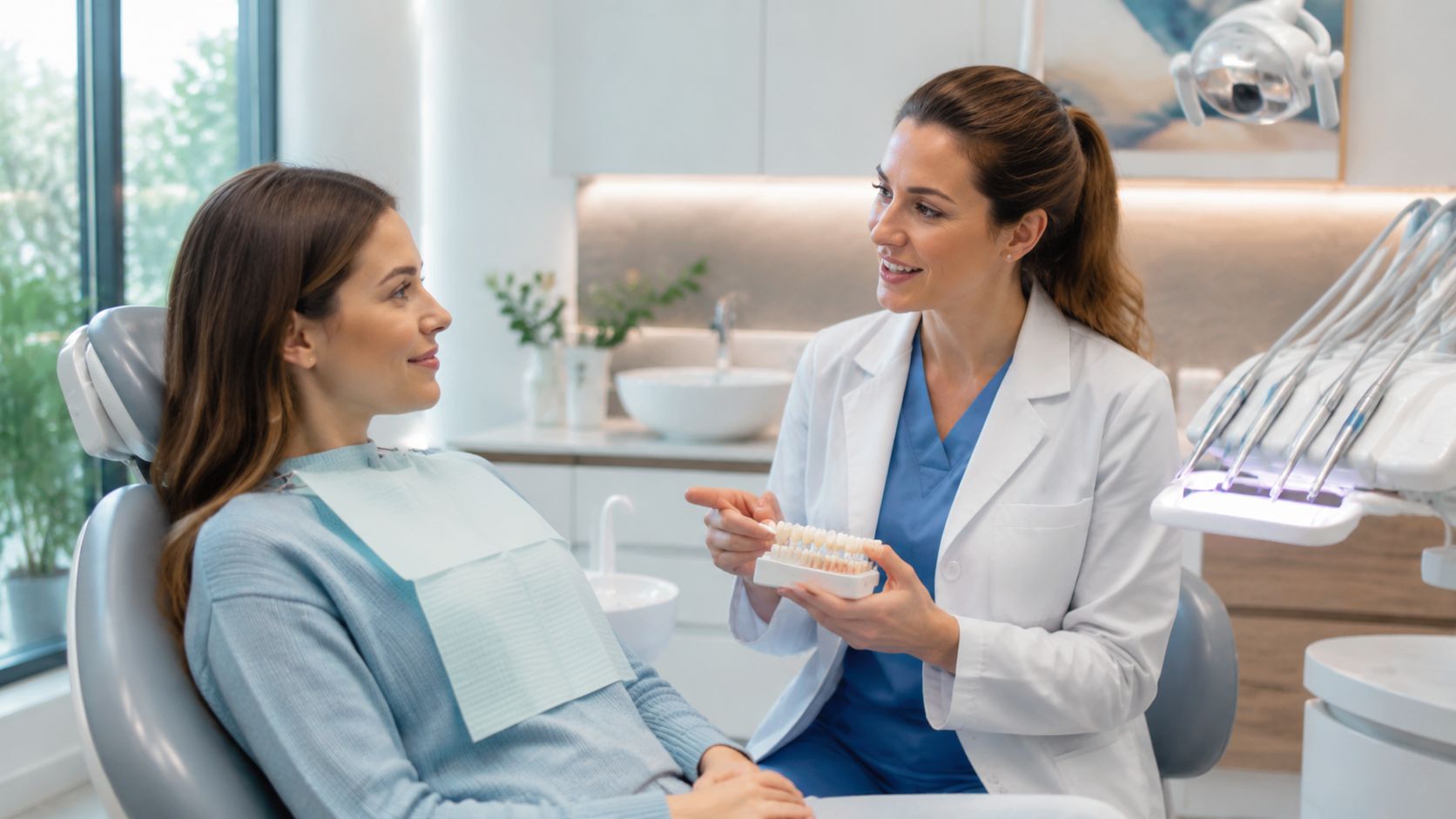
A safe whitening appointment starts before the gel touches your teeth. Your dentist checks the health of the enamel, gums, and any exposed root surfaces. They also look at fillings, crowns, veneers, and any signs that sensitivity may need special management.
During treatment, the soft tissues are protected and the whitening process is monitored throughout. If you're someone who worries about sensitivity, it helps to know there are professional ways to manage it. These may include adjusting the treatment approach, using desensitising products, and relying on the control that comes with systems such as Biolase. If this is your main concern, this article on teeth bleaching for sensitive teeth gives a more focused look at the topic.
Who tends to be a good candidate
Laser whitening tends to work best for patients with natural teeth that have yellowed or darkened over time. Common examples include staining linked to tea, coffee, red wine, smoking, or general ageing.
You may be a suitable candidate if:
- Your teeth and gums are healthy: Whitening works best when there isn't untreated decay or active gum inflammation.
- You have natural tooth enamel on the visible front teeth: Natural tooth structure responds differently from crowns or veneers.
- You want a noticeable cosmetic improvement: This treatment is usually chosen by people looking for more than a minor polish-up.
- You understand the result will be individual: Teeth don't all start from the same shade, and they don't all finish in the same place.
When whitening may not be the right fit
Some situations call for caution or a different cosmetic plan.
- Visible crowns, veneers, or fillings: These restorations won't whiten in the same way natural teeth do.
- Intrinsic discolouration: Some stains come from within the tooth and may not respond as predictably.
- Untreated dental problems: Cavities, cracked teeth, or gum disease should be addressed first.
- Unrealistic shade expectations: Whitening can brighten teeth, but it doesn't turn every smile into the same uniform white.
Whitening is best thought of as enhancement, not paint. It lightens your natural teeth. It doesn't coat them with a brand new colour.
What results usually look like
Most patients notice a brighter smile after treatment, but the exact change varies from person to person. Your starting shade, stain type, enamel condition, and existing dental work all shape the outcome. Some people see a crisp freshening effect. Others see a more obvious shift.
Results also aren't permanent. Teeth continue to live in the world, with coffee cups, curries, wine, sauces, and all the rest. Good maintenance makes a significant difference, which is why aftercare matters just as much as the appointment itself.
Aftercare Costs and Packages at The Smile Spot
The first couple of days after whitening matter more than many people realise. Right after treatment, teeth can be more prone to picking up new stains, so it helps to be a bit selective about what you eat and drink. Think pale foods and clear drinks rather than coffee, tea, red wine, cola, beetroot, soy sauce, or richly coloured sauces.
A simple checklist helps:
- Choose low-stain foods: Rice, pasta, plain yoghurt, chicken, and other lighter-coloured options are usually easier on freshly whitened teeth.
- Keep up oral hygiene: Gentle brushing, flossing, and regular maintenance help protect the result.
- Rinse after meals and drinks: Water helps reduce lingering pigments on the tooth surface.
- Don't smoke or vape if you can avoid it: These habits can quickly dull a newly brightened smile.
For many patients, whitening starts with making sure the mouth is healthy and clean first. At The Smile Spot, that can begin with the $240 care package, which includes an exam, X-rays, scale and fluoride. It's a practical first step if you're not yet sure whether whitening is appropriate for your teeth.
Cost is always a fair question, but a proper quote has to match the person in front of the dentist. Factors such as your current tooth shade, the type of staining, sensitivity, and whether any preparatory care is needed all affect the plan. That's why transparent pricing works best in consultation rather than as a one-size-fits-all promise. If you want a clearer sense of what influences pricing, this overview of how much teeth whitening costs is a useful place to start.
What sets The Smile Spot apart is the combination of Biolase laser technology, a gentle approach to anxious patients, and practical convenience. Late evening and Saturday appointments, online booking, and personalized treatment planning make it easier to fit cosmetic care into real life rather than reorganising your week around it.
Frequently Asked Questions About Laser Bleaching
Does laser dental bleaching hurt
Most patients don't describe it as painful. Some feel warmth during activation, and some notice temporary sensitivity afterwards, especially to cold air or cold drinks. The key difference in a professional setting is that the dentist can protect the gums carefully, monitor the response throughout, and adjust the treatment if your teeth are reacting more strongly than expected.
How is laser whitening different from Zoom whitening
The main difference is the type of activation technology. Laser whitening uses a true dental laser to activate the gel, while Zoom is commonly associated with a light-based system rather than a laser. From a patient point of view, that can affect how the treatment is delivered, how focused the energy is, and how the appointment feels. If you're comparing them, the useful question isn't which name sounds better. It's which system your dentist uses, how precisely they can control it, and how suitable it is for your teeth.
Can I get laser whitening if I have existing dental work
Sometimes yes, but it needs planning. Fillings, crowns, veneers, and other restorations don't whiten like natural teeth. If they're on front teeth, your dentist needs to consider whether whitening the surrounding enamel will make those restorations look darker by comparison. In some cases, whitening is still worthwhile. In others, a different cosmetic approach may create a more even final result.
If you're thinking about a brighter smile and want advice that feels clear, calm, and specific to your teeth, The Smile Spot is a great place to start. Their team combines gentle care with advanced Biolase laser technology, so you can explore laser dental bleaching with confidence and get a plan that suits your comfort, your timeline, and your smile goals.