You might already know the moment. Someone lifts a phone for a photo and you smile with your lips closed. Or you chew on one side because the other side doesn't feel reliable anymore. Or you've had a gap for a while and told yourself it isn't urgent, even though talking, eating, and feeling at ease in public have all changed in small but constant ways.
That's usually when people start looking seriously at dental implants for missing teeth. Not because they want something flashy, but because they want life to feel normal again. They want a tooth replacement that stays put, looks natural, and doesn't ask them to keep making compromises every day.
Pain, cost, and time are the three questions that sit behind almost every implant consultation. They're reasonable concerns. Most patients aren't worried about the dental terminology. They're worried about whether treatment will hurt, how long they'll be without a proper tooth, and whether the investment will be worth it over the long term. Those are the questions that matter most, and they deserve direct answers.
Reclaiming Your Smile and Your Confidence
A missing tooth affects more than appearance. It changes habits.
People often begin by avoiding hard foods. Then they notice speech feels slightly different. Over time, the social side can become the hardest part. Smiling in meetings, laughing without thinking, sitting down for dinner without scanning the menu for the “safe” options. A single gap can do more than one might expect.
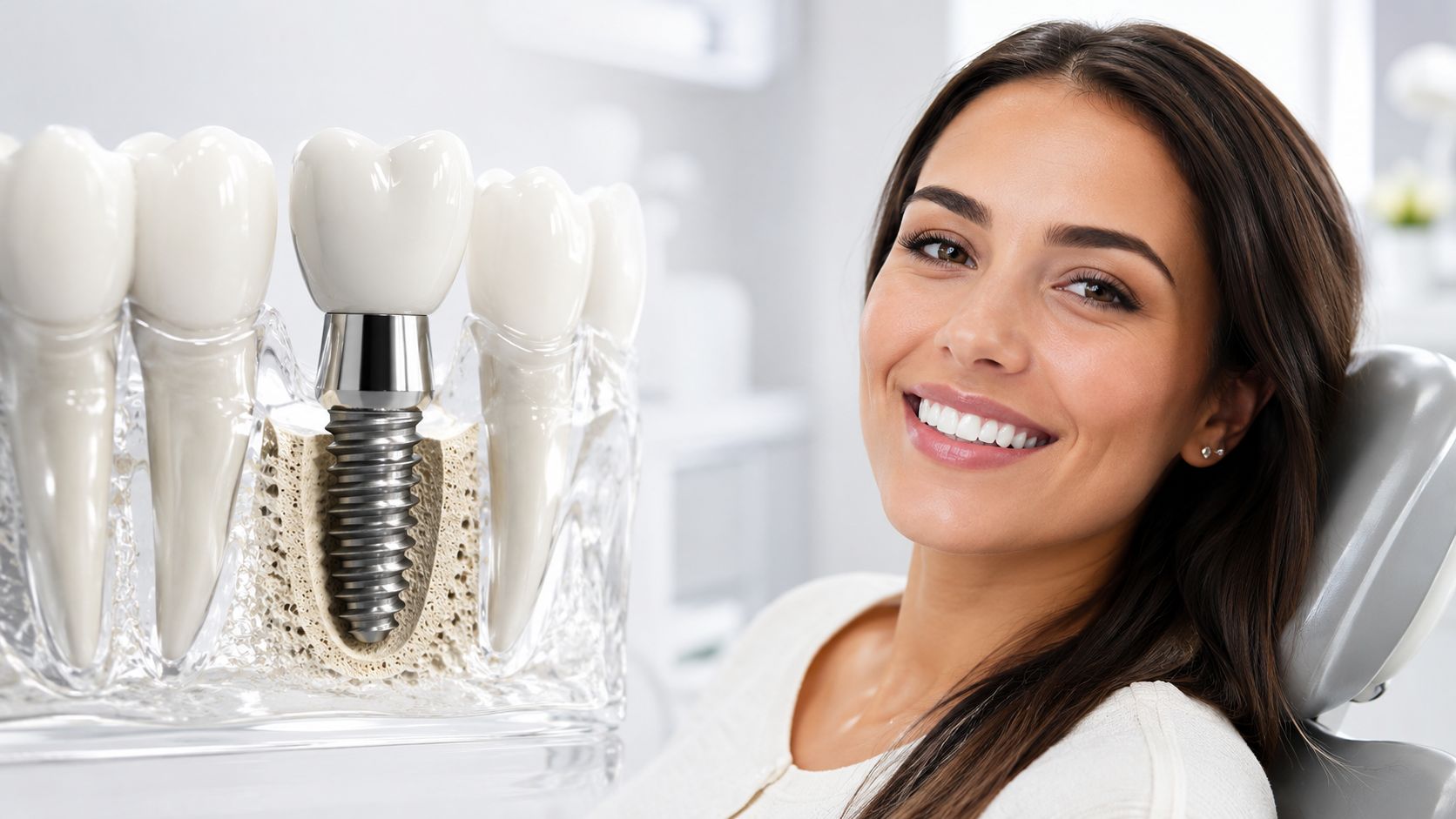
Dental implants changed that conversation because they replace the missing tooth in a way that feels stable and independent. Instead of relying on neighbouring teeth for support or wearing something removable, an implant replaces the missing root and supports a new crown in a fixed position. For many patients, that's what makes the result feel closer to having their own tooth back.
Why patients often delay treatment
The hesitation usually comes from three places:
- Pain worries. People imagine a difficult surgical experience.
- Time worries. They assume the process will be unpredictable or drag on without clear milestones.
- Cost worries. They want to avoid paying for something that won't last.
Those concerns are understandable. They also tend to soften once the process is explained properly and treatment is planned around comfort from the beginning.
A missing tooth rarely stays “just cosmetic”. Chewing changes, confidence changes, and the empty space can affect the rest of the mouth over time.
For patients who need reassurance, it often helps to see what restored smiles can look like in real life. The visual difference in these dental implants before and after examples often makes the treatment feel more tangible and less intimidating.
What people usually want most
Most patients don't come in asking for technical details first. They want to know four practical things:
- Will it look like my real tooth?
- Will I be able to eat normally?
- Will the procedure be comfortable?
- Will it last?
Those are the right questions. A good implant plan should answer all of them clearly, with no pressure and no guesswork.
What Exactly Is a Dental Implant?
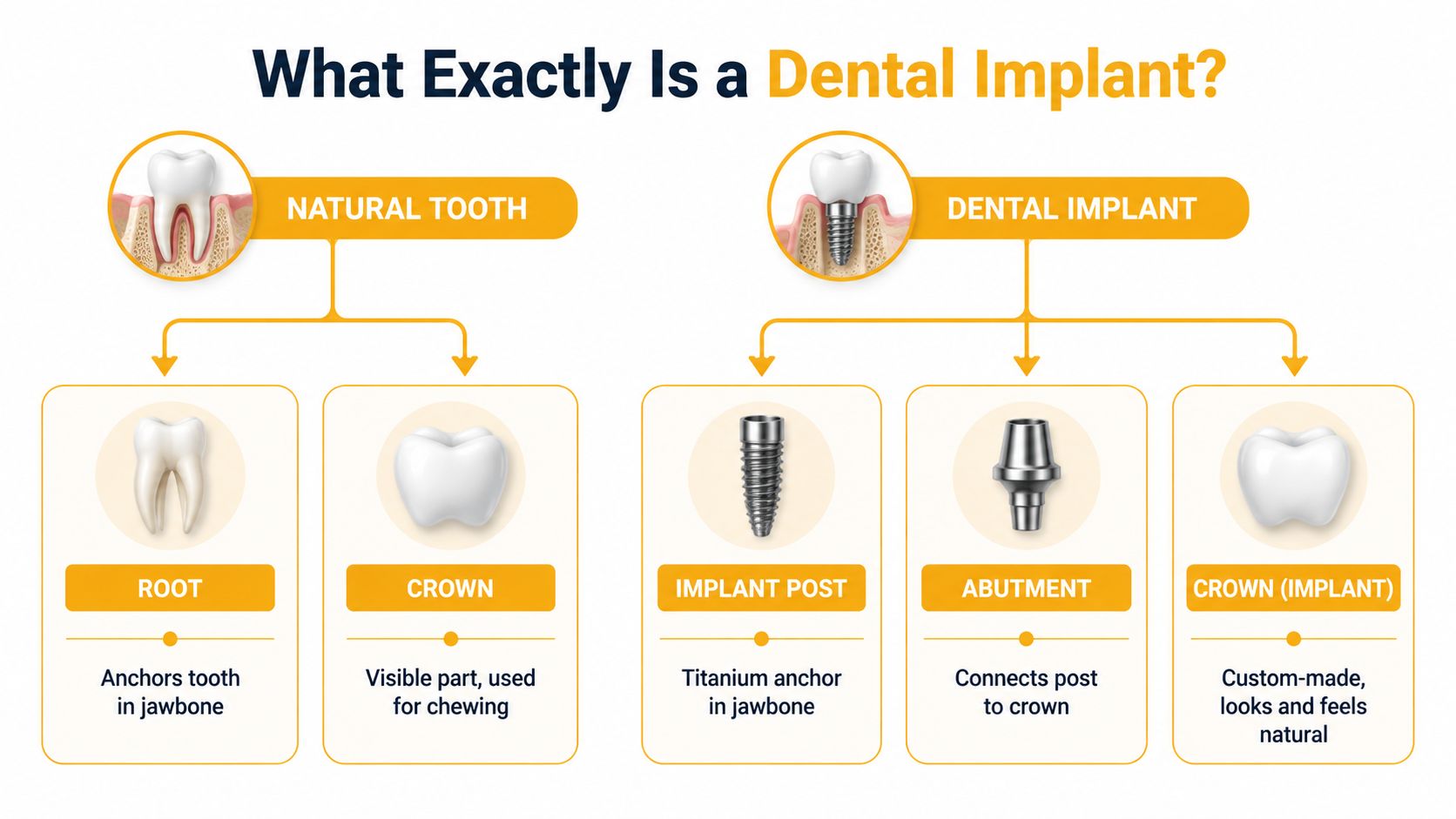
A dental implant works like a replacement root for a missing tooth. The simplest way to think about it is as a foundation. If you were rebuilding part of a house, you wouldn't place the visible structure on empty ground and hope it stays steady. You'd anchor it properly first. An implant does that job inside the jaw.
The three parts that make up an implant
A complete implant restoration has three main components.
- Implant post. This is the titanium part placed into the jawbone. It acts as the new root.
- Abutment. This small connector sits between the implant post and the visible tooth.
- Crown. This is the custom-made tooth-shaped restoration you see when you smile.
Each part has a specific job. The post provides stability, the abutment links the structure together, and the crown restores appearance and chewing function.
For a deeper look at the design and placement of the implant itself, this overview of the endosseous dental implant explains the form most commonly used in modern implant dentistry.
Why titanium is used
Titanium is used because it's biocompatible and well suited to long-term use in the body. The key biological process is osseointegration. That word sounds technical, but the idea is straightforward. The bone heals around the implant and bonds with it, which helps the implant stay firm and functional.
That bond is what separates implants from options that sit on the gums or depend on nearby teeth for support. The implant becomes part of the chewing system in a much more stable way.
Practical rule: If a replacement tooth doesn't have a stable foundation, comfort and confidence usually suffer first.
What an implant feels like day to day
Patients often ask whether an implant feels artificial. Once healing is complete and the final crown is fitted, it generally feels secure rather than foreign. You don't remove it at night. It doesn't click into place. It's brushed and cleaned as part of your normal routine, with some specific hygiene guidance around the implant area.
That's why implants are often the preferred option when someone wants the closest thing to a fixed, natural-feeling replacement. The engineering is precise, but the goal is simple. Eat comfortably, speak clearly, and stop thinking about the gap.
The Lasting Benefits of Choosing Dental Implants
The biggest advantage of implants isn't one dramatic feature. It's the way they solve several problems at once. They restore the visible tooth, support day-to-day function, and give many patients a sense of normality that removable options often don't.

Strong long-term durability
Longevity is one of the main reasons people choose implants. Dental implants in Australia demonstrate a 95% success rate over a ten-year period, with the titanium post capable of lasting indefinitely. The prosthetic crown typically requires replacement after 10 to 15 years due to normal wear, according to this Australian dental implant longevity overview.
That distinction matters. The implant itself and the visible crown aren't the same thing. The post is designed for long-term stability, while the crown may eventually need renewal because it takes the daily load of biting and chewing.
Support for the jawbone
When a tooth is lost, the bone in that area no longer receives the same stimulation from chewing. Implants help restore that function because the replacement root sits in the bone rather than above it. For patients, that matters beyond anatomy. It helps preserve the shape and support of the area over time.
This is one reason implants often feel like a more complete solution. They don't just fill a gap. They replace the missing structure below the gum as well.
A natural look and feel
A well-made implant crown is designed to blend with the surrounding teeth in colour, shape, and proportion. The aim isn't for it to look “done”. The aim is for it to disappear into your smile so no one notices it as a restoration.
Many patients say this is what changes their confidence most. They stop adjusting the angle of their smile. They stop checking the gap in mirrors and photos.
A closer look at long-term wear, maintenance, and what patients can realistically expect is covered in this article on how long dental implants last.
Here's a helpful visual explanation of how those benefits come together in everyday life.
Better chewing without relying on other teeth
Implants are fixed in place, so they don't shift the way removable teeth can. That stability changes meals in practical ways. Crunchier foods, firmer textures, and social eating all become less stressful when the replacement tooth feels anchored.
Protection for neighbouring teeth
A single implant stands on its own. That means adjacent healthy teeth don't need to be reduced to support the replacement. If preserving natural tooth structure is important, this is one of the strongest arguments in favour of implants.
Are You a Suitable Candidate for Implants?
Many patients assume they'll either be told “yes” immediately or ruled out on the spot. Real implant assessment doesn't work that way. Suitability sits on a spectrum, and a proper consultation looks at the full picture before any decisions are made.
What dentists assess first
Three things matter early:
- Jawbone support. The implant needs enough bone for stable placement.
- Gum health. Healthy tissue helps support healing and long-term maintenance.
- General oral condition. Existing decay, infection, or uncontrolled gum disease usually needs treatment first.
Advanced planning helps remove uncertainty here. A clinical exam and 3D imaging allow the dentist to assess the available bone, identify nearby anatomical structures, and map out the safest implant position before treatment begins. For patients, this usually makes the process feel more precise and less intimidating.
Health factors that need a tailored plan
Some medical and lifestyle factors don't automatically exclude implant treatment, but they do change how carefully the case needs to be planned. Smoking, diabetes, slow healing, clenching, and osteoporosis all deserve a detailed discussion.
While success rates are very high, certain conditions can affect outcomes. For example, patients with osteoporosis are more than 4.5 times as likely to experience implant failure, making a thorough pre-treatment assessment critical for a personalized plan, as noted in this review of factors affecting implant success.
If you're worried you might not be a candidate, the most useful step isn't self-diagnosis. It's getting a proper assessment with imaging and a treatment plan built around your health history.
Questions worth asking at your consultation
A good implant consultation should leave you with practical clarity. These questions usually help:
- Do I have enough bone for an implant now?
- Are my gums healthy enough to proceed?
- Would any medical condition affect healing?
- Will I need additional treatment before placement?
- What can I do to improve the chances of long-term success?
The best candidates aren't just people with ideal mouths. They're people with a clear diagnosis, a realistic plan, and the willingness to follow through on maintenance afterwards.
Your Step-by-Step Dental Implant Treatment Journey
One reason implants feel daunting is that patients often imagine the whole process as one major procedure. In practice, it's a series of stages, each with a specific purpose. When those stages are explained clearly, the treatment usually feels far more manageable.
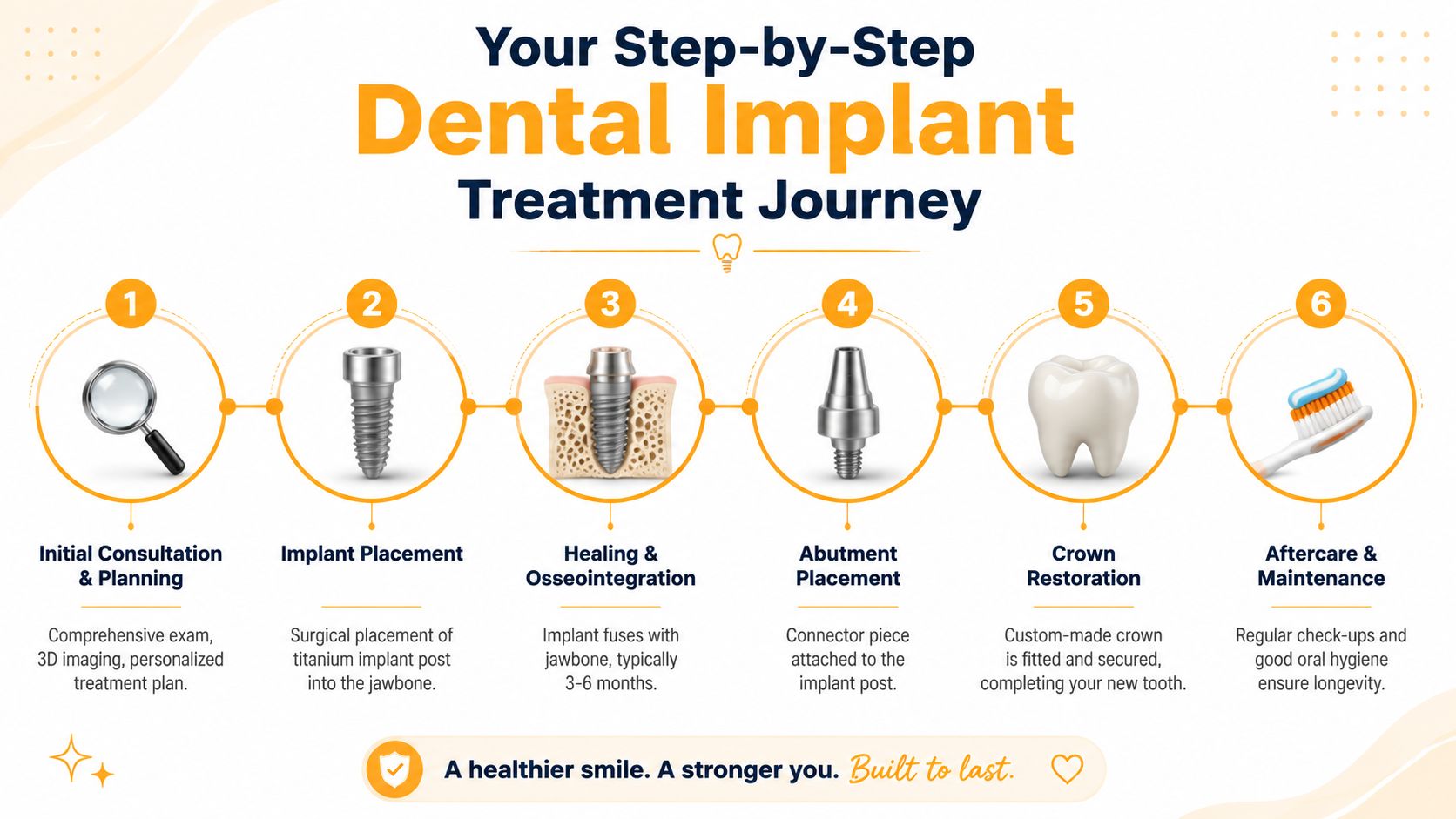
Consultation and planning
The first visit is about diagnosis, not drilling. The dentist examines the mouth, reviews relevant health history, and uses imaging to plan the exact implant position. This is the stage where patients usually get their biggest questions answered about pain, timing, suitability, and whether any preliminary treatment is needed.
A detailed explanation of the clinical stages is also available in this guide to the dental implants procedure.
Implant placement
The placement appointment is the part many patients fear most, but it's often less dramatic than expected. The area is thoroughly numbed, and for nervous patients, sedation can make the experience feel much calmer and more manageable. Gentle techniques matter. So does a team that explains each step before it happens.
In practices that use laser-assisted technology such as Biolase, treatment can be more conservative in selected cases, with an emphasis on precision and patient comfort. Sedation options can also make a major difference for people who have delayed care because of dental anxiety.
Healing and osseointegration
After placement, the bone needs time to integrate with the implant. During this period, healing is doing the primary work. You may have a temporary tooth solution depending on the case, but the long-term result depends on giving the implant a stable environment while the bond forms.
Patients usually want to know what recovery feels like rather than what it's called. Mild soreness, tenderness, and a modified diet for a short period are common topics discussed after surgery. The exact experience depends on the complexity of the case and whether extra procedures were needed.
Healing is not dead time. It's the stage that gives the final tooth its stability.
Abutment and final crown
Once the implant has integrated well, the abutment is attached and impressions or scans are used to create the final crown. Here, the cosmetic side becomes front and centre. Shape, colour, bite, and symmetry all need careful attention.
The final fitting should feel satisfying, not rushed. The crown is checked for appearance and function, and adjustments are made so the bite feels balanced.
Aftercare that protects the result
Implants don't get decay, but they do need maintenance. Long-term success depends on plaque control, regular professional reviews, and cleaning techniques that keep the tissues around the implant healthy.
A practical aftercare routine often includes:
- Careful brushing around the implant and gumline.
- Cleaning between teeth with the method recommended for your restoration.
- Routine review visits so any inflammation or bite issue is picked up early.
- Prompt attention if anything feels loose, sore, or hard to clean.
For patients, the process feels easier when each stage has a purpose and a timeframe. Clear planning turns uncertainty into a sequence.
Understanding Costs and Financing for Your Implants
Cost matters because implants are a significant dental investment. Patients deserve direct figures, a clear explanation of what's included, and honest discussion about what can increase the final fee.
Typical implant costs in Australia
In Australia, the average cost for a single dental implant in 2026, including the implant, abutment, and crown, ranges from $3,000 to $7,000 AUD. Full-arch solutions like All-on-4 typically range from $20,000 to $40,000 AUD per arch, according to this Australian implant cost guide.
That gives patients a realistic starting point, but it's still only a range. One of the biggest mistakes is comparing prices without knowing what each quote includes.
What can change the final fee
The fee usually reflects more than the visible tooth. It can include diagnostics, planning, surgery, restorative components, and follow-up care. Costs may also rise if the case involves limited bone, complex bite issues, or additional treatment before the implant can be placed.
Common variables include:
- Number of missing teeth being replaced
- Location of the implant in the mouth
- Type of restoration needed after healing
- Need for extra preparatory treatment, such as bone grafting
- Complexity of the case based on anatomy and bite
For patients comparing options, transparent itemised treatment plans are far more useful than headline numbers alone. If you're researching how clinics organise costs, administration, and treatment planning on the business side, this guide for dental practice owners offers a useful look at how billing systems affect patient communication and clarity.
Financing and planning the investment
Most patients don't want vague reassurance. They want to know whether there's a staged plan, whether private health cover may help with parts of treatment, and whether fees can be discussed in advance without surprises.
If budget is your first concern, it helps to compare the upfront quote against the expected lifespan, maintenance, and replacement needs of the alternatives. This overview of affordable dental implants in Sydney can help you think through value, not just price.
Comparing Your Tooth Replacement Options
Not every missing tooth needs the same solution. Some patients want the most fixed and long-term option available. Others need a lower upfront cost or a faster path to replacing several teeth. The right choice depends on priorities as much as diagnosis.
The practical differences
A dental implant replaces the missing root and supports a fixed crown. A bridge uses neighbouring teeth for support. A removable denture sits on the gums and can be taken out.
That sounds simple, but the day-to-day experience is very different. Stability, cleaning, comfort, and the effect on surrounding structures all vary.
| Feature | Dental Implant | Dental Bridge | Removable Denture |
|---|---|---|---|
| Long-term durability | Designed as a long-term fixed solution | Can be effective, but depends on supporting teeth | Usually the least stable long-term option |
| Jawbone support | Helps support function in the area of the missing root | Does not replace the missing root in the bone | Does not replace the missing root in the bone |
| Impact on adjacent teeth | Usually stands independently | Often requires preparation of neighbouring teeth | Usually does not require tooth preparation, but may rely on clasps or broader support |
| Comfort and stability | Feels fixed and secure once integrated | Fixed in place, but dependent on supporting teeth | Can feel bulky or move during eating and speech |
| Maintenance | Needs diligent home care and regular reviews | Needs careful cleaning under and around the bridge | Requires removal and cleaning outside the mouth |
| Overall cost | Higher upfront investment | Moderate upfront cost in many cases | Usually lower upfront cost |
When each option makes sense
- Choose an implant if you want a fixed option that doesn't depend on neighbouring teeth and you're focused on long-term function.
- Choose a bridge if the adjacent teeth already need crowns or an implant isn't the best fit clinically.
- Choose a removable denture if you need a replacement option with a lower initial cost or you're replacing multiple teeth and want a removable solution.
The best tooth replacement isn't the one with the shortest quote. It's the one that fits your mouth, your expectations, and your willingness to maintain it.
For many adults, implants become the preferred choice because they offer the strongest mix of stability, independence, and natural feel. But the best recommendation should still come from a clinical exam, not a one-size-fits-all rule.
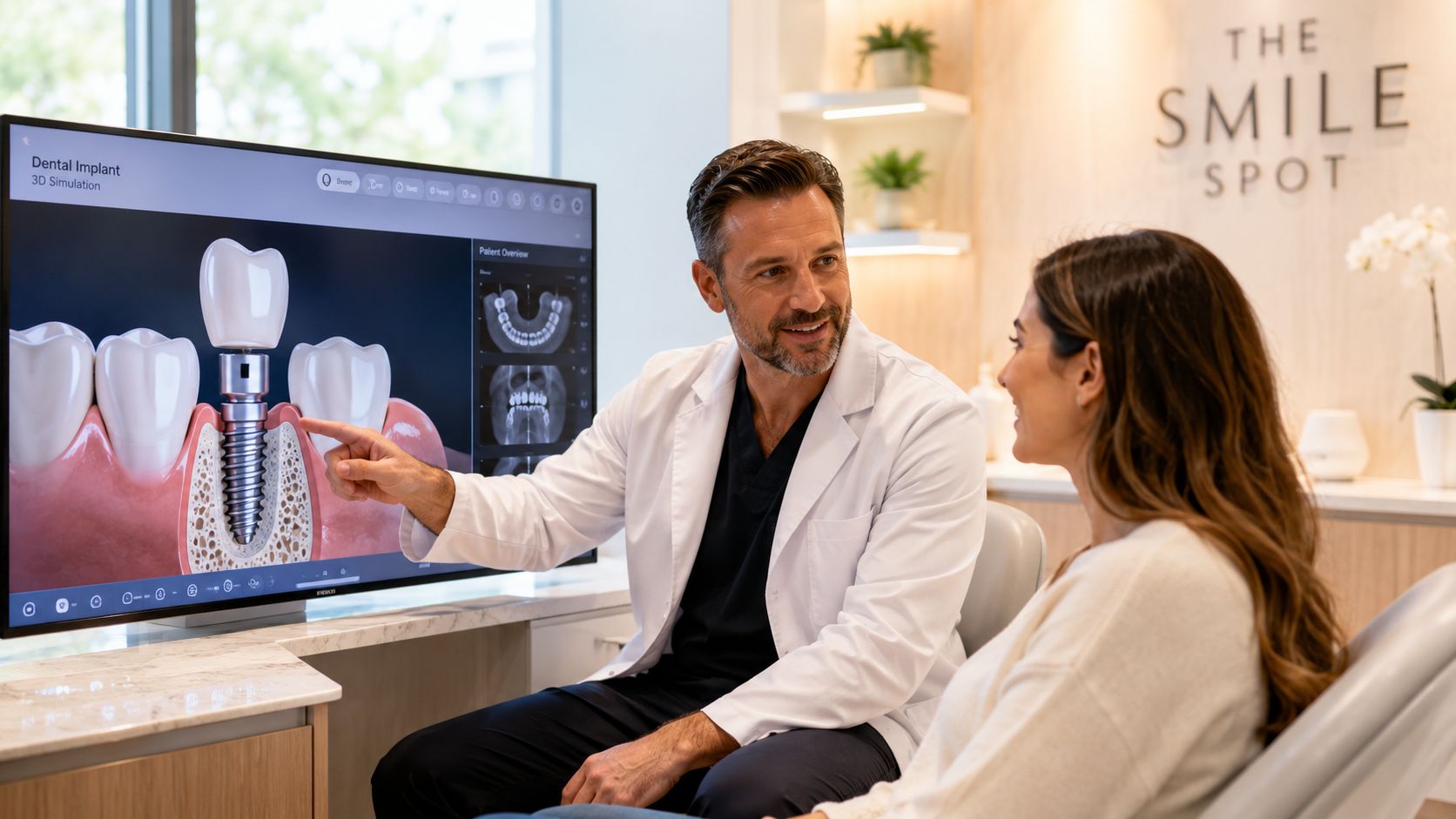
Advanced Implants and Expert Care at The Smile Spot
Full-arch tooth loss changes the conversation. At that point, patients aren't only asking about one gap. They want to know whether they can get back a full smile, better chewing, and something that feels secure enough to trust every day.
For those cases, the All-on-4 treatment concept is often part of the discussion. For full-arch rehabilitation, the All-on-4 treatment concept has a documented success rate of 98.2% in the lower jaw and 97% to 98% in the upper jaw, making it a highly predictable and reliable solution, according to this Australian review of All-on-4 success rates.
Comfort matters as much as technique
Technology only matters if it improves the patient's experience. That's why gentle implant care isn't just about placement accuracy. It's also about reducing anxiety, planning around comfort, and using tools that support less invasive treatment where appropriate.
At The Smile Spot, that includes Biolase laser dentistry and sedation options for anxious or pain-sensitive patients. For someone who's been putting treatment off because they're worried about discomfort, those details can make the decision feel possible.
A useful parallel exists outside clinical care too. The best patient experience often comes from a practice that has clear communication systems, educational content, and a transparent treatment pathway. For clinic owners interested in that side of patient trust-building, this dental practice marketing playbook gives practical examples.
Common questions patients ask last
Does it hurt?
Most patients say the anticipation is worse than the procedure itself. With local anaesthetic, careful planning, and sedation where needed, treatment is usually far more comfortable than expected.
How long does it take?
That depends on healing, the number of teeth being replaced, and whether preparatory procedures are needed. The timeline should be personalised, not guessed.
Can implants be rejected?
People often use the word “rejected” to describe any failure, but what matters clinically is whether the implant integrates and remains healthy over time. Proper assessment, careful placement, and consistent maintenance all improve the outlook.
If you're tired of adjusting how you eat, speak, or smile because of a missing tooth, a personalised implant consultation can give you a clear answer on what's possible and what the process would look like for you. The Smile Spot offers advanced, gentle care for patients across Dulwich Hill and the Inner West, including sedation options and modern implant solutions designed around comfort, function, and long-term confidence.