
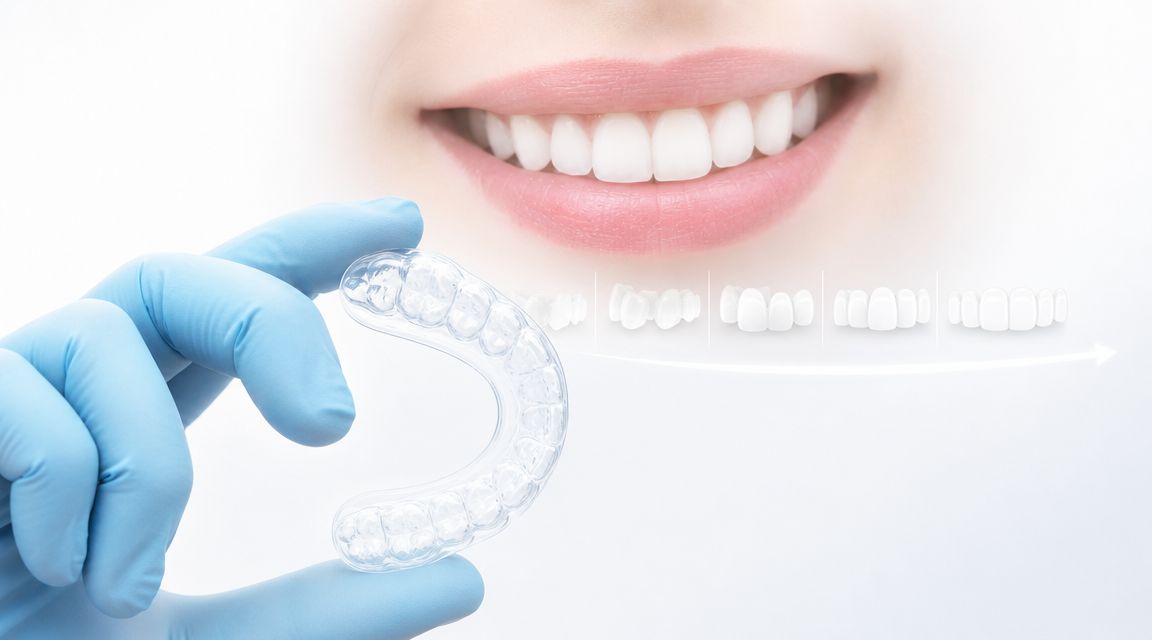
You've probably thought about straightening your teeth more than once. Maybe it's when you see yourself on a work Zoom, in family photos, or catching your reflection in a shop window on Marrickville Road. You want a straighter smile, but you don't want the look, feel, or fuss of traditional metal braces.
That's where clear dental aligners make sense for many adults. They're discreet, removable, and designed around real life. You can take them out to eat, brush, floss, and head into a meeting without brackets or wires becoming the first thing you notice about your smile.
For many patients in Dulwich Hill and the Inner West, the biggest question isn't “Do aligners work?” It's “What's the whole process like?” That's the part people often don't get a clear answer to. They hear the basics, but not what happens from the first scan to the last retainer, or what daily life with aligners really feels like when you're juggling work, school runs, commuting, and everything else.
Your Guide to a Straighter Smile with Clear Aligners
You notice it during a quick glance at your phone before heading into work. One front tooth has shifted a little more than it used to, and now you are wondering what straightening it would involve. Not just whether aligners work, but what the experience looks like when your week already includes meetings, school pickup, errands, and everything else life in the Inner West tends to pile on.
Clear aligners appeal to many adults because treatment can fit more neatly into daily routines. The trays are custom made, sit close to the teeth, and can be removed for meals and cleaning. For someone who wants orthodontic treatment without brackets and wires, that can feel like a more comfortable starting point.
What often gets missed is the full process around the trays. Good results depend on careful diagnosis, a digital treatment plan, regular checks, and the right retainer care at the end. It is less like buying a product and more like following a well-marked route, where each step needs to happen in the right order.
That difference matters.
At The Smile Spot, the aligner journey starts with understanding your teeth, your bite, and your goals as a whole, not just whether the front teeth look a bit crowded in photos. Digital scans help map the starting point with much more clarity than old-style impressions, and modern tools can make planning and tray design more precise. If you would like background on how that technology supports treatment, our guide to dental 3D printing in modern dentistry explains it clearly.
Why adults often choose aligners
Adults usually ask practical questions before cosmetic ones. Will I be able to speak clearly in meetings? Can I keep brushing and flossing normally? How often will I need to come in? Those questions are sensible, because straightening teeth has to work in real life, not just on a treatment plan.
Common reasons people ask about clear aligners include:
- A discreet option that does not draw much attention day to day
- Simpler cleaning because you remove the trays to brush and floss
- More flexibility around meals and work than fixed braces
- A clearer view of the process through digital planning and review appointments
Some patients also come in after trying to compare online, remote, or DIY-style options and realising something feels uncertain. Teeth do not move in isolation. Your bite, gum health, jaw position, and the way upper and lower teeth meet all affect whether a plan is safe and likely to work well. Dentist-led care gives you someone local who can check progress, answer questions, and spot problems early rather than after months of guesswork.
Why the patient journey matters
The trays are only one part of treatment. The experience also includes your first consultation, digital records, personalised planning, fitting, progress reviews, refinements if needed, and retainers to help hold the result.
Patients are often relieved once this is explained step by step. A tray may feel snug at first, much like a new pair of shoes feels firm before it settles into your routine. Mild pressure is expected. Ongoing pain, a poor fit, or teeth not tracking as planned need attention from a dentist who knows your case.
That is why the local clinic experience matters so much for busy adults. You are not left uploading photos and hoping everything is on track. You have a team nearby who can make the process clearer, more comfortable, and more predictable from the first scan to the final retainer.
What Are Clear Aligners and How Do They Work
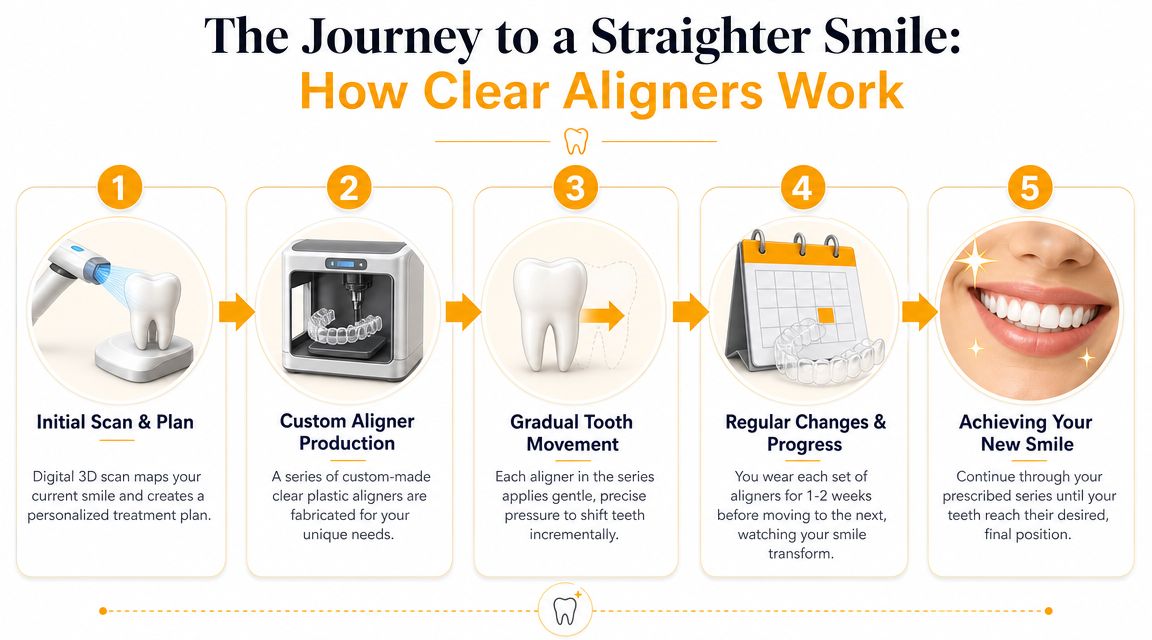
Think of clear aligners as a pre-planned sequence rather than one appliance doing all the work at once. Each tray is shaped a little differently from the one before it. That small change is what nudges selected teeth into a new position over time.
It helps to picture a flipbook. One page alone doesn't show much movement. But when each page follows the last in the right order, you see the full motion. Clear aligners work in a similar way. Each set carries your teeth one small step along a mapped path.
The digital plan comes first
Modern aligner treatment usually begins with a digital scan of your teeth. Instead of messy putty impressions, a scanner captures a 3D model of your mouth. That model lets the dentist plan tooth movements before you even wear the first tray.
This is one reason aligners feel more understandable to patients. You're not just told, “We'll straighten your teeth.” You can usually see the stages of movement in a visual treatment plan. If you're curious about how digital workflows support this kind of precision, our article on dental 3D printing in modern dentistry gives useful background.
What the trays actually do
Each aligner is a custom-made clear plastic tray that fits snugly over your teeth. When you first place a new one in, it often feels tight. That sensation is usually the sign that it's applying controlled pressure to selected teeth.
The important idea here is gentle, repeated force. Teeth don't jump into place. They respond gradually when pressure is applied in a planned way, then refreshed with the next tray.
A typical rhythm looks like this:
Scan and assessment
Your current tooth positions are recorded digitally.Treatment mapping
Movements are planned in sequence, from current position to target position.Series of trays
You wear each aligner for a set period before progressing to the next.Review and refinement
Your dentist checks that your teeth are tracking as expected and adjusts if needed.
Why aligners have become so common
Aligners aren't a fringe option anymore. One industry forecast says the clear aligners market was valued at USD 8.29 billion in 2025 and is projected to reach USD 56.81 billion by 2033, reflecting strong demand for convenient and aesthetic orthodontic treatment in Australia and globally, according to Grand View Research's clear aligners market analysis.
That popularity doesn't mean they suit every mouth. It does mean the technology, planning systems, and patient awareness have moved well beyond the early days.
Are You a Good Candidate for Clear Aligners
Some people are excellent candidates for aligners. Others need a different approach. The trick is knowing the difference before treatment starts, not halfway through.
In general, aligners tend to suit adults and teens with mild to moderate alignment concerns. That often includes teeth that are a bit crowded, small gaps between teeth, and certain bite issues that can be managed predictably with a removable system.

Signs aligners may suit you
If your main goal is to straighten front teeth, close spacing, or tidy crowding that affects how your smile looks, aligners may be worth exploring. Adults who had braces in the past and have noticed relapse are often in this group too.
Common situations that often point toward aligners include:
- Crowding where teeth overlap or twist slightly
- Spacing where small gaps affect the look of the smile
- Relapse after past orthodontics when teeth have drifted over time
- Lifestyle concerns if you want something removable for meals and cleaning
For a broader look at how tooth alignment fits into general dental and orthodontic care, this guide on dentistry and orthodontics is a helpful starting point.
When aligners may not be the right tool
Honest advice is paramount. While aligners can achieve significant results, they do not replace every other orthodontic option. Complex bite problems, major jaw discrepancies, and movements requiring greater control may still be better managed with braces or another treatment plan.
The other big issue is compliance. Aligners only work when they are worn. Public-facing marketing often skips over that reality, but professional guidance is clear. Success depends on wearing them for about 22 hours a day, and they may be less effective for complex bite problems or significant tooth movements, as explained by the American Association of Orthodontists' aligners overview.
Practical rule: If you know you'll struggle to wear trays consistently, that matters just as much as the shape of your teeth.
A quick self-check
Before booking a consultation, ask yourself these questions:
| Question | Why it matters |
|---|---|
| Do I want a subtle treatment option? | Aligners are popular with adults who don't want visible hardware. |
| Can I keep to a routine? | You'll need to wear them most of the day and night. |
| Is my concern mostly crowding or spacing? | These are common aligner goals. |
| Am I open to professional reviews? | Monitoring helps keep treatment safe and predictable. |
If you answer yes to most of those, aligners may be worth discussing. If your bite feels very off, your jaw alignment is a concern, or you've been told you have a complex orthodontic case, don't assume aligners are the answer. The best treatment is the one that fits your mouth, not the one with the slickest advertising.
Your Clear Aligner Journey at The Smile Spot
The first appointment is usually much more straightforward than people expect. Most patients come in thinking they'll get a sales pitch or a vague promise. What they need is a proper assessment of their teeth, bite, and goals.
At The Smile Spot, the aligner process begins with a conversation and a clinical exam. You talk about what bothers you, what result you're hoping for, and whether your priorities are cosmetic, functional, or both. For some people, it's one rotated front tooth. For others, it's lower crowding that's become harder to clean.
The first visit and digital scan
After that discussion, the next step is gathering accurate records. A digital scan creates a precise model of your teeth without traditional impression material. Patients usually like this part because it's quick, clean, and easy to understand when they see their teeth on screen.
That scan gives the dentist a working map. It shows where your teeth are now and helps determine whether aligners are likely to move them in a controlled, realistic way. If the case isn't suitable, that's the right time to say so.
Planning the tooth movements
Once records are taken, the case moves into planning. Technology then does a lot of heavy lifting, but the judgement of the dentist still matters just as much. Software can simulate movement. It can't replace diagnosis.
A well-planned aligner case looks ahead to practical questions:
- How much movement is realistic
- Whether the bite will stay balanced as teeth shift
- If certain teeth need more control than trays alone can provide
- Whether the expected result matches the patient's goal
Busy adults often appreciate seeing the proposed sequence laid out visually. It makes the process feel less mysterious. You're not wearing trays and hoping for the best. You're following a plan with review points built in.
Good aligner care isn't remote guesswork. It's diagnosis, planning, monitoring, and adjusting when needed.
For patients thinking about affordability while planning treatment, our article on an Invisalign payment plan and what to expect covers the financial side in plain language.
Fitting your aligners and settling in
When your aligners are ready, you'll be shown how to place and remove them properly. This sounds simple, but technique matters. The first few days are usually about getting used to the feeling, building a wear routine, and learning the small habits that keep treatment on track.
Individuals often notice three things early on:
- A feeling of pressure when a new tray goes in
- A short adjustment period for speech with certain sounds
- A need to plan meals and snacks because the trays need to go back in after eating
That learning curve is normal. The trays quickly become part of the day, much like putting on glasses or carrying a retainer case in your bag.
Why in-person review matters
This is where local, dentist-led care really separates itself from DIY or remote options. Teeth don't always move exactly as an app predicts. Trays can stop fitting well. A bite can change in ways that need attention. Attachments can need checking. A patient may be wearing trays faithfully but still need a refinement.
That's why professional monitoring matters. If you've ever been curious how clinics think about attracting and educating patients before treatment begins, this dentist's guide to patient acquisition is an interesting industry-side read because it highlights how much trust depends on clear communication, not just promotion.
For Inner West patients, local review appointments also make life easier. You don't have to rely on uploading a phone photo and hoping someone notices a problem. You can have your progress checked in person, ask questions, and get practical help if something doesn't feel right.
The final stage and retainers
When the active movement is finished, treatment isn't really over. Teeth have a memory. Without retention, they can drift.
That's why the retainer phase matters so much. After all the effort of wearing aligners properly, retainers protect the result. This stage is often the least talked about, even though it's what keeps your new smile stable over time.
Clear Aligners vs Braces and Veneers
A patient in the Inner West might walk into The Smile Spot wanting one simple outcome. Straighter front teeth before a wedding, a job change, or just because they are tired of seeing crowding in photos. The part that often feels confusing is that three very different treatments can seem to promise a nicer smile.
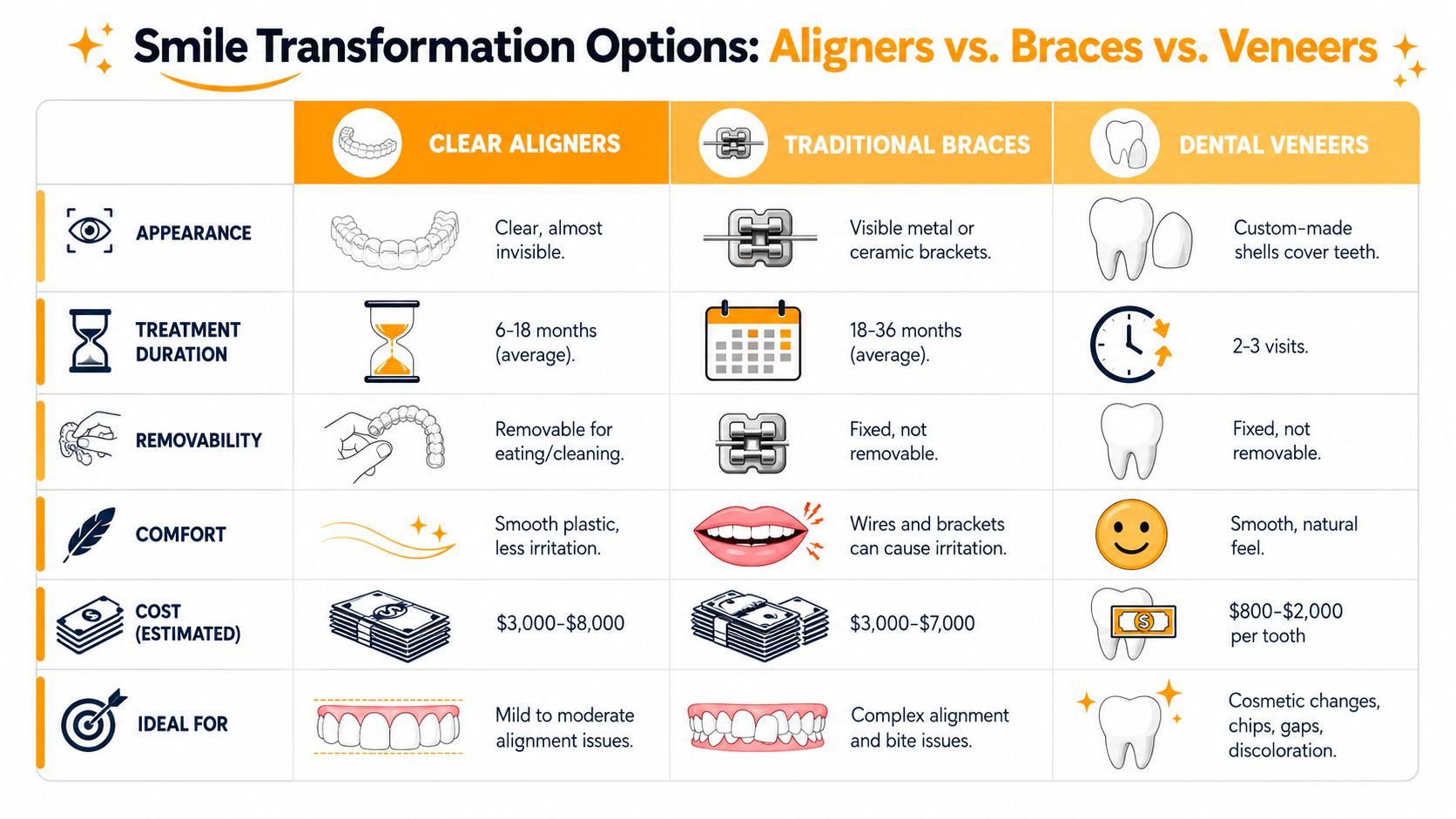
Clear aligners, braces, and veneers can all improve appearance, but they do different jobs. Aligners and braces move teeth into a better position over time. Veneers cover the front surface of teeth to change how they look. If the underlying issue is alignment, veneers can mask it visually, but they do not straighten the roots or correct how the teeth meet.
How aligners compare on function and lifestyle
Clear aligners often suit adults who want orthodontic treatment that fits around work, meetings, commuting, and social plans. They are removable, discreet, and planned digitally, which makes the process easier to understand before you begin. At a local clinic, that planning is not just a computer animation on a screen. Your dentist checks whether the predicted tooth movements make sense for your bite, your enamel, and your long term stability.
Braces still play an important role. Because they are fixed in place, they give the dentist more direct control for more difficult movements, especially where the bite needs heavier correction or several teeth need to move in a coordinated way. They also remove the daily decision of whether the trays go back in after lunch.
Veneers sit in a different category. They are usually chosen when the main goal is to improve shape, colour, minor edge wear, or the look of small gaps. They can create a straighter looking smile, but they do that by changing the visible tooth surface rather than guiding teeth into a new position.
Treatment comparison
| Feature | Clear Aligners | Traditional Braces | Porcelain Veneers |
|---|---|---|---|
| Main purpose | Orthodontic tooth movement | Orthodontic tooth movement | Cosmetic reshaping and masking |
| Visibility | Very discreet | More noticeable | No orthodontic appliance worn |
| Removability | Yes | No | Not applicable in the same way |
| Cleaning | Easy to brush and floss after removal | More cleaning effort around brackets and wires | Normal brushing and flossing |
| Best suited to | Mild to moderate cases in suitable patients | Complex tooth and bite problems | Cosmetic smile changes rather than moving teeth |
| Patient responsibility | High, because trays must be worn consistently | Lower, because appliance is fixed | Depends on ongoing maintenance habits |
Which option usually fits which goal
For many busy adults, aligners offer the best balance between appearance and flexibility. You can remove them for meals, brushing, and important occasions, but that convenience only works well when treatment is properly supervised. DIY or remote systems can make the process sound simple, yet they cannot replace an in person check of tooth movement, gum health, bite changes, and tray fit. That difference matters when you want a result that is not just cosmetic, but stable and healthy.
Braces may be the better choice if your case is more complex or if predictable control matters more than discretion. Veneers may be the better choice if the teeth are already in a reasonable position and the main concern is their shape, colour, or worn edges. If you are weighing that option, our guide to how long porcelain veneers last and what affects their maintenance can help.
The right choice depends on what needs changing. Position, surface appearance, bite, or a mix of all three.
Daily Care Costs and What to Expect
Living with aligners is usually easy once you've built a rhythm. The people who do best tend to treat them like part of their daily routine, not an optional extra.
The simple rule is this. If you take the trays out, you need a plan for getting them clean and back in promptly. That matters for both hygiene and progress.
Daily habits that make treatment smoother
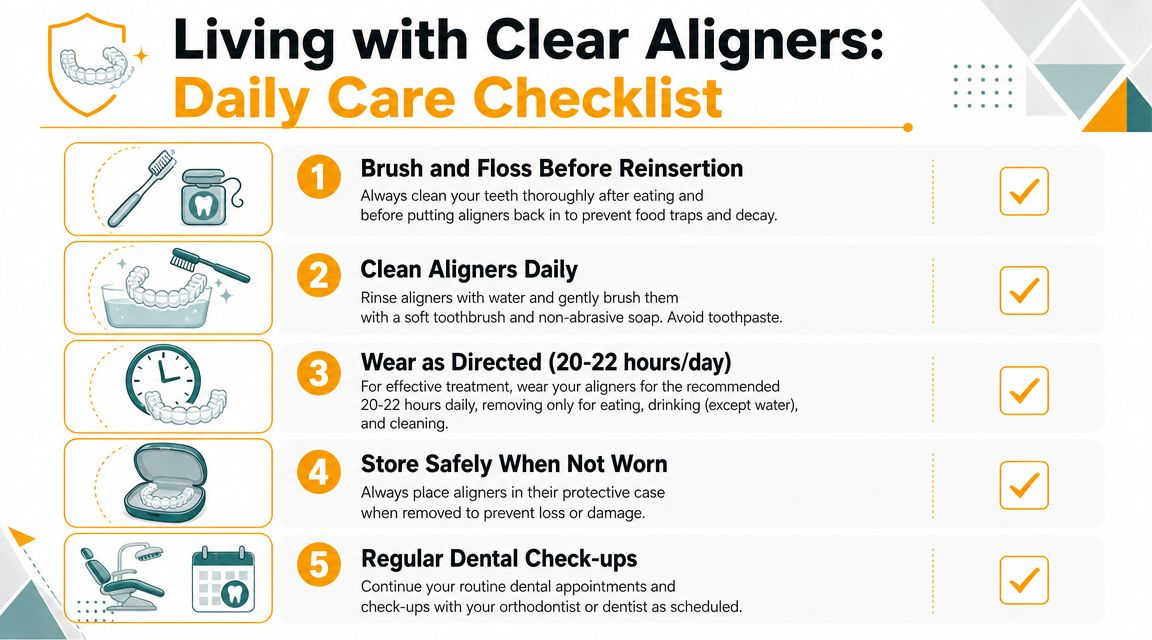
A few habits prevent most common problems:
- Brush before reinserting so food and plaque don't sit under the trays
- Rinse the aligners regularly to keep them fresh
- Store them in a case instead of wrapping them in a napkin at lunch
- Remove them for drinks other than water because staining and damage can follow
- Keep routine dental visits while treatment is underway
Many patients find it helpful to watch a visual demonstration of wear and care before they settle into the routine:
What eating and drinking are really like
This part catches people off guard at first. Aligners are removable, which is a big advantage, but it also means you need to think ahead. You can't casually sip coffee all morning with trays in. You remove them for meals and drinks other than water, then clean your teeth before putting them back.
That sounds fussy for the first week. Then it usually becomes routine. Many patients snack less during treatment because the process of taking trays out and brushing makes them more mindful.
What aligners cost in Australia
Broad comparative estimates cited in reviews place clear aligner treatment in Australia at around A$2,000, though fees vary significantly depending on the provider, case complexity, and treatment length, as noted in this clear aligners cost overview. The final fee usually reflects the planning, custom fabrication, and professional monitoring involved.
That's why one person's aligner quote can differ from another's. A short, straightforward cosmetic adjustment isn't the same as a more involved case needing a longer series of trays and closer review.
What to ask about fees
When you're comparing treatment options, ask practical questions rather than focusing on the headline number alone:
| Question | Why ask it |
|---|---|
| What does the fee include? | You want to know whether reviews and refinement are part of the plan. |
| How long is treatment expected to take? | Simpler and more involved cases differ. |
| What happens if refinements are needed? | It's worth understanding this before you start. |
| Are payment plans available? | Spreading cost can make treatment easier to manage. |
If you're looking into staged payments, this guide to dentists with payment plans near you covers the key things to check.
Common Questions About Clear Dental Aligners
Do clear aligners hurt
They usually don't feel painful in the way people fear. What most patients notice is pressure, especially when starting a new tray. That pressure means the aligner is active. It often settles after the first few days.
Will I talk normally
Usually yes, though some people notice a slight lisp at the start. That tends to improve quickly as your tongue adapts. Reading out loud for a few minutes can help.
Can I get aligners if I have fillings or crowns
Often yes, but it depends on the teeth involved and the kind of movement planned. Existing dental work doesn't automatically rule aligners out. It means the assessment needs to be careful.
What happens when treatment ends
You'll usually need a retainer. This is the part patients most often underestimate. Teeth can shift back if they aren't held in their new position, so retention protects the result you've worked for.
Can I whiten my teeth during aligner treatment
Sometimes this can be coordinated, but it depends on timing and your overall plan. It's better to ask before starting than to experiment on your own.
Why do some clinics talk so much about education and trust
Because orthodontic treatment is a commitment. Patients need clear information, not vague reassurance. If you're interested in the broader communication side of dental care, these effective dental practice marketing tips are a useful example of how clinics try to explain treatment clearly before patients commit.
If you're thinking about clear dental aligners and want practical, local advice, The Smile Spot can help you understand your options, assess whether aligners are suitable for your teeth and bite, and guide you through the full process from digital scan to retainer care.