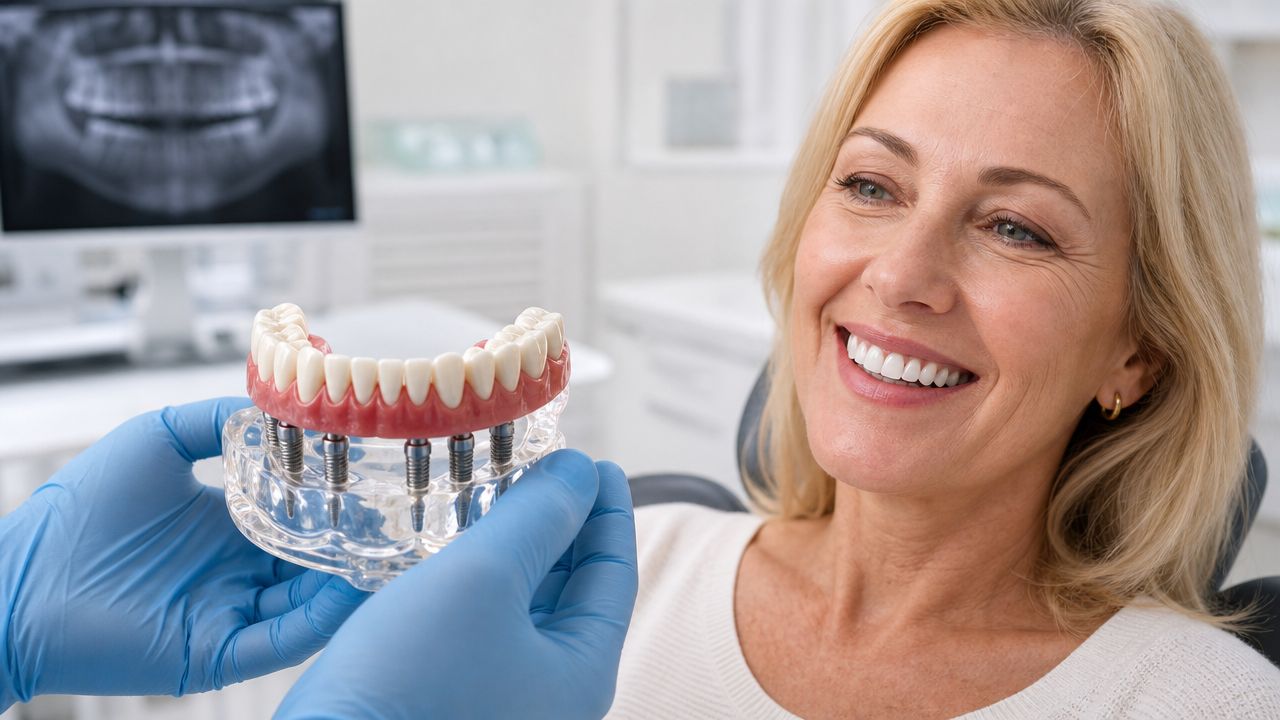
If you're reading this with a denture that moves when you talk, teeth that are breaking down one by one, or a smile you've stopped showing in photos, you're not alone. For many people, the hardest part isn't only the appearance of missing teeth. It's the daily compromise. Softer foods, awkward speech, sore gums, worry about a denture slipping, and the quiet loss of confidence that can creep into work, family life, and social situations.
Full arch dental implants are designed for this exact problem. Instead of patching one failing tooth at a time, they rebuild an entire upper or lower arch on a stable foundation. That changes more than a smile. It can restore chewing, speech, comfort, and the feeling that your teeth belong to you again.
Reclaiming Your Smile A Modern Solution to Tooth Loss
In practice, people usually arrive at this option after a long stretch of frustration. Some have worn dentures for years and never felt fully comfortable with them. Others have reached the point where multiple teeth are loose, heavily restored, or beyond predictable repair. At that stage, continuing with piecemeal dentistry often becomes more draining than decisive treatment.
Full arch dental implants offer a fixed solution for patients who are missing most or all teeth in one jaw, or who are heading in that direction. Rather than replacing every tooth with a separate implant, a clinician places a strategic number of implants to support a full set of replacement teeth. The result is a smile that feels secure and functions far more like natural teeth than a removable denture.
Why more Australians are considering fixed teeth
This treatment is no longer seen as a rare or highly specialised option. A market projection cited in an Australian implant market discussion suggests the national dental implant market is projected to reach USD 112.5 million by 2030, rising from USD 52.7 million in 2024. That same projection reflects a broader move toward fixed, long-term tooth replacement rather than removable options, which helps explain why full arch treatment is becoming part of mainstream restorative care in Australia, according to this Australian implant market projection.
That matters for patients because growth in this area usually follows increased clinical confidence, better digital planning, and wider access to implant-based care. In simple terms, more practices are building workflows around fixed full-arch treatment because demand is real and the outcomes can be life-changing for the right patient.
Full arch treatment works best when it's approached as rehabilitation, not a cosmetic shortcut.
What patients need to understand from the start
The best decisions come from clarity, not excitement. Full arch implants can be an excellent option, but they're still a major treatment. They involve diagnosis, planning, surgery, healing, a provisional phase in many cases, and long-term maintenance after the new teeth are fitted.
A useful way to think about it is this:
- If your main problem is instability, a fixed implant solution may solve what dentures never did.
- If your main problem is repeated failure, full arch treatment can replace the cycle of patch, repair, and replace.
- If your goal is “permanent” teeth with no maintenance, that expectation needs adjusting. Fixed teeth still need regular professional care.
Patients do best when they understand both sides. The upside is significant. So is the commitment.
What Are Full Arch Dental Implants?
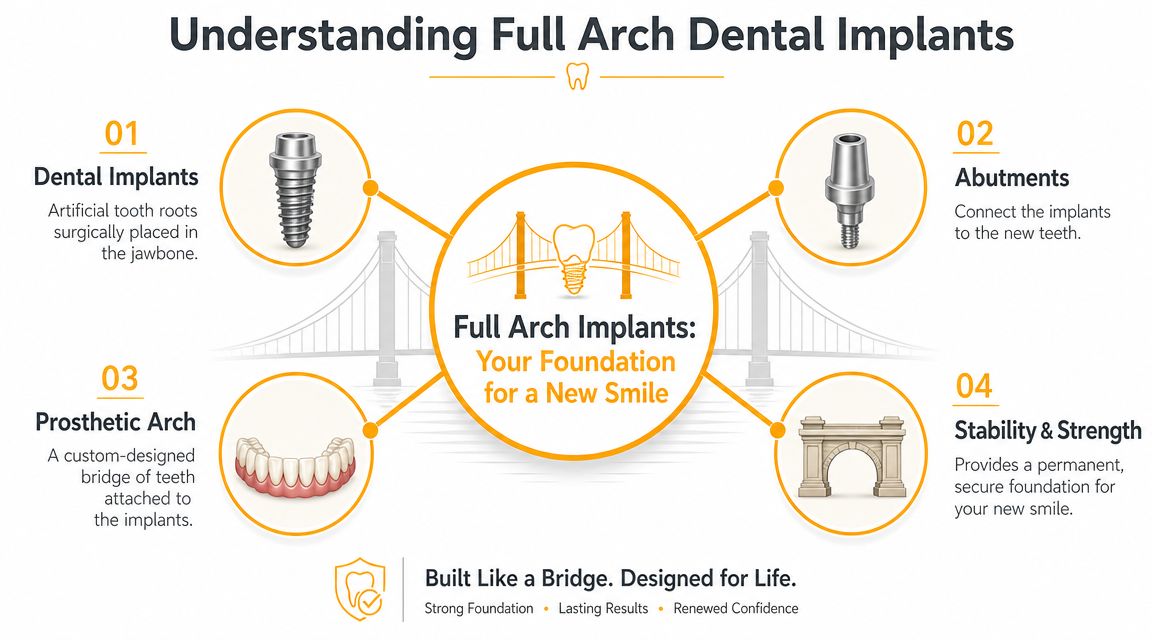
A full arch implant restoration replaces all the teeth in the upper jaw, lower jaw, or both, using a small number of implants as anchors. Those implants act like strong foundation posts in the bone. A custom-made prosthetic arch then attaches to them to create a fixed set of teeth.
The easiest analogy is a bridge. You don't need a support under every single point along its length. You need well-positioned supports that can carry the load properly. Full arch treatment applies that same principle inside the mouth.
The basic parts
A full arch restoration usually includes these components:
- Implants. These are placed into the jawbone and serve as the structural base.
- Abutments. These connect the implants to the prosthetic teeth.
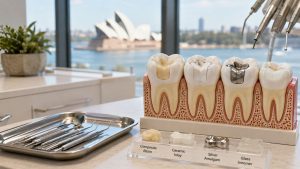
- The prosthetic arch. This is the visible bridge of teeth and gum-shaped material, designed to restore appearance and function.
When people hear terms such as All-on-4, they're hearing the name of a concept built around this idea. A full arch of teeth is supported by a limited number of carefully positioned implants rather than one implant per missing tooth. If you'd like a closer look at that approach, this guide to All-on-4 dental implants in Sydney explains how the concept is commonly used.
Why this design works
The strength of full arch dentistry isn't just that it uses implants. It's that it uses them strategically.
Instead of trying to restore each tooth separately, the treatment distributes load across the arch. That helps create a stable bite and a more efficient design. It also means the clinician can plan the position of the implants in relation to the final teeth, not place implants wherever bone happens to be available and hope the teeth work afterwards.
Practical rule: The final teeth should drive the implant plan, not the other way around.
This is one of the biggest differences between excellent full-arch work and average full-arch work. The best outcomes come from planning the smile, bite, speech, cleanability, and support first, then placing the implants to suit that design.
What makes it different from single implants
Single implants are ideal when you have isolated missing teeth and the surrounding teeth are healthy. Full arch treatment is different. It's usually chosen when:
- Most teeth are already missing
- The remaining teeth are failing
- A denture is no longer acceptable
- The whole bite needs rehabilitation, not repair
This approach can also simplify a complex situation. If several teeth are beyond reliable saving, replacing the entire arch can sometimes be more predictable than trying to maintain a collection of compromised teeth with crowns, root canal treatment, and repeated emergency care.
What patients often misunderstand
A full arch prosthesis is fixed, but it isn't exactly the same as having your original natural teeth back. It's a highly engineered restoration. That distinction matters because the design has to balance appearance, strength, speech, bite, hygiene access, and long-term serviceability.
Good full arch treatment looks natural, feels secure, and functions well. Poorly planned treatment can look bulky, trap plaque, create speech issues, or become difficult to maintain. The elegance of the concept is real, but the details matter.
Full Arch Implants vs Dentures and Bridges
Choosing between full arch implants, dentures, and bridges isn't only about what looks best on paper. It's about how you want to live day to day. The right option depends on how many teeth are missing, the condition of the remaining teeth, your expectations, and what level of treatment you're prepared to maintain.
For individuals deciding between these options, the core questions are simple. Will it stay in place? Can I chew properly? Will it feel natural? What will it mean for the next several years, not just the next several months?
The day-to-day difference
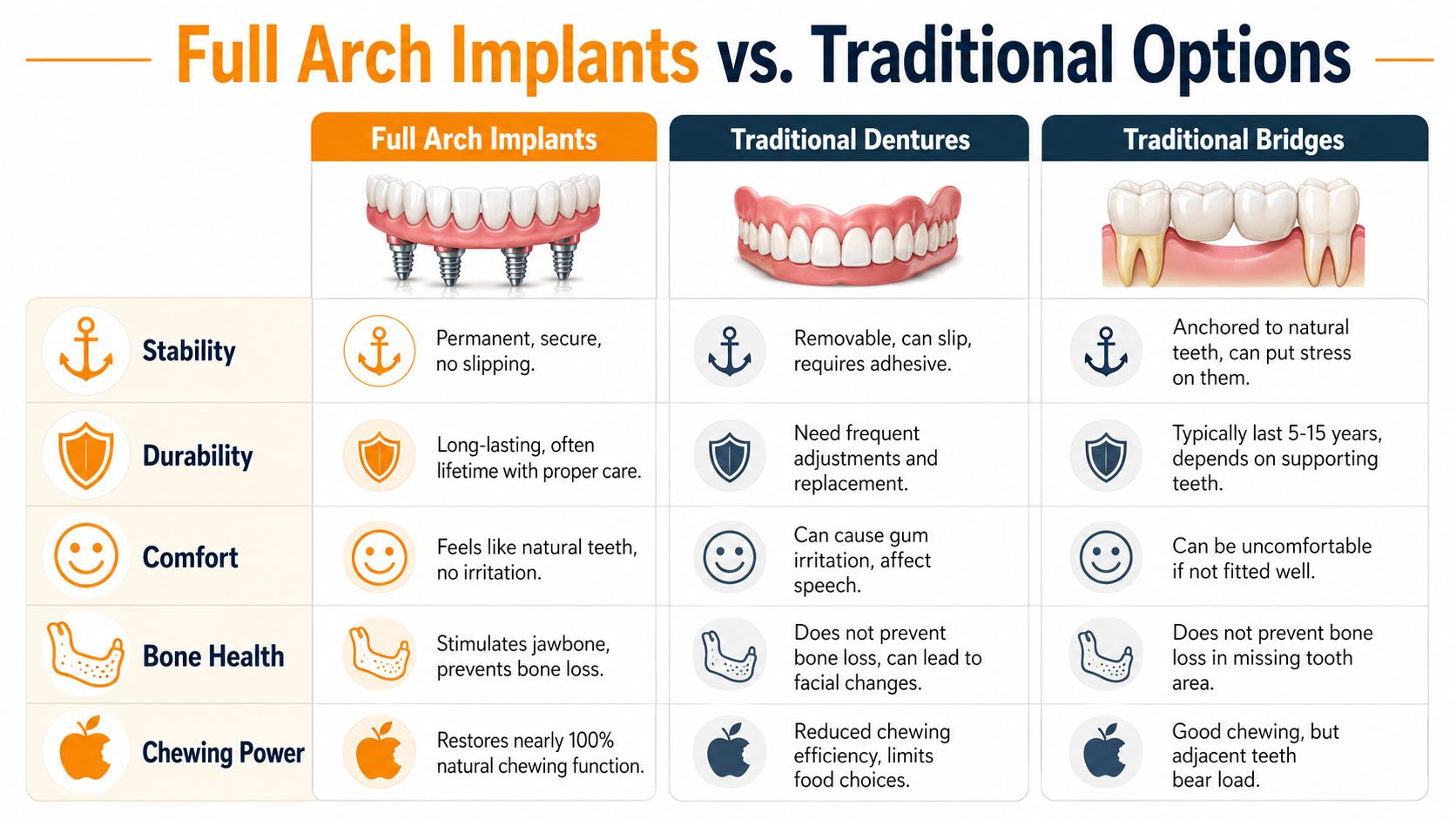
Here's how these options generally compare in practical terms:
| Option | Best suited to | Main advantage | Main limitation |
|---|---|---|---|
| Full arch implants | Missing most or all teeth in one jaw | Fixed feel and strong support | Surgical treatment and ongoing maintenance |
| Traditional dentures | Full tooth loss where a removable option is preferred | Lower upfront complexity | Movement, pressure on gums, and reduced confidence for many wearers |
| Dental bridges | Smaller gaps with healthy supporting teeth | Fixed replacement without a full-arch rebuild | Not suitable when most teeth are missing or failing |
If your problem involves a few teeth rather than an entire arch, a bridge may still be a very sensible treatment. This overview of dental crowns and bridges is useful for understanding when that option makes more sense than implants.
Dentures still have a role
Dentures are not “bad” treatment. In some cases, they're appropriate, practical, and the right place to start. They can also be a useful temporary phase while a larger plan is being developed.
The problem is that a denture rests on the gums and depends on shape, suction, and muscle control to stay in place. Some patients adapt well. Others never do. Lower dentures, in particular, often become frustrating because movement is harder to control.
Common complaints include:
- Slipping during meals or conversation
- Pressure spots and soreness
- A bulky feeling across the palate or gums
- Avoidance of certain foods
- Loss of confidence in public
For someone who has lived with those issues for years, a fixed full arch prosthesis can feel like a completely different category of treatment.
Bridges can be excellent, but not for every problem
Bridges are often misunderstood because patients use the term to mean many different things. A traditional bridge is supported by natural teeth. That works well when the neighbouring teeth are healthy enough to carry the load and the missing span is limited.
It works poorly when the whole arch is compromised. If several teeth are mobile, broken down, heavily filled, or repeatedly infected, using them as support points usually creates a chain of future problems. In that situation, preserving every remaining tooth at all costs can become an expensive way to delay a more stable plan.
If the support teeth are unreliable, the bridge is unreliable, no matter how good the lab work is.
Where full arch implants stand apart
Full arch dental implants change the support system itself. Instead of relying on gums like a denture, or overloaded natural teeth like a large bridge, they anchor the prosthesis to implants within the jaw.
Patients usually notice the difference most in these areas:
- Stability. No adhesive, no rocking, no fear of movement.
- Chewing confidence. Meals become less cautious and less selective.
- Speech. A secure prosthesis often feels more dependable during conversation.
- Psychological comfort. Fixed teeth tend to feel more integrated into daily life.
The trade-off is that full arch treatment is more involved. It requires planning, surgery, healing, and maintenance. It's the more extensive option, but not automatically the right one for every person.
Your Treatment Journey Step by Step
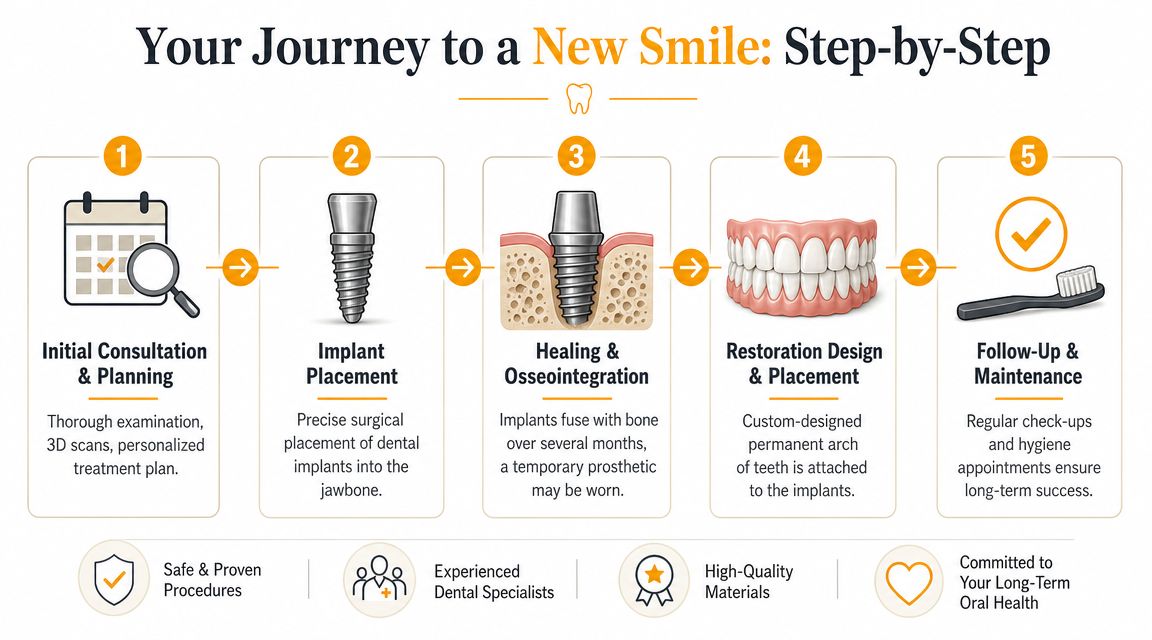
For many patients, the unknown is the most stressful part. Once the process is broken into stages, it becomes much easier to understand. Full arch treatment is structured, deliberate, and highly planned. Good teams don't improvise this kind of dentistry.
Early in the process, the most important work happens before any surgery. Modern full arch workflows are prosthetically driven, using CBCT scans and digital impressions to design the final teeth before implant placement. That approach supports guided surgery and improves predictability for both function and aesthetics, as described in this NIH-indexed digital full-arch workflow paper.
Consultation and planning
The first appointment is about diagnosis, not sales. The clinician needs to understand your teeth, gums, bite, jaw anatomy, medical history, and what has led you to this point. For some patients, the problem is complete tooth loss. For others, it's a terminal dentition, meaning the remaining teeth are present but no longer worth restoring one by one.
Digital records are central here. A CBCT scan shows the three-dimensional bone anatomy and important structures. Digital impressions or intraoral scans capture the surface details of the mouth. Photographs and bite records help the team assess smile line, lip support, tooth position, and speech.
This stage also clarifies whether the plan is straightforward or more complex. Some mouths need extractions, gum management, or changes in the bite before the definitive prosthesis can be designed properly.
A short explanation of what patients often ask about healing can help at this point. This article on dental implants recovery time gives a practical overview of what the post-surgical phase may involve.
Surgery day
Once planning is complete, the surgical appointment becomes much more controlled. The goal isn't just to place implants. It's to place them where the final teeth need support.
For some patients, surgery may involve removing failing teeth and placing implants in the same visit. Depending on stability and the treatment design, a temporary fixed bridge may also be fitted so the patient doesn't leave without teeth. In other cases, a staged approach is safer and more sensible.
Patient comfort matters here. The clinical team should explain sedation options, local anaesthetic, expected post-operative swelling, and what eating will look like in the early healing period. The calmer and more informed the patient is, the smoother this stage tends to be.
Here's a practical summary of what surgery day often involves:
- Anaesthetic and comfort planning so you remain relaxed and well managed.
- Any required extractions if failing teeth are still present.
- Precise implant placement based on the digital plan.
- A provisional restoration if the case is suitable for immediate fixed teeth.
- Clear written instructions for medication, diet, hygiene, and follow-up.
Later in the process, a visual explanation can make the timeline easier to absorb.
Healing and the final teeth
After implant placement, the bone needs time to integrate with the implants. During that phase, the temporary teeth are doing an important job. They restore appearance and basic function, but they also give the team a chance to refine bite, shape, phonetics, and aesthetics before the final prosthesis is made.
That refinement step is often undervalued by patients. It shouldn't be. The provisional stage reveals things that a scan alone cannot. How the patient speaks. Where lip support needs adjusting. Whether the bite feels balanced. Whether hygiene access is adequate.
The final bridge should not be rushed. A few careful adjustments in the provisional phase can prevent years of frustration later.
The definitive teeth are then fabricated based on those validated records. At that point, fit, bite, contour, and cleanability all matter as much as appearance. Beautiful full-arch work is not only attractive. It is also maintainable.
Candidacy Cost and Financial Planning
Two questions come up in almost every consultation. Am I suitable? And what will determine the cost? They're both reasonable questions, and both deserve direct answers.
The best candidate for full arch dental implants is not just someone with missing teeth. It's someone whose current teeth or denture situation no longer provides a reliable long-term future. That can include complete tooth loss, severe wear, repeated breakage, advanced dental disease, or a denture that never feels secure enough to trust.
Who tends to be a good candidate
In Australia, complete tooth loss is most concentrated in adults aged 65 to 74, which makes older adults a key group for full arch rehabilitation and links the treatment to broader goals around restoring function and quality of life, according to this Australian oral health report discussion. That doesn't mean full arch treatment is only for that age group. It means age-related tooth loss remains a major clinical reason this treatment exists.
Candidates often fall into one of these categories:
- Long-term denture wearers who want a fixed alternative
- Patients with terminal teeth where repeated repairs no longer make sense
- People missing most teeth in one jaw and wanting one stable restoration
- Patients seeking better function, especially if eating and speech have become difficult
Bone volume, gum health, general health, smoking status, bite forces, and hygiene habits all matter. So does mindset. A patient who wants fixed teeth but won't attend maintenance visits is not an ideal candidate, even if the bone looks acceptable on the scan.
Why the plan isn't one-size-fits-all
One of the biggest misconceptions is that every full arch case is basically the same. It isn't. Some patients are suited to a four-implant design. Others benefit from six implants, especially when the plan needs broader support and a fuller arch. A technical review notes that moving from 4-implant to 6-implant support can improve load distribution and distal support, particularly when restoring further back in the mouth, as outlined in this review of full arch implant protocols and biomechanics.
That decision affects more than the surgical appointment. It changes biomechanics, prosthetic design, and often the overall cost.
Other planning variables that influence the treatment design include:
- Whether extractions are needed
- The quality and quantity of available bone
- Temporary versus staged restoration strategy
- The material selected for the final prosthesis
- Whether one arch or both arches are being treated
How to think about cost sensibly
There isn't a single universal fee for full arch implants because the treatment isn't a single universal product. Cost reflects diagnosis, planning, surgery, components, laboratory work, temporaries, reviews, and long-term complexity.
That's why the better question isn't “What's the cheapest full arch option?” It's “What treatment plan is appropriate for my mouth, and what does that plan include?”
A proper cost conversation should cover:
| Cost factor | Why it matters |
|---|---|
| Number of implants | More support can change the surgical and restorative plan |
| Material choice | Different prosthetic materials have different strengths and maintenance profiles |
| Pre-treatment needs | Extractions and site preparation add clinical steps |
| Complexity of the bite | More complex functional cases need more planning and adjustment |
| Maintenance expectations | Long-term care is part of the investment, not an optional extra |
For patients comparing options, this guide to All-on-4 dental implants cost in Australia can help frame the discussion in practical terms.
A better way to plan financially
Patients usually do best when they separate the emotional reaction to the initial figure from the long-term value of the treatment. Full arch implants are a significant investment. They're also intended to replace years of instability, repeated patchwork dentistry, and the social and functional costs of unmanaged tooth loss.
That doesn't mean everyone should proceed. It means the decision should be made with clear eyes. If the treatment is right, financial planning should be built around a complete diagnosis, a transparent fee structure, and a realistic understanding of aftercare.
Recovery Aftercare and Long-Term Success
The surgery is only one part of the story. The long-term result depends on what happens after it. Patients who understand this from the beginning usually have a smoother recovery and fewer avoidable problems later.
In the early healing phase, the priorities are straightforward. Protect the surgical sites, follow the advised diet, keep the mouth clean using the method you've been shown, and attend review appointments. That phase is temporary. What matters more over time is the maintenance routine you build once the implants are in function.
What recovery usually requires from you
The first few weeks are about healing without overloading the new work. That often means softer foods, careful brushing, and being disciplined even when you start feeling better quickly. The temporary bridge, if you have one, is not a licence to test hard foods early.
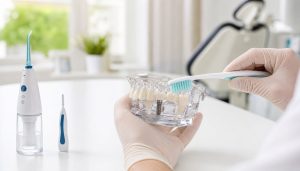
Home care becomes more specialised with a fixed full arch prosthesis. Cleaning under the bridge and around implant components takes technique, not just enthusiasm. Patients may need tools such as superfloss, interdental aids, or other cleaning methods recommended by their dentist or hygienist.
Why maintenance is not optional
Long-term success of full arch dental implants depends on consistent professional maintenance and diligent home care, and peri-implant disease is a recognised complication that can affect even otherwise successful cases, as discussed in this evidence-based review on implant maintenance and peri-implant disease.
That matters because implants don't decay, but the surrounding tissues can still become inflamed and break down if plaque accumulates. A fixed bridge can also make neglected areas harder to see and easier to miss.
Cleanability is part of good design. If a prosthesis is difficult to clean, maintenance problems usually follow.
What works long term
The patients who do best usually follow a simple pattern:
- They attend professional maintenance visits at the interval recommended for their risk level.
- They clean daily with the right tools rather than relying on ordinary brushing alone.
- They report problems early, including looseness, soreness, food trapping, or bleeding.
- They treat the prosthesis like a major restoration, not like something that can be ignored because it feels strong.
If you want a practical guide to daily hygiene, this article on how to clean All-on-4 dental implants covers the basics in patient-friendly language.
Why Choose The Smile Spot for Your New Smile
Full arch treatment asks a lot from a dental team. It requires judgement, planning discipline, restorative understanding, and the ability to keep patients comfortable through a complex process. That's where experience matters.
At The Smile Spot in Dulwich Hill, patients are cared for by Dr. Dimitrios Thanos, a University of Sydney graduate and principal dentist since 1996. That long clinical background matters in full-arch dentistry because these cases aren't only about placing implants. They're about recognising when teeth should be saved, when they shouldn't, and how to build a restoration that will still make sense for the patient years later.
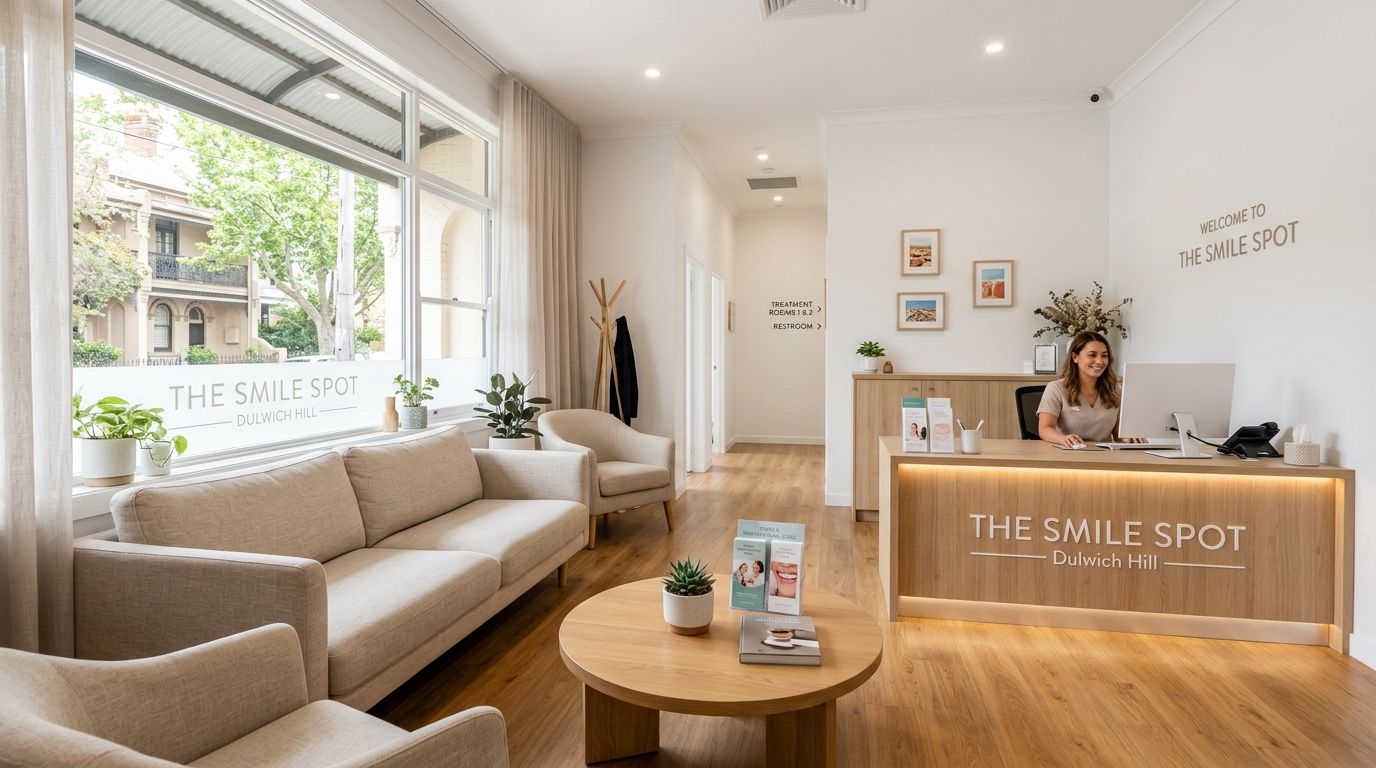
Technology and comfort both matter
The practice combines that experience with technology that supports precision and gentler care. That includes Biolase laser dentistry, which can help make selected procedures more conservative and support healing. For patients who feel anxious about surgery or extensive dental work, sedation options can also make the process far more manageable.
That combination is important because a successful implant journey isn't only technical. It's also emotional. Patients need to feel informed, respected, and calm enough to move through treatment confidently.
A clinic built for real life in the Inner West
Convenience sounds like a small detail until you're juggling consultations, surgery, reviews, hygiene visits, and work or family commitments. The Smile Spot serves patients across Dulwich Hill and the Inner West with practical appointment access, including late evening and Saturday hours.
Patients who are researching major dental treatment often start online and want information that's clearer than standard marketing copy. In that context, resources about how clinics improve visibility and patient education through AI search optimization services can be useful for understanding how trustworthy health information is being shaped and surfaced online.
Why patients stay with one clinic for the full journey
The strongest reason to choose one clinic for full arch care is continuity. Diagnosis, surgery, restoration, and long-term maintenance all affect one another. When those pieces are disconnected, communication gaps appear. When they're aligned, patients usually feel more secure and the treatment tends to run more smoothly.
A good full arch provider doesn't promise perfection. They provide careful planning, clear explanations, realistic expectations, and long-term support.
If you're weighing up full arch dental implants and want advice that's clear, practical, and specific to your needs, book a consultation with The Smile Spot. You'll get a thorough assessment, honest guidance on your options, and a treatment plan focused on comfort, function, and long-term success.