A typical wisdom teeth removal price in Australia is $200 to $600 for a single tooth and $1,200 to $4,000+ for all four, depending on whether the tooth is simple to remove or impacted and whether sedation is needed. If you've just been told your wisdom teeth should come out, that's probably the number you wanted first, before anything else.
For many people in Dulwich Hill and the Inner West, the confusing part isn't whether wisdom teeth removal costs money. It's why one quote sounds manageable and another jumps into the thousands. A friend says they paid a few hundred dollars. Someone else says theirs cost far more. Both can be true.
The difference usually comes down to three things. How difficult the tooth is to remove, what type of anaesthetic or sedation is used, and who performs the procedure. Once you understand those moving parts, the fee stops feeling random and starts making sense.
Your Guide to Wisdom Teeth Removal Prices
You might have gone in for a routine check-up, had an X-ray, and heard the words, “These wisdom teeth will need to come out.” The next thought is usually practical. How much is this going to cost me?
In Australia, a simple wisdom tooth extraction generally sits in the $200 to $350 per tooth range, while an impacted tooth often falls around $350 to $600 per tooth, based on national fee guide and regional benchmark data from the Australian Dental Association and Healthcare Bluebook Australia as summarised in the verified data. For larger cases, the total matters more than the per-tooth fee. A full set of four wisdom teeth commonly ranges from $1,200 to $3,500, and it can exceed $4,000 if IV sedation or general anaesthesia is involved.
That broad range is what frustrates patients. It feels vague because it is broad. Wisdom teeth don't all behave the same way. One may be fully erupted and straightforward. Another may be trapped under gum or bone and sitting close to a nerve.
The most useful question isn't “What's the average?” It's “What applies to my teeth, my scan, and my treatment plan?”
If you live in the Inner West, local pricing often sits toward the higher end of wider Australian ranges because metropolitan clinics and specialists carry higher operating costs. That doesn't mean every case is expensive. It means a proper quote should be based on your scan, your symptoms, and the actual surgical plan, not a rough internet estimate.
An Itemised Guide to Your Wisdom Teeth Bill
A wisdom teeth quote usually has several parts. Patients often look at the total and miss what each line means. Once you break it down, the bill becomes much easier to read.
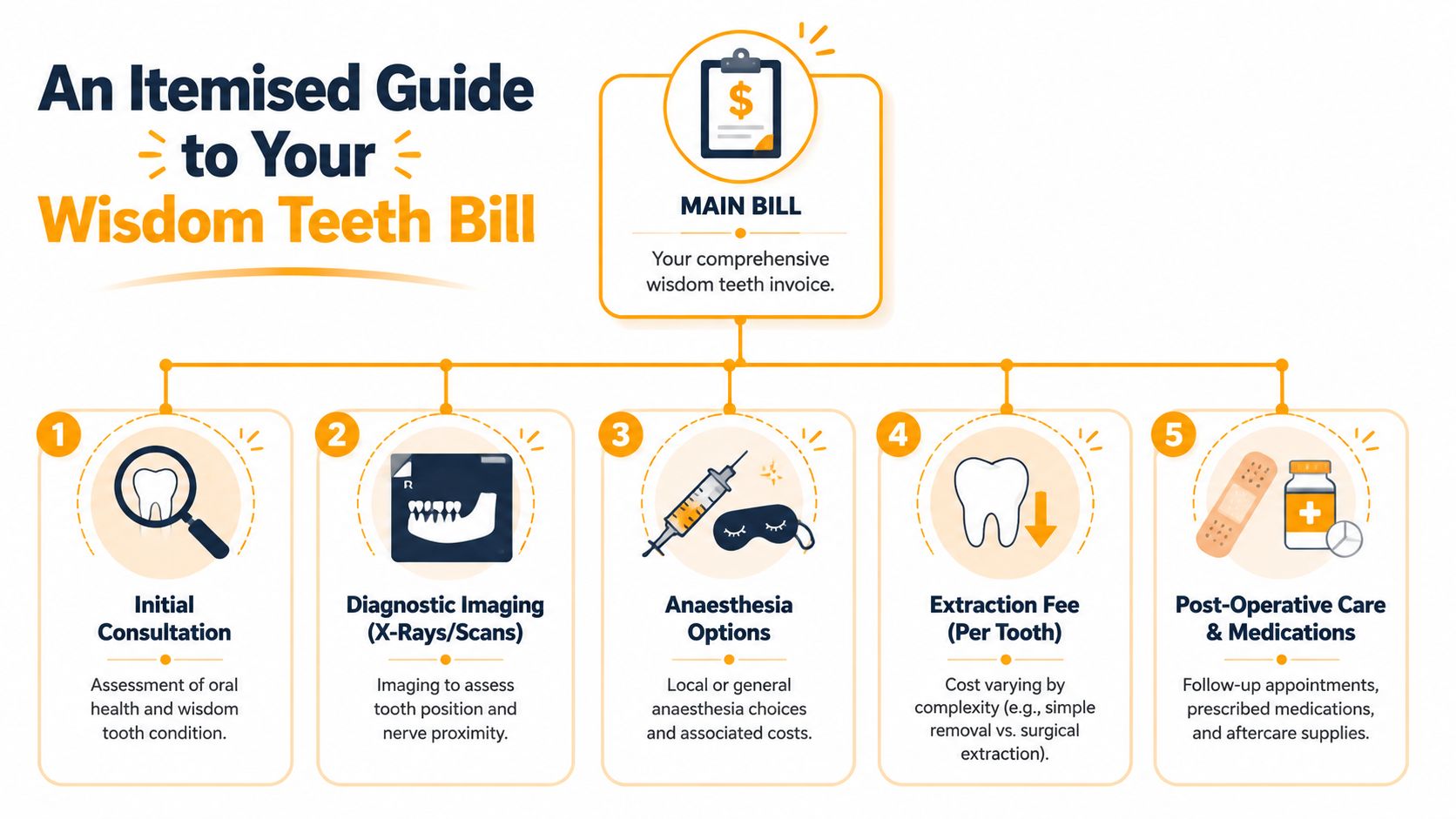
Consultation and assessment
Before any tooth is removed, the dentist or surgeon needs to assess the position of the tooth, your symptoms, your medical history, and whether the case looks simple or surgical. That first visit may include a consultation fee.
For more detailed imaging, there may also be a radiograph cost. In NSW benchmark data, a consultation and radiograph fee of $150 to $250 is described as a standard preliminary cost before treatment begins. If you're not sure what scan has been recommended, this guide to an OPG dental X-ray helps explain why panoramic imaging is often part of wisdom tooth planning.
Extraction fee per tooth
This is the main procedural charge, but it changes a lot depending on the tooth.
- Simple extraction: For a fully erupted tooth removed under local anaesthetic, the average out-of-pocket fee ranges from $250 to $400 per tooth.
- Surgical extraction: If the tooth is impacted and needs gum incision, bone removal, or sectioning, the cost rises to $500 to $900 per tooth.
- General national context: Verified national figures also place simple extractions around $180 to $350 or $200 to $350, and surgical extractions around $380 to $750 or $350 to $600, depending on the dataset used.
Those aren't conflicting numbers so much as different benchmark sets. They all point in the same direction. Surgical work costs more because it takes more time and skill.
Anaesthetic and sedation fees
This is one of the biggest sources of confusion because people assume “being put to sleep” is included in the extraction fee. Often, it isn't.
If the procedure is done under local anaesthetic only, that's usually the lowest-cost pathway. But when IV sedation or general anaesthesia is needed, the bill can rise sharply. Verified NSW and national data show that IV sedation or general anaesthesia can add a flat fee of $1,200 to $2,500 to the total bill.
Practical rule: Ask whether sedation is already included in the quote or listed separately. That one question clears up a lot of surprises.
Imaging, medication, and aftercare
Your bill may also include:
| Item | Typical verified range |
|---|---|
| Diagnostic imaging | $80 to $180 |
| Post-operative medication | $40 to $90 |
These smaller items don't usually drive the final price on their own, but they matter when you're trying to budget realistically.
Why Prices Vary Key Cost Factors Explained
Two people can both need wisdom teeth out and receive very different quotes. That doesn't automatically mean one clinic is overcharging. It usually means the cases are different.
Tooth position changes everything
The biggest cost driver is whether the tooth is non-surgical or surgical. Verified benchmark data shows that non-surgical extractions average $180 to $350 per tooth, while surgical extractions average $380 to $750 per tooth. The reason is practical. Impacted teeth often need osteotomy (bone removal) and tooth sectioning, and that extends the appointment significantly, as outlined in this article on a surgical extraction dentist.
A fully erupted upper wisdom tooth can sometimes come out quite easily. A lower wisdom tooth buried in bone is a different procedure altogether.
The anaesthetic option affects the total
Local anaesthetic is the least expensive option and works well for many straightforward removals. Sedation and general anaesthesia add cost because they involve extra medication, monitoring, equipment, and clinical time.
This isn't only about comfort. Sometimes the choice is clinical. An anxious patient, a longer surgery, or multiple impacted teeth may make sedation the more suitable option.
The practitioner matters too
A general dentist may remove simpler wisdom teeth. More complex extractions are often referred to an oral surgeon. Verified data notes that oral surgeons in NSW charge a premium for specialised surgical time compared with general dentists, and metropolitan Sydney fees also tend to be higher than rural fees.
That doesn't mean specialist care is the “expensive version” of the same job. It's often a different level of procedure with a different risk profile, especially when roots, bone, and nerve proximity are involved.
If your quote is higher than someone else's, compare the diagnosis first. Don't compare totals without comparing the type of extraction, anaesthesia, and clinician.
Example Scenarios Simple vs Complex Removal Costs
Realistic examples make pricing easier to understand because individuals don't typically think in item numbers. They think in situations.
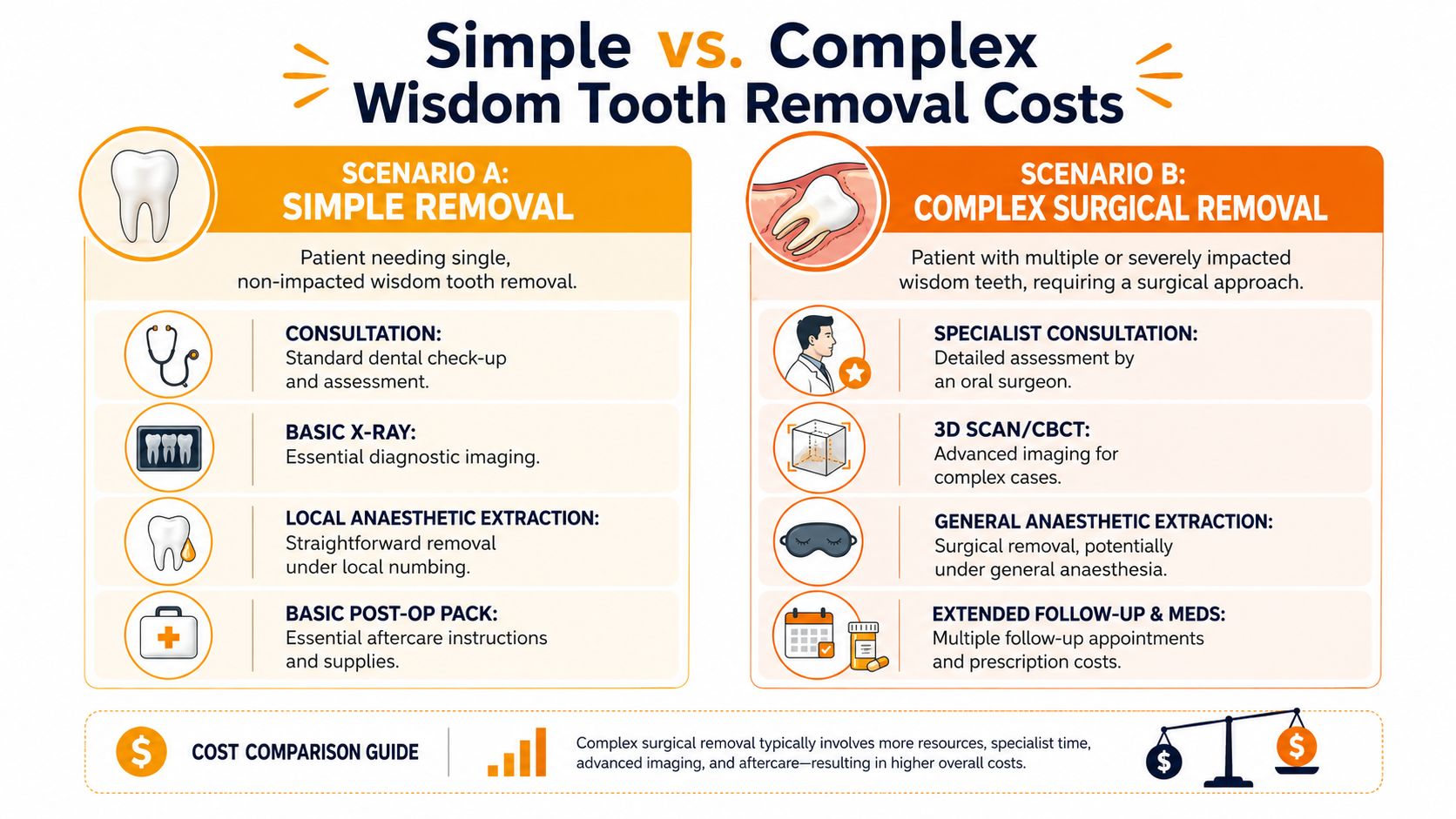
Scenario A with one straightforward tooth
A patient has one fully erupted wisdom tooth that's trapping food and irritating the gum, but it isn't impacted. The tooth can be removed in the chair under local anaesthetic.
A quote for this sort of case may include:
- Consultation and imaging: a preliminary assessment and scan
- Single simple extraction: likely within the lower national range for non-surgical treatment
- Basic aftercare: pain relief advice and routine follow-up if needed
In verified Australian data, simple wisdom tooth removal commonly sits around $200 to $350 per tooth, and some NSW out-of-pocket benchmarks place it at $250 to $400 per tooth. This is the kind of case many people mean when they say, “Mine wasn't too expensive.”
Scenario B with four impacted teeth
Another patient has four wisdom teeth, with lower teeth impacted and one or more close to bone. The removal is planned surgically with sedation because the case is longer and more involved.
Verified Australian data places a full set of four wisdom teeth at $1,200 to $3,500 in many cases. If IV sedation or general anaesthesia is needed, the total can exceed $4,000. The cost also shifts with the type of impaction. In one verified benchmark, soft tissue impactions average $315 per tooth, while completely bony impactions can reach $492 per tooth.
Here's a helpful overview of what recovery tends to involve after this type of treatment: wisdom teeth removal recovery tips.
A short visual explanation can also help if you're trying to picture the difference between simple and complex cases:
The practical takeaway from both examples
The first patient pays for a routine extraction. The second pays for surgery, sedation, and more planning. Both are “wisdom teeth removal,” but they aren't the same treatment.
That's why broad online averages can feel misleading. They blend together simple chairside care and much more complex surgery.
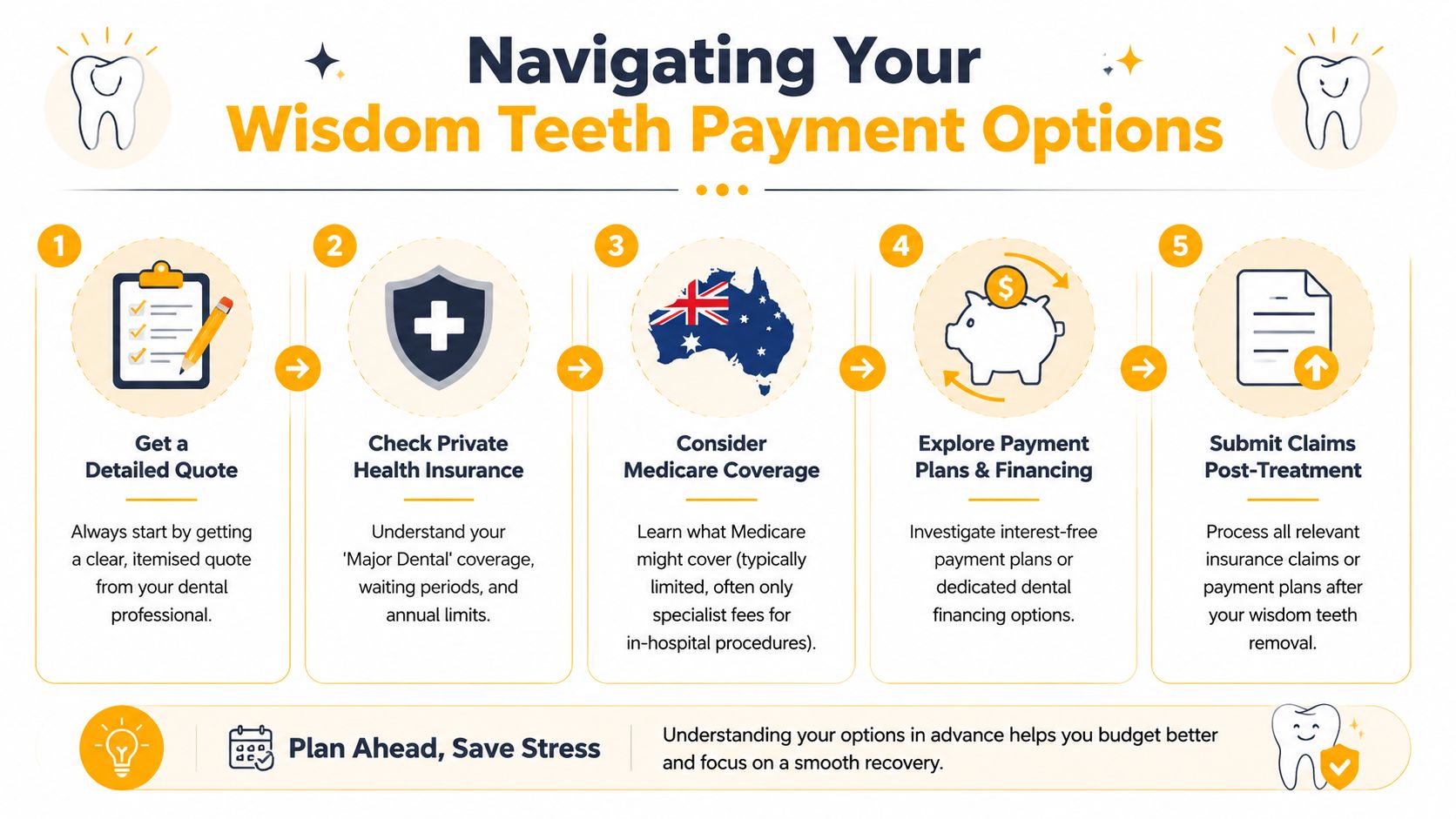
Navigating Insurance Medicare and Payment Plans
Insurance helps, but it rarely makes wisdom teeth removal free. Many patients often find their coverage insufficient.
What private health insurance usually does
Verified Australian data shows that private health insurance typically covers 50% to 80% of wisdom teeth removal costs, but the effective limit is often the annual dental cap. That annual dental limit averages $1,000 to $1,500 in the verified data. So even if your policy covers a good share of eligible treatment, the total benefit can run out quickly.
A useful example from the same verified dataset is this: a $3,000 surgical procedure may result in only $1,200 to $1,500 being covered, leaving a meaningful gap payment.
That's why it helps to ask your fund four direct questions:
- Is wisdom tooth surgery covered under my extras or major dental benefit?
- What is my remaining annual limit?
- Is IV sedation or general anaesthesia covered, and if so, how much?
- Do I need pre-approval before treatment?
If you're comparing policies before treatment, guides to best dental coverage options can be useful for understanding common policy structures and exclusions.
Why gap payments happen
The gap is the difference between what your provider charges and what your health fund pays back. Verified NSW data highlights a common patient frustration here. Forty-two per cent of NSW dental patients faced unexpected gap fees exceeding $150 for wisdom teeth procedures because schedule fees didn't match actual provider costs.
That's why a verbal “you're covered” isn't enough. Ask for the likely out-of-pocket amount based on the itemised quote.
Bring your fund details to the consultation. A proper estimate is much easier when the provider can match the treatment plan to your policy.
Medicare and payment plans
Generally, Medicare doesn't play a major role in routine private wisdom teeth removal. In day-to-day practice, patients usually rely on private health insurance, self-funding, or staged payment options.
If paying the full amount upfront feels difficult, it's worth asking about staged arrangements. This article on dentists with payment plans near me explains how structured payment options can make treatment easier to manage without delaying needed care.
The Long Term Value of Quality Dental Care
It's reasonable to focus on the bill. But cost alone isn't the whole story.
A problematic wisdom tooth can keep causing repeat inflammation, infection, food trapping, decay in the neighbouring molar, or pain that flares at the worst time. When removal is delayed too long, the eventual procedure can become more involved. In plain terms, the cheaper option today isn't always the lower-cost path over time.
Quality care also means better planning. Good imaging, careful assessment, and the right level of anaesthesia can make the treatment smoother and recovery more predictable. Patients usually notice that value in the details: clearer explanations, less uncertainty, and a treatment plan that suits the actual case rather than a one-size-fits-all estimate.
What value looks like in practice
- Experienced decision-making: A clinician can tell when a tooth is suitable for straightforward removal and when it should be managed surgically.
- Modern technology: Better imaging and minimally invasive tools can support more precise treatment.
- Comfort-focused care: Gentle technique and sensible pain management matter, especially for anxious patients.
- Clear communication: An honest quote and a realistic recovery discussion reduce stress before the procedure even begins.
The goal isn't to find the cheapest extraction on paper. It's to solve the problem safely, comfortably, and with fewer complications later.
Get a Clear Wisdom Teeth Quote in Dulwich Hill
By the time individuals search for wisdom teeth removal price, they're trying to answer one very practical question. “What will my treatment cost?” That answer depends on your scan, your symptoms, and whether the teeth are simple or surgical.
For Inner West patients, it helps to know the local market generally aligns with broader Australian surgical pricing. Verified data places surgical wisdom tooth extraction at $700 to $1,200 per tooth nationally, with all four often exceeding $3,000, and notes that Dulwich Hill and the wider Inner West broadly align with these national averages. That's useful context, but it still isn't a personal quote.
A simple way to get from estimate to certainty
The most practical path is straightforward:
- Book an assessment so the dentist can examine the teeth and review the imaging.
- Ask for an itemised quote that separates extraction fees, scans, sedation, and likely aftercare costs.
- Review all options clearly, including whether treatment can be done under local anaesthetic or whether a referral for fuller anaesthesia is more appropriate.
If you're wondering what a practice contact page looks like before taking that first step, this is the booking point many local patients use:

Some patients also want to understand whether a hospital-style or deeper sedation pathway may apply in their case. This overview of a full anesthesia dentist can help frame that conversation before the consultation.
Frequently Asked Questions About Cost
Will my health fund cover the whole amount?
Usually not. Many policies contribute, but annual limits and sedation exclusions often leave a gap. That's why it's smart to confirm your remaining benefit and ask for a written quote before booking treatment.
Is it cheaper to remove all four wisdom teeth at once?
Sometimes it can be more efficient overall, especially if sedation or a surgical setup is needed. But it isn't automatically cheaper in every situation. The right answer depends on whether all four teeth need removal and whether they can be treated safely in one visit.
Are there hidden costs after the surgery?
There shouldn't be hidden costs, but there can be extra costs you didn't realise to ask about. Common examples include imaging, prescription medication, and sedation fees if they're billed separately. Ask for each component in writing.
Can a payment plan change the total price?
That depends on the plan. Some arrangements spread the same fee over time, while others may have conditions or third-party terms. If you're trying to stay organised around treatment costs, practical budgeting tools can help too. Some patients like to discover money saving apps for 2026 so they can track expenses around larger health bills.
If you'd like a calm, clear breakdown of your options, The Smile Spot can help you arrange a consultation in Dulwich Hill and get a personalised wisdom teeth quote with transparent fees and practical next steps.