
Saturday sport in the Inner West has a familiar rhythm. Kids are lacing up boots in Dulwich Hill, parents are carrying water bottles and oranges, and someone is always calling out for a missing shin pad just before the game starts. In that rush, a mouthguard is often the thing people mean to sort out later.
That's usually fine until an elbow, ball, stick, knee or accidental collision lands in exactly the wrong place. A chipped front tooth can happen in a split second. A knocked-out tooth turns a normal weekend into an urgent dental visit. If you've been searching for a sports mouthguard near me, you're probably trying to avoid that kind of day before it starts.
Protecting Your Smile on the Inner West Fields
At local grounds around Marrickville, Summer Hill and Dulwich Hill, the mood is usually upbeat. Junior soccer, weekend footy, school sport and after-school training all bring the same mix of fun and chaos. Most families think first about the obvious gear. Boots, headgear, tape, water bottles. Dental protection often slips down the list because it doesn't feel urgent until there's an injury.

That's a mistake I see people regret quickly. A mouthguard isn't just for hard tackles in a grand final. It matters in ordinary play, during a training drill, when players are tired, off-balance or crowded around the ball. If you already keep a first-aid kit in the car, it's also worth reading the SoccerWares guide to football first aid. It's a practical reminder that preparation matters most before something goes wrong.
Why the right guard matters
The strongest reason to wear one is simple. A 2019 systematic review and meta-analysis found that the prevalence of dental trauma among mouthguard users is 7.5% to 7.75%, compared to 48.31% to 59.48% among non-users. That means mouthguard users are between 82% and 93% less likely to suffer dentofacial injuries according to the American Dental Association overview of athletic mouth protectors.
Those numbers line up with what dentists see in real life. Protection works when people wear it, and when the fit is good enough that they don't spit it out halfway through the session.
Practical rule: The best mouthguard is the one that stays in comfortably, lets the player breathe properly, and gets worn every single time.
What to do if an injury happens
Even with good protection, accidents can still happen. If a tooth chips, moves, cracks or gets knocked out, quick action matters. Keep your dentist's emergency details handy, and read these dental emergency services tips before the next game day. Parents are often calmer when they know what to do in the first few minutes.
A lot of people start with a search for a sports mouthguard near me because they want something fast. That makes sense. But speed shouldn't mean guessing. The right choice protects more than teeth. It protects confidence, comfort and a child's willingness to get back on the field next week.
Understanding Sports Mouthguards and Their Benefits
A sports mouthguard works like a shock absorber for your mouth. Instead of force landing directly on the teeth, jaw and soft tissues, the guard helps spread and cushion that impact. Think of it as a helmet for the teeth and surrounding structures. It doesn't make sport risk-free, but it gives the mouth a far better chance in a collision.
That matters because sports-related injuries account for nearly 40% of all dental injuries in Australia, yet only 36% of Australians who play contact sports wear a mouthguard, as noted in this Australian guide to sports mouthguards. The gap between risk and protection is bigger than most families realise.
What a mouthguard protects
A proper sports mouthguard helps reduce damage to several areas at once:
- Teeth. It can help lower the chance of chipped, cracked or displaced teeth after a blow.
- Lips and cheeks. It creates a barrier between the teeth and the soft tissues, which can reduce cuts inside the mouth.
- Jaw structures. It helps absorb some impact rather than letting the full force travel straight through the bite.
- Existing dental work. Fillings, crowns and orthodontic appliances can all be vulnerable during contact sport.
Why comfort matters more than people think
A mouthguard only helps if the player keeps it in. That's where fit changes everything. If a guard feels bulky, makes speech hard or slips around when the player runs, it often ends up in a pocket instead of in the mouth.
You'll hear children say a poor guard feels “too big” or “weird to breathe with”. Adults say the same thing, just with less drama. In both cases, the result is the same. Inconsistent wear means inconsistent protection.
Good mouthguards don't just protect well. They're comfortable enough that players stop thinking about them.
For families thinking about broader head safety as well, these sports concussion prevention tips are worth reading alongside mouthguard advice. They don't replace dental guidance, but they help parents think more clearly about impact risks across the whole body.
If you want a more detailed explanation of fit, material and design, this article on a dentist mouth guard is a useful next step. The main point is straightforward. A sports mouthguard is small, but it does a big job.
Stock vs Boil-and-Bite vs Custom-Fitted Mouthguards
A child gets clipped during a Saturday match at Arlington Oval, spits the mouthguard out, and the first thing a parent says is often, “It was in, so how did that happen?” In practice, the answer is usually fit. A guard that shifts, folds, or needs to be clenched into place does not protect the same way as one that stays seated properly.
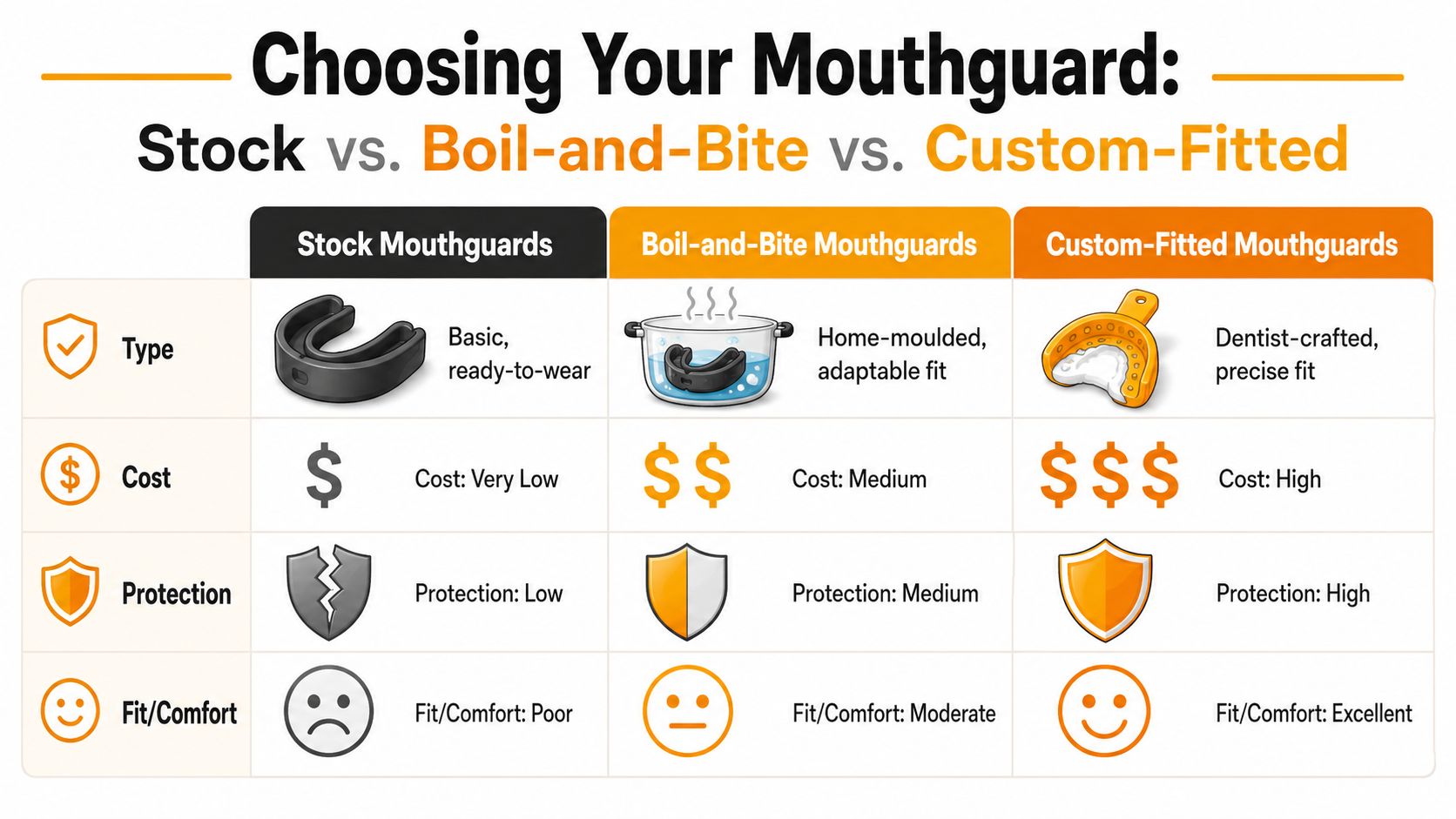
Mouthguard comparison at a glance
| Feature | Stock Mouthguard | Boil-and-Bite | Custom-Fitted (The Smile Spot) |
|---|---|---|---|
| Fit | Generic and loose | Better than stock, but inconsistent | Made to the exact teeth and bite |
| Comfort | Usually bulky | Variable | Usually the most comfortable |
| Breathing and speech | Often awkward | Can be acceptable | Typically easiest |
| Protection | Lowest | Better than stock, but limited by home fit | Highest practical level |
| Best for | Last-minute stopgap | Short-term compromise | Regular sport and reliable protection |
Stock mouthguards
Stock mouthguards are the quickest option. Open the packet, put it in, and head to training.
That speed is the only real advantage.
Because the shape is generic, stock guards often sit loosely and feel bulky. Many players end up biting down just to keep them in place, which makes breathing and talking harder. For younger players, that usually means the guard comes out between drills or gets pushed halfway forward during play.
Boil-and-bite mouthguards
Boil-and-bite guards try to solve that problem by giving you a home-moulded fit. Sometimes they turn out reasonably well. Sometimes they do not.
The weakness is consistency. The final shape depends on water temperature, timing, how firmly the player bites, and whether the material thins out in the wrong spots. A guard can look snug in the bathroom mirror and still leave poor coverage where it matters.
The Australian Dental Association has raised concerns about boil-and-bite guards offering less reliable protection than custom-made options, which is why I treat them as a backup rather than a long-term plan. If you want a clearer breakdown of what dentists look for in a better-fitting mouthguard for sports, that guide explains the design details in plain language.
A quick visual explanation can help if you're weighing the options for a child or for your own weekend sport.
Custom-fitted mouthguards
Custom-fitted guards are made from the actual teeth and bite, using an impression or scan. That changes the result more than people expect. The guard stays where it should, covers the right areas, and feels secure without constant clenching.
For Inner West families, that matters on ordinary suburban grounds just as much as in higher-level competition. Kids playing rugby, basketball, hockey, or martial arts in and around Dulwich Hill need something they will keep in for the full session, not just the first ten minutes.
At The Smile Spot, the custom option is also easier than many parents expect. We check the teeth, take the records, choose the right thickness and design for the sport, and have the guard made to fit that player's mouth, not a generic template. If braces, mixed dentition, or a crossbite are part of the picture, those details can be built into the plan.
A cheaper guard can cost more if it fails at the wrong moment.
How to choose without overthinking it
Use a practical standard.
- Stock suits a genuine last-minute situation, but the loose fit is a clear compromise.
- Boil-and-bite can work as a temporary option if nothing else is available yet.
- Custom-fitted is the better choice for regular training, weekly matches, braces, or any player who has already rejected bulky shop-bought guards.
That same fit-first thinking applies across other sports as well. Players comparing helmets, eyewear, and protective gear can also browse expert advice for women's lacrosse players to see how equipment decisions change with comfort, movement, and level of play.
Which Local Sports Require a Mouthguard
In the Inner West, mouthguards aren't only for rugby forwards and AFL players. They make sense for a much wider group than most families expect. Any sport with body contact, fast-moving equipment, falls, close marking or accidental collisions puts teeth at risk.
Around Dulwich Hill and nearby suburbs, the common examples are easy to spot.
Sports where a mouthguard is a smart idea
- Rugby league and rugby union. Direct contact is obvious, and the risk is built into the game.
- AFL and soccer. Players jump, contest, turn suddenly and collide more often than people think.
- Basketball and netball. Elbows and fast changes of direction cause plenty of facial knocks.
- Hockey and cricket. Sticks, balls and close fielding all create risk.
- Martial arts and boxing. Contact to the face is expected, not accidental.
- Skateboarding and similar activities. Falls are unpredictable, and the ground doesn't give second chances.
Families sometimes assume a mouthguard is only necessary when rules require one. That's too narrow. Teeth don't care whether an injury happened in a regulated contact sport or in a casual training session at the local court.
Training is where people forget
One of the clearest blind spots is practice. In Australian football, mouthguard use during training ranges from just 2% for juniors to 40% for elite players, despite training involving high-risk collisions, according to this PubMed study on mouthguard use in Australian football.
That pattern makes sense in a disappointing way. People prepare more carefully for match day than for drills, scrimmages and fitness sessions. But bodies get tired at training. Timing slips. Technique gets loose. That's when unexpected contact happens.
If a sport is rough enough for a mouthguard on Saturday, it's rough enough for one on Tuesday training as well.
For sports that don't always get included in the mouthguard conversation, this expert advice for women's lacrosse players is a useful example of how equipment decisions affect safety and confidence in play.
If you're unsure whether your child's sport falls into the “yes, they should wear one” category, a safe rule is simple. If there's speed, contact, sticks, balls, boards, wheels or a chance of falling face-first, a guard is worth wearing. This guide to a mouthguard for sports can help families think through sport-specific needs in more detail.
Your Custom Mouthguard Appointment in Dulwich Hill
Saturday morning sport in the Inner West gets busy fast. A child is already in uniform, a parent is checking the time, and the last thing anyone wants is a dental appointment that feels confusing or drawn out. A custom mouthguard visit should feel clear, practical and well explained from the start.
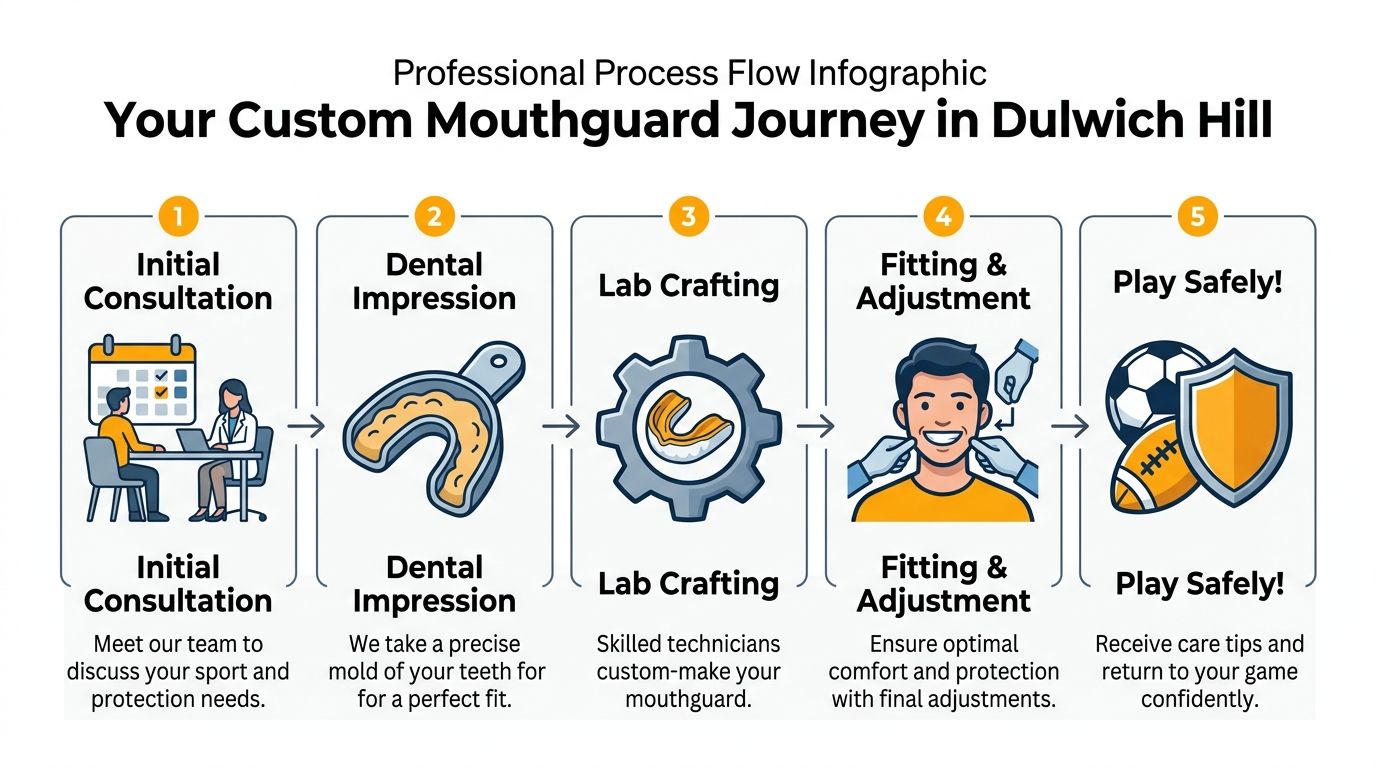
Step one is choosing the right design
The first discussion is about the person, not just the teeth. The sport matters. So do age, previous injuries, braces, breathing comfort and how much talking needs to happen during play. A child heading to weekend soccer at Arlington Oval usually needs something different from an adult doing boxing or martial arts, and a teenager with orthodontic appliances needs extra planning again.
Practical details shape the result more than people expect. If a player gags easily, has struggled with shop-bought guards, or keeps spitting them out because they feel bulky, that changes what should be made.
Step two is taking the impression or scan
This is often the part families worry about most, but it is usually simpler than expected. Some clinics use a digital scan. Others use a traditional impression when that gives a better record of the bite. The aim is accuracy, because a guard that shifts, pinches or drops out during sport is not doing its job.
Children usually cope well when the process is explained plainly. In our area, that matters. Parents want to know how long it takes, what their child will feel, and whether there are likely to be any issues before school pickup or afternoon training.
Step three is lab fabrication
Once the records are taken, the mouthguard is made for that specific mouth. That is a key difference with custom work. The fit, thickness and edge shape are planned, rather than left to chance.
The American College of Prosthodontists position statement on mouthguard use explains that thickness recommendations vary by sport and level of impact. That matters in practice. A slimmer design may feel easier to tolerate, but it still has to provide the right level of protection for the sport being played.
Step four is the fitting appointment
At the fitting visit, the guard is checked carefully for retention, comfort and trim. It should stay in place without the player biting down to hold it there. Breathing should feel easy, and speech should be clearer than it is with a bulky retail guard.
Small adjustments are normal. In fact, they are part of getting the guard right.
A custom guard should feel snug, not distracting. If a player keeps pulling it out, chewing on it, or fighting the fit, it needs attention.
Step five is learning how to use and care for it
Before the appointment finishes, patients should know when to wear the guard, how to clean it, how to store it and when it needs review. Children grow quickly. Adults may have dental work, orthodontic changes or wear from repeated use. A mouthguard needs checking from time to time, just like any other piece of sports equipment that has to fit properly to work.
Cost comes up in this conversation too, and it is a fair question. A retail guard may look cheaper at the counter, but a poor fit often means poor use. As noted earlier, custom-fitted options offer better retention and protection than boil-and-bite alternatives, which is why many families decide the extra upfront cost is worth it.
The goal is local care that feels predictable, well explained and worth the effort. Booking with a nearby Dulwich Hill dentist also makes reviews and adjustments much easier for Inner West families once the season is underway.
Your Mouthguard Questions Answered
How do I clean a sports mouthguard?
Rinse it in cool water after use and clean it gently with a soft toothbrush and mild soap. Let it dry before storing it in a ventilated case. Don't leave it in a hot car, and don't use very hot water unless you've been told to. Heat can distort the fit. This guide on how to clean a mouth splint covers the same hygiene basics that help keep a mouthguard fresh and usable.
How often should it be replaced?
Children and teenagers usually need closer review because their mouths change as they grow. Replace the guard if it feels tight, loose, cracked, warped or uncomfortable. Adults should also have it checked if there's dental work, orthodontic treatment or a noticeable bite change.
Can you wear one with braces?
Yes, and it's often even more important. Brackets and wires can increase the chance of soft tissue injury during impact, and orthodontic treatment itself is worth protecting. The mouthguard needs to be designed with those appliances in mind, rather than forced over them.
Will private health cover help?
Many patients can claim part of the cost through private extras cover, but the amount depends on the fund and level of cover. It's best to check with your insurer before the appointment so you know what to expect.
Is one mouthguard enough for every sport?
Sometimes yes, sometimes no. If someone plays sports with very different impact patterns, a dentist may recommend a design that suits the higher-risk activity. The safest choice is the one that matches the sport you play most.
If you want a properly fitted sports mouthguard for yourself or your child, The Smile Spot offers family dental care in Dulwich Hill with a practical, reassuring approach. It's an easy place to start if you'd like clear advice, a comfortable fitting process, and protection that works on the field, court or training ground.