
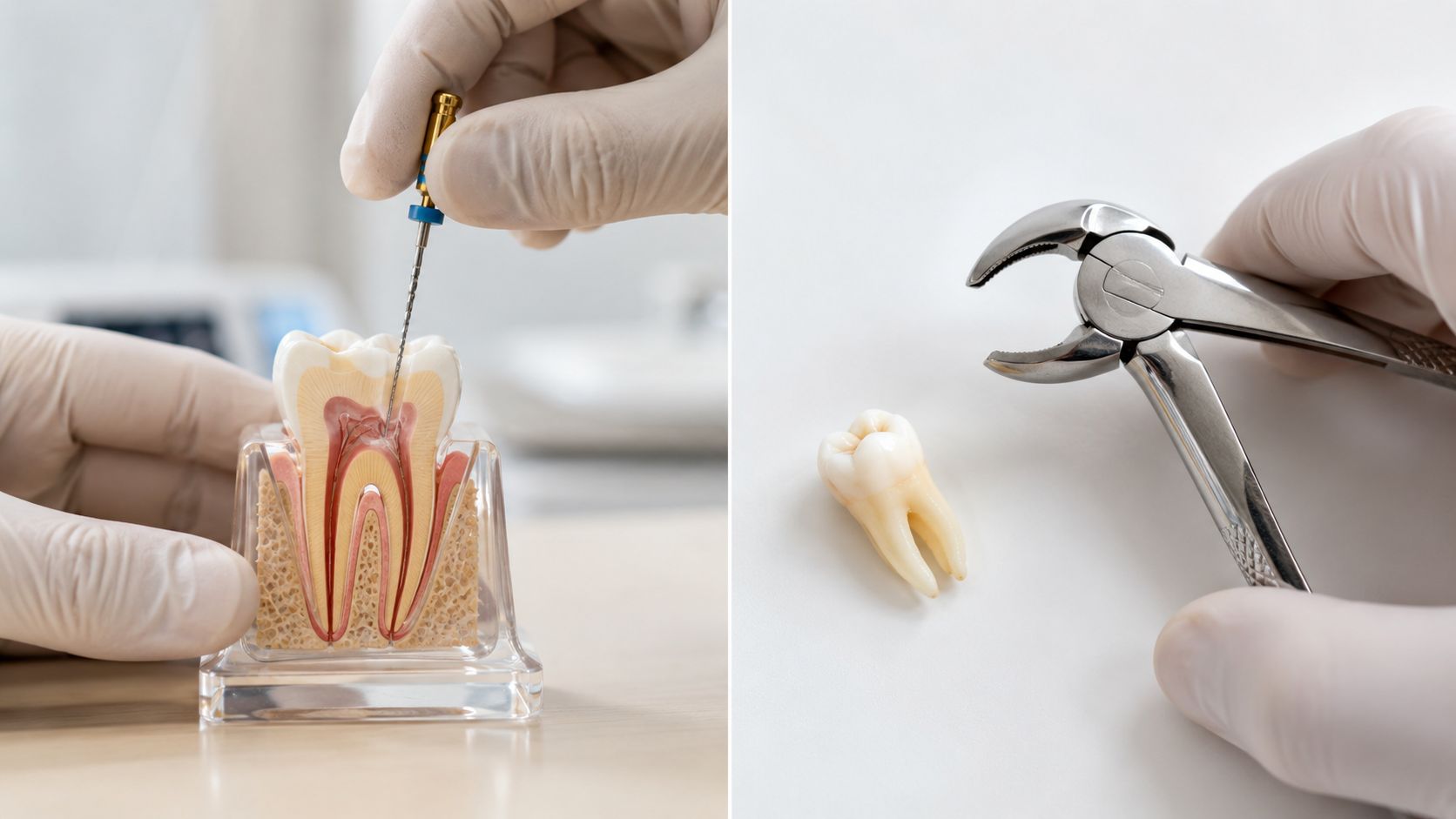
A bad toothache can make everything feel urgent. You want the pain gone, you want a clear answer, and you don't want to make an expensive mistake that causes more trouble later.
That's usually when the question appears. Should you save the tooth with a root canal, or remove it with an extraction?
Both treatments can be the right choice in the right situation. The best decision isn't just about what stops pain today. It's about what leaves you with the strongest, healthiest, most stable smile in the months and years ahead.
Facing a Difficult Dental Decision
When people compare root canal vs extraction, they're often doing it while tired, worried, and already uncomfortable. That matters. Pain makes every option feel heavier, and it can push people toward the fastest solution rather than the best long-term one.
In practice, this decision comes down to one central question. Can the tooth be predictably restored, or is it too damaged to save? If the answer is yes, modern dentistry usually favours preserving the natural tooth. If the answer is no, extraction becomes the safer path.
What patients are really deciding
This isn't only a choice between two procedures. It's a choice between two treatment paths.
- Saving path: Root canal treatment removes infected or inflamed tissue from inside the tooth, then the tooth is restored so you can keep using it.
- Removal path: Extraction takes the tooth out completely, then you decide whether to leave the space or replace it later with something like a bridge or implant.
Those paths lead to different consequences for chewing, comfort, appearance, bite balance, and future dental work.
Clinical priority: If a tooth can be saved well, preserving natural structure usually gives the mouth the most stable long-term outcome.
A calmer way to think about it
If you're anxious, simplify the decision into three practical questions:
Is the tooth restorable?
A tooth with enough healthy structure left may be a good candidate for root canal treatment and restoration.What happens after the main procedure?
Root canal treatment often needs a final restoration such as a crown. Extraction often starts a separate replacement conversation.What will this mean for the rest of my smile?
One tooth rarely acts alone. Removing a tooth can affect neighbouring teeth, bite function, and future treatment planning.
Patients usually feel more confident once they stop viewing this as a one-day procedure choice and start seeing it as a long-term oral health decision.
Understanding the Two Procedures
To choose well, it helps to know what each treatment involves. Many people hear “root canal” or “extraction” and picture something far worse than the experience.
What root canal treatment does
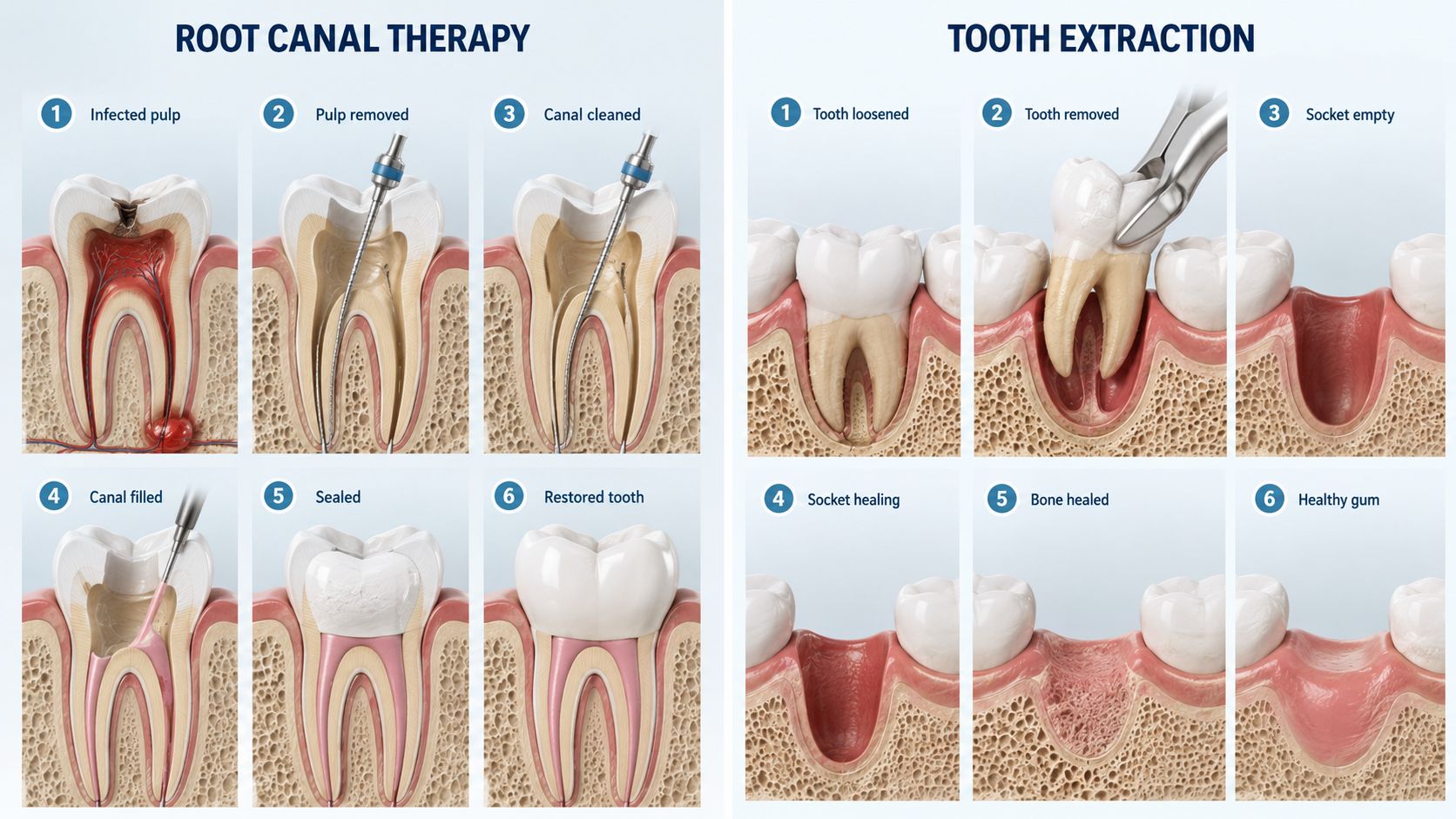
A root canal is designed to save a tooth that has an infected or inflamed pulp. The pulp sits inside the tooth and contains nerves and blood vessels. When that inner tissue becomes infected, the tooth can become very painful, sensitive, or swollen.
The treatment itself is a careful internal clean. The infected pulp is removed, the inside of the tooth is disinfected, and the canals are sealed so bacteria can't easily re-enter. After that, the tooth is restored so it can function properly again.
For a patient, the sequence usually feels like this:
- Assessment and imaging: The dentist checks whether the tooth is restorable and whether the infection is localised or more advanced.
- Numbing the area: Local anaesthetic is used so the procedure can be completed comfortably.
- Cleaning the inside of the tooth: Diseased tissue is removed from the canal system.
- Sealing and restoring: The tooth is sealed and often later protected with a final restoration.
Modern techniques matter here. Tools such as Biolase laser dentistry can support minimally invasive treatment and patient comfort in selected cases.
Patients who want a fuller walkthrough can read more about root canal dentistry and how treatment works.
What extraction does
An extraction removes the tooth from its socket. Sometimes that's a straightforward removal. Sometimes it's surgical, especially if the tooth is badly broken, impacted, or difficult to access.
Extraction can be the right treatment when the tooth can't be restored safely or predictably. That includes cases where decay is too extensive, a fracture goes too far below the gumline, or supporting structures are badly compromised.
The usual flow is different from a root canal:
- Assessment first: The dentist confirms whether the tooth is beyond repair.
- Numbing and removal: The tooth is loosened and removed, or surgically sectioned if needed.
- Healing phase: The socket heals over time.
- Replacement planning: If the gap should be restored, that discussion follows after healing or as part of the treatment plan.
Extraction ends the problem tooth. It doesn't automatically end the treatment journey, because the missing tooth may still need to be replaced.
The simplest distinction
A root canal treats the inside of the tooth so you can keep it. An extraction removes the entire tooth.
That sounds obvious, but it's the reason these options differ so much in what follows. One protects the natural root and tooth position. The other creates a space that your mouth has to adapt to.
A Detailed Comparison of Key Factors
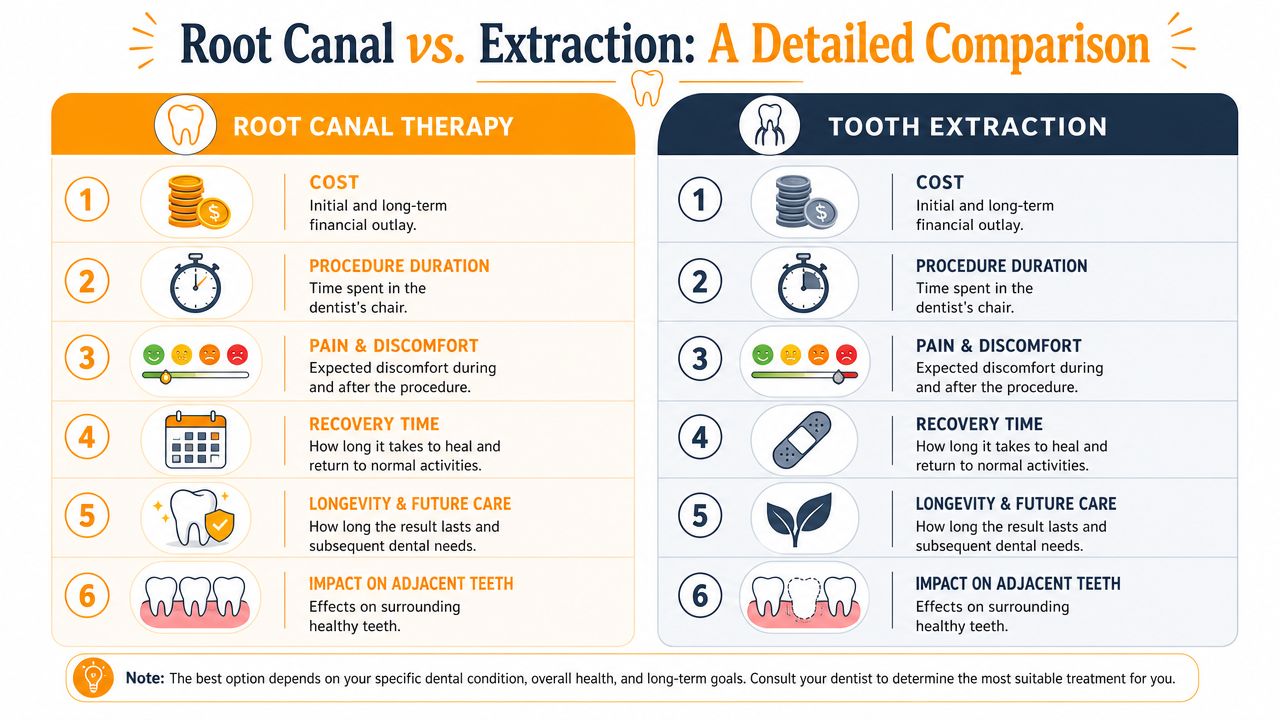
When patients compare Root Canal vs Extraction, they usually want one answer. In reality, the better question is which option creates the stronger overall outcome for your specific tooth, your bite, and your future dental needs.
Here's the quick reference version first.
| Factor | Root Canal Therapy | Tooth Extraction |
|---|---|---|
| Primary goal | Save the natural tooth | Remove the damaged or infected tooth |
| What stays in place | Natural root remains | Tooth is removed, leaving a gap |
| Long-term role | Preserves existing tooth position and function | Often leads to a replacement decision |
| Typical next step | Final restoration, often a crown | Healing, then possible implant or bridge |
| Effect on surrounding structures | Maintains the natural tooth in the arch | Can change spacing and bite if not replaced |
| Best suited for | Infected but restorable teeth | Non-restorable, severely damaged, or unstable teeth |
Reliability and lifespan
One of the strongest points in favour of saving a restorable tooth is predictability. Root canal treatment demonstrates a 95% clinical success rate with a functional lifespan of 10–25+ years when restored with a crown, making it a highly reliable procedure for preserving a natural tooth for the long term according to this Australian comparison of root canal and extraction outcomes.
That doesn't mean every tooth is a candidate. It means that when the tooth is suitable and properly restored, keeping it is often a very dependable treatment path.
What each option commits you to
A root canal and an extraction may both remove pain, but they don't leave you in the same place.
A root canal saves your natural tooth. An extraction starts a replacement decision.
That replacement question is what many patients underestimate. Once a tooth is removed, you may need to think about an implant, a bridge, or in some cases living with the gap and accepting the trade-offs that come with it.
A root canal usually keeps the architecture of your smile intact. The tooth remains in position. Your chewing pattern stays more familiar. Future treatment planning is simpler because the original tooth is still there.
Function and the bigger picture
Root canal therapy and extraction also differ in how they affect the rest of the mouth.
- Natural bite support: Keeping the tooth helps maintain the way your upper and lower teeth meet.
- Neighbouring tooth stability: A missing tooth can create a situation where adjacent teeth begin to drift.
- Jawbone stimulation: A retained root continues to play a role in normal function.
The video below gives a useful visual overview before making a final decision.
What matters most in practice
The best comparison isn't “which procedure is easier?” It's “which option leaves me in the best position six months from now, five years from now, and longer?”
If the tooth is restorable, root canal treatment often wins that comparison because it solves the disease while preserving what nature already built. If the tooth is beyond repair, extraction becomes the more responsible choice because keeping a hopeless tooth usually leads to repeated problems.
When Is Each Procedure Recommended
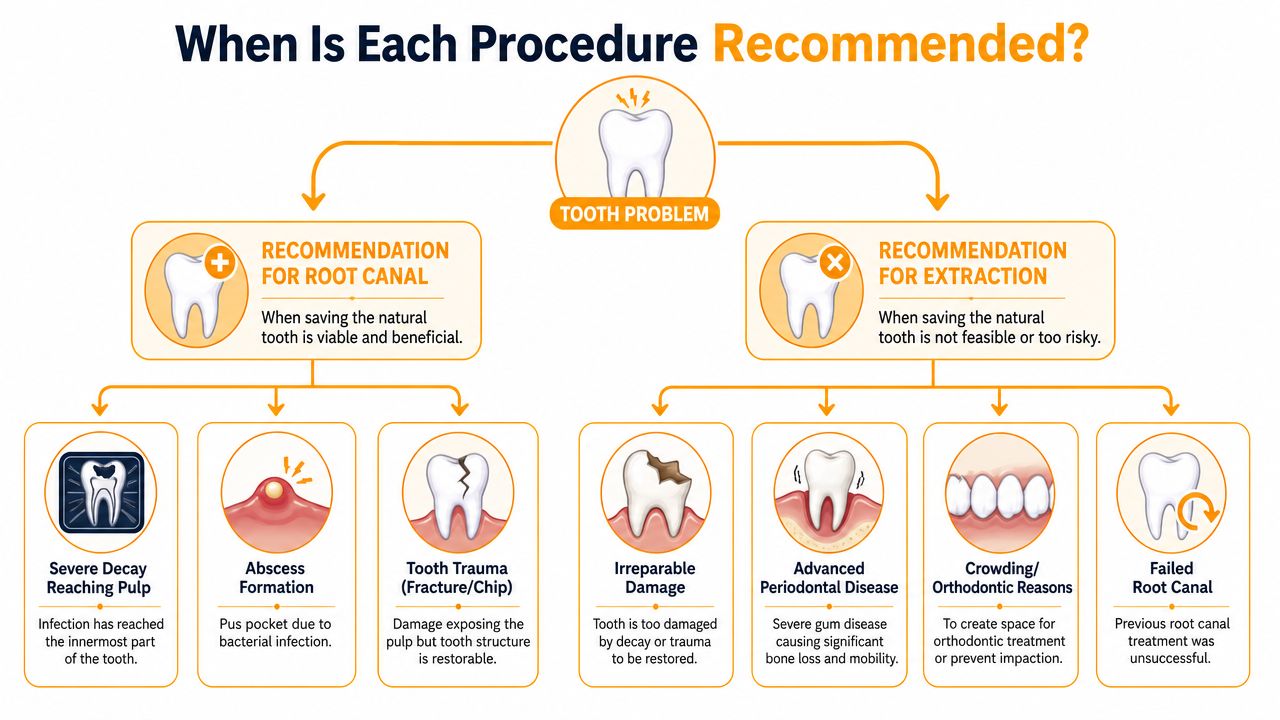
The most useful way to decide isn't by fear level, cost alone, or how quickly you want the pain gone. It's by restorability. Dentists look at whether the tooth still has enough healthy structure, support, and strategic value to justify saving it.
When root canal treatment is usually preferred
If a tooth is infected but still structurally sound, saving it is commonly the better option. If a tooth is structurally intact despite being infected, root canal treatment is generally the preferred option. It preserves the natural tooth and prevents long-term issues like jawbone deterioration and misalignment that often follow an extraction, as outlined in this Australian discussion of extraction and tooth preservation.
That often applies in situations such as:
- Deep decay reaching the pulp: The inside of the tooth is infected, but the outer tooth can still be restored.
- Dental abscess related to the root: The infection needs treatment, but the remaining tooth can still serve well.
- Trauma with a restorable tooth: A crack or chip may expose the pulp without making the whole tooth unsalvageable.
Patients who are unsure whether their symptoms match that pattern can review common signs you may need a root canal.
When extraction is the better recommendation
Extraction is often the correct choice when saving the tooth would be unreliable, short-lived, or biologically unwise.
Common examples include:
Severe fracture below the gumline
If the break extends too far, there may not be enough tooth left to support a proper restoration.Extensive decay destroying key structure
Sometimes the infection is only part of the problem. The larger issue is that the tooth no longer has enough healthy material to hold a filling or crown.Advanced periodontal damage
A tooth may look usable from above but be failing because the supporting bone and gum attachment are too compromised.A previously treated tooth with poor remaining prognosis
In some cases, retreatment may be possible. In others, removal is the more sensible option.
Practical rule: A tooth should be saved when it can be restored predictably, cleaned properly, and expected to function well. If those conditions aren't there, extraction is often the safer answer.
One diagnosis can't be guessed at home
Pain alone doesn't tell you which treatment you need. A tooth with severe pain may still be very saveable. A tooth with less pain may be badly fractured and unsalvageable.
That's why the exam matters so much. Dentists are judging not only the infection, but also the crack pattern, the amount of remaining tooth, the gum condition, and whether the tooth can support the restoration it will need afterwards.
The True Cost of Saving vs Removing a Tooth
Cost matters. Patients are right to ask about it early, because the cheapest first step isn't always the most economical treatment path.
The biggest mistake in the root canal vs extraction discussion is comparing only the immediate procedure fee. That comparison is incomplete.
Upfront fees and total pathway cost
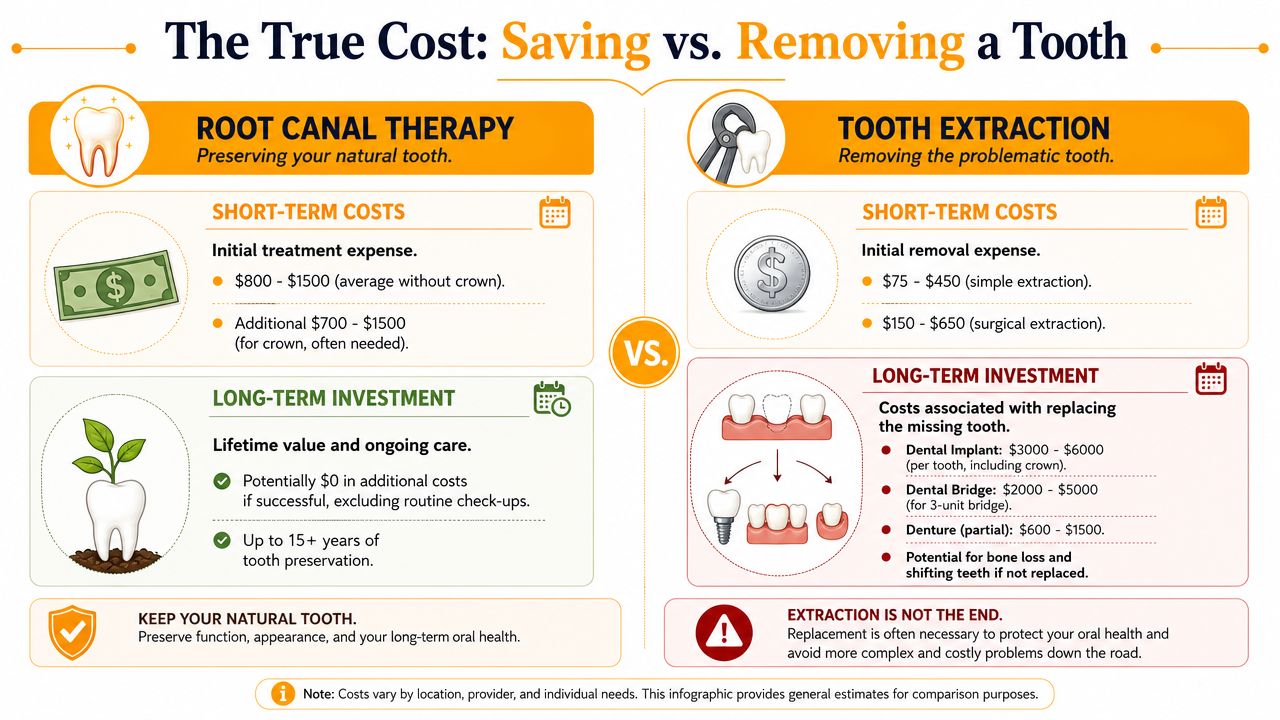
In Australia, the upfront numbers usually favour extraction. A simple extraction can cost as little as $150–$400, while a root canal is $1,000–$2,500+. However, adding a replacement like a dental implant ($3,000–$6,500) makes the total extraction pathway far more expensive than saving the tooth with a root canal and crown, according to this Australian cost breakdown of root canal treatment versus extraction.
That's the strategic point many people miss. Extraction may solve the immediate problem for less money on day one. But if the missing tooth should be replaced, the total spend can end up much higher.
The longer financial view
A peer-reviewed Australian analysis gives the broader picture. It reported a total mean cost of $689.1 for root canal treatment compared with $280.1 for extraction, but when an extracted tooth was replaced with an implant or bridge, the total cost rose to $1,245.5, exceeding the cost of preserving the tooth with root canal treatment and any necessary crown, as detailed in this Australian review of endodontic and extraction cost outcomes.
That same analysis also noted Australian fee ranges showing:
- Root canal treatment: $900 to $2,500+ depending on tooth type
- Molars: $1,500 to $2,500+
- Dental crown: $1,600 to $2,500
- Simple extraction: $75 to $200
- Surgical extraction: $250 to $450
- Implants: $3,000 to $6,500
- Bridges: $2,500 to $4,500
Those figures don't mean root canal treatment is always cheaper in every individual case. They show why the right comparison is save now vs remove and replace later, not root canal fee vs extraction fee in isolation.
How to think about value
The smarter financial question is this:
- If the tooth can be saved well, is preserving it likely to avoid a bigger replacement cost later?
- If the tooth can't be saved, which replacement plan best protects function and budget over time?
If you're already weighing what replacement may involve, whether dental implants are worth it is often the next practical question to explore.
Short-term cheap and long-term economical are not the same thing.
Recovery and Long-Term Smile Health
Most patients don't only want the problem fixed. They want to know what life feels like after treatment. That's where the gap between these options becomes clearer.
Recovery experience
Root canal recovery is often easier than people expect because the source of the internal inflammation has been removed while the tooth itself stays in place. Extraction recovery is different. The body has to heal a socket, form a stable clot, and protect the area from disruption.
Patients undergoing root canal therapy report high satisfaction and a significant enhancement in quality of life, whereas extraction carries a 6-fold higher likelihood of post-operative pain perception and risks such as dry socket, according to this study on outcomes and patient experience after endodontic treatment and extraction.
That doesn't mean extraction always causes a difficult recovery. It means the healing pattern is more exposed to short-term post-operative issues because the entire tooth has been removed.
What happens to the smile over time
The larger issue is what each treatment leaves behind.
With a root canal, the tooth remains part of your bite. Your chewing pattern stays more natural, and you avoid the immediate challenge of a missing space. That matters for comfort, speech, and confidence, but also for the simple day-to-day function of eating without favouring one side.
With an extraction, the mouth has to adapt. If the space isn't managed well, adjacent teeth may shift and the bite can change. For some patients, especially in visible or heavily used areas of the mouth, that becomes a functional and cosmetic problem rather than just a missing tooth problem.
Why dentists try to preserve restorable teeth
The long-term value of a root canal isn't just that it avoids extraction. It's that it preserves continuity in the smile.
- Better chewing stability: Keeping the natural tooth usually maintains more familiar function.
- Less disruption to adjacent teeth: The arch remains complete rather than opening a gap.
- Simpler future planning: You're maintaining a natural structure instead of replacing it with a prosthetic option.
If extraction is necessary and an implant is being considered, understanding dental implant recovery time helps set realistic expectations for the next phase.
When a tooth can be saved predictably, preserving it often gives the mouth the easiest future to live with.
Your Questions Answered
Will a root canal be painful
Modern root canal treatment is done under local anaesthetic, so the goal is comfort during the procedure. In most cases, patients are more relieved by the end of treatment than distressed by it because the infected tissue has been addressed.
Can I just leave the gap if a back tooth is extracted
Sometimes a missing back tooth can be left, but it's not automatically harmless. The decision depends on where the tooth is, how you bite, whether nearby teeth are likely to drift, and whether the gap will affect chewing.
How many appointments does a root canal take
That depends on the tooth, the complexity of the canals, the level of infection, and how the final restoration is planned. Some are completed quickly, while others need staged treatment.
If I'm very anxious, is extraction better
Not necessarily. Anxiety shouldn't force you into a less suitable treatment. Comfort options, including sedation in appropriate cases, can make either procedure much easier to manage.
What if I'm worried about pain after an extraction
That's a fair concern. Good aftercare matters, especially to protect the healing socket. If you're preparing for that possibility, this guide to Panadeine Forte after tooth extraction can help you understand post-operative pain management questions to raise with your dentist.
If you're weighing root canal treatment against extraction and want clear, experienced advice suited to your tooth, book with The Smile Spot. The team can assess whether the tooth is restorable, explain the long-term trade-offs plainly, and help you choose the option that protects your comfort, smile health, and future dental needs.