You're lying back in the chair, your dentist says there's “a bit of wear”, “possibly a crack”, or “some gum inflammation”, and you're trying to make sense of it all from a quick look in a tiny hand mirror. Most patients have had that moment. You want to understand what's going on, but it's hard to picture the problem when you can't properly see it.
That's where intraoral camera dentistry changes the experience. Instead of relying only on words, you get a close-up view of your own teeth and gums on a screen while the exam is happening. It turns a vague conversation into something concrete. You're no longer guessing what your dentist means by “early decay” or “a worn filling”. You can see it.
For many people, that simple shift makes dental visits feel less confusing and far more collaborative. You're not being told what's happening in your mouth. You're being shown.
A New Perspective on Your Dental Health
A traditional dental exam often depends on trust and imagination. Your dentist checks a back tooth, calls out notes to the assistant, then explains that a filling is wearing down or a gum area looks irritated. You believe them, of course, but it can still feel abstract.
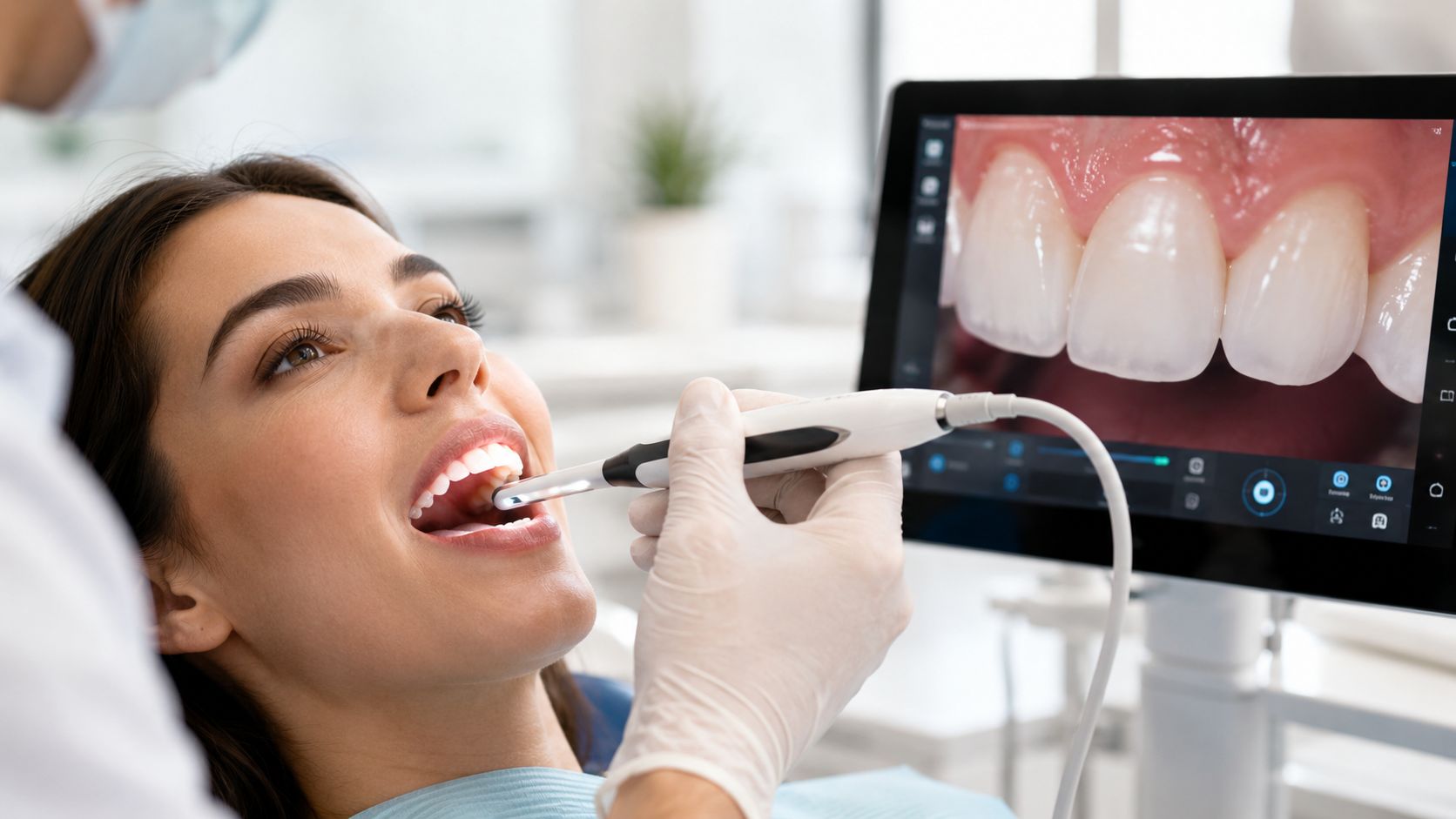
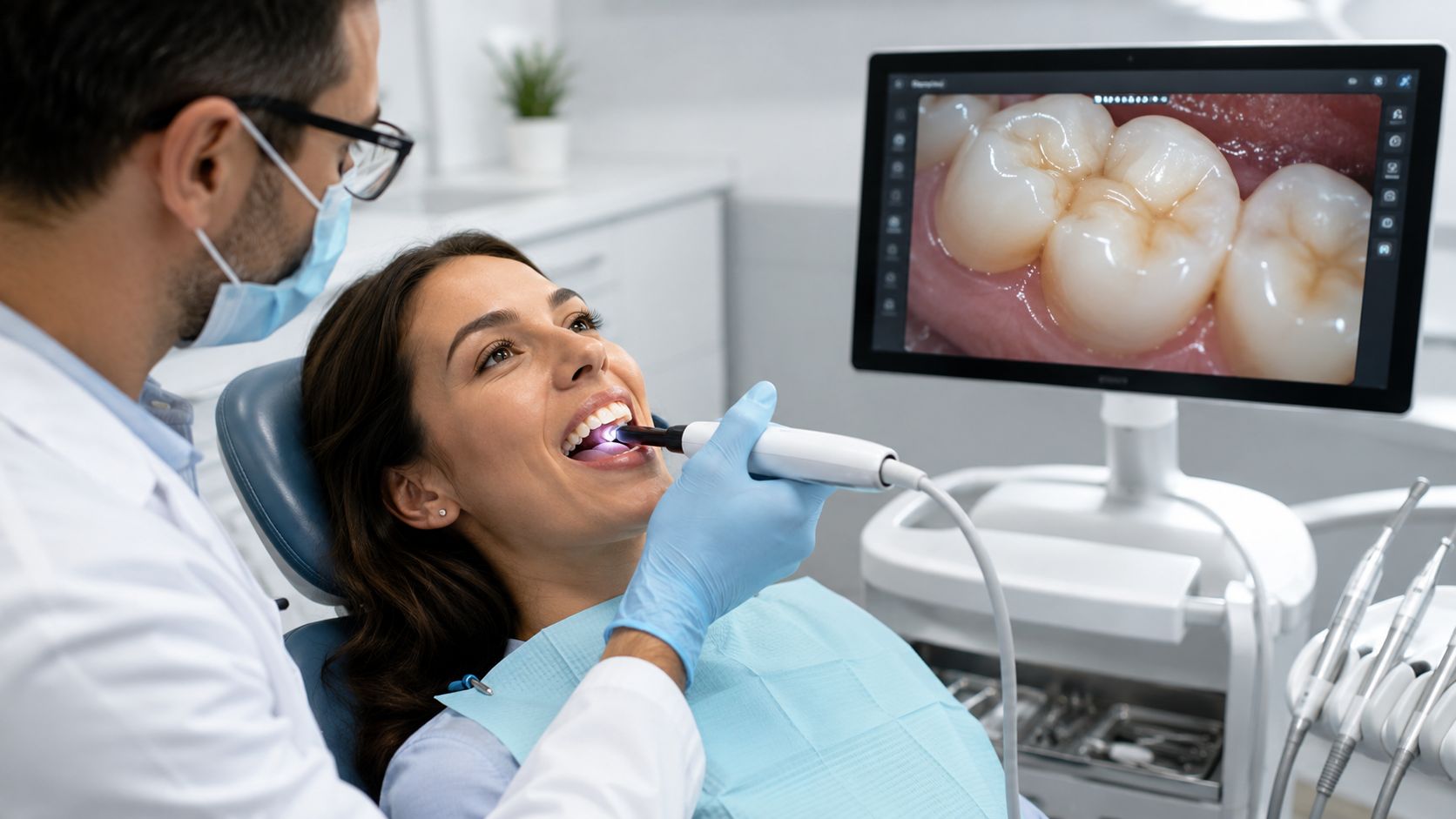
With an intraoral camera, the conversation becomes clearer. A small camera goes inside the mouth, and a sharp image appears on the monitor beside the chair. Suddenly, the dark line in a tooth, the chipped edge on a filling, or the plaque sitting near the gumline is visible to both of you at the same time. That shared view matters.
If you've ever put off treatment because you weren't quite sure what the issue was, you're not alone. Visual information helps people feel more grounded in their decisions, which is one reason modern practices keep moving in this direction. The global dental intraoral cameras market is projected to grow from $371.99 million in 2026 to $780.21 million by 2034, reflecting wider adoption as a standard of care for better diagnosis and communication, according to Fortune Business Insights on the dental intraoral cameras market.
Seeing a problem doesn't create fear for most patients. It usually replaces uncertainty with clarity.
That's especially helpful during routine visits, where small issues are easiest to manage early. If you're focused on prevention, it pairs naturally with the ideas in this guide to preventive dental care. The goal isn't to make dentistry feel more technical. It's to make it easier for you to understand what's happening, why it matters, and what comes next.
What Is an Intraoral Camera
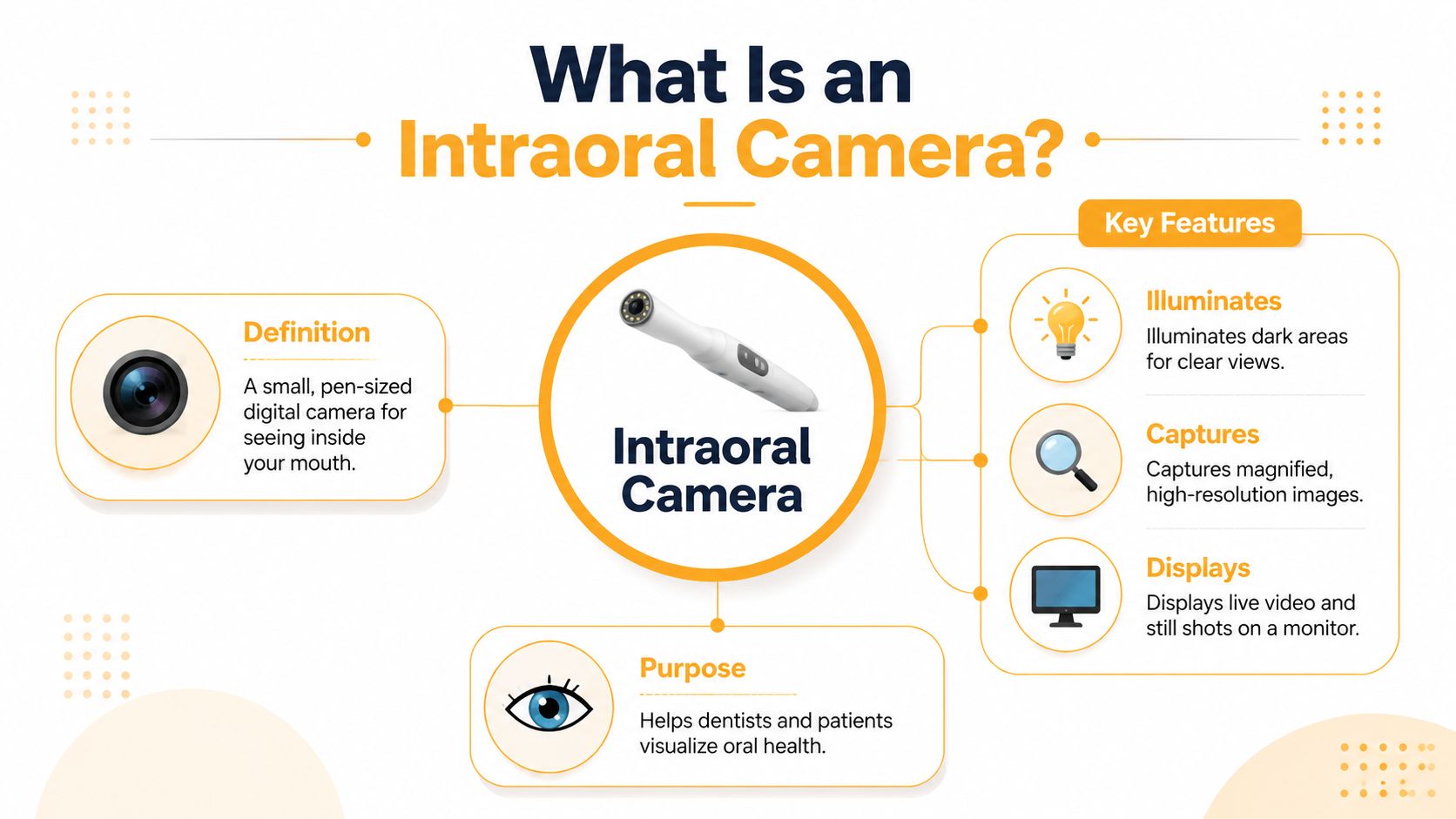
An intraoral camera is a small digital camera designed to take close-up images inside your mouth. Think of it as a slim wand with a bright light and a high-definition lens at the tip. It lets the dentist look into corners that are hard to see clearly with the naked eye or a mirror alone.
Instead of asking you to angle your head and squint into a reflective surface, the camera captures the image and shows it on a monitor. You can see a single tooth, the edge of a crown, the area around the gums, or the chewing surface of a molar in much more detail.
What it looks like in practice
The camera is usually about the size of a dental handpiece, not a large machine. It's moved gently around the mouth while live images appear on screen. Some systems also capture still photos, which can be saved to your file for later comparison.
That means your dentist can show you:
- A cracked edge on a tooth that catches food
- A worn filling that no longer seals properly
- A red or swollen gum area that needs closer attention
- A stain versus a cavity, which often look very different close up
Why it can spot things early
Some advanced intraoral cameras include macro-mode magnification up to 100x and auto-fluorescence imaging, which helps dentists detect cavities and enamel caries at pre-visual stages, before they'd be visible on traditional X-rays, as described in the overview of intraoral camera technology.
You don't need to remember those technical terms. What matters is what they mean for you. The camera can help your dentist notice trouble when it's still small. Smaller problems usually give you more options, and those options are often simpler.
Practical rule: The earlier your dentist can show you a change, the easier it is to talk through treatment before the problem becomes bigger.
How We Use Intraoral Cameras in Your Dental Visit
The value of intraoral camera dentistry isn't the gadget itself. It's how it changes the appointment. The camera helps your dentist diagnose, explain, and plan treatment with you instead of around you.
Better diagnosis in the spots that are easy to miss
Tiny cracks, early enamel changes, worn restorations, and irritated gum margins can hide in awkward angles. A close-up camera view helps your dentist inspect these areas with much more confidence.
This is especially useful on back teeth. Intraoral cameras enable dentists to identify an average of 3.52 out of 4 posterior tooth surfaces as clearly visible, compared with 3.14 out of 4 using a traditional mirror and explorer, according to this published study on posterior tooth visibility.
That sounds technical, but the patient takeaway is simple. Your back teeth are hard to inspect. The camera makes those areas easier to see, which can improve the quality of the exam.
If you already come in for a check-up and clean, this is one of the tools that can make that visit more thorough without making it more stressful.
Patient education that actually feels useful
Many people say yes to treatment once they understand the reason behind it. Not because they've been pressured, but because the issue finally makes sense.
When a dentist can freeze an image on screen and point to a leaking margin around a filling or a fracture line on a molar, the conversation becomes practical. You can ask better questions. Is it urgent? Can it be monitored? What are the options if we leave it? What would a crown or veneer involve?
Dental practices that use intraoral cameras for patient education report treatment case acceptance rates up to 30% higher than those relying only on verbal descriptions, according to this clinician buying guide discussing patient education and case acceptance.
That statistic reflects something many patients already know from experience. It's easier to make a decision when you can see the reason for it.
Planning treatment with more precision
Intraoral cameras aren't only for finding problems. They're also helpful when planning cosmetic and restorative care.
If you're discussing veneers, the camera can help show tooth shape, edges, surface texture, and any wear patterns that need to be considered. If you need a crown, it can document the condition of the existing tooth and surrounding gum. If implants are part of the conversation, detailed visual records can support clearer planning and communication.
Here's a quick look at how the camera helps in common situations:
| Treatment area | How the camera helps you |
|---|---|
| Veneers | Shows shape, chips, wear, and smile details close up |
| Crowns | Documents cracks, broken cusps, and old fillings |
| Gum care | Makes inflamed or plaque-retentive areas easier to explain |
| Implants | Helps record tissue condition and visible tooth structure nearby |
After you've seen the images, your dentist can talk through priorities. Sometimes the answer is treatment soon. Sometimes it's monitoring. Sometimes it's a better home-care plan.
A short video can also make the idea easier to picture in real life.
Why patients often feel more at ease
The camera changes the tone of the appointment. Instead of feeling like information is being delivered from above, it feels shared. That matters if you're anxious, if you've had confusing dental experiences before, or if you just prefer to know exactly what's happening.
- You can follow the conversation because the issue is visible.
- You can compare images over time if a tooth is being watched.
- You can make choices with context rather than relying on guesswork.
When patients can see the tooth, the discussion usually gets simpler. Questions become more specific, and decisions feel less rushed.
Key Benefits Over Traditional Dental Examinations
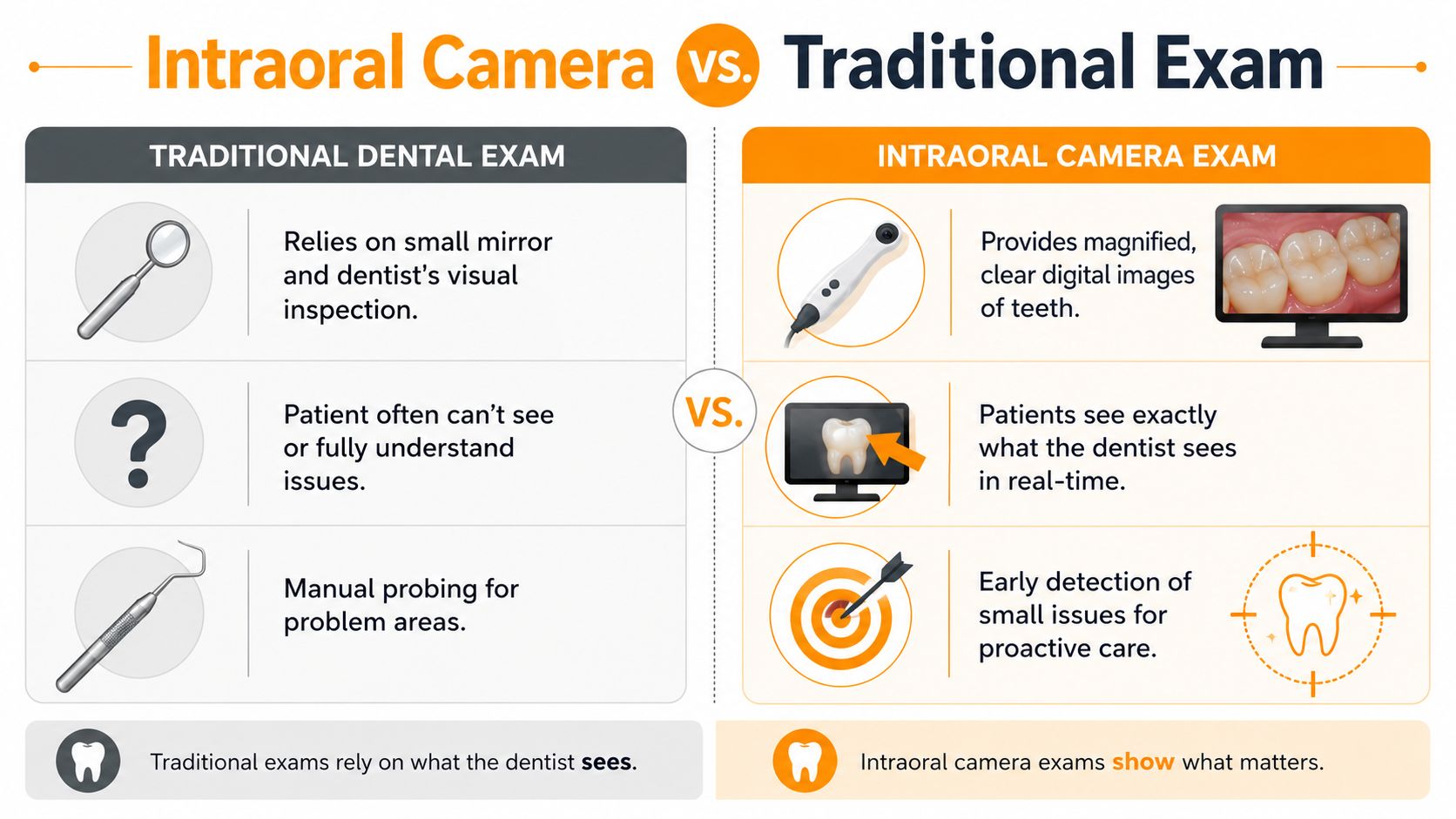
A mirror and explorer still have a place in dentistry. They're familiar, simple, and useful. But from a patient's point of view, an intraoral camera offers a different kind of appointment. It's more visual, more collaborative, and often easier to understand.
You can see what your dentist sees
This is the most immediate benefit. During a traditional exam, your dentist may spot something in a back tooth that you can't easily view. With the camera, the image appears on a screen in real time, so the explanation becomes much easier to follow.
For many patients, that simple visual proof removes the feeling of being “in the dark” during a dental visit.
Hard-to-see areas become clearer
Back teeth are notoriously awkward to inspect. Intraoral cameras make those areas easier to visualise than a mirror alone. The published comparison showing 3.52 out of 4 posterior surfaces clearly visible with the camera versus 3.14 out of 4 with a mirror and explorer was covered earlier. The practical result is better visibility where hidden decay and cracks often begin.
The record doesn't disappear when the appointment ends
A verbal description is easy to forget. A saved image is not. Intraoral photographs can become part of your clinical record, which helps when tracking change over time.
That's useful if you're monitoring a suspicious groove, comparing the condition of a filling from one visit to the next, or discussing findings alongside other imaging such as an OPG dental X-ray.
It's radiation-free
An intraoral camera doesn't use radiation. It captures light-based images of the mouth. That makes it a reassuring option for routine monitoring and patient education, including for children and adults who prefer a gentler, more visual exam experience.
The camera doesn't replace every other tool in dentistry. It fills an important gap between what the dentist can describe and what the patient can clearly understand.
Your Intraoral Camera Experience at The Smile Spot
If you've never had an intraoral camera used during an appointment, the process is usually much simpler than people expect. It doesn't feel like a scan in a hospital setting. It feels more like a guided close-up look around the mouth.
At the start of the visit, the dentist or oral health therapist may mention that they'd like to show you a few areas on screen. The camera is small, and it's moved gently from tooth to tooth. You'll usually be asked to open slightly and turn your head a little, just as you would in a standard exam.
What you'll notice during the appointment
Most patients notice the screen first. As the camera moves, live images appear chairside. A tooth that felt “fine” might show a dark fissure, a rough filling edge, or plaque sitting near the gums. If everything looks healthy, that can be reassuring too.
The process is brief and comfortable. There's no drilling, no pressure, and usually no strange sensation beyond the presence of a small wand in the mouth.
What happens after the images are taken
High-resolution intraoral cameras can integrate with practice management software to create permanent visual records, which support patient education, treatment planning for procedures such as All-on-4 implants, and insurance documentation, as described by Whicam M intra-oral camera equipment details.
For patients, that means your images don't vanish after the conversation. They can be stored in your file and used later if your dentist needs to compare changes or explain why a recommendation has changed.
If you're someone who likes to understand how modern clinics present information clearly online, good patient communication matters there too. Teams looking at digital communication in healthcare often study examples such as Leaping Lemur Media's services to understand how websites can make complex topics easier to follow.
If you tend to feel nervous before appointments, it may also help to read more about gentle dental care. Knowing what the appointment will feel like often lowers the stress before you even arrive.
Frequently Asked Questions About Intraoral Cameras
Is it safe?
Yes. Intraoral cameras are radiation-free. They use a camera lens and light to capture images inside your mouth, not X-rays. That makes them a comfortable option for routine visual checks and monitoring.
Does it hurt?
It shouldn't. The camera is small and used gently. Patients generally find it no more uncomfortable than a normal dental mirror, and many find it easier because they're not trying to crane around to see something indirectly.
Is it covered by my health fund?
That depends on your fund and the way your visit is itemised. In many cases, the camera is part of the examination and record-keeping process rather than a separate “technology fee”. The best approach is to ask your dental team how your appointment is billed and what your fund usually includes.
If you're thinking ahead about keeping problems small and avoiding bigger treatment where possible, these habits to help prevent tooth decay are a sensible next read.
If you'd like a clearer, more comfortable way to understand your dental health, The Smile Spot offers family-focused care in Dulwich Hill with modern technology, gentle treatment, and practical guidance you can follow. Book a visit if you'd like to see what your dentist sees and feel more confident about your next step.