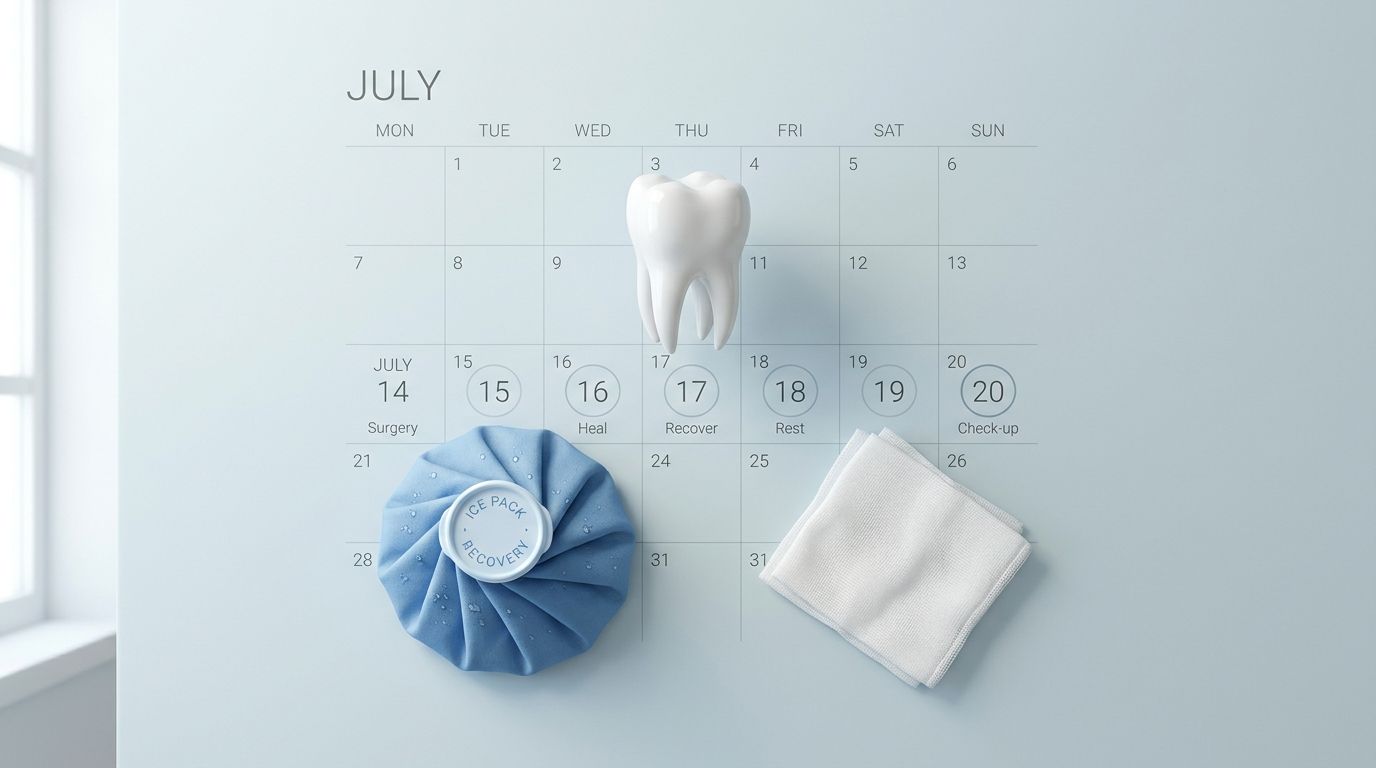
A return to school, work, or normal routines is generally possible within about 3 to 5 days after wisdom teeth removal, while full gum healing usually takes 1 to 2 weeks. If your tooth was impacted or the surgery was more involved, it can take longer to feel fully settled.
If you're reading this before your appointment, you're probably trying to work out one practical thing: how many days of normal life you'll need to pause. If you're reading it after surgery, you're likely checking whether what you're feeling is normal. Both are reasonable.
The biggest mistake people make is thinking recovery is one single finish line. It isn't. Wisdom teeth removal recovery time happens in phases. First, you protect the blood clot. Then the gum tissue starts closing and calming down. After that, the deeper bone healing continues in the background for much longer, even when you already feel fine.
That phased view makes recovery much easier to understand, because it explains why you may be comfortable enough to answer emails or go back to uni in a few days, but still need to eat carefully and baby the area for longer.
Understanding Your Wisdom Teeth Recovery Timeline
If you've been told you need wisdom teeth out, the timeline matters almost as much as the procedure itself. Parents want to know when their teenager can get back to school. Adults want to know whether they'll need a long weekend or a full week off. The short answer is reassuring, but it needs context.
Return to ordinary routines typically occurs in about 3 to 5 days, and full recovery commonly takes 1 to 2 weeks according to the Cleveland Clinic's wisdom teeth removal guidance. That doesn't mean every person feels the same on every day. It means the broad pattern is predictable.

The three phases that matter
It helps to think about healing in three distinct stages.
Clot protection
This is the first 48 hours. Your body forms a blood clot in the socket where the tooth was removed. That clot acts like a natural bandage. If it's disturbed too early, recovery becomes more painful and slower.Soft tissue healing
This is the next week or so. The gum tissue starts sealing over. Swelling eases, jaw stiffness improves, and eating becomes more manageable.Bone healing
This takes much longer than is often expected. You may feel normal well before the jawbone has fully remodelled. That's why “I'm fine now” and “everything is fully healed” are not the same thing.
Recovery feels faster once you understand that discomfort, chewing, and tissue healing all improve on different schedules.
Why planning ahead helps
A good X-ray helps us judge whether your recovery is likely to be straightforward or more involved, especially if the tooth is impacted or sitting at an angle. If you want to understand how that assessment works, our guide to an OPG dental X-ray explains why imaging is such a useful planning tool before extractions.
The goal isn't to make recovery sound complicated. It's to make it make sense. When you know which phase you're in, you're far less likely to worry about normal symptoms, and far more likely to protect the area properly.
The First 48 Hours Managing Swelling and Protecting the Clot
The first two days are the part that deserves the most respect. Not because everything will be terrible, but because what you do here affects everything that follows.
Why the blood clot matters
After a tooth is removed, the socket fills with blood and a clot forms. That clot is doing important work. It covers the underlying bone and nerve endings, and it gives the area a stable base to heal from.
If the clot is disturbed, the socket becomes exposed. That's when recovery can become much more uncomfortable.
Practical rule: treat the extraction site like fresh skin after a scrape. You want to protect it, not keep checking it.
That means no forceful spitting, no hard rinsing, no poking with your tongue, and no sucking through a straw.
What to do on the day of surgery
Keep the first day simple.
- Bite on gauze as instructed. Gentle pressure helps control the early ooze and supports clot formation.
- Rest with your head slightly raised. Lying completely flat can make throbbing feel worse.
- Start pain relief on schedule. Don't wait for discomfort to build if you've been given a medication plan.
- Choose cool or lukewarm soft foods. Hot food and vigorous chewing can irritate the site.
If you've been prescribed stronger pain relief and want general context around how that fits into dental extraction care, this article on Panadeine Forte for tooth extraction may help you understand why timing and dosage instructions matter.
How to manage swelling properly
Swelling usually builds during the first two days. Ice is most useful early, not later.
In NSW guidance provided in your brief, ice application for 24 to 48 hours can reduce swelling by up to 40%, and smokers or people who use straws within 72 hours face a dry socket incidence rate of 12 to 15%. That's why the first days are so instruction-heavy.
Use an ice pack against the outside of the cheek in short sessions. Keep a cloth between the ice and your skin. Gentle, repeated cooling works better than overdoing it once.
What doesn't work well
Some habits make healing harder even when people mean well.
- Frequent checking in the mirror: it usually increases anxiety and doesn't change care.
- Crunchy or chewy food too soon: this irritates the socket and gets debris stuck.
- Smoking or vaping: this interferes with the clot and healing environment.
- Using a straw: the suction is the problem, not the drink itself.
For these first 48 hours, your job is simple. Keep the clot stable, keep swelling under control, and keep the area undisturbed.
Your Day-By-Day Recovery Guide
Once you're past the clot-protection stage, recovery usually starts to feel more predictable. At this point, many patients begin asking, “Am I on track?” In most cases, the answer becomes easier to judge from day 3 onward.
A useful way to think about this part of wisdom teeth removal recovery time is that the trend matters more than the exact symptom. You don't need every hour to be better than the last. You do want the overall direction to be improving.
Wisdom Teeth Recovery At a Glance Days 3 to 7
| Day | What to Expect | Diet |
|---|---|---|
| Day 3 | Swelling and jaw stiffness may still be noticeable, but things should start feeling more stable | Soft foods that don't need much chewing |
| Day 4 | Many people feel they've turned a corner and discomfort begins easing | Soft foods with a little more texture if comfortable |
| Day 5 | Energy often improves and daily routines feel more manageable | Soft diet continues, with careful expansion |
| Day 6 | Gum tenderness may remain, but most people feel more functional | Continue gentle chewing away from the sore area |
| Day 7 | The area is usually less reactive, though not fully healed | Soft to easy-to-chew foods, avoiding hard or sharp items |
What day 3 and day 4 usually feel like
By this point, many people notice that the pain is less intense than it was at the start, even if the jaw still feels tight. This is why recovery can be confusing. You may be improved, but not comfortable enough to forget about it yet.
A separate recovery summary notes an average recovery time of 2.27 days and suggests that many patients need only 2 to 3 days off work or school in a lighter-duty sense, which supports the idea that feeling functional can happen before full healing is finished in this wisdom teeth removal numbers summary.
That distinction matters. “I can go in to work” isn't the same as “my mouth is completely healed.”
If you're steadily improving by day 3 or 4, that's usually a healthy pattern.
When most people go back to normal routines
For uncomplicated cases, many people can handle office work, school, or normal home routines in the second half of the first week. You may still prefer softer meals, slower chewing, and less social energy if your jaw is stiff or you're tired.
If your extraction involved buried or angled teeth, recovery can take longer. A helpful way to frame it is this: straightforward extractions are often cited at 3 to 4 days, while impacted or multi-tooth removals can stretch symptoms across 1 to 2 weeks according to this overview of typical wisdom tooth extraction healing and recovery time.
Our own guide to wisdom teeth removal recovery tips goes into practical day-to-day habits if you want more help with eating, cleaning, and pacing your return to normal activities.
What week 2 actually means
Week 2 is often where patients say, “I feel mostly back to normal.” That's a reasonable description. Gum tissue is usually much calmer by then, and ordinary chewing starts to feel less awkward.
Still, the area may remain tender if food presses directly into the socket. That doesn't automatically mean something is wrong. It often means the surface is healing while the deeper site is still settling.
A few things are common in this phase:
- Mild tenderness with certain foods
- A visible dip where the tooth was
- Food trapping more easily than usual
- Improving, but not perfect, jaw opening
The longer phase people don't see
Even after the gums look much better, deeper healing continues for months. That doesn't usually require special day-to-day attention, but it explains why the area can feel “different” for a while.
This is also why a simple day-by-day list never tells the full story. Recovery has layers. Function returns first. Surface healing follows. Deeper bone healing takes its time.
Key Factors That Influence Your Healing Speed
No two extractions are exactly alike. One person has a tooth that lifts out with ease. Another has a tooth trapped under the gum or partly in bone. That difference changes the recovery experience more than typically anticipated.
Simple extraction compared with impacted extraction
In NSW, approximately 70% of wisdom teeth removal cases involve at least one impacted tooth, and those cases can extend initial recovery from the more typical 3 to 5 days to 7 to 10 days because the surgery is more complex and involves more bone.
That's the biggest reason blanket advice often frustrates patients. The headline answer may be right for a straightforward case, but it can feel wildly inaccurate for someone who has had multiple impacted teeth removed.
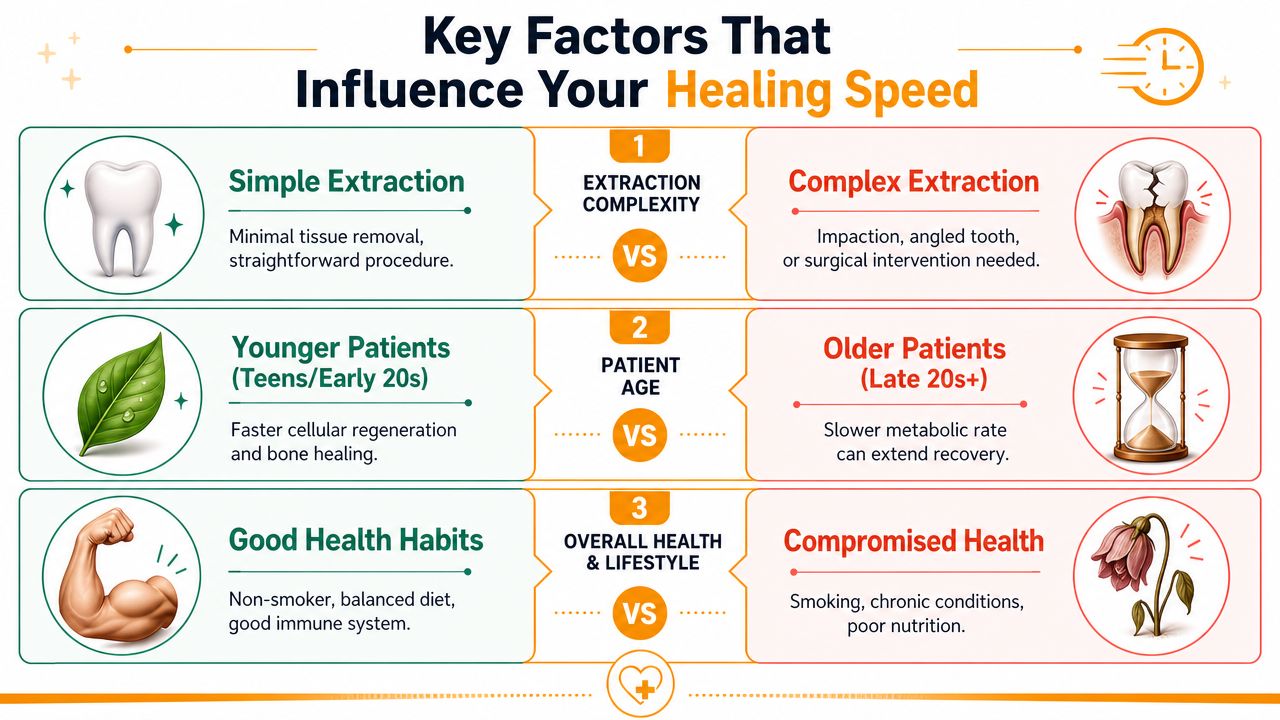
A simple comparison helps:
- Straightforward removal: less tissue disruption, easier cleaning afterwards, faster return to normal chewing
- Impacted removal: more swelling, more jaw stiffness, more soreness with opening and eating
- Multiple teeth at once: more overall inflammation, even if each site individually is healing well
Age, general health, and habits
Healing speed also depends on the person, not just the tooth.
Younger patients often recover more smoothly because the tissues and bone tend to repair more readily. General health matters too. If you're run down, dehydrated, or not eating well after surgery, recovery can feel slower and rougher.
Smoking deserves separate mention. It changes the healing environment in the mouth and raises the chance of complications. So does ignoring aftercare because you “feel okay” on the first day.
For patients who like reading broader discomfort-management resources, this explainer on Medistik for discomfort and healing gives a useful overview of how supportive care can fit alongside treatment guidance.
Procedure planning also affects recovery
How the procedure is planned can shape the recovery just as much as the extraction itself. Good imaging, a clear surgical approach, and the right comfort option reduce stress and make aftercare easier to follow.
If anxiety has made you delay treatment, it's worth looking at oral sedation dentistry before your appointment. Patients who are calmer going in usually find the whole process easier to manage afterwards too.
Essential Aftercare for a Smooth Recovery
Good aftercare isn't a bonus. It's the main thing that turns a normal extraction into a smooth recovery instead of an avoidable setback.
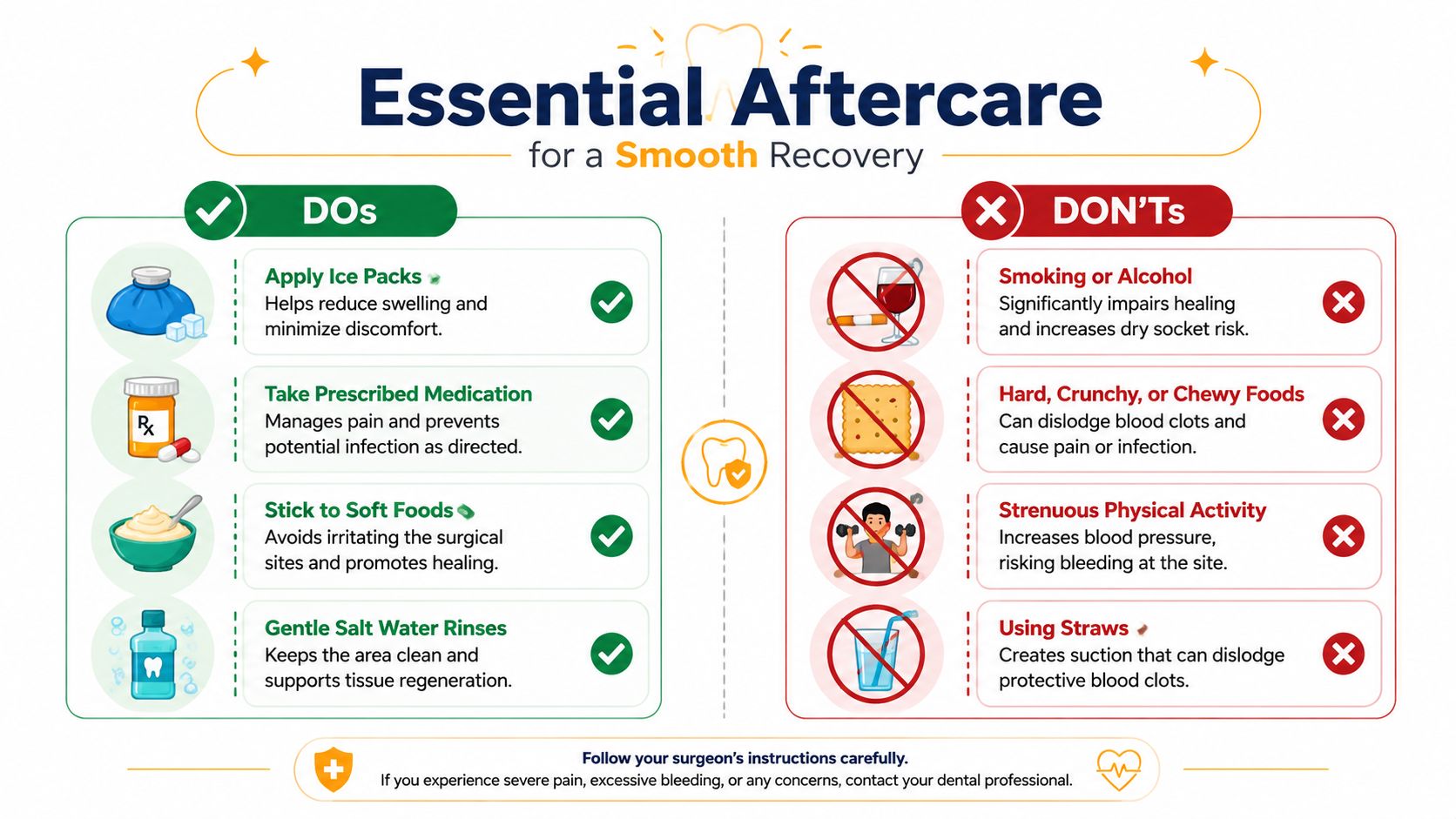
What to do each day
Once you're home, keep your routine boring and consistent. That usually works better than trying lots of little fixes.
- Take medication as directed. Stay ahead of pain rather than chasing it once it builds.
- Use ice in the early phase. In NSW guidance from your brief, post-operative ice application for 24 to 48 hours can reduce swelling by up to 40%, which is why we push it early.
- Eat soft, low-effort foods. Yoghurt, mashed vegetables, soups that aren't too hot, scrambled eggs, and smoothies eaten with a spoon are usually easier.
- Hydrate normally. Sip from a cup. Don't use a straw.
- Rest more than you think you need. Pushing through too soon often means more throbbing later.
A lot of patients also do better when discharge instructions are written clearly and easy to revisit at home. In broader healthcare, tools that streamline hospital discharge process show why plain-language instructions improve follow-through after treatment.
When and how to clean the area
Keeping the mouth clean matters, but the timing and method matter just as much.
After the first day, gentle saltwater rinses can help keep the area cleaner without being harsh. The key word is gentle. Let the water move around the mouth and fall out. Don't swish aggressively. Don't spit hard.
You can still brush your other teeth normally, but be careful around the extraction site. The goal is cleanliness without disruption.
The best oral hygiene after an extraction is cautious, not aggressive.
The dry socket rules that matter most
Dry socket is one of the few complications patients hear about before surgery, and that's not a bad thing if it leads to better habits.
Avoid dry socket
Don't smoke. Don't vape. Don't use a straw. Don't rinse forcefully. Don't spit hard. Don't test the site with your tongue or fingers. For at least the first week, protect the socket as if the clot is fragile, because it is.
In NSW guidance from your brief, smokers and people who use straws within 72 hours have a dry socket incidence rate of 12 to 15%, and strict avoidance of straws and tobacco for at least one week is considered critical.
This video gives a practical overview of the kind of aftercare habits that support healing:
Foods and activities to avoid
Some setbacks are completely preventable.
- Hard or crunchy foods: chips, crusty bread, nuts, and crackers can irritate the wound and lodge particles in the socket
- Very hot foods or drinks: heat can aggravate the area early on
- Heavy exercise too soon: increased blood pressure can restart bleeding or throbbing
- Alcohol if it conflicts with medication or irritates the site: follow your specific instructions
If your recovery is getting steadily easier, that's the sign to trust. If pain is getting worse instead of better, or the taste, smell, swelling, or bleeding feels off, contact your dentist rather than trying to self-manage for days.
Partnering with The Smile Spot for Your Recovery
A smoother recovery usually starts before the tooth is removed. Careful assessment, a clear treatment plan, and realistic advice matter because they shape what happens once you get home.
At The Smile Spot's wisdom tooth removal service in Dulwich Hill, treatment planning includes looking at tooth position, likely surgical difficulty, and what support will make recovery more manageable for that patient. That might mean talking through sedation options for anxious patients, or deciding whether advanced imaging is needed before the procedure.
Where technology helps
Laser dentistry can be useful in procedures involving soft tissue because it allows a more controlled approach to the gum. In practical terms, that can support the soft tissue healing phase by reducing trauma to the area being treated.
For patients who are nervous, comfort matters just as much as clinical technique. Gentle local anaesthetic delivery, calm communication, and sedation where appropriate can make it easier to go through the procedure without building up fear around it.
When to get in touch after surgery
You shouldn't be left guessing about what's normal.
Call your dental team if you have:
- Pain that gets worse instead of better
- Bleeding that doesn't settle with pressure
- Swelling that feels excessive or keeps escalating
- Trouble eating or drinking because discomfort is not improving
- Any symptom that feels out of step with the instructions you were given
Most recoveries are uneventful. The reason people feel more confident with clear follow-up is simple. They know what to expect, and they know when to ask for help.
If you're planning wisdom teeth removal, the best approach is to treat recovery as part of the procedure, not something separate from it. The right planning, the right aftercare, and the right support usually make the timeline much less daunting.
If you'd like personalised advice about your wisdom teeth removal recovery time, or you want to find out whether your case is likely to be simple or impacted, book a consultation with The Smile Spot. We'll talk you through the expected healing phases, the aftercare steps that matter most, and the treatment options that fit your situation.