
Home/Dentures
At The Smile Spot in Dulwich Hill, dentures are designed, fitted and adjusted in-house by a qualified dental prosthetist, with a dentist on site for extractions, gum care and implants. We make full, partial, cobalt-chrome and implant-retained dentures.
Call (02) 9569 0199The right denture depends on how many natural teeth you still have, how healthy they are, and how much stability you need. Full dentures replace every tooth in an arch, partial dentures fill gaps between natural teeth, and implant-retained dentures clip onto implants for extra hold.
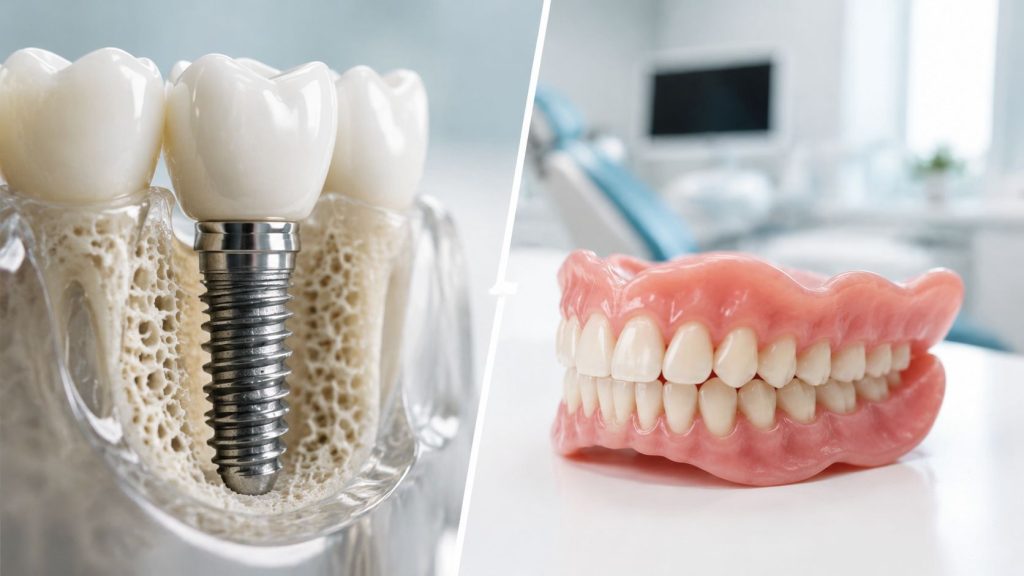
| Denture type | Replaces | What holds it in place | Often suits |
|---|---|---|---|
| Full acrylic denture | All teeth in the upper or lower arch | A close fit and suction against the gums and palate | People who have lost, or are about to lose, all teeth in an arch |
| Acrylic partial denture | Several missing teeth | Contact with the gums and simple clasps on natural teeth | A lower-cost option, or an interim one while other treatment is planned |
| Cobalt-chrome partial denture | Several missing teeth | A thin metal framework that rests on and clips to natural teeth | Longer-term partial replacement with less bulk over the palate |
| Implant-retained overdenture | A full arch | Attachments on dental implants; still removable for cleaning | Wearers of loose dentures, especially lower ones, who want more stability |
The table is a starting point. Your gum shape, bite and remaining teeth determine the final recommendation. If you are still weighing a denture against fixed teeth, our guide to tooth replacement options compares every approach side by side.
A denture is only as good as the mouth it sits in. When the prosthetist and the dentist work side by side, extractions, gum treatment and implant planning happen in one place, and the denture is designed around your whole mouth rather than just the gap.
Our dental prosthetist, Hussein, qualified as a dental technician in 2012 and as a dental prosthetist in 2015. His work focuses on full and partial dentures, chrome frameworks and implant-retained prostheses, and he has experience with complex cases and aged-care patients. He consults in English and Arabic.
Where teeth need attention first, Dr Dimitrios Thanos, who founded The Smile Spot in 1996, and the dental team look after it here on Marrickville Road. You don’t need a referral across town.
Most new dentures take several appointments over a few weeks, because each stage is checked in your mouth before the next one begins. Rushing that sequence is what produces dentures that rub, click or drop.
Assessment
Your remaining teeth, gums and jaw are examined, with X-rays where needed. Decay or inflammation is dealt with first, including gum disease treatment when a partial denture will rely on natural teeth.
Impressions
Detailed moulds capture the shape of your gums and palate.
Bite registration
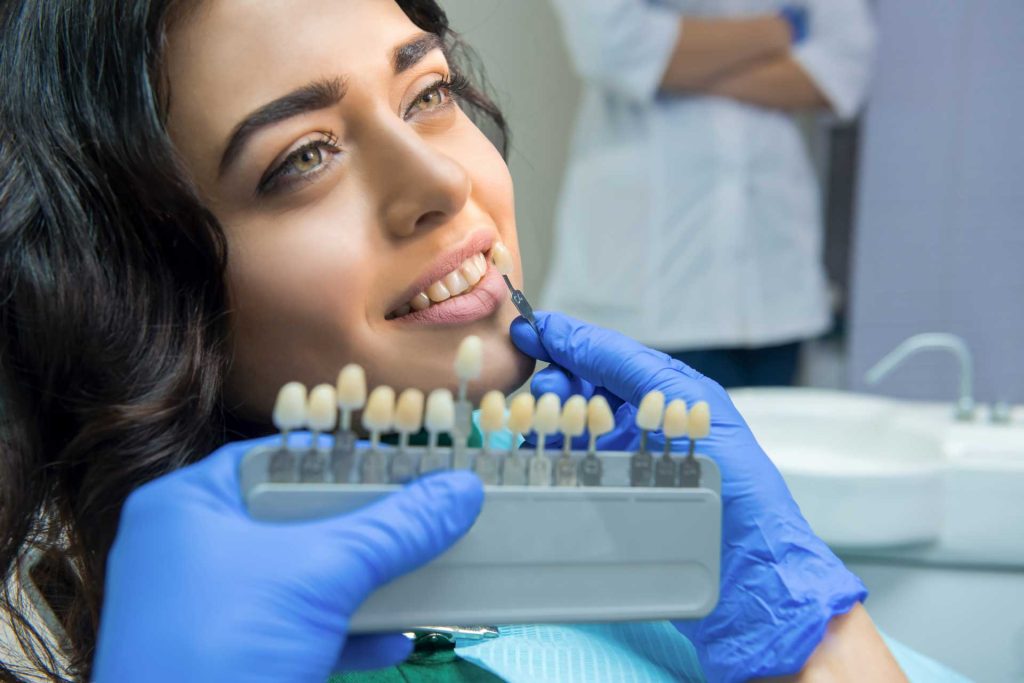
We record how your jaws meet, how much lip support you need, and the shade and shape of the teeth.
Wax try-in
You see and test the teeth set in wax, checking appearance and speech before anything is finalised.
Fitting
The finished denture is fitted and any pressure points are adjusted.
Review
Follow-up visits ease sore spots as your gums settle.
If teeth need removing, tooth extractions are planned alongside the denture so you are without teeth for as short a time as possible.
Good to know: Bring your current denture to your first appointment if you have one. It shows exactly what is working for you and what needs to change.
New dentures feel large at first, and that is normal. Most people adjust to speaking within days and to eating over a few weeks. Lower dentures usually take longest, because the tongue and cheeks are constantly moving around them.
Good to know: Never file or bend a denture yourself. A small change in the wrong place can ruin the fit.
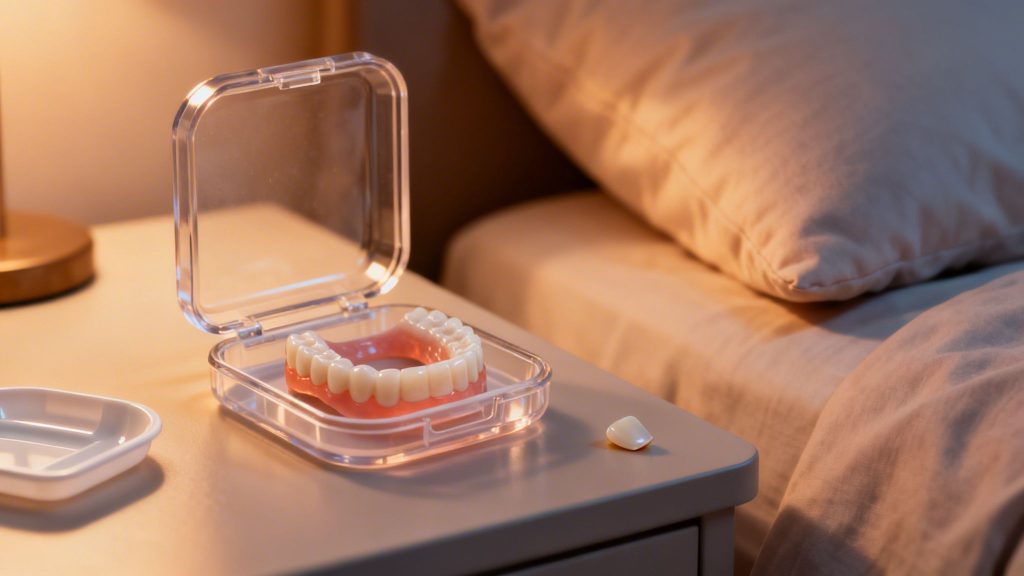
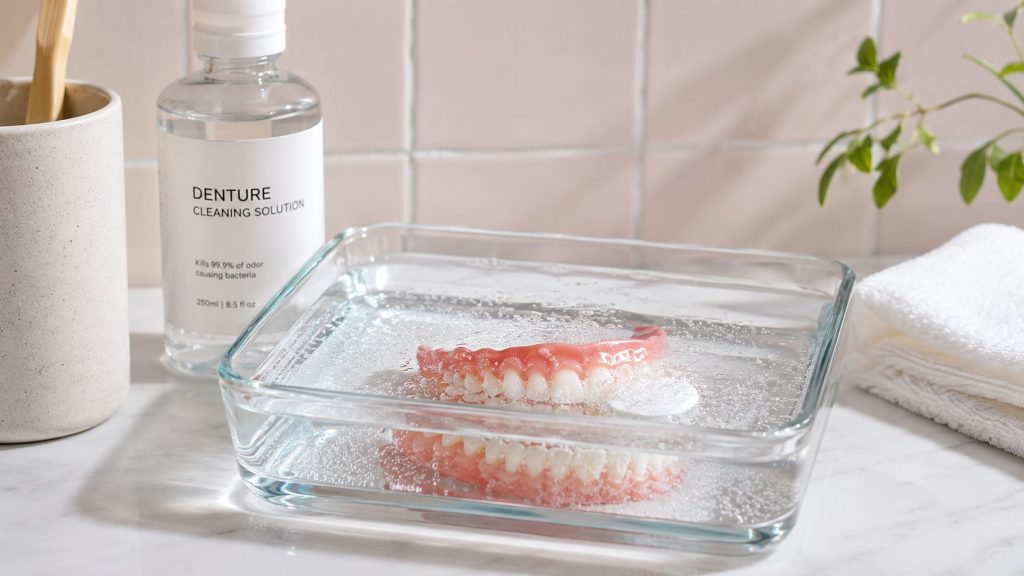
Brush your dentures every day with a denture brush and mild soap or denture paste. Regular toothpaste is abrasive and gradually dulls acrylic.
Clean them over a basin of water or a folded towel, because a dropped denture can crack. Soak them overnight, never in hot water, which can warp acrylic, and keep bleach away from cobalt-chrome partials, because it corrodes the metal. Our guide to choosing the right denture soaking solution explains which cleaners suit which materials.
Have the fit checked if you notice:
Once teeth are lost, the gums and jawbone slowly shrink, so even a well-made denture gradually loses its fit. Many need replacing within five to ten years. Keep up regular dental check-ups as well, so the soft tissues of your mouth and any remaining natural teeth are examined.
Dentures are not the only way to replace teeth, and they are not always the best. If you are weighing up options, compare stability, upkeep, cost and timeframe side by side before deciding.
Fixed · one gap
Bridge or single implant
A single gap between healthy teeth often suits a dental bridge or a single implant.
Fixed · individual teeth
Dental implants
Dental implants replace individual teeth without anything resting on the gums. We use Nobel Biocare and BioHorizons systems.
Fixed · full arch
All-on-4
All-on-4 full-arch implants provide a fixed set of teeth that is not removed at night.
Removable · full arch
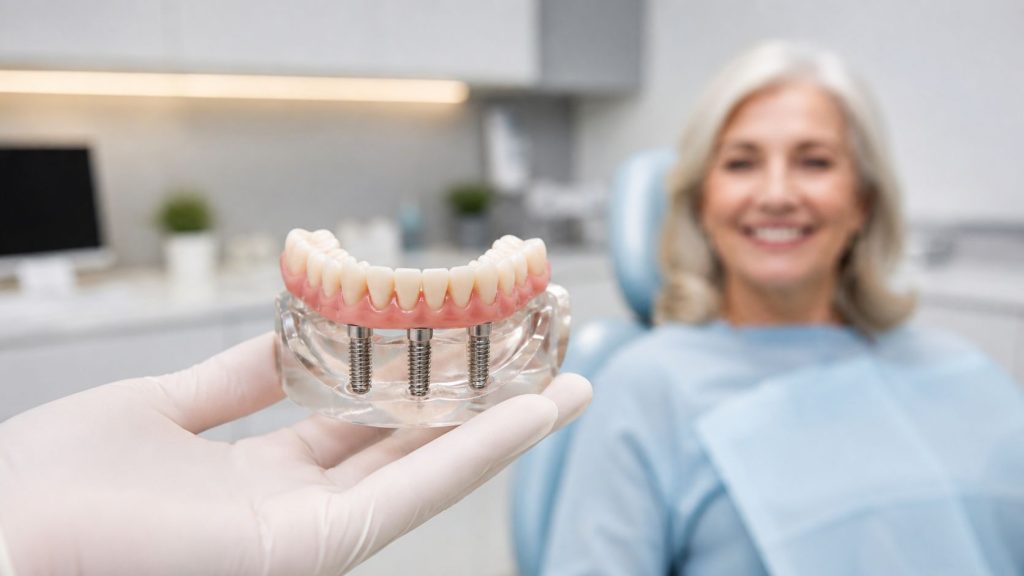
Implant-retained overdenture
An implant-retained overdenture sits between the two: removable, but far more stable. See how implant-supported dentures work.
For long-term costs and trade-offs, read our comparison of dental implants and dentures. At your assessment we set out every suitable option, including improving your current denture if that is possible.
Written quote first
Denture fees depend on the type, the materials, and whether extractions or implants are involved, so we provide a written quote after your assessment, before any work begins. You can also view our published fees and charges for general dental care.
Interest-free payment plans
Interest-free payment plans are available for eligible treatments.
Health fund rebates
We accept most major health funds. Dentures are usually claimed under major dental extras cover, so check your policy’s annual limits.
What changes the cost of a denture
Good to know: Ask for the item numbers on your written quote. Your health fund can use them to confirm your rebate before you commit.
Visit us in Dulwich Hill
Our dentist in Dulwich Hill is at 504 Marrickville Rd, an easy trip from Marrickville, Summer Hill, Lewisham and Petersham. Call (02) 9569 0199 or book a denture consultation.
Call (02) 9569 0199It depends on the denture type, the materials and any treatment needed first, so we provide a written quote after an assessment. Interest-free plans are available for eligible treatments, and most health funds are accepted.
No, Medicare does not cover dentures for most adults. Private extras cover usually contributes under major dental. Eligible concession card holders can apply for public dental care through NSW Health, where waiting lists apply.
Usually four to six, spread over several weeks: assessment, impressions, bite registration, wax try-in, fitting and at least one review. Extractions or implants add time to the plan.
Many dentures need replacing within five to ten years, because the gums and jawbone gradually change shape. Looseness, clicking or new sore spots are signs the fit should be checked.
Yes. A partial denture relies on your remaining teeth, so decay and gum disease should be treated first. At The Smile Spot, the dentist and the dental prosthetist work in the same clinic.
It is generally best to take them out overnight. This lets your gums rest, lowers the risk of denture stomatitis, and gives you time to clean and soak the denture properly.
At first, yes. Most people speak normally within days and eat comfortably within a few weeks. Reading aloud and starting with soft food cut into small pieces speeds this up.
Often, yes, provided there is enough jawbone to place implants. An assessment with X-rays shows whether you are a candidate and how many implants would be needed.

The Smile Spot – Affordable Family Dentist, providing dental services at Dulwich Hill, Marrickville, Canterbury, Sydenham, Petersham, Lewisham, Summer Hill, Enmore, New Town, Earlwood, Wolli Creek, Bardwell Park, Arncliffe, Kogarah, Rockdale, Banksia, Bexley, Bexley North, Tempe, St. Peters, Erskineville, Sydney, Leichardt, Inner West.
Mon - Tue : 9 am -8 pm
Thu : 9 am -8 pm
Fri - Sat : 9 am -3 pm
Closed on Wednesdays and Sundays
Comprehensive Care Package includes examination, X-rays (as many as required), scale/clean and Fluoride treatment at $240 , For children under the age of 17 years $180.