You're usually not deciding about a missing tooth on the day it's lost. More often, it's the quiet version of the problem that brings people in, a back molar they've ignored for years, a front tooth that's been “fine for now”, or a denture that never really felt right. In a family practice, that's the moment the conversation shifts from whether to do anything at all to which tooth replacement option fits the mouth, the budget, and the long game.
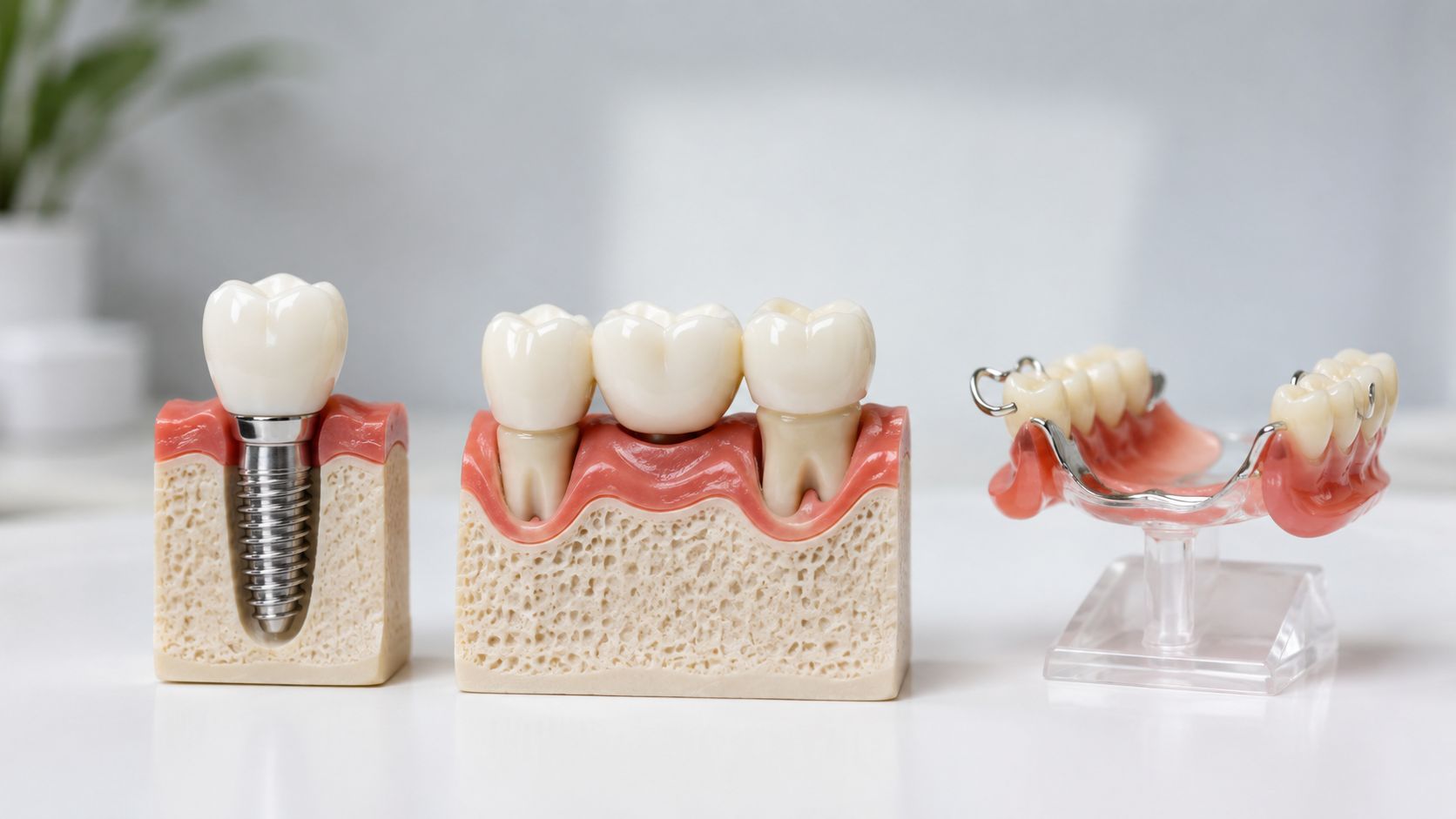
| Criterion | Dental Implant | Fixed Bridge | Removable Denture |
|---|---|---|---|
| Best suited for | A single tooth, multiple teeth, or a full arch when bone and health allow | A gap with strong neighbouring teeth on both sides | Several missing teeth, or a full arch when surgery isn't the right fit |
| Impact on neighbouring teeth | Leaves adjacent teeth alone | Requires preparing supporting teeth | Usually doesn't alter neighbouring teeth, but may use clasps |
| Comfort and feel | Closest to a natural tooth root and crown | Fixed in place, but depends on the supporting teeth | Removable, so movement and bulk can be an issue |
| Bone impact | Helps preserve the jaw where the implant sits | Doesn't replace the root, so it can't do the same job as an implant | Doesn't replace the root, so bone change can continue |
| Maintenance | Brushing, flossing, and review visits | Needs careful cleaning under and around the bridge | Daily removal, cleaning, and periodic relining or remake |
| Main trade-off | Higher upfront investment and surgery | Healthy teeth must be altered | Less invasive and often cheaper, but less stable |
The Australian picture makes the decision feel less abstract. The Australian Institute of Health and Welfare reported that in 2017–18, 13% of adults aged 65 and over were edentulous, and 61% of adults aged 65 and over had at least one natural tooth missing, which is why full dentures, partial dentures, bridges and implants stay central in everyday dentistry. In the same broad national context, untreated decay also remained common, so replacement isn't some niche cosmetic add-on, it's part of how adults stay able to chew, speak, and keep their bite stable.
Why Missing Teeth Deserve a Real Decision
A common scene in Dulwich Hill is the parent or commuter who says, “I lost that back tooth years ago, and I'm still managing.” They are usually not in pain, which is exactly why the decision gets postponed. Then the bite changes slowly, the gap becomes harder to clean, and the teeth next to it start doing the work the missing tooth used to do.
That delay matters because replacement is easier to plan before the mouth adapts around the gap. Teeth can drift, the opposing tooth can over-erupt, and chewing becomes more uneven. None of that happens overnight, which is why the decision feels easy to ignore and hard to reverse later.
The full spectrum of choices available
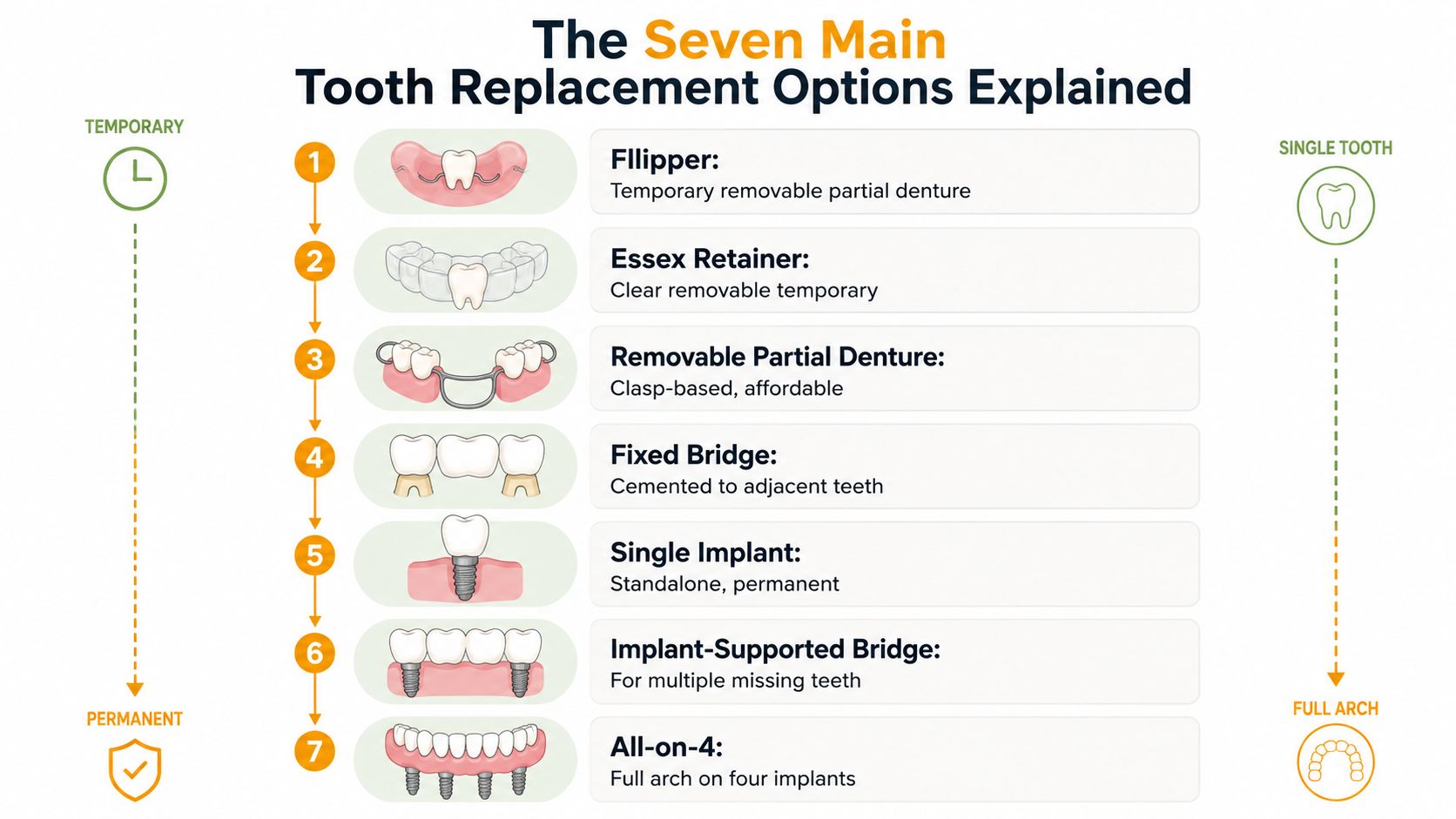
At clinic level, tooth replacement options usually fall into seven practical pathways. A temporary flipper or Essex-style retainer can keep a smile presentable while a longer plan is being made. A removable partial denture or full denture is often used when more than one tooth is missing, or when surgery is not the right call.
At the fixed end, a traditional bridge, resin-bonded bridge, or cantilever bridge can close a single-gap or short-span situation, while a single implant, implant-supported bridge, or All-on-4 style full-arch solution is usually considered when long-term stability is the priority. A quick reference on bridge construction and use is available in this bridge and crown guide.
The right choice depends on the situation in front of you. A single front tooth gap in a patient with healthy neighbouring teeth calls for a different plan than several back teeth missing in someone who wants to avoid surgery, and both are different again from a full arch where stability and bite function have been lost.
Cost and maintenance sit behind every option. A removable appliance may cost less up front, but it usually means daily removal, cleaning, and future relines or remakes. A bridge fixes the gap in place, yet it adds cleaning demands around the supporting teeth and can bring future repair costs if those teeth change. An implant usually asks more at the start and less day-to-day movement later, although it still needs proper home care and review visits.
Insurance and payment plans also affect the decision. Some private health funds contribute to certain restorations, but the level of cover varies, and the rebate often depends on the item code and the policy. That means a cheaper-looking option is not always cheaper over time, and a more durable option is not always fully covered.
Practical rule: the right option is rarely the one that sounds most advanced, it is the one that matches the number of missing teeth, the health of the neighbouring teeth, and how much maintenance you are willing to live with.
The point is not to rush into treatment. It is to stop treating one missing tooth like a trivial issue when it has already changed the mechanics of the bite. The sooner the mouth is assessed, the more options usually stay on the table.
The Seven Main Tooth Replacement Options Explained
Temporary choices when timing matters
A flipper is a light removable acrylic tooth, usually used as a short-term placeholder after extraction or while healing is underway. An Essex-style retainer does a similar job with a clear tray, which can be useful when appearance matters but the person isn't ready for a fixed restoration yet. These are stopgaps, not final solutions.
A removable partial denture is the practical answer when several teeth are missing and the person wants a lower-cost, non-surgical option. It can be the right fit for someone waiting on other treatment, or someone whose gums and bone aren't ready for fixed work.
Fixed and implant-based options
A traditional bridge replaces a missing tooth by using the teeth next to the gap for support. A resin-bonded bridge uses wings bonded to neighbouring teeth, which is why it's often considered for more conservative situations where the adjacent teeth are intact. A cantilever bridge is used more selectively when support is only available on one side.
A single dental implant replaces the root and crown together, which is why it's often the preferred option when the surrounding teeth are healthy and the person wants to avoid preparing them. For a single missing posterior tooth, the implant literature describes posterior implant sizing in the 3.5–6 mm diameter range and 9–15 mm length range, with titanium alloy and anti-rotational design features helping stability. A deeper clinical explanation sits in this implant procedure overview.
A bridge can be quicker. An implant is usually more self-contained because it doesn't ask the neighbouring teeth to carry the load.
For more than one missing tooth in a row, an implant-supported bridge shares the load across implants instead of depending on natural teeth. For a full arch, All-on-4 is the shorthand many patients hear for a fixed or snap-on prosthesis supported by four implants, which is often discussed when the whole arch needs rebuilding rather than just filling a gap.
The implant world is not one-size-fits-all. The Cochrane evidence summary found no evidence that any one implant surface, shape, or material is superior to another for implant failure or bone-level changes, which is a good reminder that planning matters more than marketing when a patient is comparing brands or system names. That also means the clinician's assessment of bone, bite, and hygiene access usually matters more than glossy advertising.
Comparing Implants, Bridges and Dentures Side by Side
| Criterion | Dental Implant | Fixed Bridge | Removable Denture |
|---|---|---|---|
| Clinical candidacy | Needs adequate bone, healthy gums, and willingness for surgery | Needs strong adjacent teeth to support the bridge | Works when surgery isn't ideal, or multiple teeth are missing |
| Effect on adjacent teeth | Usually leaves them untouched | Requires preparing supporting teeth | Usually spares the natural teeth, though clasps may be used |
| Comfort | Feels most like a tooth anchored in the jaw | Fixed and stable, but still depends on other teeth | Can feel bulky or mobile, especially at first |
| Bone preservation | Best suited to replacing the root function | Can't replace the root, so bone change can still continue | Can't replace the root, so bone change can still continue |
| Maintenance | Brush, floss, and review the implant properly | Clean carefully under the bridge and around the supports | Remove, clean, store, and attend adjustment visits |
| Main limitation | Surgery, planning, and cost | Healthy teeth are altered to carry the restoration | Movement, bulk, and ongoing adaptation |
The big advantage of an implant is that it sits in the jaw like a replacement root. That gives it the most natural mechanical feel, especially when the neighbouring teeth are healthy and you want to preserve them. It's not the right answer for everyone, but it is the closest match to a natural tooth structure.
A bridge solves a different problem. It is often chosen when the person wants a fixed result without surgery, or when the gap is small and the supporting teeth already need crowns. The trade-off is straightforward, the adjacent teeth become part of the restoration, so you're asking healthy teeth to do more work.
Key differentiator: bridges are fixed but dependent, implants are independent but surgical, dentures are flexible but removable.
Dentures sit at the other end of the comfort scale. They're still a valid and often sensible solution, especially for multiple missing teeth or full-arch replacement, but they can move, feel bulky, and need regular maintenance. That maintenance burden is where people often feel the difference over time, not on day one but after a few months of use.
For readers comparing fixed and removable options, this implant-versus-denture guide is a useful companion. The honest answer is that none of these choices is “best” in a vacuum, because candidacy, hygiene habits, neighbouring teeth, and budget all pull in different directions.
Which Option Fits Which Situation
One missing front tooth
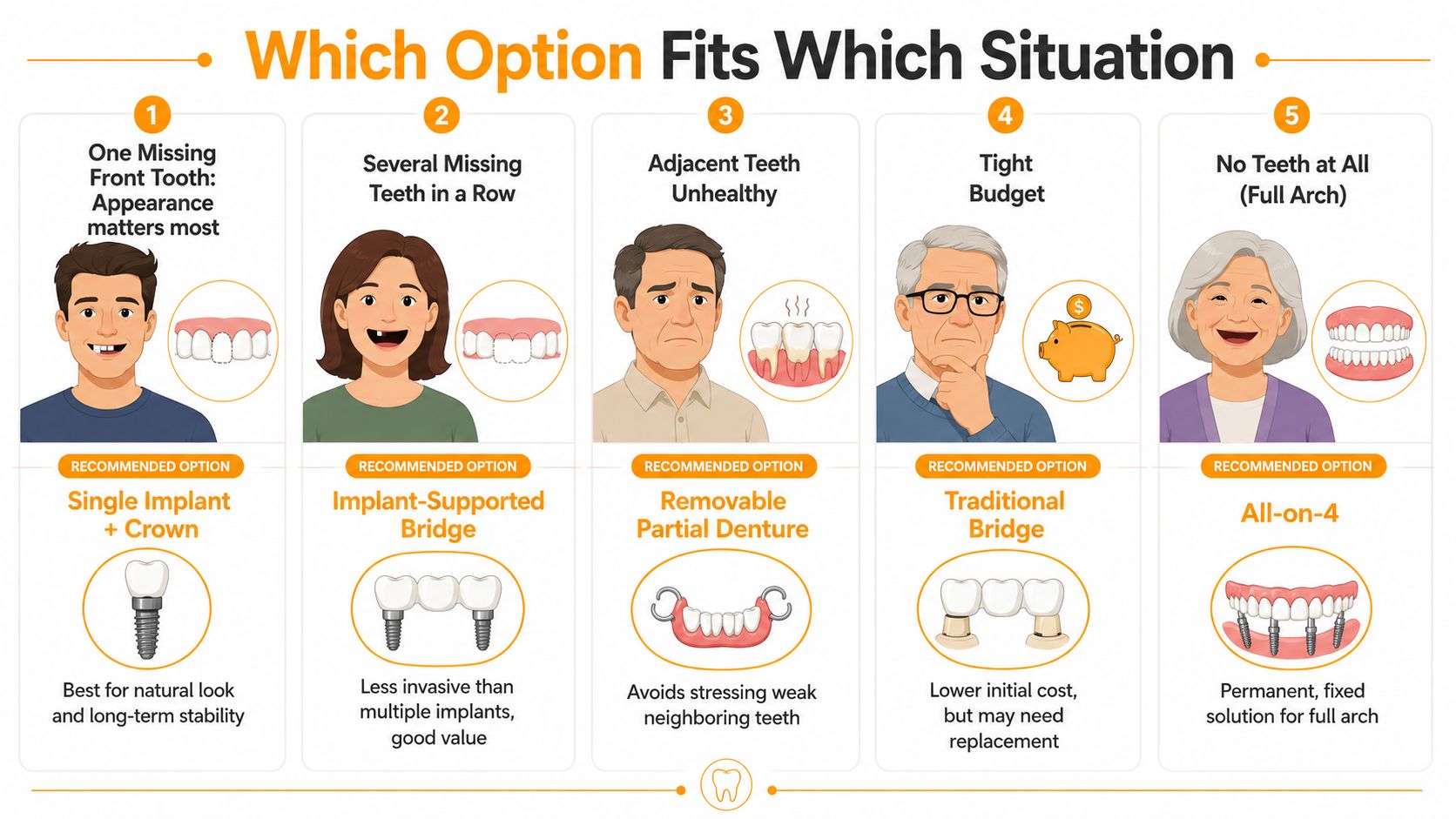
A single implant with crown usually suits this best when appearance matters and the adjacent teeth are healthy. It avoids reducing the neighbouring teeth, which is especially important in the smile zone where symmetry matters. A resin-bonded bridge can be a decent second choice when surgery isn't appropriate or the bite is gentle.
If the surrounding teeth are sound, don't let a front-gap solution involve them unless there's a clear reason.
Several missing teeth in a row
An implant-supported bridge often makes the most sense because it replaces several teeth without placing all the load on natural teeth. It can be a more efficient answer than placing one implant for every missing tooth. A removable partial denture is the backup when cost, bone, or general health make fixed implant work less practical.
No teeth at all
For a fully edentulous arch, All-on-4 or another implant-retained full-arch design is often the most stable route when the person wants a fixed result. Traditional full dentures remain valid when surgery isn't wanted or bone support is limited. The deciding factor is usually how much stability the person wants, and how much maintenance they're prepared to accept.
The right full-arch solution is rarely about looks alone, it's about how the prosthesis will behave while eating, talking, and being cleaned every day.
An anxious patient who has delayed care
A removable partial denture or a staged plan with a temporary flipper often works best when fear has kept treatment on hold for years. That keeps the process manageable while the mouth is assessed properly. Sedation, gentle techniques, and careful sequencing matter more here than the restoration type itself.
A budget-conscious adult prioritising function
A traditional bridge or a removable denture often fits best when the main goal is restoring chewing quickly without the higher surgical cost of an implant. A bridge can be appealing if the adjacent teeth are already compromised and need crowns anyway. If the neighbouring teeth are healthy, though, it's worth resisting the temptation to solve a budget gap by sacrificing tooth structure unnecessarily.
For bridging choices, this Maryland bridge overview is helpful because conservative bridge designs are often overlooked in quick comparisons. The takeaway is simple, each scenario points to a different tool, and the “best” option changes with the number of teeth missing, not just the patient's preference.
What the Implant Timeline Actually Looks Like
Single implant appointments
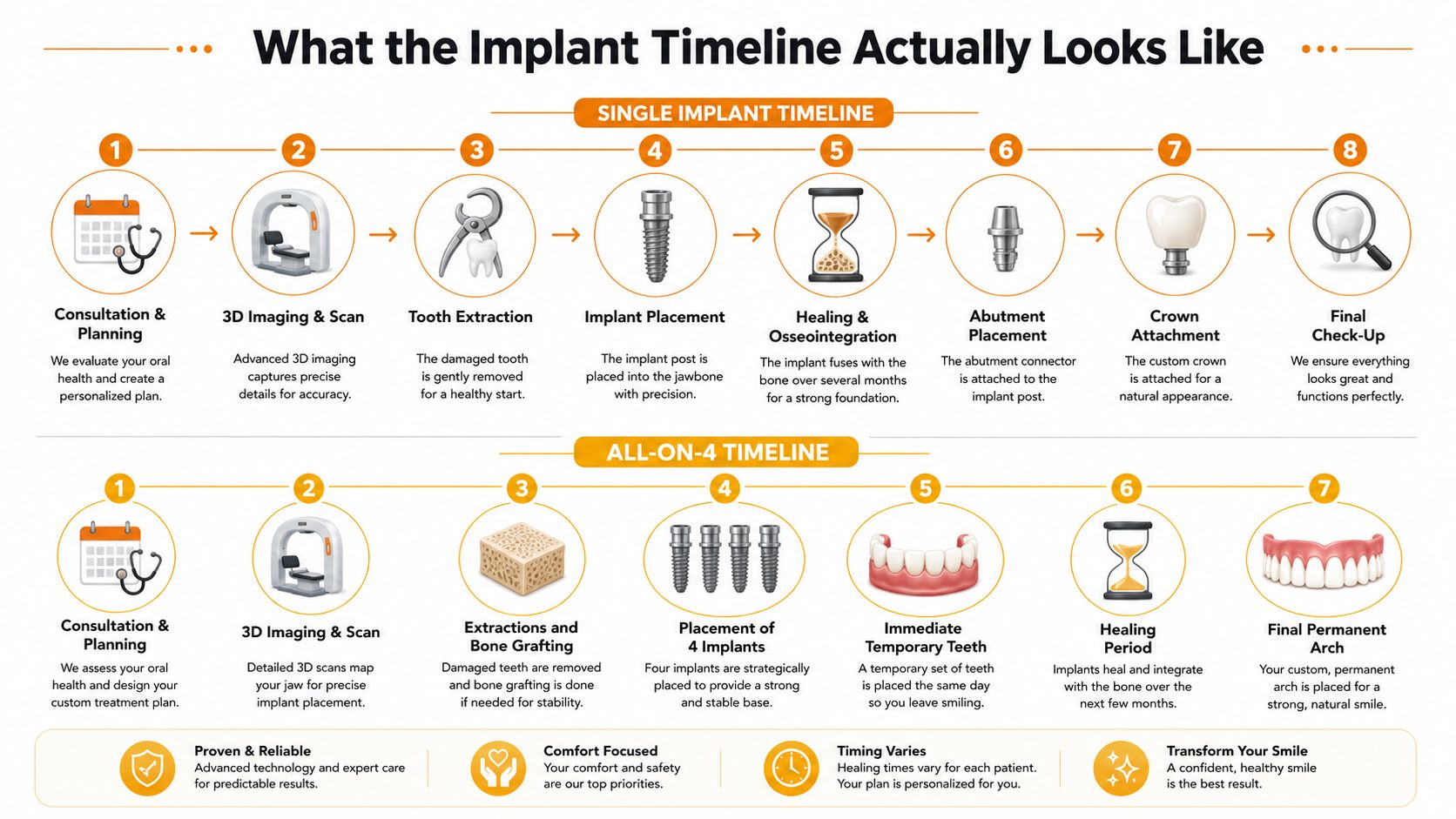
A single implant case usually starts with consultation, exam, and 3D imaging to confirm bone volume and the position of nearby structures. If the tooth still needs removal, the extraction is planned around that. The implant is then placed, and the site is allowed to heal while the bone integrates around the fixture.
The stage that patients usually underestimate is osseointegration, the healing phase where the implant becomes anchored in bone. After that, the abutment is placed and the crown is attached. The Cochrane review on implant loading found no convincing evidence of clinically important differences between immediate, early, and conventional loading in implant failure, prosthesis failure, or bone loss, and the reported bone-loss difference of 0.10 mm was very small. In plain language, same-day teeth can be appropriate in selected cases, but they're not the default.
All-on-4 and full-arch sequencing
All-on-4 planning follows a similar front end, but the surgical and prosthetic sequence is broader because the whole arch is being rebuilt. Some cases involve extractions and bone grafting before the implant set is placed. Many people receive immediate temporary teeth, then return later for the final arch once healing has matured.
Biolase laser dentistry can fit into this process where soft tissue work benefits from a minimally invasive approach, especially for flap management and comfort during recovery. It doesn't replace sound surgical planning, but it can support a gentler experience in selected cases.
Recovery rule: soft foods, excellent hygiene, and follow-up visits matter more than any single product choice after implant surgery.
A single implant often takes several months end to end, while many All-on-4 cases are structured to give the person a same-day temporary smile and a later final arch. Smoking, poor hygiene, and ignoring review appointments all make the process more fragile. That's why aftercare is part of the treatment, not an optional extra.
Costs, Insurance and the Long-Term Value Question
The sticker price is only part of the decision. In Australia, the public system is limited and NSW public dental access is generally income-tested, so many adults pay privately for replacement work. That's why the question isn't just what the restoration costs today, it's what the whole cycle of maintenance, repair, and replacement will look like over time.
Typical out-of-pocket ranges vary by case complexity and clinician, but broad Australian planning often lands around $200 to $500 for a flipper, $500 to $2,000 for a removable partial denture, $1,500 to $4,000 for a traditional bridge, $3,000 to $6,000 for a single implant, and $24,000 to $36,000 for an All-on-4 style arch. Those figures are only useful if they're read as planning guides, not fixed quotes.
The long-term value difference is where patients often change their mind. Bridges can be appealing at the start, but they depend on supporting teeth and may need replacement over time. Dentures usually cost less up front, but they tend to need relining, adjustment, or remake cycles. Implants usually ask for more at the beginning and can return value through stability and reduced reliance on neighbouring teeth.
How long dental implants last is the better question than “what do they cost”, because maintenance is part of value. Australian private spending on dental care was about AUD 10.5 billion in 2021–22, which shows how common private restorative care has become, but it doesn't erase the fact that many patients still face a funding gap. Health funds may contribute, but the contribution depends on the policy, the item numbers, and the patient's own extras cover.
The most useful mindset is to compare first-year cost against lifetime cost. A cheaper option is not automatically the cheaper option if it needs more replacement, more adjustment, or more compromise over the next decade. That's the budget discussion, and it's the one worth having before anyone starts drilling, extracting, or planning surgery.
Getting Assessed at The Smile Spot in Dulwich Hill
A proper assessment starts with the mouth you have, not the brochure version of it. At The Smile Spot, the new-patient pathway includes a $240 care package with exam, X-rays, scale and fluoride, and there's a reduced rate for children as well. From there, a replacement consultation can be layered in so the plan is built around the missing tooth, the bite, and the teeth that still need to stay healthy.
The practical advantage for anxious patients is that treatment can be staged. Sedation is available, gentle techniques are part of the approach, and Biolase laser dentistry can support minimally invasive care and calmer healing in suitable cases. That matters for people who've delayed replacing a tooth because the thought of surgery or drilling felt harder than living with the gap.
The clinic also fits the way Inner West families book care. Online booking, acceptance of most private health funds, and late evening plus Saturday hours make it easier for commuters and parents to come in without rearranging the whole week. The practice serves Dulwich Hill, Marrickville, Earlwood, Ashfield, Summer Hill, Lewisham, Petersham, and Hurlstone Park, which keeps the advice local rather than generic.
A consultation usually works best if you bring any existing scans, previous treatment records, or older denture or bridge details you already have. Ask for a written plan that compares the two or three options that fit, with the maintenance and cost cycle spelled out clearly. That's the point where a vague idea becomes a decision you can live with.
Questions Anxious Patients Ask Most Often
Does tooth replacement hurt
The procedure depends on the option, but individuals are often more worried before treatment than after. A bridge or denture usually involves less surgical discomfort than an implant, while an implant is managed with local anaesthetic and careful planning. A calm, paced consultation usually does more for anxiety than any generic reassurance.
How much time off work do I need
A simple bridge or denture adjustment may need little downtime, while a single implant can involve a few days of comfort-focused recovery. A full-arch implant case can be more demanding, especially if extractions are part of the plan. The answer depends on how much surgery is involved and whether the person has a hands-on job or a desk role.
What happens if I leave the gap alone
The teeth around the space can drift, the bite can shift, and cleaning the area often gets harder over time. That doesn't mean every missing tooth must be replaced immediately, but it does mean the gap deserves a proper review rather than wishful thinking. If you're feeling overwhelmed, a resource like Anxiety Checklist Anxiety University can help you separate fear from the actual treatment decision.
How do I know if the recommendation is clinical or commercial
Ask what problem the treatment is solving, what the alternatives are, and what happens if you do nothing for a year. A solid recommendation should explain why that option suits your bone, neighbouring teeth, bite, and budget. If the answer sounds canned or one-size-fits-all, get a second opinion before committing.
If you're weighing bridges, dentures, implants, or a staged temporary option, The Smile Spot can assess the mouth, explain the trade-offs, and map a treatment plan around your schedule and budget. Book with The Smile Spot if you want a written comparison of the tooth replacement options that fit your case, not a generic sales pitch.