You wake up with a tight jaw, a dull headache near your temples, or teeth that feel oddly sensitive when you sip cold water. Sometimes your partner hears grinding at night. Sometimes nobody hears anything, but your jaw still feels tired by breakfast.
A lot of people put up with these signs for months because they seem minor or random. They aren't always random. Clenching, grinding, and jaw joint strain can all show up this way, and they can slowly wear down teeth, irritate muscles, and make mornings feel harder than they should.
A dental mouth splint is one of the main conservative tools dentists use in this situation. The important part is that it isn't just a bit of plastic to stop rubbing. When it's properly planned, made, fitted, and adjusted, it's a therapeutic device designed around your bite, your jaw joints, and your symptoms. If you'd like a broad patient-friendly overview of causes, it's also helpful to learn about bruxism from 3D Dental.
Understanding Your Jaw Pain and Headaches
Jaw pain often starts subtly. You might notice clicking near your ear, soreness when you chew crusty bread, or a headache that feels like a tight band around the sides of your head. Other people notice chipped edges on teeth, flattened biting surfaces, or a feeling that they clench without meaning to, especially during stress.
These symptoms can point to two common problems. One is bruxism, which means clenching or grinding your teeth. The other is TMD, a group of problems affecting the jaw joints and the muscles that move your jaw. They can overlap, which is why self-diagnosis can be tricky.
Why these symptoms shouldn't be ignored
Teeth don't heal from wear the way skin heals from a scratch. If grinding is heavy enough, it can gradually flatten enamel, strain fillings and crowns, and overload the chewing muscles. Jaw joints can also become irritated when the bite isn't stable or the muscles stay tense for hours overnight.
Jaw pain isn't always caused by the joint itself. In many people, the muscles are doing far more work than they should.
A dentist looks for patterns, not just one symptom. Morning headaches, tooth wear, cheek biting, jaw fatigue, tenderness in the chewing muscles, and joint noises all help build the picture.
Where a splint fits in
A mouth splint is often discussed before invasive treatment because it's reversible and conservative. It may help protect teeth, reduce overload on the bite, and create a more stable starting point for the jaw. It can also show whether symptoms improve when the bite is managed in a controlled way.
That matters because the answer isn't always “you need a guard”. Sometimes you need a different kind of appliance. Sometimes you need habit advice, muscle care, or monitoring. The value of the splint starts with the diagnosis.
What Is a Dental Mouth Splint
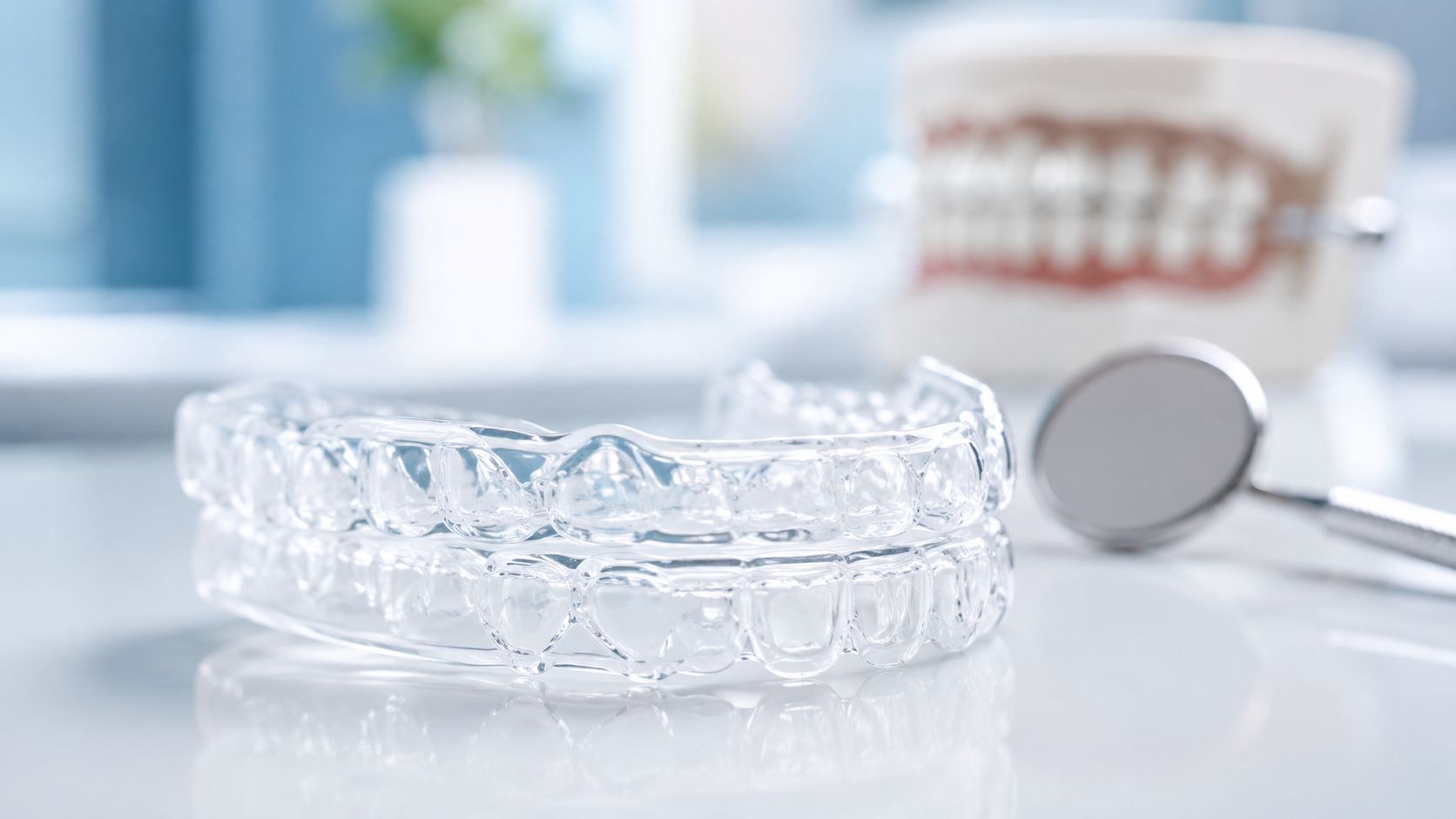
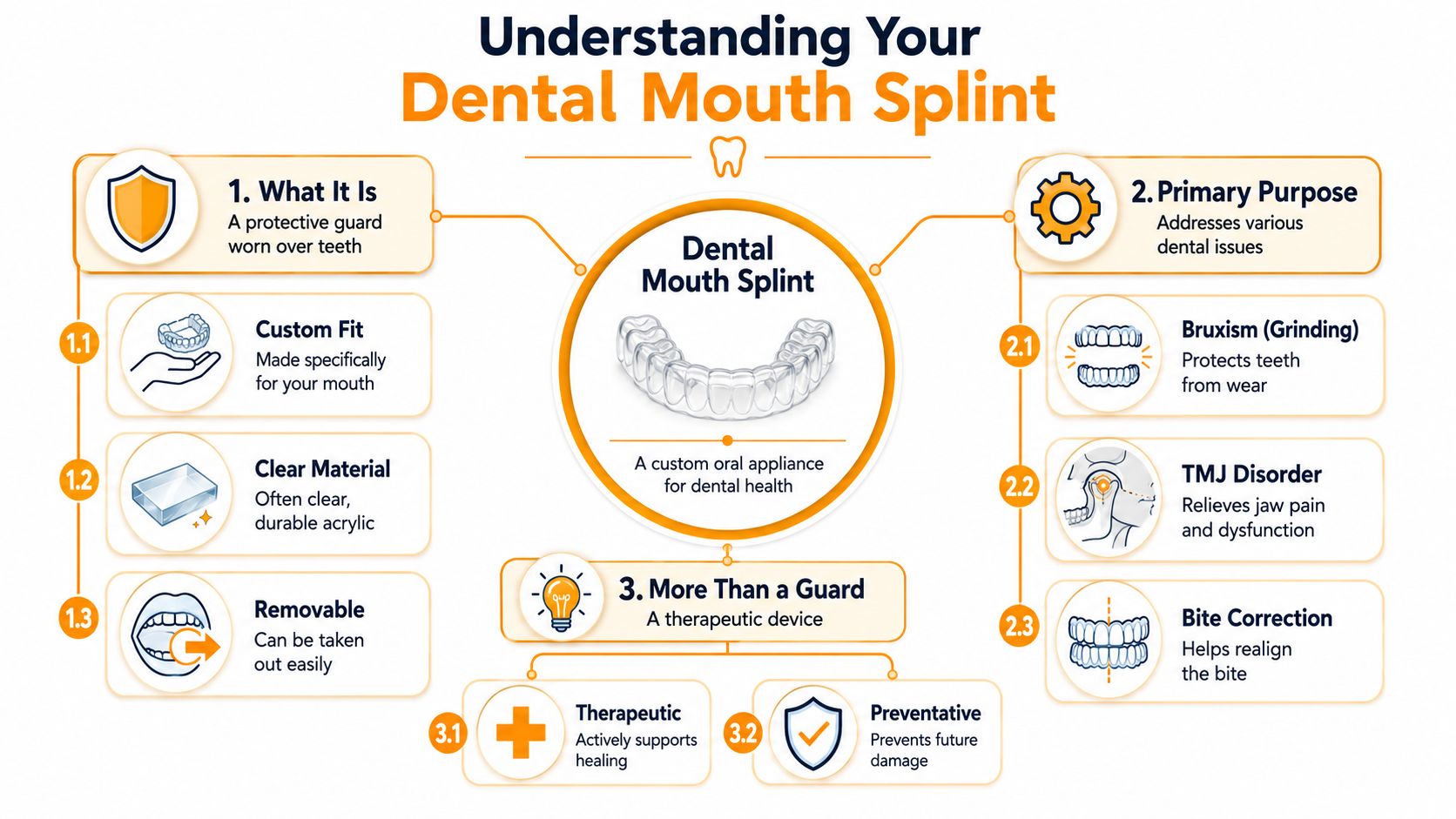
A dental mouth splint is a custom oral appliance that fits over your teeth and is designed for a treatment purpose. Unlike a sports mouthguard, which is made to absorb impact, a splint is made to control how your teeth meet and how your jaw sits when the appliance is in place.
The splint acts as a carefully tuned surface between two sets of gears. It doesn't just stop contact. It changes the way force is distributed. That can help protect enamel and restorations while also giving the jaw muscles a more even, less strained pattern of contact.
More than a simple guard
People often use the words guard, splint, and nightguard interchangeably. In casual conversation, that's understandable. In clinical care, the distinction matters.
A therapeutic splint is prescribed for a reason. It may be used to:
- Protect tooth structure by creating a barrier against grinding and clenching forces
- Support a more balanced bite so no single tooth or area takes too much load
- Reduce muscle strain by changing the way the jaw closes on contact
- Help assess symptoms if your dentist needs to see how your jaw responds to a controlled appliance
If you're comparing terms, this guide on a dentist mouth guard can help clarify where different appliances overlap and where they don't.
What it's made from and why that matters
In clinical practice, a custom occlusal splint is generally made from hard acrylic resin using study models or digital scans, then designed so contacts are even across the arch and jaw movement is properly guided, according to the information summarised at GoToAPro's splint overview. That hard, stable surface is part of the treatment. It lets the dentist adjust the bite precisely.
Practical rule: A splint only works as intended when the fit and contacts are checked in your mouth and adjusted if needed.
That last part is where many patients get confused. Wearing an appliance isn't the treatment by itself. The treatment is the combination of diagnosis, fabrication, fitting, and fine adjustment.
When Is a Mouth Splint Recommended
Dentists most often recommend a splint for two situations. The first is bruxism, where the main goal is protection. The second is TMD-related symptoms, where the aim may be to reduce overload on the muscles and joint while monitoring how you respond.
For bruxism and tooth protection
If you grind or clench, the damage is often cumulative. Enamel can wear down. Tiny fractures can turn into bigger problems. Existing dental work can also take a lot of force. In that setting, the splint acts as a controlled surface that helps protect teeth from further harm.
Clinical reviews describe occlusal splints as highly effective for protecting teeth, even though their direct effect on bruxism itself may be temporary. In sleep bruxism studies, reductions in rhythmic masticatory muscle activity often lasted only 7 to 15 days before returning towards baseline, as noted in the clinical review at ScienceDirect's occlusal splint topic page. So the honest message is this: a splint may not stop the habit reliably, but it can still be very useful because it limits damage while your dentist manages the bigger picture.
If you're looking for another plain-language explanation of protective appliances, this page on solutions for dental protection gives a helpful general overview.
For TMJ and TMD symptoms
When the problem involves the jaw joint or overworked muscles, the splint may be used to create a more stable bite relationship and reduce strain during clenching. Some patients report less morning tightness, fewer tension headaches, or easier chewing. Others improve only a little, which is why your dentist shouldn't oversell it.
For TMJ pain, the same clinical review reports an NNT of 6 for pain and 4.3 for mouth-opening improvement at ScienceDirect's occlusal splint topic page, meaning some patients benefit meaningfully, but not everyone does.
Signs a dentist may consider one
A splint might be discussed if you have:
- Morning jaw soreness that settles during the day
- Frequent clenching during work, driving, or sleep
- Visible tooth wear such as flattening, chipping, or cracking
- Temple headaches linked with jaw tension
- Clicking or joint tenderness with opening and closing
- Damage to restorations from heavy bite forces
For people dealing specifically with grinding at night, this article on a night guard for grinding explains when a protective appliance may be appropriate.
Custom Splints vs Over the Counter Nightguards
Many people go wrong by buying a chemist nightguard, assuming all guards do the same job, and then wonder why their jaw still feels off. The difference isn't just comfort. It's diagnosis and control.
The main types a dentist may discuss
Not every custom appliance is identical. A dentist may recommend a hard stabilisation splint, which is commonly used when controlled, even contacts are needed. In some cases, a softer style may be considered, depending on the indication and how you tolerate it. The design choice depends on your symptoms, bite pattern, and what the appliance is trying to achieve.
A custom occlusal splint is fabricated in a lab from hard acrylic resin, using dental models or digital scans, and is designed on an articulator to create even, equal-intensity contacts across the teeth. That precise fit helps seat the jaw condyles in a stable position and support the joint and muscles, according to GoToAPro's splint guidance. That level of control isn't possible with a boil-and-bite product.
Custom Dental Splint vs OTC Nightguard
| Feature | Custom Dental Splint (from a Dentist) | Over-the-Counter (OTC) Nightguard |
|---|---|---|
| Fit | Made from your models or digital scans and refined at a fitting visit | Approximate fit based on a generic tray or home moulding |
| Material | Commonly hard acrylic for a stable, adjustable surface | Usually softer material designed for convenience |
| Purpose | Protection plus therapeutic bite management when indicated | Mostly a barrier between teeth |
| Adjustment | Dentist can fine-tune contact points and bite balance | No precise clinical adjustment |
| Jaw support | Can be designed to guide the jaw in a controlled way | May feel bulky or uneven |
| Safety monitoring | Reviewed over time to check fit, comfort, and bite changes | Usually self-managed with no professional follow-up |
| Best use | Ongoing care when diagnosis matters | Short-term stopgap if no custom option is available yet |
One good way to think about it is this. An OTC guard is a product. A custom splint is a treatment process.
Why the fitting appointment matters
When patients say, “Can't I just wear something at night?”, they're usually thinking about tooth coverage alone. But even a well-made appliance still has to be checked in the mouth. A tiny high spot can change how your jaw closes. If that isn't corrected, the guard can feel annoying at best and aggravating at worst.
A splint that isn't balanced can become part of the problem instead of part of the solution.
If you're interested in how digital workflows support more precise dental appliances, this overview of dental 3D printing explains why scans, digital design, and fabrication accuracy matter. For a broader patient perspective on custom appliances for clenching, some readers also find this discussion on addressing teeth grinding in Manhattan useful.
Benefits and Potential Risks of Splint Therapy
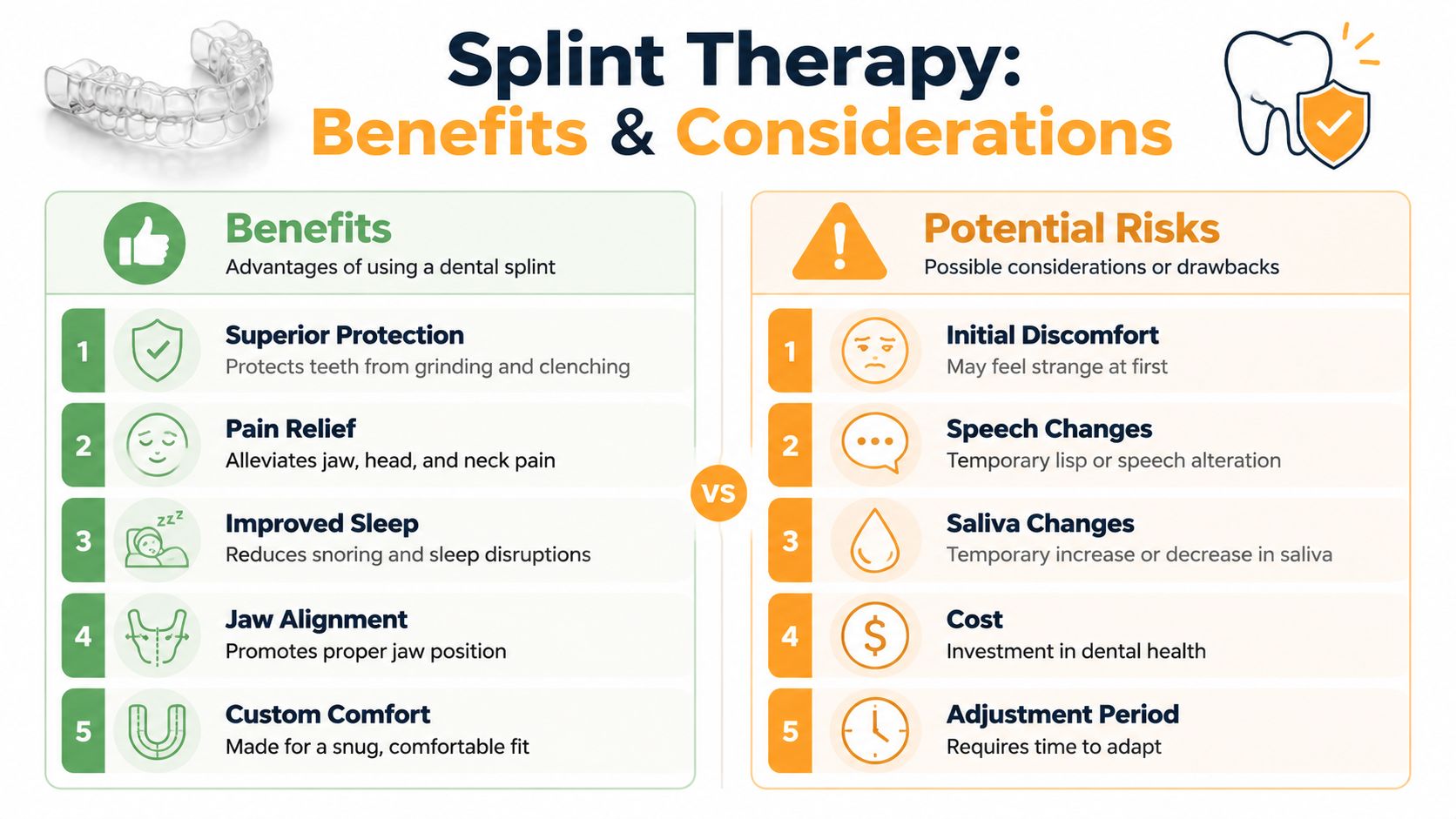
Splint therapy has real strengths, but it's not magic. The biggest strength is often straightforward: protection. If your teeth, crowns, veneers, or fillings are taking repeated grinding forces, a custom splint can reduce direct wear and help preserve the work already in your mouth.
The main benefits patients notice
For some people, the first benefit is waking up with less tension in the jaw muscles. Others notice fewer chipped edges, less tenderness on chewing, or more confidence that they aren't slowly wearing their teeth down every night.
Common benefits include:
- Tooth protection against grinding-related wear, chipping, and loading
- Muscle relief when the appliance creates a more stable bite pattern
- Joint support in selected TMD cases where unloading helps symptoms
- Restoration protection for crowns, veneers, and fillings exposed to heavy force
The limitations patients should know
The evidence on pain relief is mixed. A 2020 systematic review covering 37 trials found very low-certainty evidence that oral splints meaningfully reduce pain for pooled TMD cases, with the main pain outcome reported as SMD -0.18 and 95% CI -0.42 to 0.06, based on 13 trials and 1,076 participants in that analysis, as summarised in Nature's review of oral splints for TMD and bruxism. The same review reported no evidence of improvement in clicking, mouth opening, or quality of life.
That doesn't mean splints are useless. It means expectations need to be realistic. They are widely used, often sensible, and often protective. They just aren't a guaranteed cure for chronic jaw pain.
Possible downsides and adjustment issues
A new splint can feel strange at first. Some people notice extra saliva, a dry mouth feeling, or mild speech changes when the appliance is in. Those issues usually settle as you adapt.
More important is the need for review. If a splint is poorly designed, not adjusted properly, or worn without monitoring, it can create bite problems instead of helping.
Some discomfort during the first few nights can be normal. A bite that feels wrong in the morning is something to tell your dentist about.
Getting Your Custom Splint at The Smile Spot
The process matters as much as the appliance. A proper splint appointment isn't just “take an impression and hand it over later”. Your dentist needs to work out what problem is being treated, which arch should carry the appliance, what design suits your bite, and how the final contacts should feel.
Step one is diagnosis
At your consultation, the dentist checks your teeth, muscles, jaw joints, and bite. They also ask practical questions. Do you wake sore. Have you broken fillings. Do headaches cluster around mornings. Is there clicking, locking, or limited opening.
This stage decides whether a splint is the right tool. In some cases, the issue is mostly tooth protection. In others, the symptoms suggest a broader TMD plan.
Digital records and custom fabrication
Once the plan is clear, records are taken so the splint can be fabricated to your mouth rather than guessed from a generic shape. Many practices now use digital scans instead of traditional putty impressions, which makes the process cleaner and more comfortable for patients.
Custom appliance workflows commonly use digital impressions, STL design files, and post-processing to preserve fit accuracy and vertical dimension, as described in the TMJ Association's discussion of splints at TMJ.org. If you want to see how custom appliance planning fits into modern care, this article on a custom mouth guard in Sydney gives a useful local overview.
The fitting visit is not optional
When the splint comes back from the lab, it has to be inserted, checked, and adjusted. The dentist looks for pressure points, tests how the opposing teeth contact the appliance, and smooths or reshapes areas until the bite is even and controlled.
Leading health bodies cited by the TMJ Association note that splints should be used for a short time and should not cause permanent changes to your bite, which is why professional fitting and follow-up are essential, according to TMJ.org's splint guidance.
A short video can help you visualise what appliance discussions and jaw care can involve in practice.
Follow-up keeps it safe and useful
Your bite can change. The splint can wear. Symptoms can improve, plateau, or shift. That's why review appointments matter. The appliance isn't meant to be forgotten in a drawer or worn forever without checks.
At The Smile Spot, a splint can be part of a monitored conservative care plan when the diagnosis supports it. That's the safest way to treat it as a medical device rather than a one-size-fits-all purchase.
Caring for Your Splint and FAQs
Once you have your splint, daily care is simple. Rinse it after use, clean it gently with a soft brush, and store it in its case when it's not in your mouth. Avoid hot water, which can distort some appliances, and don't wrap it in a tissue because that's an easy way to throw it out by accident.
For a more detailed routine, this guide on how to clean a mouth splint covers the practical steps.
Quick answers to common questions
How much does a dental splint cost, and is it covered by private health?
Costs vary because the diagnosis, design, lab work, and review appointments vary. Some private health funds may contribute depending on your level of extras cover. The best approach is to ask for a written quote and item numbers after your assessment.
How long does it take to get used to wearing one?
An adjustment period is typically needed. It may feel bulky or unusual at first, especially in the first several nights. Consistent use and small adjustments from your dentist can make a big difference.
How long will a splint last?
That depends on how heavily you clench, the material used, and how well you care for it. A professionally made splint can last well, but it should still be checked regularly for wear and fit.
Should I stop wearing it if my bite feels strange?
Don't ignore that feeling. Call your dentist. A brief bite change sensation right after removal can happen, but anything persistent or uncomfortable deserves review.
A custom splint isn't just an appliance. It's an investment in protecting your teeth, your jaw, and the dental work you've already paid for. The value comes from precision, adjustment, and follow-up, not from plastic alone.
If you're in Dulwich Hill or the Inner West and you're waking with jaw pain, headaches, or signs of grinding, book an assessment with The Smile Spot. A customized review can show whether a dental mouth splint is the right next step for your bite, your symptoms, and your long-term oral health.