You've chipped a tooth on the way to work, or your old crown has started to ache at the worst possible time. You want the tooth fixed properly, but you don't want two appointments, a temporary cap that might loosen, or a week of rearranging your life for dental work. That's exactly where a same day dental crown changes the conversation, because the advantage is not magic, it's a workflow that lets a dentist scan, design, mill, and place a ceramic crown in one visit.
For busy Inner West patients, that difference matters. The question isn't just, “Can this tooth be crowned?” It's, “Can it be crowned safely in one appointment, or would a laboratory-made crown be the better clinical choice?” If you've been weighing speed against certainty, this guide breaks the decision down in plain English so you can tell the difference between convenience and the right treatment.
Walking in With a Cracked Tooth, Walking Out With a Crown
A patient walks into the clinic with a cracked back tooth, chews on the other side, and hopes it will not turn into weeks of disruption. By the time they leave that afternoon, the tooth has a finished crown on it, not a temporary shell waiting for a second appointment. That outcome is why people search for a same day dental crown, but the point is practical, not dramatic.
A crown is still a crown. It is an indirect restoration used when a tooth has been weakened by extensive decay, large fillings, fracture, root-canal treatment, or abnormal wear. The Australian Dental Association describes these situations as common reasons a tooth may need full coverage, and it also explains when a crown is used as part of restoring function and protecting the remaining tooth structure.
For time-poor adults and families in Dulwich Hill and the Inner West, that distinction matters. One appointment means less disruption, fewer handover points, and no temporary crown sitting in the mouth while a lab works in the background. It also means the tooth can be stabilised quickly, which helps when a crack or fracture has already made normal chewing uncomfortable.
A same-day crown is a workflow choice, not a blanket upgrade. If the tooth can be prepared, scanned, and bonded with good visibility and stable bite conditions, a same-day workflow can be a sensible option. If the tooth is hard to isolate, the bite is difficult to control, or the case needs more planning, a conventional lab-made crown may be the safer clinical path.
For readers who want a broader overview of how chairside digital workflows fit together, the 3D DDS guide to CAD/CAM explains the scan, design, and milling steps in plain language. For patients trying to understand whether a walk-in appointment is realistic, walk-in dental care can help frame how same-day treatment fits into real clinic scheduling.
The rest of this guide follows that logic. It looks at how the technology works, what the visit feels like, when a lab-made crown is the better call, what the costs usually mean in Australia, and how a patient books the right next step with a clinic such as The Smile Spot.
How CAD/CAM Turns a Crown Into a Single Visit
A crown is basically a custom-made cap that covers and protects a damaged tooth. The reason a same day dental crown can happen in one appointment is that the work is done by CAD/CAM, which means computer-aided design and computer-aided manufacturing. If that sounds technical, think of it as a digital potter's wheel combined with a very precise milling system.
The dentist first captures the tooth with a digital scan instead of mouldy impression material. That scan becomes a three-dimensional model, and the crown is designed on screen to fit the prepared tooth and the bite around it. For readers who want a broader technical overview, the 3D DDS guide to CAD/CAM is a useful plain-language explainer of how digital design and chairside milling fit together.
Then the material choice matters. Public-sector guidance and university teaching programs describe same-day ceramic crowns as being milled from lithium-disilicate or zirconia-type ceramics. Those materials are chosen for different reasons. Lithium-disilicate is often favoured when conservative bonding and natural-looking aesthetics matter, while zirconia is used where higher fracture resistance is needed, especially in back-tooth situations.
Why precision matters more than speed
The crown isn't just “made and popped in”. The tooth preparation has to provide enough clearance, the scanner has to capture the margins clearly, the milling unit has to reproduce the shape accurately, and the bonding protocol has to be done properly. If any of those parts are weak, the final result suffers.
That's why same-day crowns are best understood as a workflow, not a shortcut. Speed only helps when the digital scan is clean, the margins are readable, and the bite is managed properly from the start. If those conditions are met, chairside ceramics can deliver a restoration that is both practical and durable, with the added benefit of a dramatically shorter treatment path. A related overview of digital fabrication is also discussed on dental 3D printing, which helps clarify where scanning, design, and in-office production overlap.
What Your Appointment Actually Looks Like
A same-day crown appointment usually begins with diagnosis, not with the machine. The dentist examines the tooth, confirms that a crown is the right treatment, and checks that the preparation can be completed safely in one visit. If local anaesthetic is needed, it is given before the tooth is reshaped, so the rest of the visit stays comfortable.
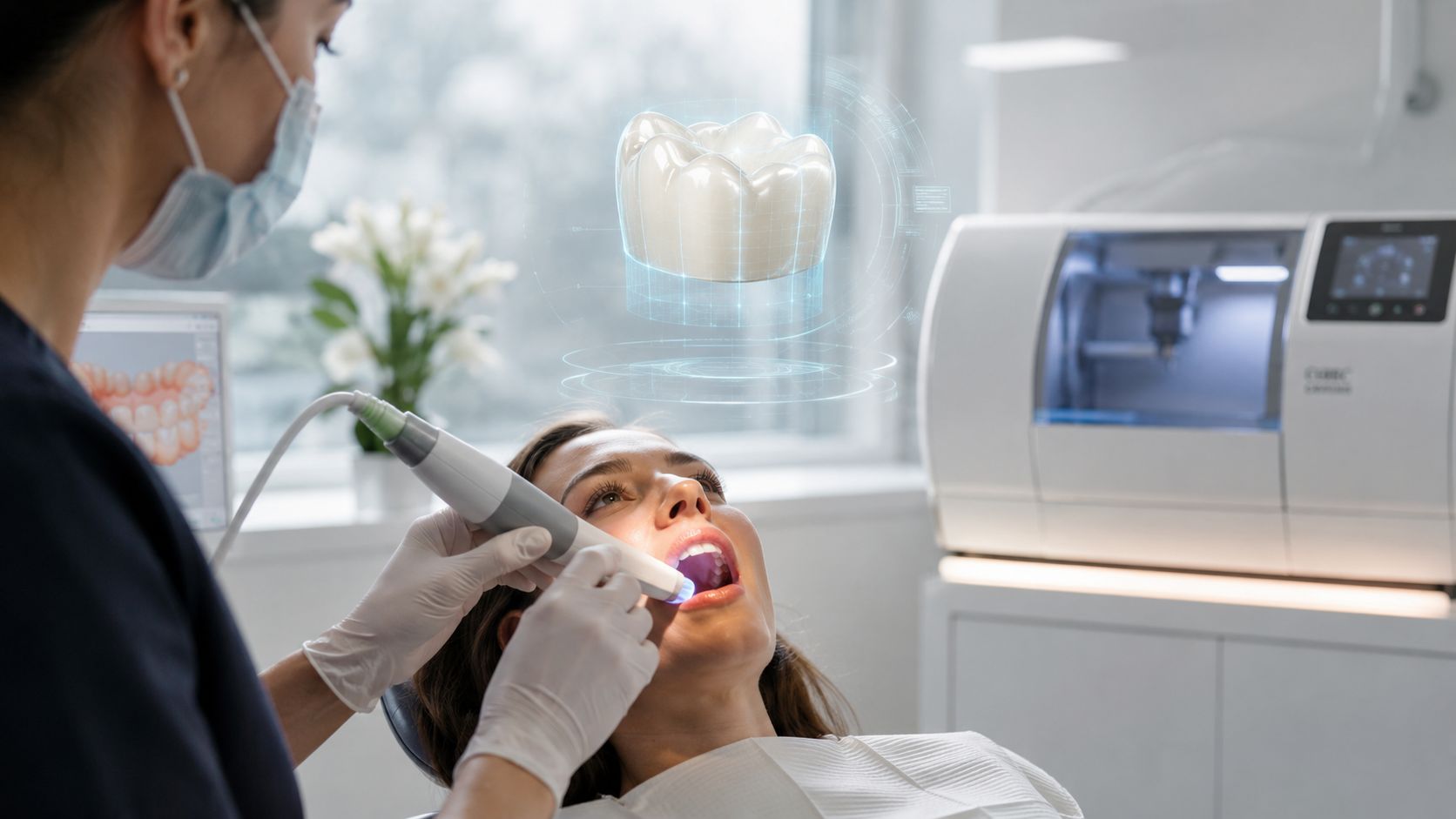
From there, the appointment shifts from hands-on dentistry to digital recording. Instead of a traditional impression tray, the dentist uses a scanner to capture the tooth and the bite around it. Many patients find that easier, especially if impression material has triggered gagging in the past. If you want a clearer look at the imaging side of care, the clinic's intraoral camera dentistry article explains how digital visuals can make treatment easier to understand.
Once the scan is captured, the crown is designed on screen. In many cases, the patient can see the outline before milling begins, which helps make the shape and fit feel less abstract. The in-office milling unit then carves the crown from a ceramic block, and the dentist checks the colour, bite, and margins before the crown is bonded into place.
The time needed depends on how straightforward the tooth is. Public procedural descriptions commonly place same-day crown visits at around 60 to 120 minutes, while patient education sources such as Healthline describe one-day appointments as generally taking 2 to 4 hours and traditional crown care as needing two appointments spaced 1 to 2 weeks apart. In practice, a simple crown may fit into one concentrated visit, while a more involved case can take most of a morning or afternoon.
The crown is only finished when the fit, bite, and cementation all check out. That final check is where the dentist decides whether the restoration is actually ready to stay.
Bonding is the last step. The crown is cemented or bonded, excess material is removed, and the bite is checked again before you leave. A short video walkthrough of that finishing sequence is available in this procedural example, and it shows why the final minutes of the visit matter just as much as the scan.
Same Day Crowns Versus Traditional Lab-Made Crowns
A cracked tooth in the chair usually leaves patients with one practical question, do they want the restoration completed in one visit, or do they want the extra planning that comes with a laboratory-made crown? That is the core comparison here. A same day dental crown is a single-visit workflow, while a traditional crown follows a two-visit laboratory workflow.
The same-day route removes the temporary crown stage. That matters more than it sounds. Without a provisional crown, there is no waiting period where the temporary can loosen, feel bulky, or trigger extra sensitivity while you go about normal life. It also avoids the second appointment, which can be difficult to fit around work, school pickup, or travel across Sydney.
Traditional crowns still have an important place. A laboratory gives the dentist more room to customise shape, contour, and fit, and that can help when a case needs more adjustment flexibility or a broader choice of materials. For many Inner West patients, the difference is practical as much as clinical. One workflow condenses the treatment into a single visit. The other spreads the work out and leaves room for a remake if the first design needs refinement.
Durability is not the weak point people expect
The common fear is that a crown made chairside must be less durable. That does not match the long-term evidence that has been reported for CEREC ceramic crowns. Peer-reviewed studies have shown high survival rates over time, which means the material itself is not a convenience option with poor staying power. The exact choice still depends on the tooth, the bite, and how much structure remains.
Fit is the other part of the comparison. The ADA notes that chairside systems can scan, design, mill, and cement a ceramic crown in one appointment, but the dentist has to capture the margins and occlusion accurately because there is no laboratory remake stage in the background. That is the trade-off. A same-day crown gives speed, fewer visits, and no temporary, while the dentist must get the digital design and bite adjustment right at the chairside.
For a professional who cannot easily return for multiple appointments, the single-visit path can be the better fit. For a patient with a complex bite or a tooth that needs more laboratory adjustment, the traditional route may still be the calmer and safer option. The right choice is the one that suits the tooth first, then the calendar.
When a Same Day Crown Is the Wrong Choice
The biggest mistake patients make is assuming same day dental crown automatically means better. It doesn't. It means faster, and faster is only helpful when the tooth and bite are suitable for that workflow.
Heavily damaged teeth are one problem. If the fracture extends too far, or if the tooth has lost too much structure, the dentist may need the extra planning room of a laboratory workflow or a different restoration altogether. Severe bruxism is another issue, because grinding and clenching load the crown hard, especially overnight.
Clinical situations that often need a different answer
- Complex bite issues: If the upper and lower teeth don't meet cleanly, the dentist may need more adjustment flexibility than a same-day workflow allows.
- Multi-unit restorations: When more than one tooth is involved, laboratory design can give the clinician more control over fit and contour.
- Poor isolation or unclear margins: A scanner can only work well when it can clearly capture the tooth edges.
- Extensive structural loss: When the remaining tooth is too compromised, another restoration may be more appropriate.
Australian teaching and public-sector guidance also emphasise that crown success depends on conservative preparation, reliable bonding substrate, and clear margins. That means the tooth itself still sets the rules. The workflow can't rescue a case that needs a different kind of planning.
If you're sitting in the chair at The Smile Spot, the right question is simple. Ask whether your tooth has enough remaining structure, whether your bite is stable enough for chairside design, and whether the dentist expects an adhesive ceramic crown or a stronger posterior material. A clear answer there matters more than the marketing label on the treatment.
Costs, Rebates, and Realistic Budgets in Australia
A crown quote can look straightforward until you ask what sits behind it. Material choice, tooth position, the amount of shaping needed, and whether the restoration is made chairside or in a laboratory all affect the final figure. That is why patients often see different numbers online and assume someone is quoting the same treatment when the clinical setup is different.
For Sydney patients looking at dental crown cost Sydney, the useful way to read a quote is to treat it as a complete treatment plan, not just a single item on a bill. A same-day ceramic crown may save a return visit and avoid a temporary crown, while a lab-made crown may be the safer choice if the tooth needs more design control or the bite needs more adjustment. The cheaper option on paper is not always the better budget choice once the full workflow is considered.
Private health insurance can change the picture again. In Australia, most dental care is privately funded, and extras cover usually pays according to the item number, the wording of the policy, and the limits left in the annual benefit pool. Two patients can walk in for the same crown and leave with very different out-of-pocket costs because their funds, cover levels, and remaining benefits are not the same.
That is why the budget question is broader than price alone. Ask what is included, how many visits are expected, whether a temporary crown is part of the plan, and whether the tooth is a good fit for a single-visit ceramic workflow or a conventional laboratory crown. A same-day crown is often about convenience and planning, not a promise of lower cost.
Budget rule: compare the whole episode of care, not just the crown itself. The figure on the invoice is only one part of what you are paying for.
Aftercare and How Long a Same Day Crown Lasts
Once the crown is fitted, the bite is the first thing to notice. It should feel natural, or settle quickly as the mouth adjusts, but a little tenderness or mild awareness around the crowned tooth is common right after treatment. The main aim is to avoid putting extra strain on it while the cement sets and the surrounding tissues calm down.
The first day is about giving the tooth an easy start. Choose softer foods, stay away from very hard or sticky items, and do not use the crowned tooth to test whether it is fully fixed. If the mouth is still numb, take care with hot drinks and chewing on that side, so you do not bite the cheek or tongue by accident.
Crowns can last many years with proper care, and their lifespan depends on how the tooth is used, how well the margins are maintained, and whether habits like grinding are managed. A crown is built to handle daily chewing, but it still lives in the same environment as every other tooth, with plaque, pressure, and wear all around it. You can read more about how long crowns last if you want a fuller explanation of the factors that affect durability.
Regular check-ups matter because the dentist can look for margin wear, cement changes, or bite problems before they turn into crown failure. For patients who grind their teeth, a night guard can protect the restoration. It also helps to avoid ice, hard lollies, and habits like using teeth to open packets, since those forces can chip ceramic or loosen the crown over time.
A crown should be treated as part of your preventive routine, not a repair you fit once and then forget. Clean it carefully, keep up with reviews, and treat small changes in comfort or bite as a reason to have it checked.
Getting a Same Day Crown at The Smile Spot
At The Smile Spot in Dulwich Hill, a crown consultation sits inside a broader restorative and family dentistry workflow, so the tooth can be assessed alongside other needs like whitening, veneers, bridge planning, or implant work if that's relevant. Under Dr. Dimitrios Thanos, the practice uses advanced dental technology, offers gentle techniques, and has sedation options for anxious patients, which matters when a cracked tooth has already made you nervous about treatment.
The practical side is built for busy people. The clinic offers late evening and Saturday hours, online booking, and acceptance of most private health funds. Emergency appointments are also available, which is useful if the tooth has fractured suddenly or a filling has failed and you don't want to wait for the next routine slot.
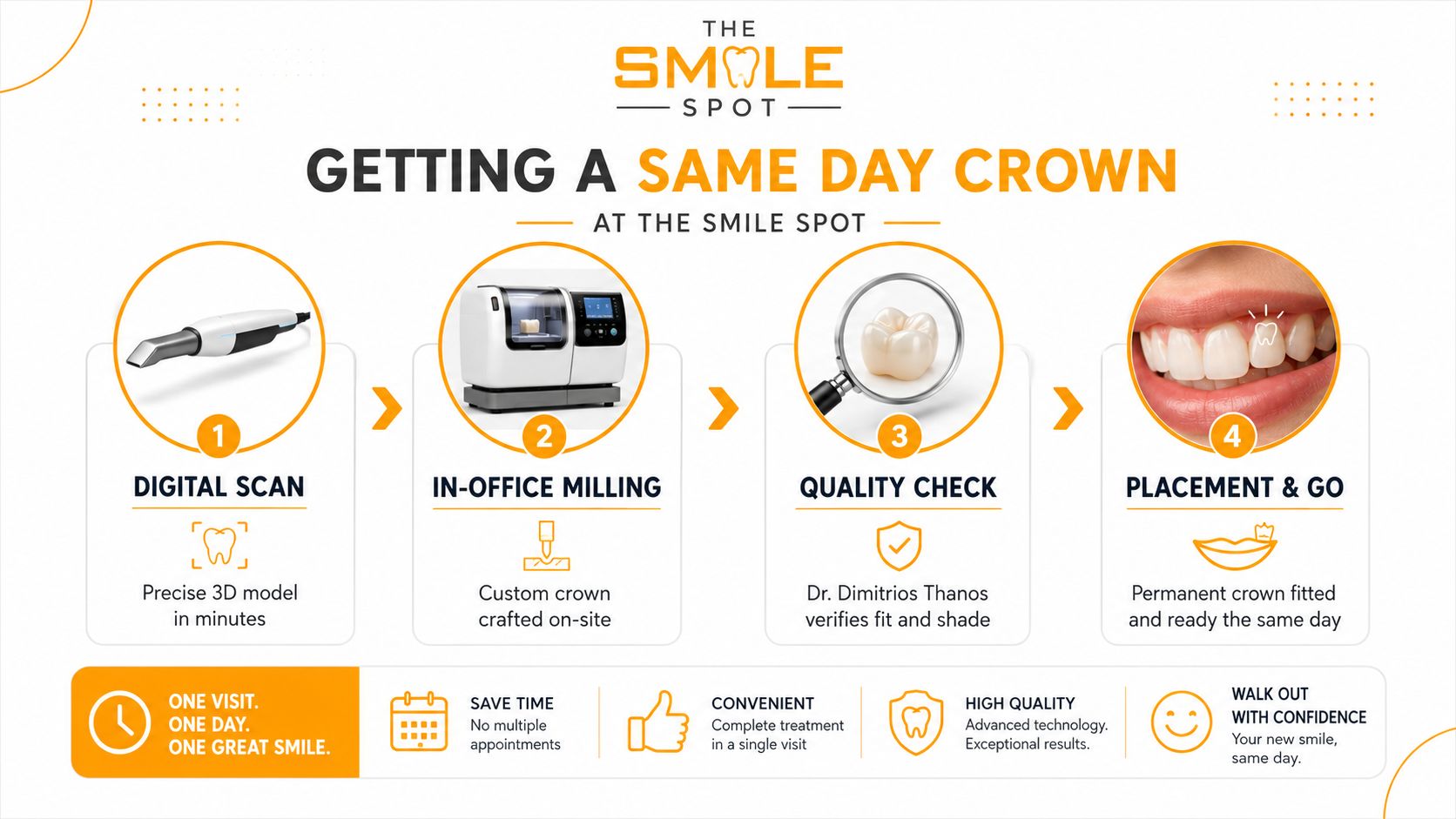
The same-day crown workflow is straightforward from the patient's point of view. You book, come in for assessment, get scanned, have the crown designed and milled in-house, then return to the chair for fit, shade, and placement. If the tooth is suitable, you leave with a permanent restoration the same day.
For Inner West patients, that can be the difference between putting off treatment and getting it done. If you're dealing with a cracked, weakened, or heavily filled tooth, book a crown consultation, bring your health fund details, and be ready to discuss whether a chairside ceramic crown or a lab-made crown gives you the safer result for that specific tooth.
A CTA for The Smile Spot.