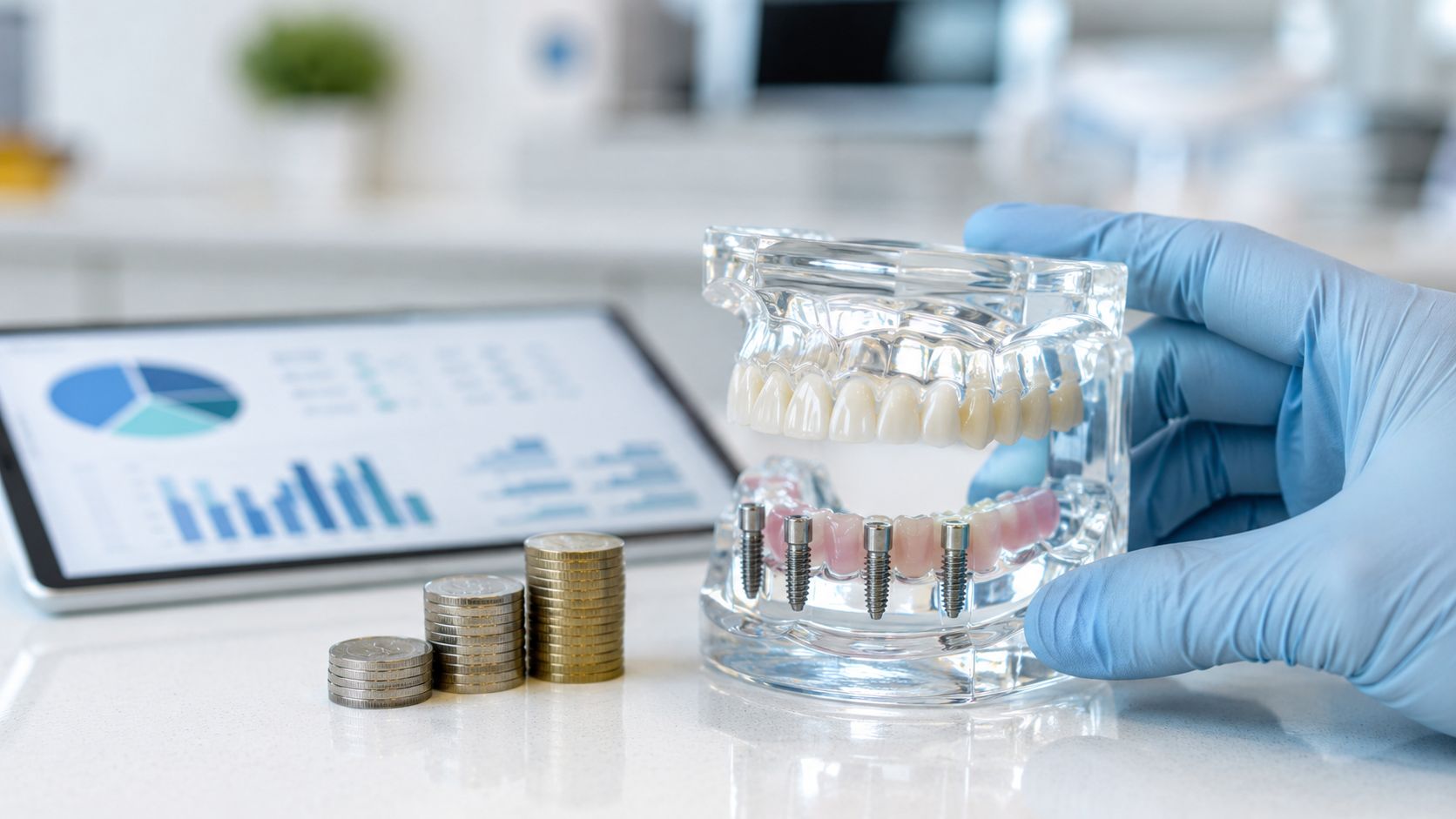
A single All-on-4 arch typically costs between $15,000 and $30,000, with both arches commonly totalling $30,000 to $60,000+. The final price depends heavily on what's included in the quote, and that's where two seemingly similar plans can diverge by a lot.
If you're staring at two treatment estimates and wondering how one clinic can be so much cheaper than another, you're not alone. In full-arch dentistry, the headline number rarely tells the whole story, because the cost sits inside the line items, the prosthesis material, the imaging, the provisional teeth, and the follow-up care.
Why All-on-4 Quotes Vary So Much
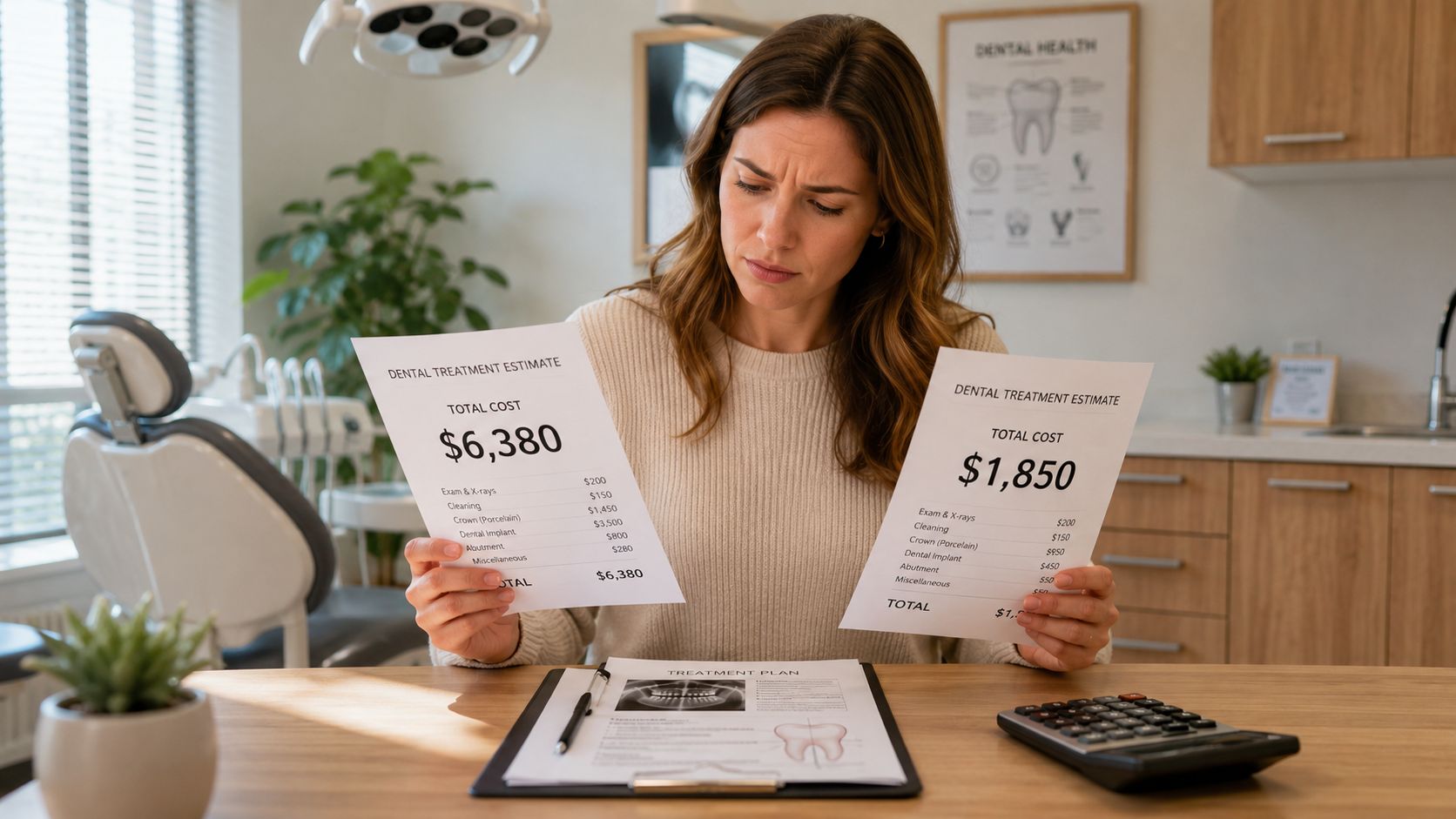
A patient often walks out of one consultation with a tidy one-page quote, then gets a second estimate that looks almost identical at first glance but lands thousands of dollars higher. That difference usually isn't random. It comes from how each clinic packages the treatment, what they include up front, and what they expect to bill later.
Headline pricing can hide real differences
A full-arch plan may be quoted as a per-arch package, but the package itself can be broad or narrow. Some clinics include imaging, extractions, immediate provisional teeth, and the final prosthesis in the base fee, while others separate those items out. That's why a lower quote can look attractive and still end up being the more expensive path once the extras are added.
Practical rule: compare what is included, not just the sticker price. If one estimate covers more stages of treatment, it may actually be the better value even if the number is higher at the start.
In Australia, the most useful way to review a quote is to treat it like a bundled service rather than a single procedure. For a plain-language breakdown of how implant pricing is often presented, this guide on dental implants cost in Australia is a useful companion read.
Why some clinics appear cheaper
Some practices keep the initial number low by leaving out items that patients assume are included. That might mean the surgeon's fee is shown separately from the prosthetics fee, or that the provisional bridge is listed as an additional charge. Other clinics present a more complete figure from the beginning, which can look expensive even when it's more transparent.
A helpful way to think about medically necessary dental billing explained is that treatment billing should reflect the service pathway, not just the surgery day. In implant dentistry, that distinction matters because planning, surgery, temporaries, and the final restoration all affect the out-of-pocket cost.
A quote that looks simple is not always a complete quote. Ask what happens if extractions, sedation, or a second prosthesis are needed.
What Is Actually Included in an All-on-4 Fee
A proper All-on-4 fee is usually a bundle of several clinical and laboratory steps, not just the four implants themselves. That's why the same treatment can sit at very different price points from one clinic to another. If you want to compare like for like, you need to know which pieces are inside the package and which ones are still waiting outside it.
The common line items
The most common components are consultation and planning, 3D imaging, surgical placement of the implants, extractions if teeth need to come out, a provisional bridge, and the definitive prosthesis later on. Some clinics also include review visits and minor adjustments during healing. Others treat those as separate appointments with separate charges.
The technical reason this matters is simple. The final arch is only one part of the workflow. If a clinic has to coordinate imaging, surgery, lab fabrication, anaesthesia, and follow-up, each of those steps can change the number on the invoice.
| Typical All-on-4 Line Items | Usually Bundled | Often Quoted Separately |
|---|---|---|
| Initial consultation | Sometimes | Yes |
| 3D imaging and planning | Sometimes | Yes |
| Extractions | Sometimes | Yes |
| Four implants per arch | Often | Sometimes |
| Immediate provisional teeth | Often | Sometimes |
| Final prosthesis | Often | Sometimes |
| Sedation or anaesthesia | Sometimes | Yes |
| Follow-up reviews | Sometimes | Yes |
| Repairs or later maintenance | No | Yes |
For a practical overview of the treatment sequence itself, this explainer on the dental implants procedure helps connect the quote to the actual stages of care.
What patients should ask before signing
Ask whether the quote includes the provisional arch, the final arch, and any re-making of the prosthesis if the fit changes during healing. Ask about extractions, because some clinics price them per tooth and others build them into the package. Ask whether sedation is part of the figure or added later.
You should also clarify what happens if the treatment needs to be staged. A quote that assumes everything will go smoothly may be fine for a straightforward case, but it can leave you exposed when the mouth needs more preparation than expected. If the clinic uses itemised pricing, that can be a strength, not a weakness, as long as the inclusions are clear.
How Prosthesis Material Changes the Price
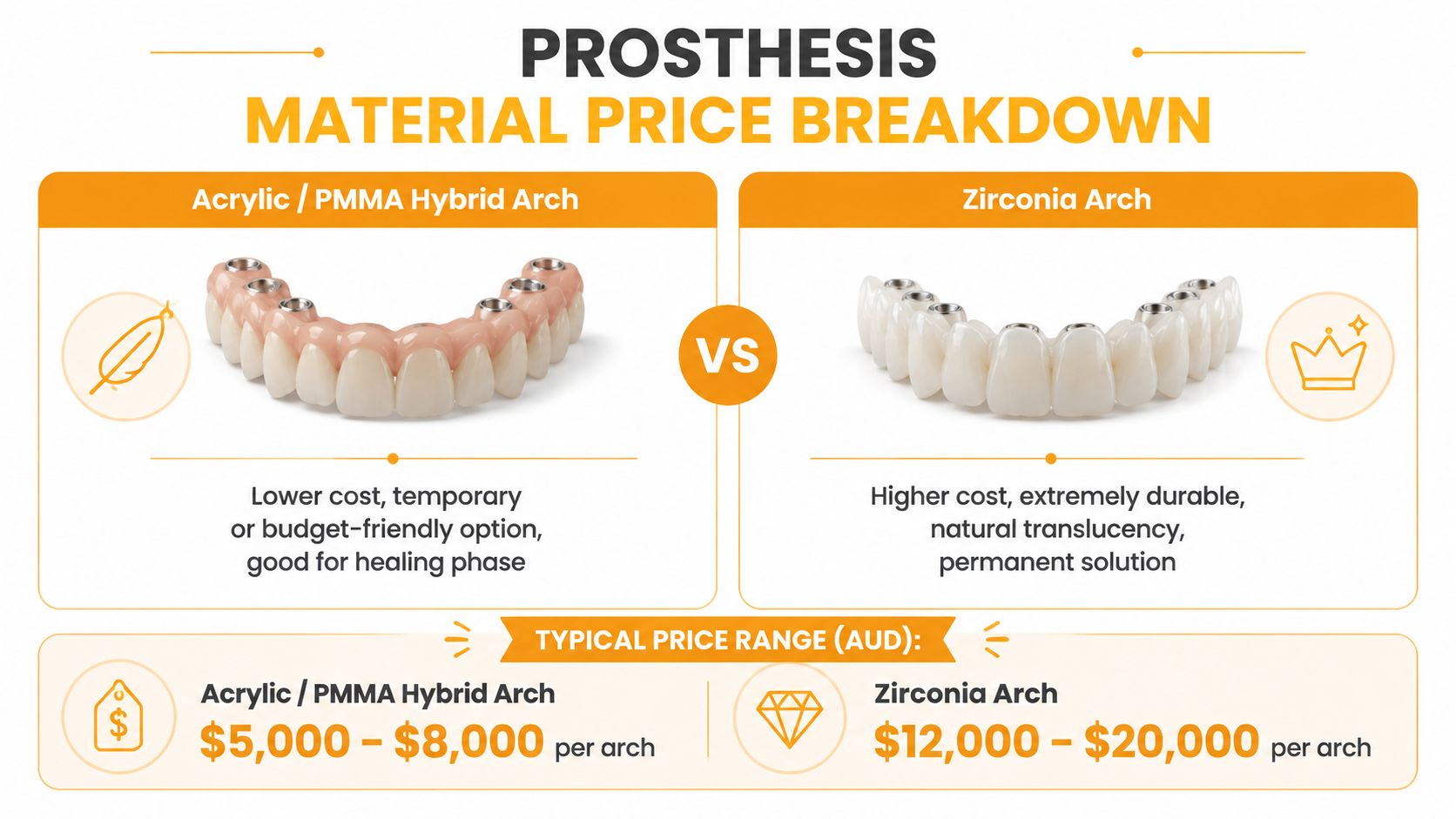
The material used for the final arch is one of the biggest reasons two All-on-4 quotes can feel worlds apart. Acrylic or PMMA hybrid arches sit at the lower end of the cost spectrum because they are lighter and simpler to fabricate. Zirconia costs more because the lab work is more demanding and the material itself is a higher-end option.
Acrylic or PMMA hybrid arches
Acrylic and PMMA hybrid arches are usually the more practical choice for patients who want a lower upfront fee. They are commonly used as provisional or budget-friendly definitive restorations, and they feel lighter in the mouth. In neutral-market pricing guides, these arches often sit around US$15k–US$25k per arch, which gives a useful benchmark when you are comparing Australian quotes that bundle laboratory work differently, as noted in the all-on-4 material comparison guide.
The trade-off is durability and refinement. Acrylic can be easier to adjust and repair, which matters during healing or if you are managing a tight budget. It is also less costly if you are not ready to invest in a premium permanent bridge straight away.
Zirconia arches
Zirconia is the more premium choice, and patients usually pay for that upgrade in the final price. It is highly durable, looks more lifelike in the right hands, and can be a better long-term option for people who want a definitive restoration with a harder wearing surface. The benchmark range commonly quoted outside Australia is US$25k–US$38k per arch, which explains why zirconia quotes tend to climb faster than acrylic ones.
Clinical insight: zirconia is not automatically the right answer for everyone. If you are still healing, or if you need a more economical staged plan, acrylic can be the more sensible first step.
For patients comparing crown and bridge materials in a wider implant context, this guide on the dental implant crown gives useful background on why lab work changes the final bill. A video review of prosthesis options can also help when you are comparing quote language with real-world outcomes.
Clinical and Personal Factors That Shift Your Cost
The treatment plan starts changing the moment the mouth needs extra preparation. Missing teeth, failing teeth, gum disease, bite problems, bone loss, smoking, and general health all affect how simple or complex the case is. That complexity shows up in time, materials, appointments, and eventually the final fee.
The mouth sets the starting point
If remaining teeth need to be removed, the plan grows immediately. If the gums are inflamed or infected, treatment has to be stabilised before implants are placed. If the upper jaw needs more space or support, additional surgical planning may be required. None of that means All-on-4 is off the table, but it does mean the quote can't be finalised until the mouth is properly assessed.
Bone grafting and sinus lifts are the big examples of procedures that may push the cost higher. All-on-4 was designed to reduce surgical complexity, but it doesn't eliminate every extra step for every patient. The consultation has to show whether the anatomy is suitable or whether a more staged approach is safer.
The patient also changes the plan
Lifestyle and medical history matter because they affect healing and maintenance. Smoking raises the risk profile, bruxism can increase wear on the prosthesis, and uncontrolled systemic issues can make healing slower or less predictable. That doesn't mean treatment is impossible, but it does mean the dentist may recommend more monitoring or stronger maintenance planning.
If your mouth has more than one problem at once, the quote should reflect that reality. A fair plan doesn't pretend every case is straightforward.
The practical step is to separate base treatment, surgical add-ons, and long-term maintenance before you agree to anything. That makes it easier to see whether a quoted price is inclusive or just starting the conversation. It also helps you understand why one patient's All-on-4 plan may be much simpler than another's, even at the same clinic.
All-on-4 Versus Traditional Implants and Overdentures
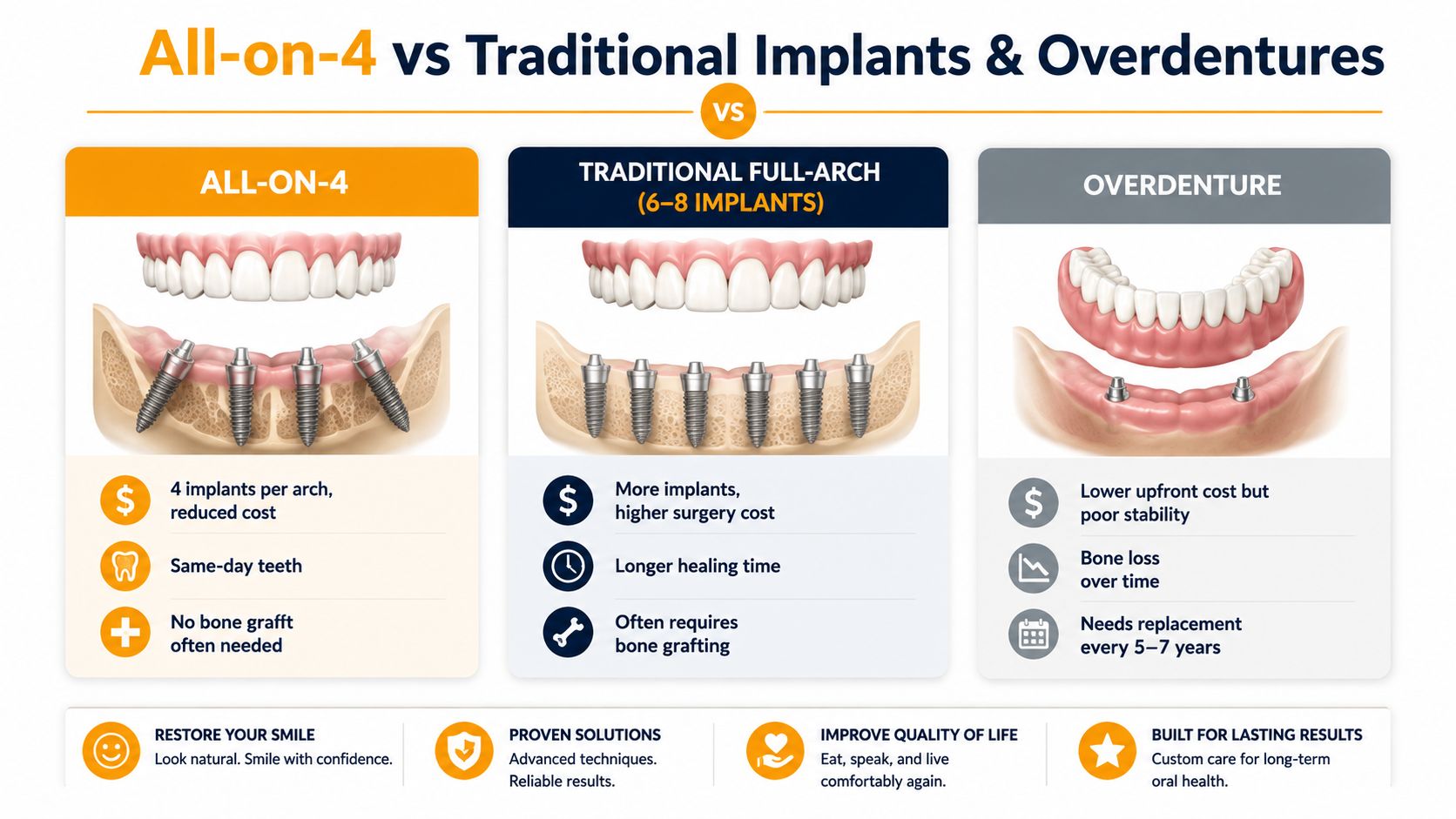
All-on-4 became popular because it changed the number of implants needed to support a full arch from the more conventional 6–8 implants down to 4 implants. That reduction matters because it can lower surgical complexity and prosthetic cost while still delivering fixed teeth. For many patients, that's the core economic logic behind the treatment.
The benchmark comparison
A retrospective cost analysis reported an average adjusted total cost of $42,422 ± 3,860 for All-on-4 compared with $57,944 ± 20,198 for a historical conventional full-arch implant group, with a difference of $7,307 per jaw and a statistically significant gap (P = 0.01) PubMed cost analysis. That's not an Australia-specific fee schedule, but it is a useful peer-reviewed benchmark because it shows why a fewer-implant design can change the economics of full-arch care.
Traditional full-arch implant rehabilitation generally asks more of the surgery and the laboratory. More implants usually means more time, more chairside complexity, and often a higher total bill. That's why the All-on-4 design became a foundational model in high-cost markets, including Australia.
How overdentures fit into the picture
Implant-supported overdentures usually sit at a lower upfront price than a fixed All-on-4 bridge. They can be a reasonable compromise for patients who prioritise cost and accept removability. But they're not the same treatment. Stability, feel, and convenience are different, and patients need to decide whether they want a fixed solution or a removable one.
For a clear patient-level comparison between fixed implants and removable options, this guide on implants versus dentures is worth reading. The most important point is that comparing only the purchase price can miss the value of function, stability, and maintenance.
The cheapest full-mouth option is not always the least expensive over time. What matters is how the teeth function, how long they last, and how often they need to be replaced or adjusted.
Financing, Insurance, and Evaluating Your Quote
A good quote should help you plan, not confuse you. That means clear inclusions, clear exclusions, and a payment path you can manage. If a clinic can't explain the cost structure in plain language, that's a warning sign.
What to check before you commit
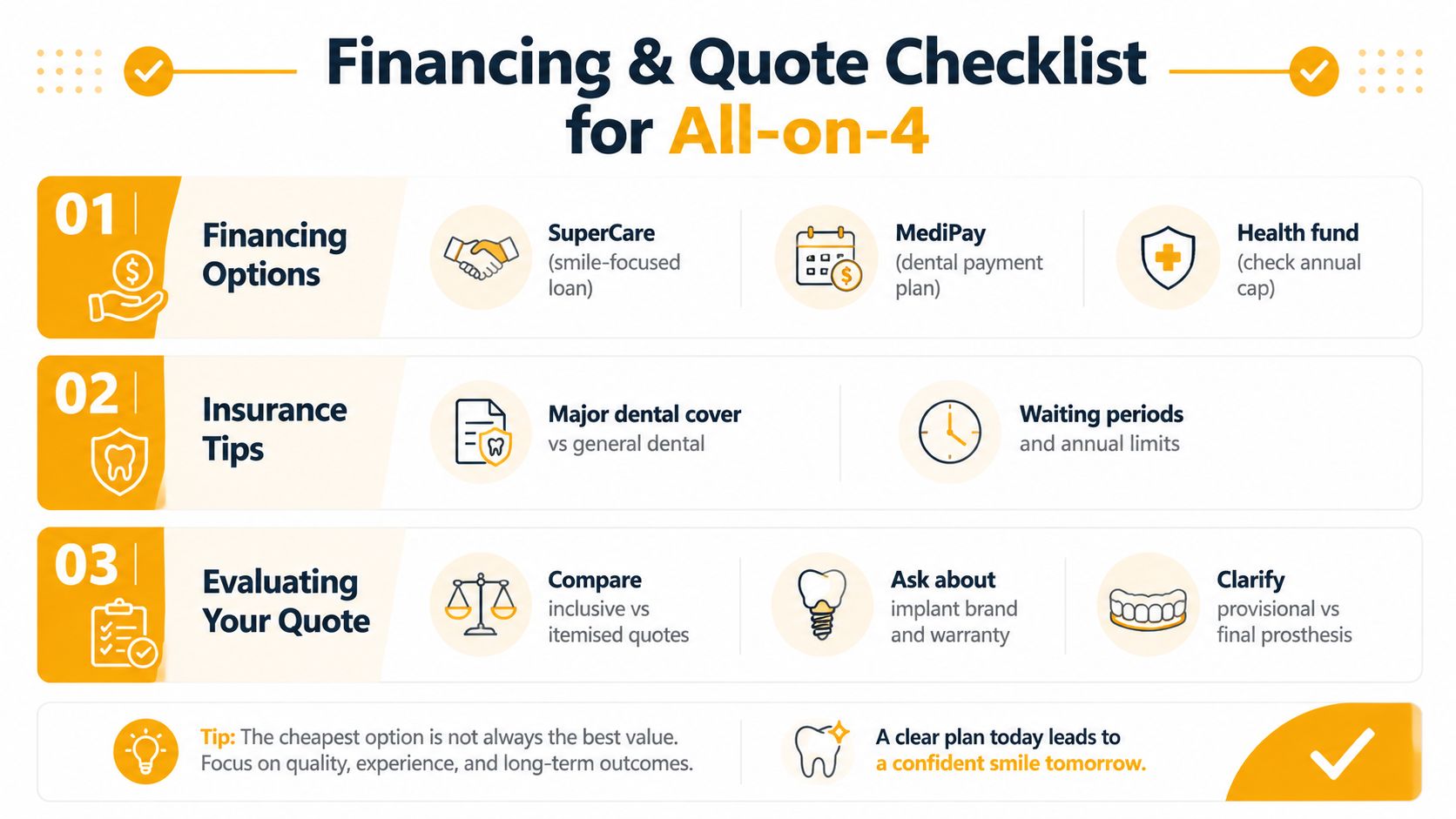
Start with whether the quote is fixed or estimated. A fixed quote gives more certainty, but only if it includes the steps you need. An estimate may be fine early in the process, provided the clinic explains what could change the price later.
Also ask whether the implant system is supplied in Australia and listed on the Australian Register of Therapeutic Goods, because the TGA states dental implant systems are regulated as medical devices and, where supplied in Australia, they must be included in the ARTG unless an exemption applies TGA compliance guidance. That's a concrete compliance point, not a marketing detail.
How to think about payment support
Private health funds may contribute to parts of treatment depending on your cover, though the level of support varies. The most useful move is to ask the clinic for item numbers and then check your own policy rules, annual limits, and waiting periods. For a plain guide to that process, this resource on dental health insurance in Australia is a practical starting point.
If you're comparing financing options, ask whether payment plans are available and what the total repayment looks like once fees are added. Also ask whether the quote separates the temporary arch from the final prosthesis, because that's one of the easiest places for cost confusion to creep in.
A transparent quote should answer three things quickly. What's included, what's optional, and what could change the price.
Your Next Steps at The Smile Spot
The smartest next move is a proper consultation, not a guess based on a price screenshot. All-on-4 can be a very good solution for the right patient, but the final cost only becomes meaningful after the mouth is examined, the prosthesis material is chosen, and the treatment sequence is mapped out. That's the point where budget and biology meet.
The Smile Spot in Dulwich Hill offers implant consultations, restorative care, and advanced technology including Biolase laser dentistry, which supports minimally invasive treatment and can help with comfort in selected cases. The clinic also offers late evening and Saturday appointments, which helps busy patients fit planning into real life rather than postponing it.
Bring any previous dental records, your health fund details, and any quote you've already received. A side-by-side comparison is often the fastest way to see whether a lower number is better or just less complete. If you're ready to understand your options properly, a consultation is the most practical first step.
If you're comparing All-on-4 quotes and want a clearer view of what's included, book a consultation with The Smile Spot in Dulwich Hill. The team can review your goals, explain the cost variables, and build a treatment plan that matches your mouth and your budget.