You're sitting back in the chair, your lip is numb, and the dentist has just said the word laser. For a lot of people, that sounds high-tech, a little intimidating, and maybe even a bit experimental. In reality, a laser root canal is still a root canal, just with a light-based tool helping with cleaning and disinfection inside the tooth.
That matters because root canal treatment is already a routine procedure in dentistry, not a niche one. A global systematic review estimated that 8.2% of teeth have had endodontic treatment and 55.7% of adults have at least one root-filled tooth, which helps explain why comfort and cleaning improvements matter at population scale in Australia too (systematic review). For many patients, the central question isn't whether a laser sounds advanced. It's whether it provides a tangible benefit in the chair, and where it fits beside the proven parts of treatment.
What a Laser Root Canal Actually Is
A patient often hears “laser” and imagines a tooth being zapped instead of treated. That's not what's happening. A laser root canal is still a conventional root canal, with the same goals, remove infected tissue, clean the canal system, and seal the tooth, but a laser is used as an adjunct tool to improve parts of the cleaning process.
At The Smile Spot, that kind of workflow sits inside a normal, calm dental visit, not a science-fiction setup. The laser doesn't replace the dentist's judgement, the files, or the irrigants. It supports them, especially when a tooth has narrow branches, awkward anatomy, or stubborn bacteria hiding deeper inside the root system. Their Biolase workflow reflects that practical approach, the laser is one tool among several, used to make treatment more precise and comfortable.
For patients, the clearest way to think about it is this. Traditional root canal treatment is the main repair job. The laser is the specialist cleaning attachment that helps reach spots the usual tools can't always access easily. If you want a broader look at how laser dentistry is used across the mouth, The Smile Spot's overview of laser in dentistry gives helpful context without overhyping it.
Practical rule: if a clinic describes laser root canal as a replacement for everything else, that's a red flag. The evidence-backed role is support, not magic.
How the Laser Cleans and Heals Inside Your Tooth
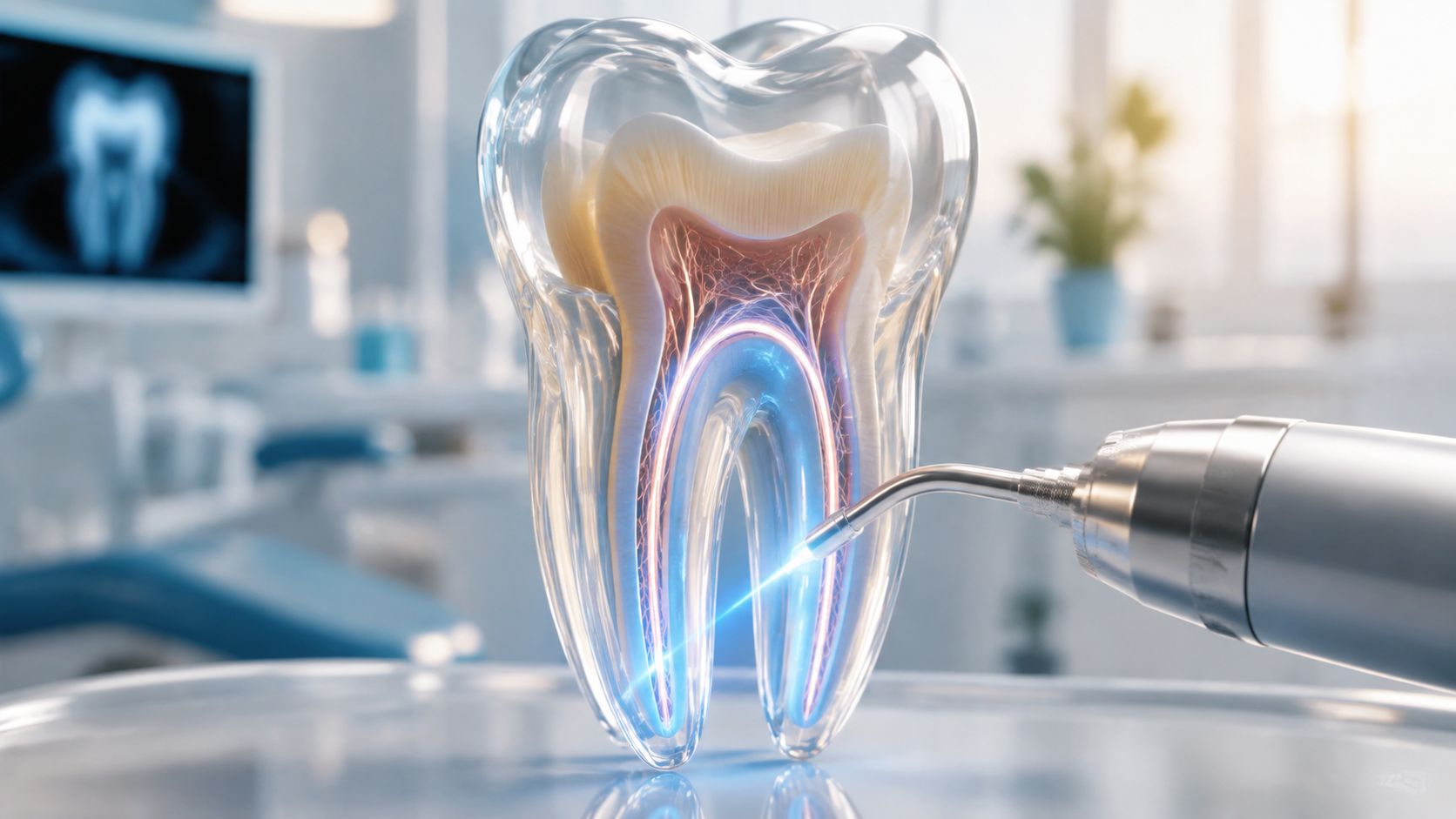
Inside a root canal, the space is tiny, dark, and irregular. A file can shape the canal, but it cannot always reach every side branch or pocket. The laser earns its place by helping with the cleaning step, almost like a microscopic pressure washer that also helps disrupt bacteria.
Different systems do different jobs. Diode lasers are commonly discussed for disinfection. Er:YAG and Er,Cr:YSGG systems are used in laser-activated irrigation, and Nd:YAG has been described for smear-layer evaporation and contraction in endodontic use. In plain English, each wavelength behaves differently in tissue and fluid, so dentists choose the tool based on the canal, the cleaning goal, and the protocol they're using.
Why irrigation matters so much
The light itself is not doing the full job. Its main value comes from what it does to the irrigant already inside the tooth. In photonic-induced photoacoustic streaming, often called PIPS, an Er:YAG laser at 2940 nm is strongly absorbed by water, which creates rapid microcavitation and fluid movement in the irrigant (PIPS review). That movement helps the liquid reach areas that metal files cannot.
A useful way to picture it is a narrow bottle neck. A brush can scrub the sides you can reach, but a shaken cleaning solution swirls into corners the brush misses. In endodontics, that swirling can improve debris and smear-layer removal when it is used properly, alongside sodium hypochlorite and conventional instrumentation.
The Smile Spot's laser periodontal therapy page explains a similar idea in another part of dentistry, where light is used to support cleaning and healing around the gums: laser periodontal therapy.
If you want a broader sense of how light can support healing in dentistry, this science-backed wound care from MedEq Fitness is a useful read. It explains the general idea of light-based support without suggesting every laser behaves the same way.
The main point is simple. A laser does not clean a tooth by itself. It helps chemical disinfection and fluid movement do their work better in the hard-to-reach parts of the canal.
What Happens During the Appointment
A patient usually arrives with the same questions in mind. Will it hurt, what will the dentist do first, and where does the laser fit in? The process is usually more familiar than it sounds.
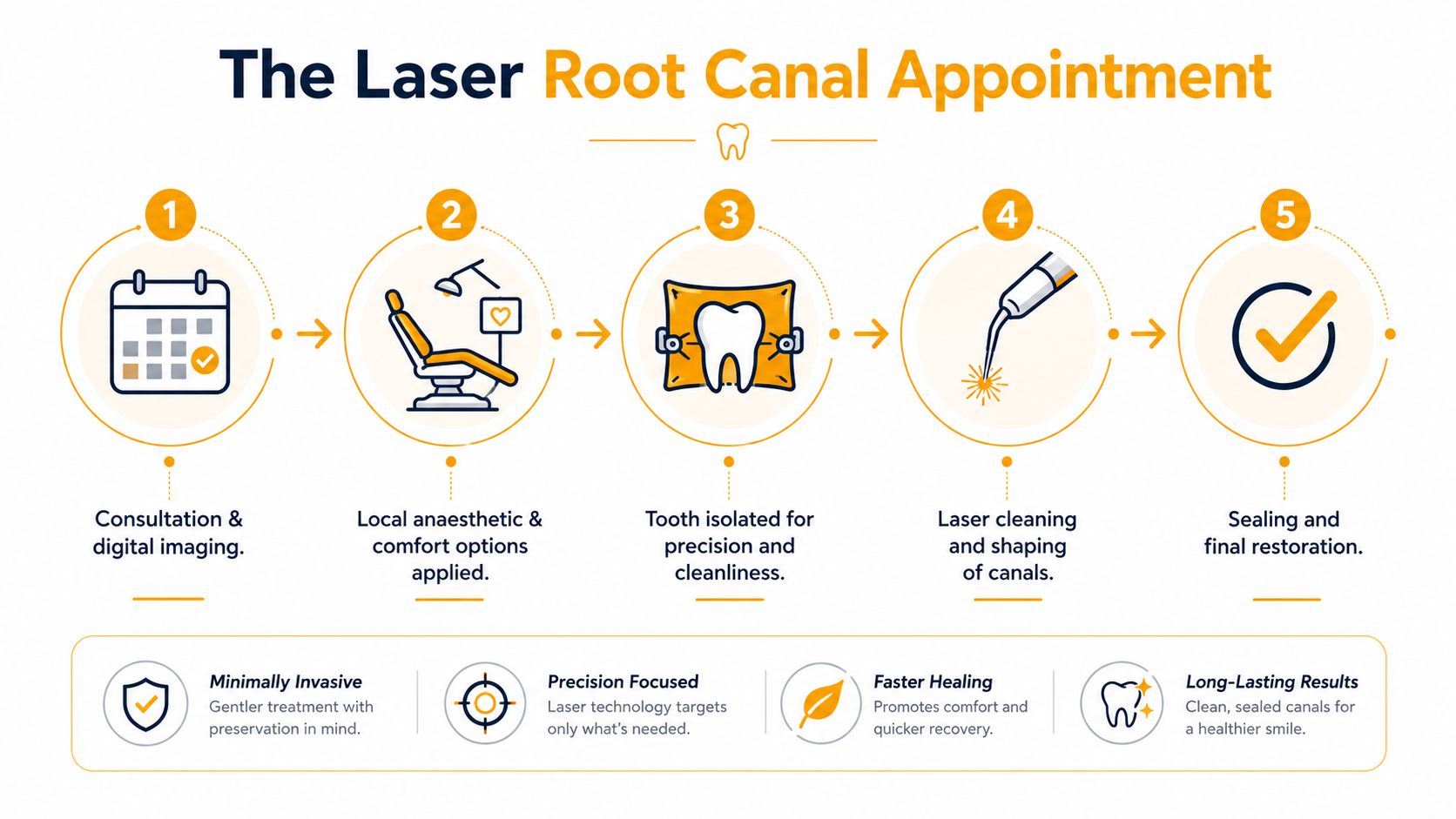
The appointment usually starts with an examination and imaging. The dentist needs to see the tooth's shape, the pattern of infection, and the bone around it before any treatment begins. Local anaesthetic is then given, and comfort options can be discussed for nervous patients. At The Smile Spot, patients who feel anxious can also ask about sedation, which helps many people get through treatment with less stress.
The treatment flow in plain terms
First, the tooth is isolated with a rubber dam so the area stays clean and dry. The dentist then shapes the canals using conventional endodontic instruments. That step is still the backbone of treatment, because the canal needs physical preparation before any laser step can assist.
Once the canal is prepared, the laser is used to support disinfection inside the root system. This is the part many patients ask about, but it sits inside a standard root canal workflow rather than replacing it. If a case also involves gum tissue, The Smile Spot's guide to laser periodontal therapy explains how the same technology can be used outside the root canal as well.
For a broader look at the usual sequence of treatment, The Smile Spot's guide to RCT treatment steps is a helpful companion. The laser-assisted version follows the same overall structure, just with an added cleaning aid used at the right point.
For practical home care after procedures that involve sterilisation or light-based treatment, a general hygiene resource like UV cleaning for home use can be useful context, although it is obviously not a substitute for dental treatment. It is a reminder that cleaning tools work best when the whole process is controlled and methodical.
The final steps are irrigation, sealing, and either a temporary or permanent filling. Some appointments finish with a straightforward restoration discussion, while others need a separate visit for the final crown or filling, depending on the tooth and the amount of remaining structure.
Laser Root Canal vs Traditional Root Canal
A lot of marketing makes this comparison sound bigger than it is. Both treatments aim for the same result, keeping the tooth in place. The practical difference is how the canal is cleaned and disinfected, and how the tooth may feel in the first part of recovery.
The strongest evidence places lasers in an adjunct role. A 2024 systematic review and meta-analysis found laser-based treatments produced a 32.4% higher rate of “no/mild pain” versus placebo and a 28.9% increase versus combined controls, with the clearest benefits from 4 to 72 hours after treatment (2024 review). Separate clinical work also showed lower pain scores at 6, 12, 24, and 48 hours in the laser group, and one study reported diode laser disinfection of 90% against E. faecalis compared with less than 2% in controls (clinical study).
That still does not show lasers are better than conventional treatment for long-term success. Dentists stay cautious because the promise is support, not replacement.
| Factor | Traditional Root Canal | Laser-Assisted Root Canal |
|---|---|---|
| Cleaning approach | Files and irrigants do the main work | Files and irrigants still do the main work, with the laser helping disinfection |
| Post-op comfort | Often manageable, but varies | Often aimed at less early discomfort |
| Complex anatomy | Effective, but some areas are harder to reach | Can help irrigant movement in hard-to-reach spaces |
| Noise and vibration | More noticeable for many patients | Often feels less mechanical during the laser step |
| Long-term success | Strong baseline treatment benchmark | Promising, but not proven superior overall |
A fair comparison also has to include the limits. A review on laser use in root canal disinfection concluded lasers have bactericidal effects but cannot replace sodium hypochlorite and should be used as an adjunct to conventional chemical disinfection (review). Another high-power laser review described baseline root canal therapy success rates of about 95% for irreversible pulpitis and 85% for necrotic pulp, which shows how effective standard care already is (high-power laser review).
For a plain-language overview of how root canal care is approached in practice, The Smile Spot's guide to dentistry for root canal treatment is a useful companion. It sits well beside the comparison here, because the main question is usually not whether a laser can do everything, but whether it can add value in the right case.
If you want a related example of how clinics compare treatment costs across different laser services, you can also compare CoolPeel laser costs. The numbers and the context are different, of course, but the same basic rule applies. A device is only worth discussing when it adds something meaningful to the treatment plan.
Bottom line: the laser can improve cleaning and may reduce discomfort, but it does not remove the need for proper endodontic technique.
Who Is a Good Candidate and What It Costs
A laser step can be useful in the right tooth, but it is not needed for every case. It tends to suit teeth with complex curved canals, retreatment cases, or situations where better irrigation reach may help the dentist clean deeper inside the canal system. Some anxious patients also like the lower noise and reduced vibration, as long as they understand they are still having a real root canal, not a shortcut around it.
Some teeth need more caution. Heavily restored teeth, very narrow canals, and difficult retreatments can make laser access less straightforward, and that is where a careful clinical judgment matters more than the technology label. A review noted that among 22 included studies, 15 reported potential dentinal crack formation, which is one reason a laser should be selected thoughtfully rather than assumed to be safer in every case (review). A separate synthesis also warned about thermal damage and sensitivity to settings when the technology is used poorly (recent review).
What patients should ask before booking
- Is my tooth suitable? Canal shape and the amount of remaining tooth structure matter.
- Is this a first-time treatment or a retreatment? Retreatment cases often need a more customized plan.
- Will the laser replace anything? No, it works alongside conventional endodontic care.
- Do I need a specialist endodontist? Some teeth are better managed by a specialist, especially when the anatomy is complex.
Cost in Australian private practice varies because the time involved, the tooth being treated, imaging, and whether a specialist is needed all affect the final fee. Some clinics, including The Smile Spot, discuss pricing upfront so patients can plan without surprises. For a broader sense of how clinics talk about laser pricing, it can help to compare CoolPeel laser costs, because the same basic idea still applies. The technology matters, but the complexity of the treatment shapes the fee too.
If you are reading The Smile Spot's page on dentistry for root canal, the practical takeaway is simple. The right candidate is the one whose tooth, symptoms, and goals match the tool, not the one drawn in by the word “laser.”
Recovery and Aftercare Day by Day
Day one is usually about numbness, not drama. Once the anaesthetic wears off, the tooth or jaw can feel tender for a short time, and that's normal after root canal treatment. Chew on the other side if you can, and avoid anything hard until the dentist says the tooth is ready.
Day two to day three is when judging whether the tooth is settling typically begins. Mild soreness that eases is expected. Sharp pain, swelling, a bad taste, or pain that gets worse instead of better should prompt a call to the clinic.
Simple aftercare that actually helps
- Eat soft foods first. Soup, yoghurt, eggs, and similar meals reduce pressure on the tooth.
- Brush gently. Keep the area clean without scrubbing the temporary filling.
- Avoid hard chewing. Crackers, nuts, and ice can strain a tooth that hasn't been permanently restored yet.
- Take prescribed or recommended pain relief as directed. Don't wait for discomfort to become severe.
By day four to day seven, patients are either steady or clearly improving. If the tooth still feels high when you bite, or the temporary filling feels loose, it's worth checking in. Final restoration matters too, because a crown or permanent filling protects the tooth long term once the canal system has been sealed.
If you want a more detailed recovery checklist, The Smile Spot's guide on root canal recovery time is a practical companion. The big idea is simple. Good aftercare keeps a good procedure from being undone by avoidable stress on the tooth.
Common Questions Patients Ask Before Booking
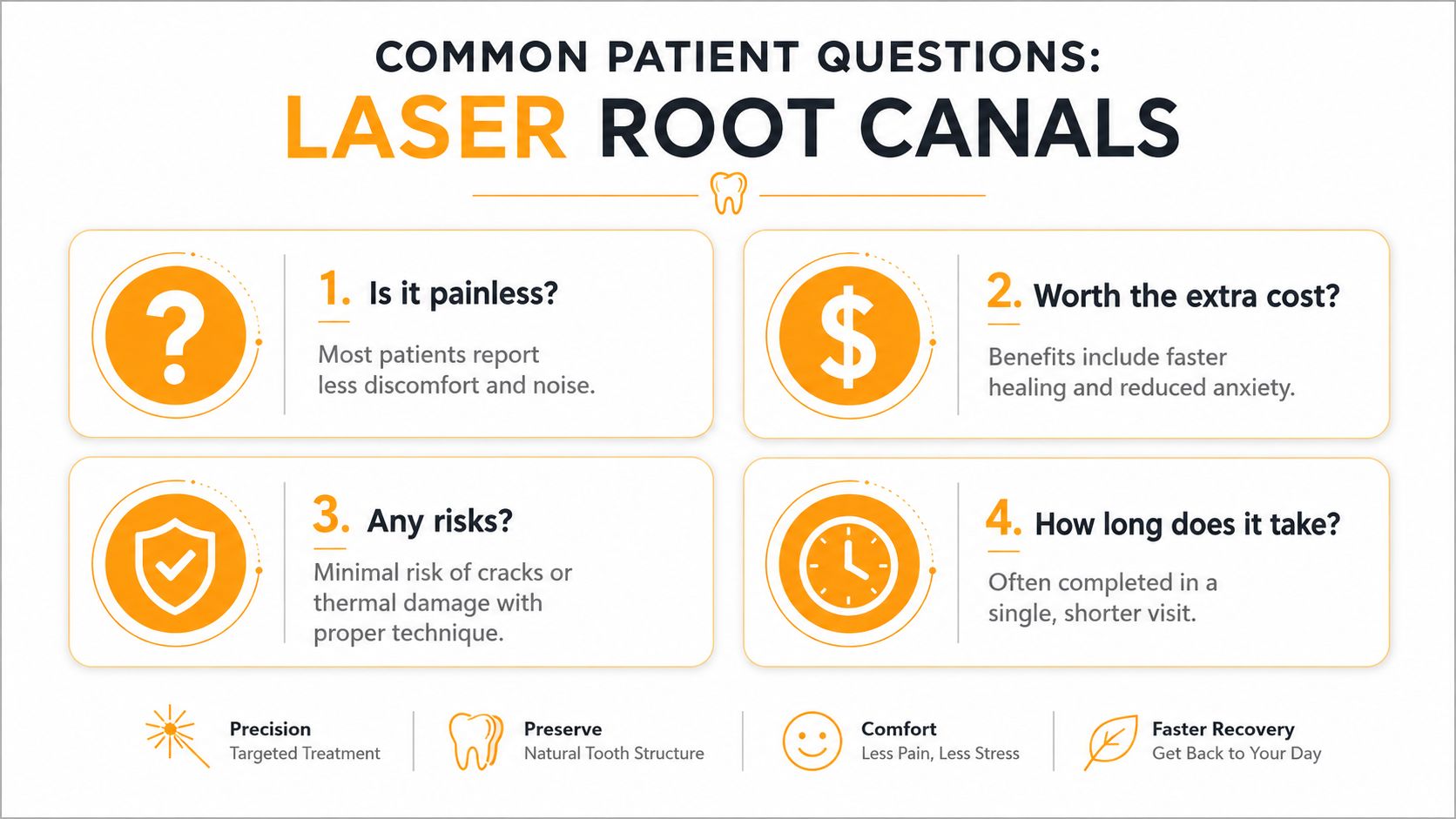
Is a laser root canal painless? Some tenderness can still happen, and no careful dentist should promise a pain-free procedure for everyone. What the evidence supports is that many patients report less early discomfort after treatment, especially in the first 4 to 72 hours, but local anaesthetic and proper endodontic care are still part of the job (2024 review).
Is it worth paying more for? Sometimes it is, especially if the tooth is complex, you feel anxious in the chair, or the dentist believes extra disinfection support may help. If the case is straightforward, conventional treatment may already be enough. The right call depends on the tooth in front of you, not the marketing label.
Are there risks? Yes. Reviews warn about thermal damage, sensitivity to the laser settings, and possible dentinal cracks if the device is used poorly or in the wrong situation (review, review). That is why the dentist's judgement matters more than the brand of laser.
How long does it last? A well-done root canal can last a long time, but the result still depends on the seal, the final restoration, and the condition of the tooth itself. A laser may help with cleaning, but it does not replace a solid crown or filling, or careful follow-up.
A common misunderstanding is that newer equipment automatically gives a better outcome. In endodontics, it is more measured than that. A laser can make treatment more comfortable or more thorough in certain cases, but the basic rules of tooth survival still apply.
Choosing a Gentle, Modern Root Canal in the Inner West
If you're weighing a laser-assisted root canal, the best question isn't “Is it high-tech?” It's “Does my tooth need this extra help, and do I trust the team using it?” In Dulwich Hill, The Smile Spot pairs Biolase laser dentistry with gentle techniques, sedation options for anxious patients, late-evening and Saturday hours, online booking, and acceptance of most private health funds.
Dr Dimitrios Thanos and the team can talk through whether your tooth is a good fit for laser-assisted cleaning or whether standard endodontic care makes more sense. That kind of honest triage matters more than any marketing claim, because the goal is still the same, save the tooth, calm the nerves, and keep the treatment sensible.
If you live in Marrickville, Earlwood, Ashfield, Summer Hill, Lewisham, Petersham, or Hurlstone Park, book a consultation and ask whether a laser-assisted root canal is the right fit for your tooth.
If you're ready for a calm, clear conversation about your tooth, book with The Smile Spot and ask about laser-assisted root canal treatment, comfort options, and whether your case is a good candidate for Biolase support. The team can walk you through the choices in plain English and help you plan the next step without pressure.