Composite bonding in Australia is commonly discussed at A$150 to A$700 per tooth, and a typical single-tooth figure often lands around A$100 to A$500 out of pocket in consumer-facing pricing guides. If you're pricing a chipped front tooth or a small gap, that's the range most patients can use as a realistic starting point.
You're usually not paying for resin alone. You're paying for diagnosis, shade matching, chair time, finishing, and the skill needed to make a repair disappear in a smile line.
What Composite Bonding Is and Why the Price Tag Confuses People
A patient can bring in one chipped front tooth and expect a quick fix, then be surprised that the quote also reflects matching the surrounding teeth, checking bite contact, and making the repair disappear under daylight and indoor lighting. That is where the price confusion starts. Composite bonding looks straightforward from the waiting room, but the final fee is built from the actual chairside work, the number of teeth involved, and how precise the colour match has to be.
Composite bonding is a tooth-coloured resin placed directly onto the tooth, shaped by hand, then hardened and polished in one visit. It is used for chips, small gaps, edge wear, and reshaping teeth that are slightly uneven. The material itself is only part of the treatment. A front tooth that sits in the smile line often needs more careful layering and finishing than a back tooth or a small corner repair.
A simple example is a single incisor chip with one nearby shade to match. If the neighbouring tooth is fairly uniform, the case may be straightforward. If the enamel has white flecks, translucency near the edge, or a warmer colour near the gumline, the dentist may need to blend several resin tones so the repair does not stand out. That extra matching time is one reason two patients can hear very different quotes for what sounds like the same treatment.
A small chip repair and a full smile-line reshape may both be called bonding, but they are not the same job clinically or financially.
Why one quote looks easy and another doesn't
The fee changes because the dentist is not billing a single object, they are billing a sequence of clinical steps. A tiny repair may only need cleaning, roughening, resin placement, contouring, and polish. A broader aesthetic case can require isolation, layering, detailed shaping, and several rounds of adjustment so the tooth sits naturally next to its neighbours.
Time in the chair matters, but so does the level of finish. A front tooth that catches every reflection needs a more careful polish than a small repair hidden from view. If a case needs photographs, imaging, or a review of the bite before treatment starts, those steps also sit inside the total a patient pays.
That is why one patient with a single chipped tooth may receive a very different estimate from someone who wants three or four front teeth matched and refined together. It is also why some clinics prefer to explain bonding as a treatment plan rather than a simple shelf price.
For a broader look at how cosmetic treatments are often grouped in Australian private practice, see The Smile Spot's cosmetic dentistry guide. It gives useful context for bonding without making the decision feel bigger than it is.
What the treatment is really for
Bonding is usually chosen when the problem is localised. If the tooth is structurally sound and the goal is to improve shape, close a gap, or smooth a visible defect, bonding often makes sense. If the tooth is heavily broken down or the cosmetic change is much more ambitious, the quote naturally moves because the work moves.
It also suits patients who want a conservative repair and are comfortable with the maintenance that comes with resin. The decision is rarely only about appearance. It is about how much change the tooth needs, how much precision the smile line demands, and how much time the dentist must spend to make the result hold up in everyday use.
Typical Composite Bonding Teeth Cost in Australia
A patient asking about composite bonding teeth cost usually wants one clear number, but the answer depends on whether the case is a single repair or a broader cosmetic plan. In practice, the total is shaped by consultation, photos, shade matching, and any follow-up adjustments that are needed after the first appointment. For a rough starting point, private-market guides commonly place bonding around A$150 to A$700 per tooth, with overseas pricing references showing a similar spread for simple repairs and more detailed aesthetic work (source).
Australian consumer pricing guides often describe bonding as A$100 to A$500 per tooth out of pocket, which is a more practical benchmark for local patients trying to compare clinics and treatment plans (source). That range is broad because the fee is not just about resin on the tooth. It reflects chair time, colour matching, contouring, polishing, and the extra care needed when the result has to sit naturally beside the front teeth.
The total also rises quickly once several teeth are treated together. A single chipped edge can stay near the lower end of the range, while matching multiple front teeth pushes the fee higher because each tooth has to be shaped, blended, and finished as part of one smile rather than as an isolated repair. In Australian private practice, that is often the difference between a straightforward fix and a treatment plan that needs a longer appointment and more refinement.
Published pricing guides from the UK show the same pattern, with single-tooth bonding commonly quoted at £150 to £400 per tooth and larger smile makeovers reaching A$900 to A$4,000 in comparable cases (source). Those figures are not an Australian price list, but they do show how bonding costs climb once the work moves from one tooth to several, even though there is no lab fee in the background.
Composite Bonding Cost Bands in Australia
| Treatment Scope | Typical AU Range | What Drives the Fee |
|---|---|---|
| Small chip or edge repair | Lower end of the per-tooth band | Minimal resin, less chair time, simpler finishing |
| Single front tooth cosmetic bonding | A$100 to A$500 per tooth out of pocket (source) | Shade matching, shaping, polishing |
| Multi-tooth cosmetic bonding | Can move into four figures | Chair time scales with tooth count, more finishing, more adjustment |
| 6-to-10-tooth smile makeover | A$900 to A$4,000 in comparable UK guidance (source) | Case complexity, location, clinician experience |
The part that often surprises patients is how much the final out-of-pocket amount can differ from a headline sticker price. A consultation, imaging, and a review visit after treatment all add to the cost, especially when more than one front tooth is being matched. For a straightforward explanation of how bonding is planned in a local practice, The Smile Spot's cosmetic tooth bonding overview shows the kind of treatment breakdown patients usually need before they can compare quotes with confidence.
What Changes Your Final Quote
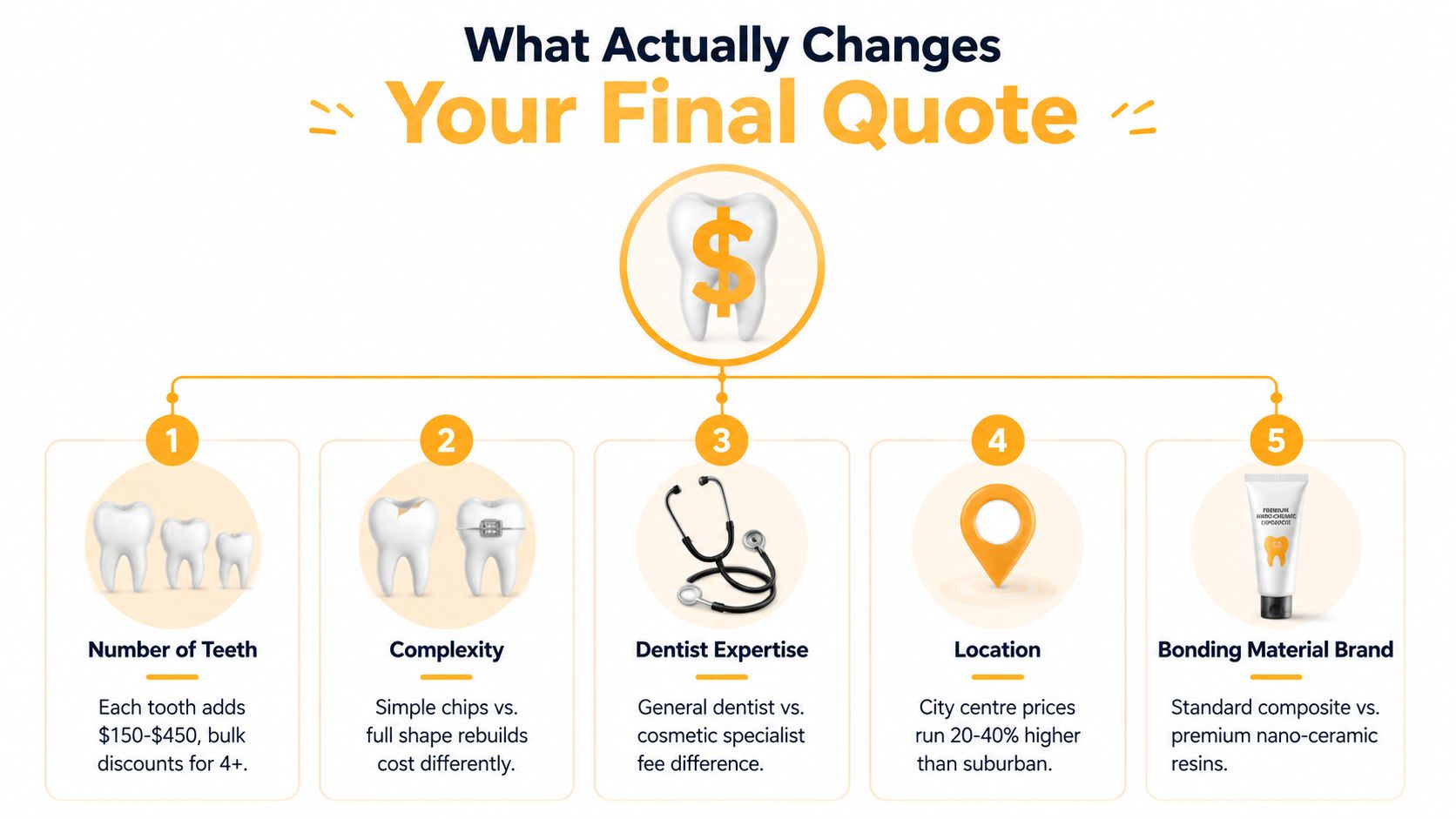
A quote rises because of time and judgement, not just materials. Composite resin itself is not the expensive part. The fee changes because the dentist has to design the shape, control moisture, layer the material carefully, and make the surface sit naturally in the smile line.
The key distinction between quotes comes down to three variables.
Tooth count and case complexity
A one-tooth chip repair is very different from bonding four upper front teeth so they match each other. More teeth mean more isolation, more shade work, and more finishing across several surfaces. A simple repair is mostly additive, while a larger aesthetic case needs more contouring and more balance across the smile.
Dentist experience and location
Experience matters because composite bonding is part clinical skill, part visual judgement. A dentist who does a lot of cosmetic work may charge differently from a general dentist who only does occasional repairs. Location matters too, with central practices often pricing differently from suburban clinics because overheads and demand are not the same.
Material choice and rework risk
Not every resin behaves the same in the chair. The dentist also has to factor in how much finishing and repolishing may be needed later, especially if the bite is tight or the tooth sits in a high-load area. When a case is more likely to need refinement, the upfront fee often reflects that extra chair time.
If the bonding chips early or needs repeated adjustment, the cost climbs quickly.
For a straight comparison with a more expensive cosmetic option, see The Smile Spot's veneer cost guide. It makes the trade-off between conservative bonding and porcelain much easier to read.
What Happens During the Appointment
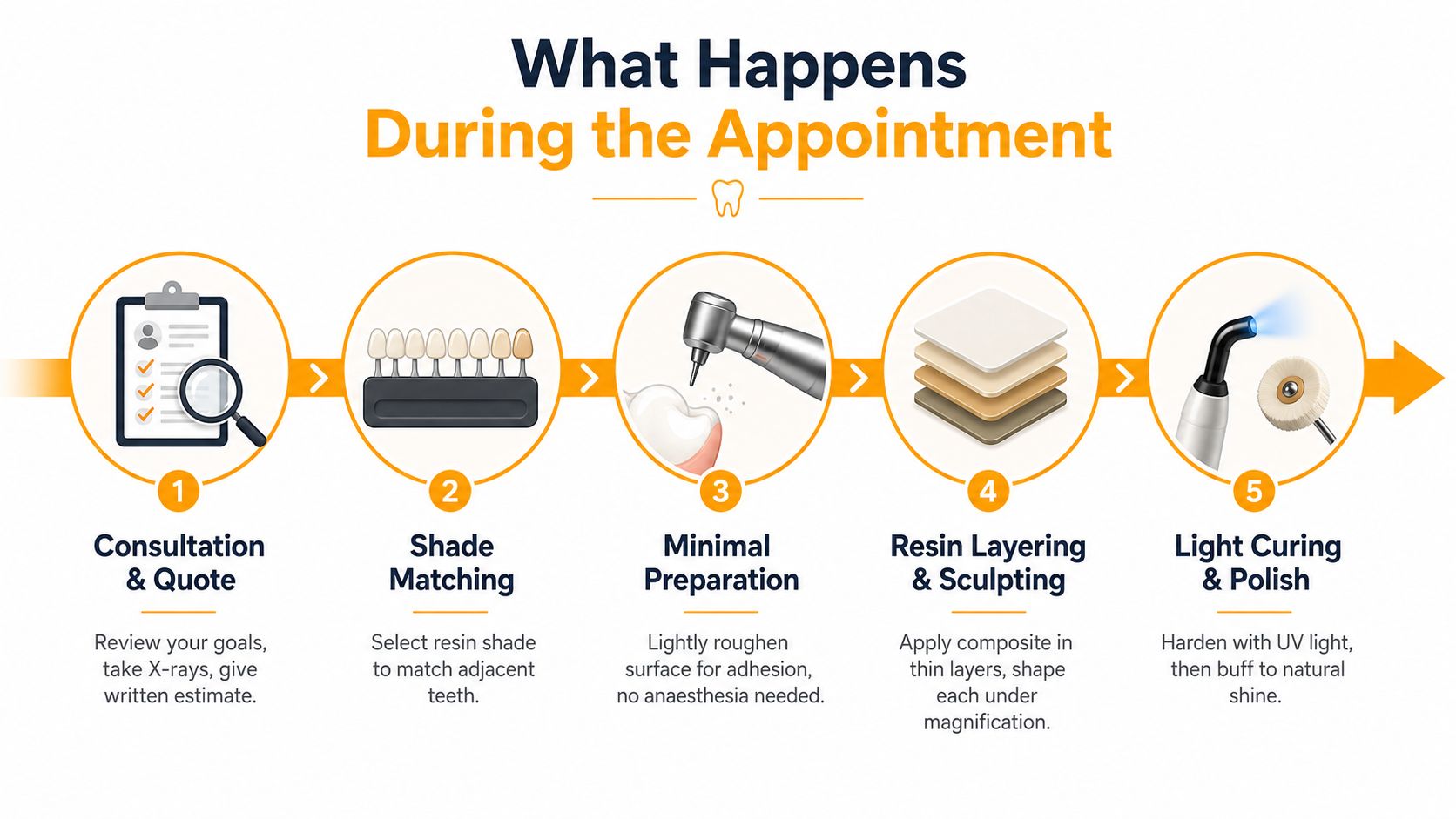
The appointment starts with a review of the tooth, the bite, and the look you want to change. That first part matters because a bonding case can look cosmetic on the surface but still need a small structural assessment before resin ever touches enamel.
Next comes shade matching. The dentist chooses a resin shade against the surrounding teeth so the repair doesn't stand out in daylight or flash photography. After that, the tooth is lightly prepared so the resin can adhere properly, then the material is placed in thin layers, shaped, and cured with a light before final polishing.
A longer bonding appointment usually means more shaping and more polishing, not just “extra time in the chair”.
That's why a one-hour spot repair and a broader smile-line session don't cost the same. One may need a single surface rebuilt, the other might involve multiple teeth and a lot more contouring to make the result look even.
A practical way to think about the fee is this. You're paying for a sequence of hands-on steps, and each one adds chair time. The more teeth that are included, the more those steps repeat.
For a visual sense of real chairside results, The Smile Spot's bonding before-and-after gallery post is a useful reference point before you decide how much change you want.
Composite Bonding Versus Veneers, Crowns, and Whitening
Composite bonding sits in the practical middle of cosmetic dentistry. It asks for less tooth removal than porcelain, gives more control than whitening, and is usually easier to repair if the result needs adjusting later. For a patient whose teeth are healthy but have a chip, a gap, or a shape issue, that balance often makes the fee easier to justify than jumping straight to a more permanent option.
Whitening changes colour only. It will not close a gap, rebuild a worn edge, or disguise a small fracture line. Veneers and crowns handle larger aesthetic or structural problems, but they come with a higher fee because the work is more involved and usually less reversible. If the concern is small and localised, those treatments can be more than the mouth needs.
How the options stack up in real life
| Treatment | Typical cost | Main use | Main trade-off |
|---|---|---|---|
| Composite bonding | A$150 to A$450 per tooth in comparable market guidance | Chips, gaps, small reshaping | Less durable than porcelain |
| Porcelain veneers | Higher than bonding, often used for major smile changes | Shape, colour, symmetry | More irreversible |
| Crowns | Higher again, usually for damaged teeth | Heavy structural repair | More tooth reduction |
| Whitening | Colour-only change | General stain removal | Doesn't alter tooth form |
A table like this is useful, but it does not tell the whole story. In chairside planning, I usually look at how much tooth structure is still healthy, how visible the tooth is in the smile, and whether the patient wants a conservative repair or a longer-term cosmetic rebuild. That is where the cost difference starts to make sense.
Here is a common scenario from practice. A patient may come in wanting a darker front tooth to blend in with the smile line. If the tooth is intact and the issue is mainly shape and colour, bonding can correct the look with less preparation and a smaller bill than veneers. If the same tooth is cracked, heavily worn, or has already been treated several times, the conversation shifts, because the better clinical answer may be a crown or porcelain veneer even though the upfront cost is higher.
The practical choice is usually simple. If the tooth is sound and the change is local, bonding is often the first option worth considering. If the tooth is heavily damaged, a crown may be more appropriate. If colour is the main concern, whitening may give the biggest visible change with the least treatment.
For a broader sense of how patients compare value across different types of cosmetic fixes, the same logic shows up in best drugstore makeup swaps, where a targeted lower-cost option often does most of the visible work without paying for a full premium replacement.
If you want a patient-facing comparison between a conservative repair and porcelain, The Smile Spot's bonding versus veneers guide is a useful next read.
Realistic Results, Longevity, and Maintenance
Bonding looks most natural when it's matched well on day one, but it won't age exactly like enamel. Composite is more prone to staining and edge wear than porcelain, and that means the finish needs sensible care if you want it to stay discreet. In practical terms, bonding is a repairable cosmetic treatment, not a forever solution.
The upside is that it's conservative. If a small section chips or dulls, the dentist can often repair or repolish it without starting from scratch. That's one reason patients like it for front teeth, especially when they want to keep as much natural tooth structure as possible.
What helps it last
- Avoid hard bite points: Don't use bonded teeth to crack nuts, bite ice, or open packets.
- Watch staining habits: Coffee, tea, red wine, and smoking will mark composite faster than enamel.
- Get maintenance polish visits: A quick repolish can restore gloss and clean up surface staining before it becomes obvious.
- Protect against grinding: A nightguard helps if you clench or grind, because that extra pressure shortens the life of the repair.
The useful mindset is to treat bonding as a maintained cosmetic surface. If you look after it, it can stay attractive for years. If you load it hard or ignore staining and wear, you'll pay again sooner.
Health Funds, Payment Plans, and Reading Your Treatment Plan
Most Australian private health funds handle bonding conservatively, and the rebate can vary a lot depending on how the item is classified. Because dental care is only partially covered, if at all, by Medicare, many patients end up paying a meaningful out-of-pocket amount even when they have extras cover (source). That's why the treatment plan matters as much as the quote.
The treatment plan should tell you what's included, not just the headline number. Look for consultation fees, imaging, the number of teeth treated, and any planned review or adjustment visit. If those items aren't clear, ask before you book.
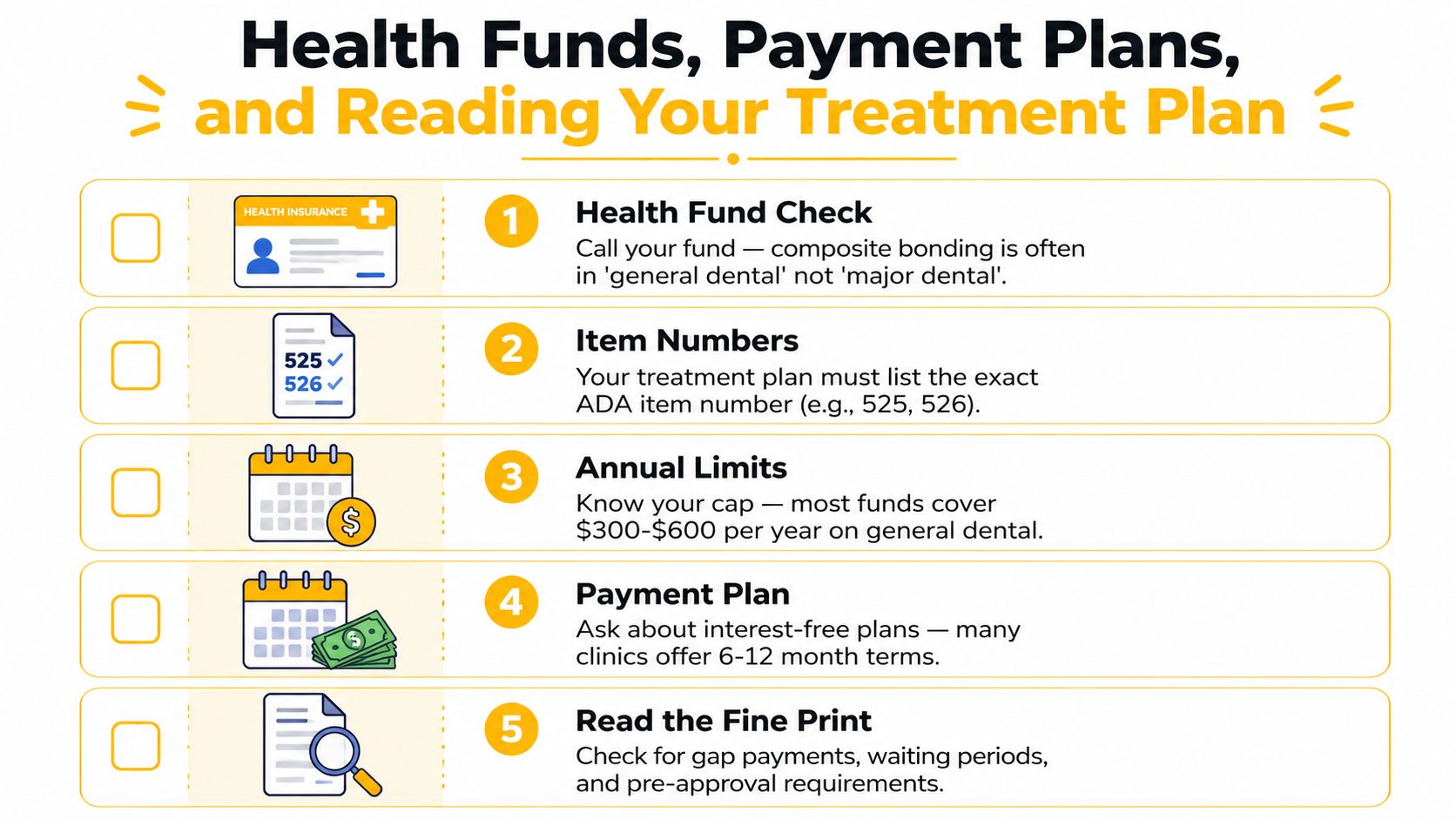
What to check before you agree
- Health fund category: Composite bonding may sit under general or cosmetic dentistry, so confirm how your fund classifies it.
- Exact item numbers: Ask for the item number on the plan so you can check your rebate properly.
- Annual limits: Many general dental limits are modest, so a large bonding case can use most or all of them.
- Payment flexibility: If you need to spread the cost, many clinics can discuss instalment options.
- Pre-approval and gap payments: Get clarity early so there's no surprise at the front desk.
If you want to compare instalment-style budgeting with a third-party option, the Gerald Technologies buy now pay later app is one example of the kind of payment tool patients sometimes use to spread non-emergency treatment costs. The key is to check the total cost, not just the repayment label.
Composite Bonding at The Smile Spot in Dulwich Hill
In Dulwich Hill, the most useful bonding quote is the one that matches the actual case, not a generic per-tooth number. At The Smile Spot, composite bonding is approached as an itemised cosmetic service, which suits patients who want to understand the consult, the tooth count, and the likely follow-up before treatment starts. That matters in the Inner West, where people are often comparing a quick repair against a broader smile plan and need clear numbers before they commit.
The practice also offers a wider cosmetic and preventive setting around the work, so a bonding case can be assessed alongside whitening, veneers, crowns, or routine care when appropriate. Dr. Dimitrios Thanos, a University of Sydney graduate and principal dentist since 1996, leads the clinic with a conservative, practical approach to treatment planning. For patients who are anxious or time-poor, the combination of transparent fees, online booking, and extended hours makes it easier to get an actual plan instead of a vague estimate.
If you're deciding between a small repair and a multi-tooth cosmetic change, ask for a written breakdown that shows what's included and what could change the final fee. That should cover consultation, imaging, the number of bonded teeth, and any likely review visit. Once you've got that, it becomes much easier to compare bonding with other options without guessing.
If you're in Dulwich Hill or anywhere in the Inner West and you're weighing up a chipped tooth, a gap, or a smile-line refresh, book a consultation with The Smile Spot and ask for an itemised composite bonding plan. You'll get a clearer picture of what the treatment involves, what drives the fee, and whether bonding is the right fit for your teeth before anything begins.