The appointment is in your calendar, but your body has already decided it's a bad idea. Your shoulders tighten. You replay an old dental memory. You wonder whether you can put it off for another few months, even though the tooth has started bothering you when you drink something cold.
That reaction is more common than many people realise. Dental anxiety affects approximately 1 in 6 Australian adults, or 15.3%, and 3.3% experience severe dental phobia or odontophobia according to this Australian dental anxiety overview. If you've been delaying treatment because you feel tense, embarrassed, or overwhelmed, you're not unusual and you're not difficult.
Sedation can change that experience. It doesn't replace good communication, gentle treatment, or trust, but it can make dental care feel manageable again. For some patients, the hardest part isn't the procedure. It's making the call, hearing the phone ring, and talking through it when they're already stressed. That's one reason tools like an AI receptionist for dental clinics can be quite useful. They can reduce friction at the first point of contact, which matters when anxiety is already high. If you're also looking for a gentler approach overall, this article on finding a gentle dentist near me is a helpful place to start.
Your Path to a Stress-Free Dental Experience
A patient with dental anxiety often doesn't walk in saying, “I'd like sedation.” More often, they say they've cancelled before, they hate the sound of the drill, they gag during impressions, or they need a lot of work done and can't face doing it over multiple visits.
That's where general sedation dentistry becomes less abstract and more practical. The goal is simple. Help you stay calm enough to receive care safely, with less distress and less mental exhaustion.
You don't have to “push through” fear to deserve treatment. A good sedation plan meets you where you are.
For some people, a calm visit means mild support such as happy gas. For others, it means oral medication or IV sedation arranged with appropriately qualified providers. The right option depends on your health, the procedure, and how your anxiety shows up on the day.
Why anxiety changes treatment decisions
An anxious patient doesn't just feel uncomfortable. Anxiety can affect timing, cooperation, and the type of treatment that's realistic in one sitting. It can also lead to delaying care until a small issue becomes harder to treat.
That's why sedation dentistry is best thought of as part of modern patient-centred care, not as an extreme last resort. Used properly, it helps people get necessary dentistry done in a way that feels controlled rather than overwhelming.
Understanding Sedation Dentistry and Its Candidates
Sedation dentistry is best understood as a dimmer switch for anxiety, not an on-off button. At one end, you're more relaxed. At the other, you may be heavily sedated or fully unconscious in a hospital setting. The key distinction is that not every level is offered in every clinic, and not every patient needs the deepest option.
Sedation also isn't the same as pain control. Local anaesthetic still does the work of numbing the tooth or gum area. Sedation reduces fear, tension, and the feeling of being on edge while treatment happens.
If you've read about oral sedation dentistry, you'll know that many patients don't need hospital-based general anaesthesia. They need a level of support that makes routine or moderately complex care feel tolerable and calm.
Who tends to benefit most
Some patients are obvious candidates. Others only realise it after years of difficult appointments. Sedation may be appropriate if any of these sound familiar:
- High dental anxiety: You lose sleep before appointments, avoid booking, or become tearful or panicky in the chair.
- A strong gag reflex: Even simple procedures become stressful because instruments, suction, or impressions are hard to tolerate.
- Low tolerance for lengthy visits: You can cope with short check-ups but struggle when treatment takes longer.
- Past difficult experiences: One bad appointment can make future care much harder, even if the current dentist is gentle and careful.
- Complex treatment needs: Multiple extractions, implant-related work, or extensive restorative care may be easier with sedation support.
- Difficulty getting numb or staying settled: Some patients remain physically tense throughout treatment, which can make the appointment harder for everyone.
- Sensory sensitivity: Sounds, smells, vibration, and the feeling of instruments can be enough to trigger distress.
Who may need a different plan
Not everyone is a suitable candidate for every sedation level. Medical history matters. Current medications matter. So does the specific procedure.
Practical rule: The safest sedation plan is the one matched to both the treatment and the patient, not the one that sounds strongest.
That's why a proper assessment comes first. A rushed, one-size-fits-all approach doesn't work well in sedation dentistry. Careful screening does.
The Four Main Types of Dental Sedation
The simplest way to compare sedation options is to think in layers. Each layer changes how relaxed you feel, how it's given, and what sort of procedures it suits. In Australian practice, it's also important to distinguish clinic-based conscious sedation from hospital-based general anaesthesia.
Comparing your sedation dentistry options
| Sedation Type | Level of Consciousness | How It's Administered | Best For |
|---|---|---|---|
| Nitrous oxide | Awake and relaxed | Inhaled through a nosepiece | Mild anxiety, shorter appointments |
| Oral conscious sedation | Awake but drowsy | Medication taken by mouth | Moderate anxiety, longer or more stressful treatment |
| IV sedation | More deeply relaxed, still responsive | Medication through a vein | Significant anxiety, complex or lengthy care |
| General anaesthesia | Fully unconscious | Delivered by specialist anaesthesia team | Major oral surgery, selected high-complexity cases |
Nitrous oxide
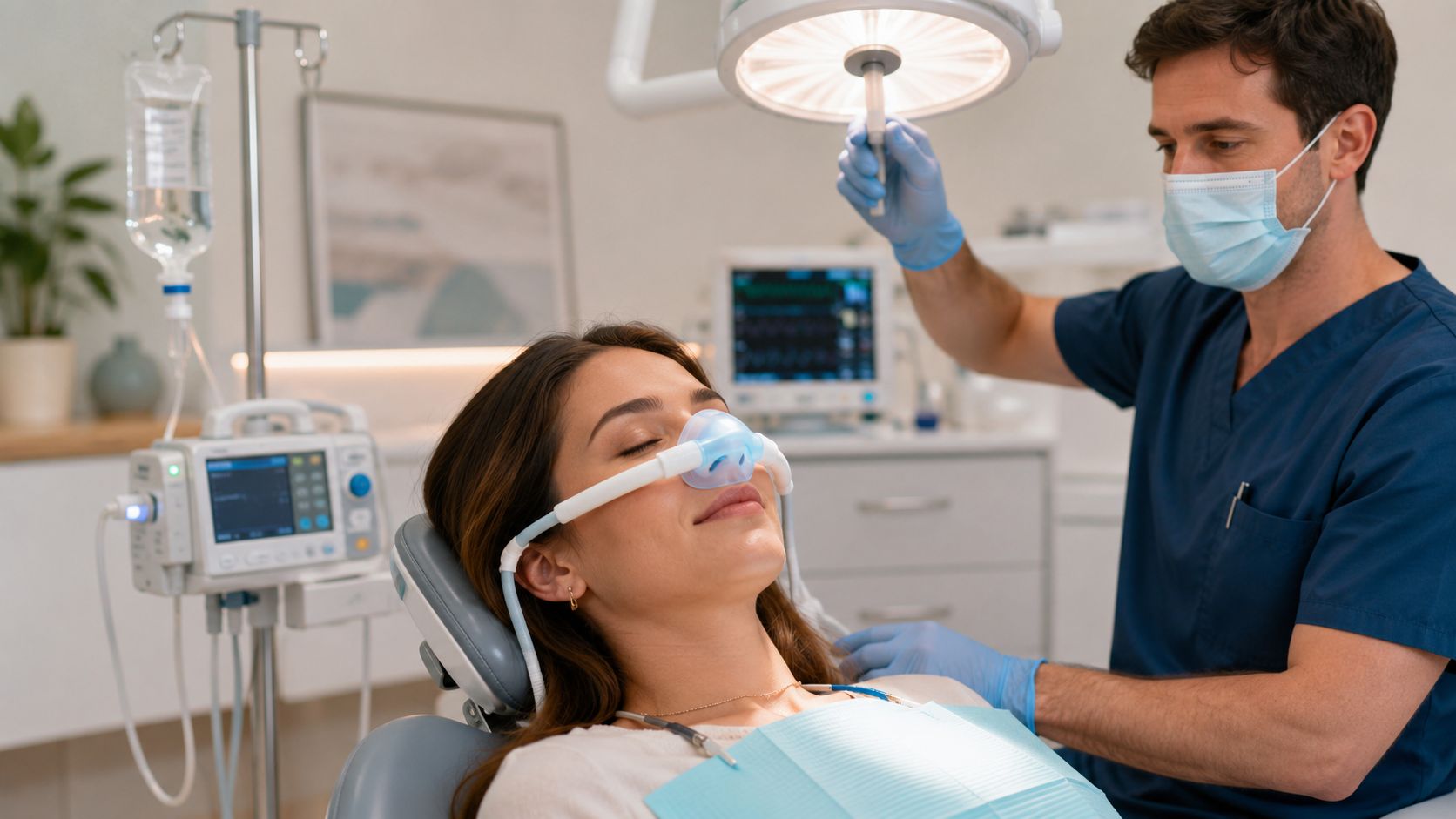
Nitrous oxide, often called happy gas, is the lightest common option. You breathe it in through a small nosepiece, and the effect comes on quickly. Most patients remain fully awake, just less tense and less reactive.
It suits people who want the edge taken off but still want a fast recovery. For mild to moderate nervousness, it can be enough to make treatment feel straightforward. If you're comparing entry-level options, this page on a dentist with nitrous oxide gives useful context.
Oral conscious sedation
Oral sedation uses medication taken before treatment. It doesn't make you unconscious. It usually makes you feel drowsy, less alert to the environment, and less focused on what's happening around you.
This can work well for patients who become distressed before they even enter the surgery. It's also useful when the idea of a cannula for IV sedation feels like too much. The trade-off is that the effect can be less adjustable once the medication has been taken.
IV sedation
IV sedation offers a deeper level of calm than oral medication because the sedative is delivered directly into a vein and can be adjusted during treatment by properly qualified providers. Patients usually stay responsive, but they're profoundly relaxed and often remember very little afterwards.
This option is often considered when anxiety is substantial, the procedure is longer, or the patient has had poor experiences with lighter methods. It can be an excellent middle ground between mild sedation and full general anaesthesia.
General anaesthesia
General anaesthesia is different in kind, not just degree. Under general anaesthesia, the patient is fully unconscious. In dentistry, that's generally reserved for hospital-based care and higher-complexity situations rather than ordinary anxiety management.
A useful Australian distinction comes from historical data on dental general anaesthetic use. In Australia, Dental General Anaesthetic is primarily a surgical intervention for complex procedures like impacted teeth, accounting for 63.7% of cases, while routine restorative work accounts for only 12.4% of DGA cases, according to this Australian dental general anaesthetic study. That matters because many patients use “general sedation” to mean “I want to be asleep,” when what they often need is conscious sedation in a clinic, not hospital-based anaesthesia.
General anaesthesia isn't the default answer to dental anxiety. In most cases, it's the wrong tool unless the procedure or patient factors clearly justify it.
Your Sedation Dentistry Journey Step by Step
A lot of fear comes from not knowing what the day will look like. Once the process is clear, patients usually feel more settled because they can plan around it rather than imagining the worst.
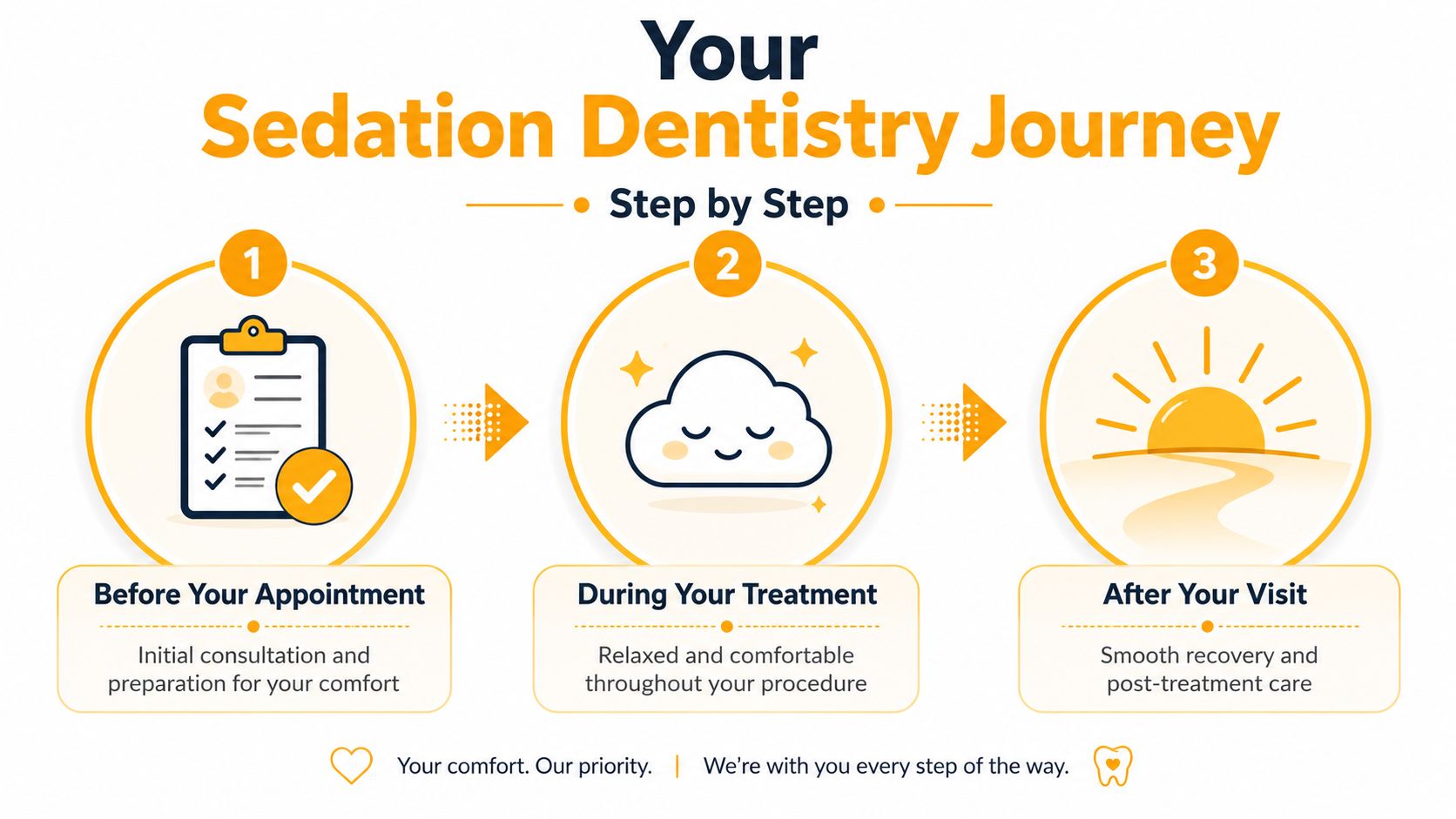
Before your appointment
The process starts well before the treatment itself. First comes a consultation. That's when the dental team reviews your medical history, current medications, previous experiences with sedation or anaesthesia, and what specifically triggers your anxiety.
You'll also be given practical instructions. Depending on the sedation type, these may include when to stop eating or drinking, what to wear, whether to take your usual medication, and whether you need someone to accompany you home. This part matters more than patients often expect. Good preparation reduces risk and avoids cancelled appointments.
A useful consultation also separates emotional concerns from medical ones. Some people are mostly frightened. Others are worried about gagging, claustrophobia, loss of control, or hearing dental sounds. Those details shape the sedation plan.
During your treatment
On the day, the team checks that the pre-treatment instructions have been followed and confirms the agreed plan. If you're having light inhalation sedation, the setup is simple. If you're having oral or IV sedation, the pace is slower and more deliberate.
Once the sedative starts working, most patients describe the experience as distance rather than absence. They may still know treatment is happening, but it feels less sharp, less threatening, and less emotionally charged. Time often seems to pass more quickly.
Local anaesthetic is still used where needed. Sedation supports comfort and calm. It doesn't replace the need to numb the area being treated properly.
After your visit
Recovery depends on the level of sedation used. With very light options, many patients feel normal quickly. With deeper options, you'll need more support and a clear plan for the rest of the day.
This is the part generic articles often rush past. If general anaesthesia has been used, discharge is only the beginning of recovery. While major complications are rare with a specialist, short-term side effects like nausea and fatigue are “not uncommon” after general sedation, and patients need to follow a 24-hour period of avoiding driving or major decision-making, as explained by the Australian Society of Anaesthetists guidance for oral surgery anaesthesia.
Don't focus only on the procedure. Plan the trip home, who stays with you, what you'll eat, and how you'll rest afterwards.
That advice is especially important for people who assume they'll “bounce back” by the afternoon. Even when everything goes smoothly, your body may feel flat, sleepy, or unsettled for a while. Smart planning makes recovery feel much easier.
Our Commitment to Your Safety and Peace of Mind
When patients ask whether sedation is safe, they're usually asking two questions at once. Is the medication itself safe, and is the team properly prepared if something doesn't go to plan? Both questions matter.
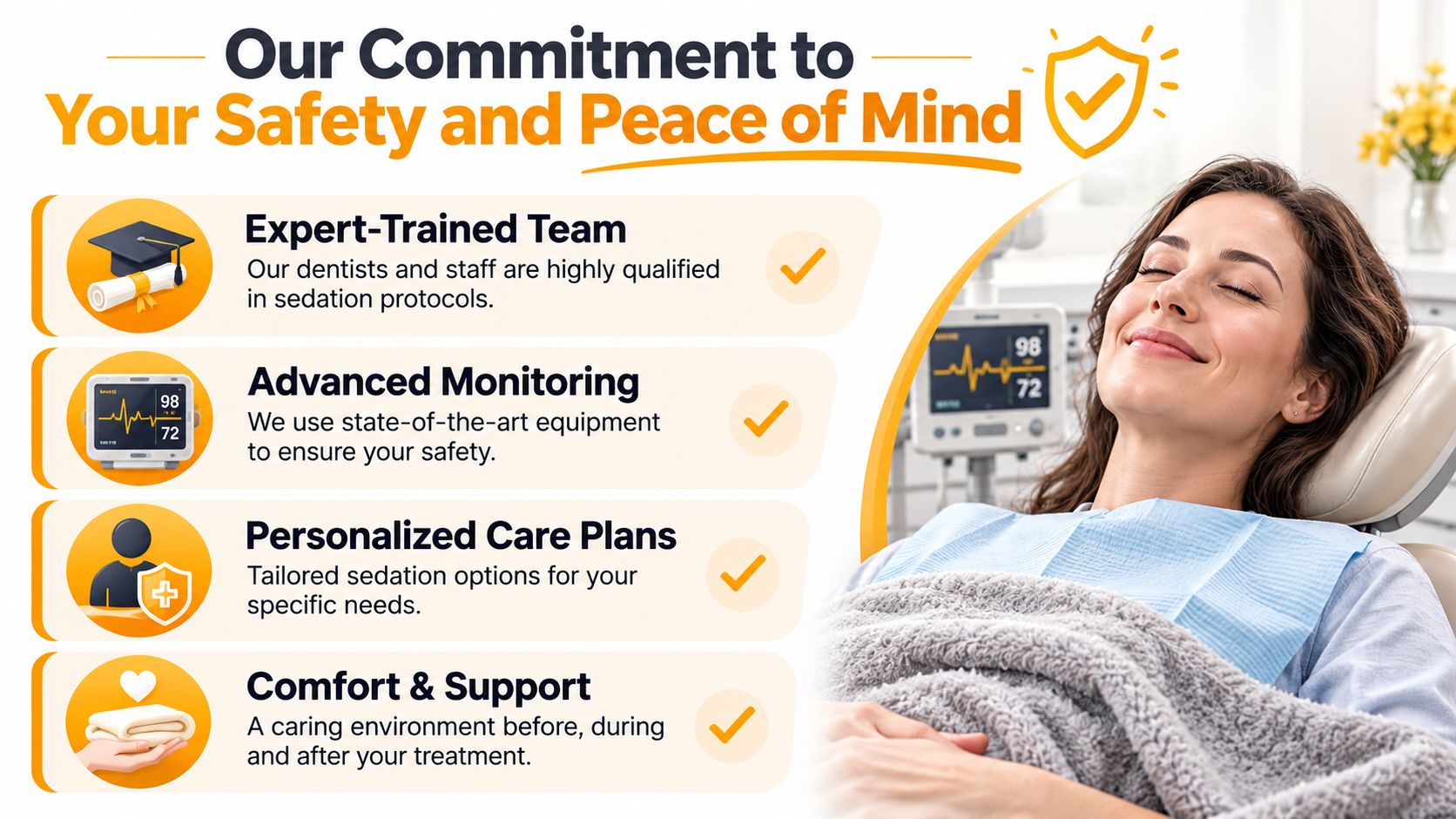
Sedation safety starts with selection. A proper pre-sedation assessment looks at your medical background, airway considerations, medications, allergies, and the nature of the dental procedure. This isn't paperwork for its own sake. It's how clinicians identify which level of sedation is appropriate, and whether it's appropriate at all.
What regulation means in practice
Australian regulation is stricter than many patients realise. Not every dentist can provide every level of sedation. There's a legal and clinical distinction between lighter forms of sedation and endorsed conscious sedation, especially when medication depth increases.
That's why credentials matter. If you're reading about IV sedation dentistry, the key question isn't whether a clinic mentions sedation on its website. It's whether the practitioner has the training and endorsement required for the level being offered.
Monitoring is not optional
During minimal and moderate sedation, monitoring requirements are specific. Australian standards require continuous physiological monitoring, with oxygen saturation, heart rate, and blood pressure recorded at least every 15 minutes throughout the procedure and recovery, according to these Australian dental sedation monitoring standards.
That standard tells you something important. Safe sedation is active care, not passive observation. The team doesn't “keep an eye on you.” They monitor, record, and respond.
- Qualified clinicians: Training determines what level of sedation a dentist may legally and safely provide.
- Appropriate equipment: Monitoring devices, alarms, oxygen, and emergency equipment must be ready and in use.
- Documented checks: Recording vital signs at required intervals helps the team detect subtle changes early.
- Recovery supervision: Sedation safety continues after the dental work is finished, not just during it.
For clinicians who want a broader emergency-care refresher, this guide for healthcare professionals is a useful example of the kind of airway awareness that supports safe patient management.
A calm patient is important. A monitored patient is essential.
Sedation Dentistry at The Smile Spot in Dulwich Hill
For patients in Sydney's Inner West, the practical question isn't just “What is sedation dentistry?” It's “What's realistically available to me, and how do I choose the right level without overcomplicating it?”
At The Smile Spot in Dulwich Hill, the focus is on tailoring care for anxious patients rather than forcing everyone into the same pathway. That matters because many people asking about “general sedation dentistry” don't need full anaesthesia. They need a clinician who can assess their anxiety level, treatment needs, and medical history carefully, then talk through the safest fit.
What patients should expect locally
In Australian practice, sedation is regulated, credential-based, and priced according to complexity. The Dental Board definition often used is that sedation is a technique to “induce a state of calm.” Cost also varies by method. IV sedation typically ranges from AUD$850 to $1,500, oral sedation from AUD$200 to $400, and nitrous oxide from AUD$100 to $150 per session, as outlined in this Australian sedation dentistry cost overview.
Those ranges help patients set realistic expectations. They also show why sedation isn't an automatic add-on to a routine visit. It requires planning, equipment, and the right level of training.
Choosing the right pathway
If your treatment is straightforward and your anxiety is mild, lighter sedation may be enough. If your anxiety is severe or the dental work is more involved, the discussion may include deeper options or referral pathways where appropriate. For patients wondering about the difference between in-chair sedation and being fully asleep, this guide to a full anesthesia dentist helps clarify that choice.
The best next step is usually a consultation, not a guess. A calm, honest conversation about what you're afraid of often reveals the right plan quickly.
Frequently Asked Questions About Sedation Dentistry
Will I feel pain during the procedure
Sedation reduces anxiety and helps you stay relaxed. It doesn't replace local anaesthetic. If a tooth or gum area needs to be numbed, it will still be numbed. The aim is for you to feel comfortable, calm, and far less reactive to the procedure.
Will I remember anything afterwards
That depends on the type of sedation. With nitrous oxide, you'll usually remember the visit quite clearly. With oral or IV sedation, memory can be patchy, and many patients recall much less than they expected. The important point is that memory effects vary from person to person.
How do I know which level is right for me
The right choice depends on three things. Your medical history, the type of treatment, and how your anxiety presents. A patient who is mildly nervous about a clean needs a different plan from someone who avoids care for years and becomes panicked before injections.
Is general anaesthesia better because I'll be fully asleep
Not necessarily. Being fully unconscious is sometimes appropriate, especially for hospital-based oral surgery, but it isn't automatically the best answer for dental anxiety. In many cases, conscious sedation gives enough relief with a simpler recovery and fewer logistics.
What should I organise for the day of treatment
If you're having anything beyond the lightest sedation, organise transport home, keep the rest of the day clear, and follow every pre-appointment instruction carefully. Recovery goes more smoothly when you've planned ahead instead of trying to fit treatment around work, school pickup, or important decisions later that day.
If dental visits have felt difficult for a long time, you don't need to keep forcing yourself through them. The Smile Spot offers gentle, personalised dental care in Dulwich Hill, with support for anxious patients who want clear advice on sedation options, safety, and what will make treatment feel manageable.